

Distracted Driving and Children: How to Keep Kids Safe as Passengers and Pedestrians

Distracted Driving and Children: How to Keep Kids Safe as Passengers and Pedestrians
When parents think about distracted driving and their children, they typically think in one direction: warning their teenagers not to use their phones behind the wheel. That is an important conversation and this site has covered it extensively in our parent’s guide to talking to your teen about phone use while driving.
But children face distracted driving danger from two entirely separate directions, and only one of them involves their own future driving behavior.
The first risk is children as passengers in vehicles where the driver is distracted. The driver may be using a phone. Or the driver may be distracted by the children themselves, who research shows create more distraction than a cell phone in a measurable and alarming proportion of family driving.
The second risk is children as pedestrians in a road environment where distracted drivers may not perceive them until it is too late. Children are smaller, less predictable, and less capable of assessing vehicle speed and intentions than adult pedestrians. And as we documented in our article on distracted driving and pedestrian safety, distracted drivers killed 639 non-occupants in 2024.
Both risks are real. Both are preventable. And both point to the same solution: the driver making a phone-free decision before the car starts moving.
The Passenger Data: 413 Killed in 2024
Of the 3,208 people who died in distraction-affected traffic crashes in 2024, there were 1,300 drivers who were distracted (41 percent). The remaining fatalities consisted of 413 passengers riding with distracted drivers (13 percent), 856 occupants of other vehicles (27 percent), and 639 nonoccupants including pedestrians and cyclists (20 percent). Mainspring Recovery
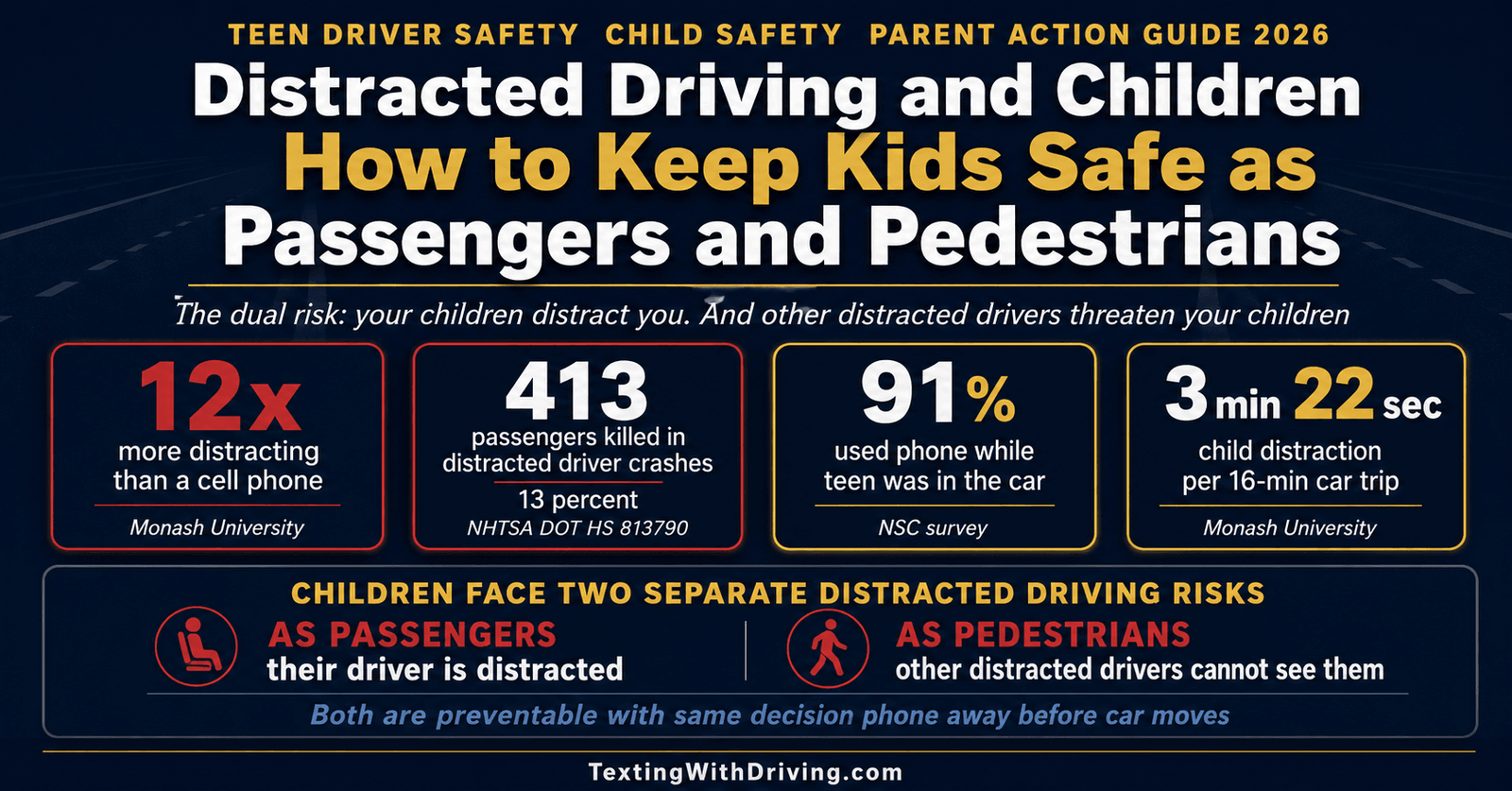
413 passengers killed in crashes where their driver was distracted. 13 percent of all distracted driving deaths in 2024 were passengers in the distracted driver’s own vehicle. They had no control over the driver’s decision to use their phone. They were simply in the vehicle when it happened.
The data does not break down these 413 passenger deaths by age, but the implications for children riding with parents, grandparents, rideshare drivers, and any other adult driver are direct and sobering. A child in a car seat, a child in a booster seat, a child in the back seat with a seatbelt: all of them are exposed to the same crash risk as any other passenger in a vehicle being driven by a distracted driver.
The most immediate implication for parents is one that this data underscores with painful clarity: the most dangerous time for your child while in a vehicle may not be when they are a teen driver making their own phone decisions. It may be right now, while they are a passenger in a vehicle you are driving.
The Most Surprising Finding: Children Are More Distracting Than Phones
Here is the research result that most parents find genuinely unexpected.
According to the AAA Foundation for Traffic Safety, children create four times the distraction to drivers as adult passengers do, while infants are nearly eight times as disturbing. Drivers with children can be twelve times more distracted than drivers using a cell phone. Researchers at an Australian university studied compare the distraction risks of children and mobile phones while driving. For three weeks, 12 families had all of their car trips recorded by cameras installed in their vehicles. NHTSA
Twelve times more distracting than a cell phone. The Monash University research used in-vehicle cameras to document actual driver behavior during family car trips, capturing the specific moments when children created distraction events for the driver. What they found was that children in the back seat created not occasional brief distractions but sustained, high-frequency attention demands that significantly exceeded the distraction produced by phone use in the same driving environment.
During an average 16-minute car trip, drivers are distracted by their children for an average of 3 minutes and 22 seconds. PubMed Central
3 minutes and 22 seconds of child-related distraction during a 16-minute drive. That represents more than 20 percent of total drive time with attention diverted from the road. The specific distraction behaviors documented in the research include turning around to look at children in the rear seat or watching them in the rearview mirror, which accounted for more than 75 percent of all child-related distraction events, handing objects to children, managing conflicts between siblings, responding to questions, and reaching back to assist with clothing or dropped items.
None of these behaviors involved a phone. All of them produced visual and manual distraction that substantially exceeded the distraction profile of phone use alone.
The Parent Phone Problem: 91 Percent
The child distraction issue is compounded by the documented prevalence of parent phone use with children in the vehicle.
According to a National Safety Council survey, among parents who drove distracted, 91 percent said they used their cell phones while their teens were in the car. T-driver
91 percent. Among parents who admitted to any distracted driving, essentially all of them used their phones with their teenage children present. And a Harvard Medical School study conducted in emergency rooms found that nearly 90 percent of parents admitted to being distracted by technology in the last month while driving with their kids, with phone calls being the top distraction reported by nearly 75 percent.
This data reveals the gap between what parents understand intellectually about distracted driving and what they actually do when managing the competing demands of parenting and driving simultaneously. A parent who has had the conversation with their teen about phone-free driving and then picks up their phone at a red light while driving that same teen home from school is creating two simultaneous problems: the safety risk from their own distraction and the modeling event that research consistently shows increases teen phone use while driving.
As we covered in our articles on why teen drivers are the most at-risk and the parent’s guide to teen phone-free driving, parent modeling is one of the strongest predictors of teen driver behavior. The University of Michigan Transportation Research Institute finding that teens are 2.5 times more likely to engage in distracted driving behaviors if they frequently observe their parents doing it is directly relevant here. The car ride to school or to practice is a modeling event whether parents treat it as one or not.
Children as Pedestrians: The Specific Vulnerability
The pedestrian dimension of child safety and distracted driving involves a different but equally serious set of risk factors.
Children are less visible than adult pedestrians because of their smaller stature. They are less predictable than adult pedestrians because children do not reliably check for traffic before stepping into a street, lack the experience to accurately judge vehicle speed and stopping distance, may run between parked cars without warning, and are often focused on play or destination rather than traffic awareness.
A distracted driver who is looking at their phone experiences the visual processing suppression we documented in our how distracted driving affects your brain article. Even with eyes nominally pointed at the road, the brain is not fully processing the visual environment. A small child who steps off a curb in a distracted driver’s field of view may not be registered as a hazard requiring response because the cognitive resources needed to process that hazard are consumed by the phone interaction.
At typical residential and school zone speeds of 25 to 35 miles per hour, the combination of a partially processed visual environment and a child’s unpredictable movement creates crash scenarios where even a brief two to three second distraction event eliminates the response time needed to brake before impact.
The school zone provisions we covered in our school zone distracted driving laws article exist specifically because children are more vulnerable pedestrians and their concentration in school zones at arrival and dismissal times creates the highest-density child pedestrian environment in the typical driver’s daily route. The enhanced fines and primary enforcement in school zones reflect a policy judgment that protecting children specifically warrants stricter standards than what applies on open roads.
Safe Kids Worldwide recommends that drivers be extra cautious when children are present near roadways, slow down in residential neighborhoods and near schools, and never rely on children to behave predictably near traffic. These are sound behavioral recommendations. But they depend on the driver having sufficient attentional capacity to notice the child and implement the recommendation, which distracted driving compromises at exactly the moments when it matters most.
The Backseat Distraction: What the Research Actually Looked Like
The Monash University research deserves a more detailed description because its specific findings reveal the nature of child distraction in ways that statistics alone cannot.
Over three weeks, 12 families had all of their car trips recorded by cameras installed in their vehicles. Researchers analyzed the footage to categorize every driver distraction event. What the cameras captured was not primarily phone use or adjusting the radio. The dominant distraction category by substantial margin was physical interaction with children in the rear seat.
The three most common specific distraction events were: turning around completely to attend to a child (both visually and manually distracting), sustained monitoring of children through the rearview mirror (visually distracting for extended periods), and reaching back to hand objects to children or retrieve items from the rear seat (manually and visually distracting).
These behaviors produced significantly longer distraction durations than typical phone glances. A driver who turns around to address a conflict between siblings in the back seat may have their eyes off the road for three to five seconds. A driver who monitors a crying infant in the rearview mirror may have a sustained pattern of mirror checks every 15 to 20 seconds for extended periods. Over a 16-minute drive, this produced the documented 3 minutes and 22 seconds average distraction exposure.
The practical implication is not that parents should stop attending to their children in the car. It is that the management of child-related needs in a vehicle is most safely done during planned stops rather than while moving. A child who drops a toy should not have the driver reaching back while the vehicle is in motion. A conflict between siblings should not be mediated by the driver while driving at highway speed. These are genuine competing demands of parenting and driving that most parents manage continuously without recognizing them as distraction events of the same nature as texting.
The Infant Factor
The Monash University research and AAA Foundation data both specifically identify infants as producing the highest level of individual driver distraction.
Infants create nearly eight times the distraction of adult passengers. The specific behaviors associated with infant-related distraction include checking on the infant in a rear-facing car seat, which requires extended mirror use or turning, responding to crying with soothing vocalizations that create ongoing cognitive engagement, and the anxiety that infant crying creates which is itself a form of cognitive distraction. An infant who is crying consistently for several minutes of a car trip is creating sustained elevated cognitive distraction that operates independently of any specific physical interaction.
New parents who are navigating the combination of sleep deprivation and infant care responsibilities while driving represent one of the most distraction-vulnerable driver populations that road safety research has identified. The fatigue dimension, which we covered in our article on distracted driving at night, compounds the cognitive load of infant-related distraction in ways that produce the extreme risk multiplier documented in the research.
Practical Strategies: Keeping Children Safe as Passengers
The research on child-related driver distraction points to several specific strategies that reduce the most dangerous distraction events while maintaining the essential parenting functions.
Prepare before moving. Address children’s needs, including snacks, entertainment setup, music selection, seatbelt checks, and any other anticipated requests, before the car starts moving. A child who has a snack, their preferred music, and settled seatbelt before the car leaves the driveway creates fewer mid-drive demand events than a child whose needs emerge after the car is in motion.
Use a co-pilot for child management. When driving with a second adult, explicitly designate the non-driving adult as the primary child manager for the trip. Hand off all child-related interactions, dispute resolution, object retrieval, and attention to the passenger. The driver’s role is driving. The passenger’s role is everything else. Many parents with a co-present adult continue performing child management tasks from the driver’s seat despite having a capable adult passenger. Make the handoff explicit.
Establish backseat interaction protocols. Children old enough to understand simple rules can be taught that the driver does not turn around, does not reach back, and does not respond to conversations while driving. This is not dismissiveness toward the child. It is a safety boundary that protects them specifically. Frame it as a safety rule rather than an inconvenience: “When the car is moving, I need to watch the road to keep us safe. I will answer your question when we stop.”
Pull over for serious situations. A crying infant, a child who has undone their seatbelt, a medical concern, a significant conflict between siblings: these are situations that warrant a full stop rather than driver management while in motion. Find a safe pull-off spot, address the situation completely, and resume driving when the situation is resolved.
Never use your phone with children in the car. This is both a safety practice and a modeling practice. The 91 percent of parents who used their phones while driving with their teenagers present are simultaneously creating crash risk and establishing the behavioral norm their teen will carry into their own driving. Phone in the back seat before the car starts applies with the same force when children are aboard as at any other time.
Practical Strategies: Keeping Children Safe as Pedestrians
The pedestrian protection strategies for children differ from the passenger strategies because they do not involve the parent driver at all. They involve children’s own pedestrian skills and the structural environment around schools, parks, and neighborhoods.
Teach and practice pedestrian safety from an early age. Safe Kids Worldwide recommends that children learn to look left, right, and left again before crossing any street and to make eye contact with drivers before stepping off a curb. These skills are teachable and should be explicitly practiced rather than assumed. Most children do not naturally look both ways before stepping into a street until it is specifically taught and reinforced.
Walk routes before children use them independently. A parent who walks a child’s school or activity route with them, practicing the specific crossing points and identifying the most dangerous street interactions, creates concrete spatial knowledge that abstract rules cannot provide. Identify the specific crosswalks, the specific corners, the specific moments where looking for cars matters most.
Reinforce awareness of distracted drivers. Older children can understand that some drivers are looking at their phones rather than the road. Teaching children that they need to make sure a driver has seen them before they step into a street is a specific, actionable skill that accounts for the reality of distracted driving. A car that is stopped does not mean a car that has seen you.
Address screen use among pedestrian children. As we noted in our distracted driving and pedestrian safety article, pedestrian distraction is a real and separate risk factor from driver distraction. Children who walk to school with earbuds in and phones in hand are less able to hear approaching vehicles and less attentive to traffic signals. Establishing phone-away-while-walking norms for children creates the same pre-move habit that phone-away-while-driving creates for drivers.
The Unified Message
The child safety dimension of distracted driving is ultimately the same message as every other dimension, applied with specific urgency because the people most at risk are the ones who depend most on adults to make safe decisions on their behalf.
A child in your back seat trusted you to drive safely when they got in your vehicle. A child walking near your route did not have any say in the matter at all. Both of them are protected by the same pre-drive decision: phone in the back seat, driving mode active, every time, before the car moves.
For the technology tools that make this automatic regardless of how demanding the backseat situation is, our Do Not Disturb while driving setup guide covers the complete two-minute configuration. For the national statistics that frame all of this in the full distracted driving context, our distracted driving statistics 2026 overview covers everything in one place.
Sources Used in This Article
All links verified working before publication.
NHTSA CrashStats: Distracted Driving in 2024 — DOT HS 813 790, 413 passenger deaths, person type breakdown
NHTSA: Distracted Driving Dangers and Statistics — 3,208 total deaths 2024
Backseat Wally: Distracted Driving Child Research — Monash University 12x distraction finding, 3 min 22 sec per 16-min trip
Johnson and Gilbert: How Children May Cause Distracted Driving Accidents — AAA Foundation 4x distraction, infant 8x, 12x combined
Harvard Health: Most Parents Report Distracted Driving — Emergency room study, 90 percent parent technology distraction
Brown Health Hasbro Children’s: Distracted Driving Teen Safety — NSC 91 percent parent phone use with teens, phone call top distraction
EndDD: AAA Study Distracted Driving 58 Percent Teen Crashes — Passenger interaction 15% of teen inattention crashes
Kidslox: Teen Distracted Driving Protection — AAA Foundation 58% teen crashes, 4 of 6 seconds before crash
NHTSA: Pedestrian Safety — 7,080 pedestrian deaths 2024
GHSA: Distracted Driving State Laws — Legislative context
TextingWithDriving.com is professionally built and maintained to ensure accurate, accessible safety information reaches every driver who needs it. Website development and ongoing support is handled by Budgetic, a digital agency specializing in purpose-driven WordPress websites.

About Texting With Driving
TextingWithDriving.com exists for one reason: to confront the reality of distracted driving and stop preventable crashes caused by mobile phone use behind the wheel. Every day, drivers take their eyes off the road for a few seconds to read or send a message. Those few seconds are enough to cause life-altering consequences. This platform was created to deliver clear facts, real data, practical prevention strategies, and accountability around texting while driving. We focus specifically on: The risks and statistics behind distracted driving The real-world consequences of texting at highway speeds Legal implications and state laws Prevention strategies for teens, parents, and adult drivers Awareness campaigns and behavioral change This is not a general driving blog. It is a focused awareness initiative built around one critical issue: phone distraction behind the wheel. Our content is direct, research-driven, and practical. We prioritize accuracy over opinion and education over sensationalism. The goal is simple — reduce distracted driving incidents by increasing awareness and responsibility. If one article causes one driver to put their phone down, the mission is working. For inquiries or partnerships, contact: privacy@textingwithdriving.com
View all posts by Texting With Driving