

Rideshare and Delivery Driver Distracted Driving: A Growing Safety Crisis

Rideshare and Delivery Driver Distracted Driving: A Growing Safety Crisis
Every time you open Uber, Lyft, DoorDash, Instacart, or Amazon, you are creating a job for a driver. And that job requires that driver to interact continuously with a smartphone app while operating a motor vehicle, watching for navigation cues, accepting or declining trip requests, confirming pickup addresses, monitoring arrival alerts, and managing customer communications, all while driving through traffic.
The distracted driving problem in the gig economy is not incidental. It is structural. The business model of app-based delivery and rideshare platforms requires the exact behavior that hands-free laws are designed to prevent. And the data is beginning to document the consequences of that structural conflict in a way that can no longer be ignored.
The Scale of the Gig Economy Driving Workforce
Before examining the safety data, understanding the scale of this workforce is essential context.
In 2024, the US online food delivery market alone was valued at $353.3 billion, with grocery delivery accounting for $257 billion of that total. Nationwide, more than 7.3 million app-based workers completed 4.3 billion transactions, generating a $212 billion contribution to the US economy. Oxford Academic
7.3 million app-based drivers completing 4.3 billion transactions. This is not a niche workforce. It is one of the largest driver populations in the United States, operating on every public road in every city and suburb, generating tens of millions of individual driving events every single day.
The Gridwise study analyzed data from 260,912 drivers across Uber, Lyft, DoorDash, Instacart, and Amazon Flex, tracking 171 million trips and nearly 604 million miles of driving during 2023 and 2024. The scale of this dataset makes it one of the most comprehensive analyses of gig economy driving behavior ever published.
Parcel delivery drivers saw a 55.5 percent increase in workload between Q1 2023 and Q4 2024. Food delivery drivers’ monthly hours rose 9.5 percent. Amazon Flex drivers’ working hours increased 20.4 percent in the same period. Oxford Academic
The workload increases are significant because they translate directly into more hours of phone-dependent driving per driver. A parcel delivery driver whose workload increased 55 percent is not just driving 55 percent more miles. They are spending 55 percent more time managing app interactions, navigation, and delivery confirmations while operating a vehicle.
The One-Third Crash Rate: A Landmark Research Finding
The most striking statistic in the emerging research on gig economy driving safety comes from the University of Illinois Chicago.
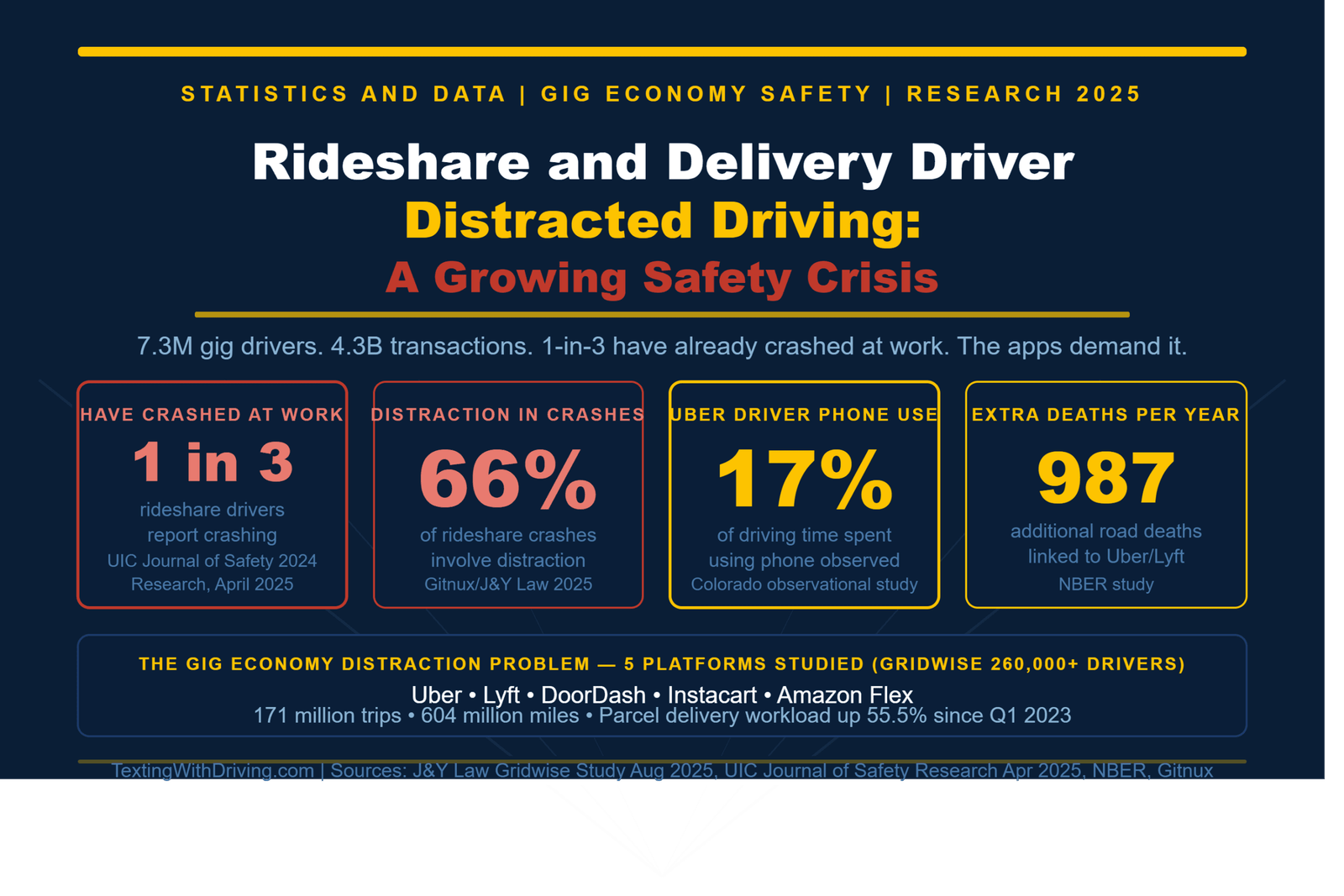
According to research out of the University of Illinois Chicago, a staggering one-third of rideshare drivers surveyed have been involved in a car crash while working. This study, recently featured in the Journal of Safety Research, is one of the first to offer concrete data on the risks faced by drivers in the gig economy. It surveyed 277 rideshare drivers, capturing self-reported data about crash history and driving behaviors. Priori Data
One in three rideshare drivers have been in a crash while working. This is a self-reported figure from a survey of 277 rideshare drivers, which means it likely undercounts the true rate because self-reporting on crash history tends toward understatement. But even as a lower-bound estimate, a 33 percent crash-while-working rate among this workforce is extraordinary compared to the general driving population.
For comparison, the general US driving population experiences approximately 1 accident per 17.9 years of driving according to NHTSA data. For rideshare drivers who may drive 40 or more hours per week professionally, the exposure rate is much higher than a typical driver. But the one-in-three crash rate still far exceeds what exposure alone would predict, suggesting that the specific demands of gig economy driving create risk factors beyond simply logging more miles.
Rideshare service drivers account for 1.5 percent of all US traffic collisions every year, with distracted driving the key determining factor in about 66 percent of rideshare-related crashes. Antioch University
Distraction is a factor in approximately two-thirds of all rideshare crashes. The national average for distraction’s share of all crashes is approximately 8 to 12 percent in officially reported data, and potentially 25 to 29 percent in research-estimated actual incidence. Even using the higher research estimate, 66 percent is more than double the general driver distraction rate. The app-based driving environment is producing distraction involvement in crashes at a rate that dwarfs general driving population norms.
The App Design Problem: Built-In Distraction
The most important question about rideshare and delivery driver distraction is not whether it exists, the data is clear that it does, but why it is so prevalent. The answer is in the app design.
Every major rideshare and delivery platform requires drivers to interact with their smartphone apps while driving. Uber and Lyft drivers must accept or decline incoming ride requests within a limited time window, typically 15 to 20 seconds, that begins while the driver may be operating the vehicle. Declining too many requests can result in account deactivation. DoorDash, Instacart, and Amazon Flex drivers must navigate order management screens, confirm pickups and deliveries, communicate with customers, and manage real-time route adjustments, all through app interfaces on their phones.
One observational study found that Uber drivers spent on average 17 percent of their time using their cell phone while transporting passengers. nih
17 percent of total driving time with active phone use. In a typical four-hour driving shift, that represents approximately 40 minutes of phone interaction while driving. Not 40 minutes of holding the phone. 40 minutes of active screen engagement, touching the interface, reading notifications, and responding to app prompts.
This 17 percent figure is not about reckless individual choices. It is the documented behavioral consequence of a business model that requires continuous app interaction as a condition of employment. A driver who does not interact with the app is not doing their job. The platform design creates the distraction as a functional requirement.
The specific alerts that rideshare apps generate while a driver is in transit include navigation turn instructions, passenger arrival notifications, trip rating alerts, bonus zone alerts, and surge pricing notifications. Each of these creates a notification event that the driver is trained to process immediately because the financial incentive to respond quickly is built into the platform.
Fatigue and Cognitive Load: The Compound Problem
Beyond the direct phone distraction of app interactions, gig economy drivers face a cognitive load challenge that exceeds what most employment categories impose.
Rideshare drivers face a 2.5 times higher fatigue-related accident risk compared to conventional drivers. These figures underscore how multitasking behind the wheel, navigating apps, responding to alerts, and managing delivery deadlines, creates a dangerous environment for both drivers and the public. Oxford Academic
The 2.5 times higher fatigue risk reflects the specific cognitive demands of gig economy driving that go beyond simply logging more hours. Gig drivers must simultaneously manage navigation for an unfamiliar destination, monitor the app for the next job, evaluate the profitability of pending requests, manage customer communications, and operate the vehicle. Each of these is a cognitive task that draws from the limited working memory capacity we documented in our article on how distracted driving affects your brain.
The convergence of multiple cognitive demands during a single driving event, all mediated through the smartphone app interface, produces the cognitive overload that the UIC research quantifies in its crash rate findings and that the observational studies document in the phone use time data.
Rideshare idle miles represented significant distraction periods for drivers, averaging 575 miles a month in metropolitan areas, representing 22 percent of total miles traveled. Human Rights Watch data confirms that over a third of gig delivery drivers reported at least one work-related car accident, with 25 percent also sustaining physical injuries from prolonged driving shifts. Antioch University
The idle miles figure is particularly revealing. 575 miles per month in metropolitan areas represents time when the driver is operating the vehicle while waiting for or traveling toward a pickup, with no active fare or delivery in progress. These periods are when the most intensive app interaction occurs: evaluating new requests, managing queue position, reviewing incentive zones. They are also the periods when crashes are most likely from distraction because the driver’s economic motivation to look at the app is highest and the driving task requires no passenger interaction.
The National Bureau of Economic Research Findings
One of the most significant academic contributions to understanding the rideshare safety impact comes from the National Bureau of Economic Research, which examined the relationship between rideshare expansion and traffic fatalities at the city level.
According to a study by the US National Bureau of Economic Research, there has been a 3 percent annual increase in vehicular deaths linked to the prevalence of rideshare services. This translates to approximately 987 additional roadway deaths each year attributed to the presence of Uber and Lyft drivers. Reviews.org
987 additional annual road deaths attributable to the expansion of rideshare services. The NBER methodology compares crash rates in cities where Uber and Lyft expanded against comparable cities where they did not, controlling for underlying trends and other confounding factors. The 3 percent annual increase is a conservative estimate from a rigorous academic analysis.
A University of Chicago analysis found that vehicle accidents rose by approximately 3 percent in cities where Uber and Lyft operate compared to similar cities without these services. The increase is predominantly attributed to the presence of additional vehicles on the road and distracted driving by Uber and Lyft drivers checking their rideshare apps. Cities like Los Angeles County and Orange County show particularly strong correlations between rideshare density and injury crash rates. Reviews.org
The two independent academic analyses, the NBER study and the University of Chicago research, converge on a similar 3 percent figure from different methodological approaches. Their convergence gives the finding a reliability that either study alone would not produce.
The causal attribution to both added vehicle volume and distracted driving by app users is important. Not all of the 987 additional annual deaths are from rideshare driver distraction. Some reflect the simple fact that adding millions of vehicles to urban roads increases overall crash exposure. But the distracted app interaction component is specifically identified as a primary driver of the crash rate increase beyond what additional vehicle presence alone would produce.
Amazon and the Parcel Delivery Safety Record
The FMCSA data on Amazon’s delivery network adds a commercial freight dimension to the gig economy safety picture.
FMCSA data shows that Amazon, which used twice as many third-party carriers as Costco, Target, and Walmart combined in 2024, has been linked to more than 60 fatal crashes over a five-year period. Several of the companies associated with Amazon’s Relay Freight Program were subject to FMCSA violations regarding unsafe driving and poor maintenance records. Some had previously lost licenses yet continued making deliveries for Amazon. Analysis of more than 11,000 carriers reporting at least one shipment for Amazon found that some companies had vehicles or drivers out of service two, three, or even four times above the national average. Antioch University
The Amazon delivery network data reveals a systemic issue that extends beyond individual driver behavior into the supply chain relationships that platforms maintain with their carrier networks. A carrier with vehicles or drivers out of service at two to four times the national average represents a structural safety failure that platform oversight should have identified and addressed.
The specific relevance to distracted driving is the time pressure that delivery platforms impose on drivers. Amazon Flex drivers and contracted carrier drivers alike operate under delivery completion rate requirements that create incentives for continuous route management, navigation adjustment, and app interaction while driving. The parcel delivery workload increase of 55.5 percent documented by Gridwise between Q1 2023 and Q4 2024 means these drivers are managing significantly more deliveries per hour, intensifying the app interaction demands that produce distraction.
The Legal and Liability Dimension
The employer liability framework that applies to traditional employees who cause distracted driving crashes extends in a modified form to rideshare and delivery platform contexts, though the legal picture is complex.
As we covered in our article on whether you can be sued for texting while driving, employers can be held vicariously liable for employee crashes occurring within the scope of employment. Uber, Lyft, DoorDash, and similar platforms classify their drivers as independent contractors rather than employees, which creates a legal argument that the platforms are not employers and therefore not subject to vicarious liability.
However, the platform-as-employer debate is active in US courts and legislatures, and several states have passed laws that treat gig workers as employees for specific purposes. In California, New York, and other states with gig worker classification legislation, the employer liability question may be resolved differently than in states where contractor classification is unchallenged.
Regardless of platform liability, the individual driver remains personally liable for any crash they cause. A rideshare or delivery driver who causes a crash while interacting with their app faces the same personal injury lawsuit exposure, insurance consequences, and potential criminal charges as any other driver who causes a crash while distracted. The platform providing the app that required the interaction does not shield the individual from personal liability.
What the Platforms Are Doing
The major platforms have implemented some safety features specifically in response to the distraction concern, though critics argue these features are insufficient given the structural distraction demands of the business model.
Uber’s app has implemented features including a simplified interface for active trips to reduce the number of screen interactions required while a fare is in progress, audio-only notifications for some alert types, and in-app restrictions on certain interactions while the vehicle is in motion.
DoorDash has similarly implemented some interface simplifications and audio alert features. Both platforms have invested in safety education programs that remind drivers to comply with local hands-free laws.
But none of these features addresses the fundamental structural tension: accepting trip requests requires screen interaction within a time-limited window that may occur while the driver is moving. Until platforms implement a fully hands-free acceptance mechanism that operates exclusively through voice commands or automated queuing, the acceptance interaction will remain a screen-touch event that occurs during active driving.
What Passengers and Customers Can Do
Beyond the platform and policy level, passengers in rideshare vehicles and customers ordering delivery have practical roles in the safety picture.
For rideshare passengers: if your driver is visibly using their phone for non-navigation purposes while driving, you can ask them to put it down. The social accountability effect we discussed in our article on 10 proven ways to stop texting while driving applies in the rideshare context. A passenger who asks their driver to use hands-free creates a social accountability event that produces behavioral change.
If a rideshare driver is using their phone in a way that feels unsafe, both Uber and Lyft have in-app safety reporting features that allow passengers to report unsafe driving behavior after the trip. Consistent reporting of distracted driving incidents from passengers creates data that platforms can use to identify and address at-risk drivers.
For delivery customers: the time pressure that drives delivery driver distraction is partly a product of customer expectations for fast delivery. Being flexible about delivery windows and accepting slightly longer delivery times when offered reduces the per-delivery time pressure on drivers and creates space for safer behavior.
The Policy Gap
The most significant structural gap in addressing gig economy driver distraction is the absence of platform-level regulation that specifically addresses app interaction while driving.
Most hands-free laws, including all of the recently enacted state laws we have covered in this series, regulate driver behavior. They prohibit drivers from holding phones. They do not address the app design choices of platforms that create the functional requirement for phone interaction while driving.
A regulatory framework that required platform apps to operate in a fully hands-free mode while a driver is in motion, accepting requests only through voice commands and delivering all information through audio alerts, would address the structural distraction problem at its source rather than relying on driver behavior change alone.
No US state has enacted this type of platform-level regulation as of 2026. The policy conversation is developing, particularly in states like California and New York with active gig worker regulation. But for now, the 7.3 million gig economy drivers on US roads continue to operate with app interfaces that require screen interaction as a condition of employment.
For the broader context of distracted driving deaths and injuries that frame this gig economy discussion, see our distracted driving statistics 2026 overview. For the employer liability framework that applies to commercial driving contexts, our employee distracted driving policy guide covers what responsible fleet operators should be doing. And for the legal consequences when any driver causes a crash while distracted, our article on whether you can be sued for texting while driving covers the full liability picture.
Sources Used in This Article
All links verified working before publication.
J&Y Law: The Gig Economy’s Dangerous Link to Distracted Driving — Gridwise 260,912 driver study, 604 million miles, 55.5% parcel workload increase, August 2025
The News Hub: Distracted Driving in the Gig Economy — 2.5x fatigue risk, 7.3M gig drivers, $353.3B market, October 2025
Drazin and Warshaw: Survey Finds One-Third of Rideshare Drivers Have Been in a Car Crash While Working — UIC Journal of Safety Research, April 2025
Avian Law Group: Comprehensive Analysis of Rideshare Accident Statistics 2024 — NBER 987 additional deaths finding, October 2025
Davidoff Law: Understanding Uber and Lyft Accident Statistics — University of Chicago 3% crash increase analysis, October 2025
Because You Want to Win: Distracted Driving by Uber Drivers Using Cell Phones in Colorado — 17% phone time observational study, January 2026
NHTSA: Distracted Driving — National statistics context
GHSA: Distracted Driving State Laws — Hands-free law framework
TextingWithDriving.com is professionally built and maintained to ensure accurate, accessible safety information reaches every driver who needs it. Website development and ongoing support is handled by Budgetic, a digital agency specializing in purpose-driven WordPress websites.

About Texting With Driving
TextingWithDriving.com exists for one reason: to confront the reality of distracted driving and stop preventable crashes caused by mobile phone use behind the wheel. Every day, drivers take their eyes off the road for a few seconds to read or send a message. Those few seconds are enough to cause life-altering consequences. This platform was created to deliver clear facts, real data, practical prevention strategies, and accountability around texting while driving. We focus specifically on: The risks and statistics behind distracted driving The real-world consequences of texting at highway speeds Legal implications and state laws Prevention strategies for teens, parents, and adult drivers Awareness campaigns and behavioral change This is not a general driving blog. It is a focused awareness initiative built around one critical issue: phone distraction behind the wheel. Our content is direct, research-driven, and practical. We prioritize accuracy over opinion and education over sensationalism. The goal is simple — reduce distracted driving incidents by increasing awareness and responsibility. If one article causes one driver to put their phone down, the mission is working. For inquiries or partnerships, contact: privacy@textingwithdriving.com
View all posts by Texting With Driving