

Virginia School Bus Cameras 2026: Chesterfield, Fairfax and the Statewide Stop-Arm Expansion

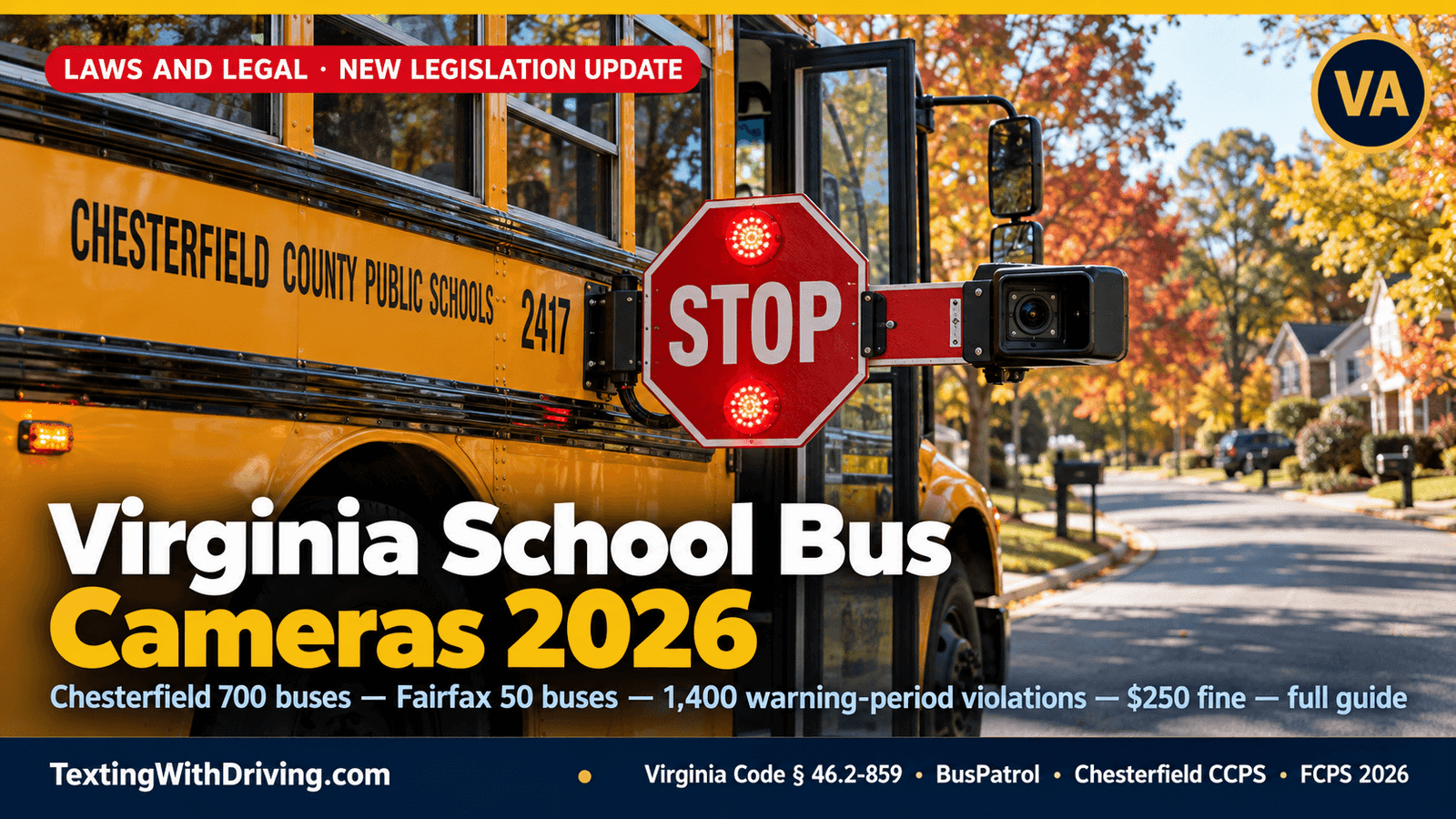
Virginia School Bus Cameras 2026: Chesterfield, Fairfax and the Statewide Stop-Arm Expansion
Virginia school bus cameras 2026 represents one of the most significant expansions of automated traffic enforcement in the Commonwealth’s history — a statewide movement that now spans Chesterfield County’s 700-bus fleet, Fairfax County Public Schools’ spring 2026 launch, Culpeper County’s August 2026 program expansion, Chesapeake Public Schools’ 500-plus bus deployment, and the growing list of Virginia school divisions equipping their buses with AI-powered stop-arm cameras that automatically capture and process violations.
The program in Chesterfield County — Virginia’s most prominent and comprehensive school bus camera deployment — reached its one-year mark in October 2026. The numbers from that first year reflect what the original warning-period data predicted: passing a stopped school bus was occurring at a frequency that most Virginia drivers would find alarming, and the camera system is documenting the violations with a speed and scale that officer-only enforcement could never match.
During the warning period in Chesterfield County, from September 15 to October 8, 2025, more than 1,400 violations were recorded in just 24 days — before any fines were issued, when the only consequence was a warning letter. That is more than 58 violations per day, across a county that was already subject to the same Virginia law against passing stopped school buses that has existed for decades.
Passing a stopped school bus is not only against the law, but it also places the lives of children in danger. Unfortunately, this reckless behavior occurs far too often. That assessment from Chesterfield Chief of Police Col. Jeffrey Katz captures the scale of a problem that existed long before cameras — and that cameras are now documenting and deterring with a consistency that no previous enforcement approach achieved.
This guide covers the complete Virginia school bus cameras 2026 picture: how the camera systems work, the Virginia law they enforce, the $250 fine structure, the specific counties with active programs, what the first-year results show, the connection to distracted driving, and what every Virginia driver must know to avoid a camera citation.
The Virginia Law These Cameras Enforce
Virginia school bus cameras 2026 do not create a new law. They create automated enforcement of a law that has existed in the Virginia Code for decades. Virginia Code § 46.2-859 governs the obligation of drivers when approaching a stopped school bus.
In Virginia, all drivers must stop when a school bus’s stop-arm is extended and red lights are flashing. The only exception is when the bus is traveling in the opposite direction on a divided roadway separated by a median or barrier — a concrete, grass, or other physical divider that creates a true physical separation between the lanes.
The specific Virginia requirement covers two situations that many drivers misunderstand:
Both directions on undivided roads. On any two-lane road without a physical divider, drivers in both directions must stop when a school bus stops and extends its arm. The driver approaching the bus from the front must stop. The driver approaching from behind must stop. A yellow center line is not a physical divider under Virginia law — it is a painted marking. Drivers on the same side and the opposite side of a yellow center line both must stop.
All speeds of vehicles. There is no speed threshold below which the stop-arm obligation does not apply. A vehicle approaching a stopped school bus at 5 mph must stop when the stop-arm is extended, exactly as a vehicle at 35 mph must stop.
Even when no stop-arm is visible but loading is occurring. Virginia DMV notes that drivers must stop whenever the bus is loading or unloading passengers, even if the lights and stop sign are not activated — though the camera enforcement specifically captures the flashing-red-lights-and-stop-arm-extended scenario.
In a one-day survey conducted in March 2025, Chesterfield bus drivers reported 384 instances of drivers illegally passing stopped school buses — in a single day. 384 violations in one county, one day, documented by the bus drivers themselves without camera technology. That one-day survey established the scale of the problem that the camera system was designed to address.
How BusPatrol’s AI Camera System Works
Virginia school bus cameras 2026 are primarily implemented through BusPatrol — a Virginia-based public safety technology company headquartered in Lorton, Virginia, that has deployed stop-arm camera systems in over 400 communities nationwide.
BusPatrol uses a proprietary AI engine called AVA to detect when the bus stops and extends its arm, then starts recording potential violators. The specific technology pipeline:
Detection. When the bus comes to a complete stop and the stop-arm is deployed, the camera automatically activates and begins recording. The AI detects the stop-arm deployment as the trigger — the camera is not recording continuously, only when the stop-arm is out.
Capture. The cameras capture images and video of any vehicle that drives past the stopped bus while the stop-arm is extended and red lights are flashing. Multiple camera angles — including stop-arm cameras that capture the license plate directly and side cameras that capture the vehicle in context — provide comprehensive violation documentation.
Human review. BusPatrol does not issue tickets. Each incident is reviewed by trained county staff before a notice is issued. The human review step is the critical due process protection built into the system — the AI identifies the potential violation, and a human officer reviews the footage before any citation is processed.
Citation issuance. After human review confirms the violation, the vehicle owner receives a $250 civil penalty notice by mail. The citation is sent to the vehicle’s registered owner — not necessarily the driver — in the same structure as speed camera and red light camera citations.
Chesterfield will pay BusPatrol a monthly fee of $225 per bus (approximately $157,500 total per month) and $65 out of every ticket. The $65 per citation that BusPatrol retains covers the system’s costs, with the remaining fine revenue flowing to the county. The no-cost-to-district structure used in some Virginia districts — including Chesapeake and Culpeper — funds the camera deployment entirely from fine revenue, making the program self-sustaining once enforcement volumes reach the citation threshold.
The $250 Fine: What It Means and What It Doesn’t
Virginia school bus cameras 2026 citations carry a specific fine structure that differs from moving violation fines in several important ways.
$250 civil penalty. The fine is $250 per violation. There is no graduated first/second/third offense structure — each violation carries the $250 penalty.
No DMV points. The fine does not add points to a driver’s license. This is the same civil penalty structure as Maryland’s AI camera citations, Virginia’s SB84 stop-sign camera citations, and red light camera citations across Virginia. The civil penalty — addressed to the vehicle owner rather than requiring driver identification — carries no points because it is a civil infraction rather than a moving violation.
No insurance impact from the citation itself. Because no DMV points are assessed, the camera citation does not directly trigger the insurance rate consequences that a police-issued moving violation carries. However, if a driver receives both a camera citation and a subsequent police-issued reckless driving charge for the same behavior pattern, the reckless driving conviction carries the full insurance impact.
Vehicle owner liability. The citation is issued to the vehicle’s registered owner, not the identified driver. If the registered owner was not driving when the violation occurred — if a family member, employee, or other authorized driver was operating the vehicle — the registered owner must handle the citation. Most programs provide a process for registered owners to identify the actual driver, but the initial citation names the owner.
The reckless driving upgrade. Virginia Code § 46.2-852 makes reckless driving a Class 1 misdemeanor. A driver who passes a stopped school bus at high speed, who makes a pattern of repeated violations, or whose passing creates a near-miss with a child can be charged with reckless driving separately from — and in addition to — the camera citation. The reckless driving charge carries criminal consequences including potential license suspension, insurance impact, and the criminal record implications we documented in our Virginia reckless driving and distracted driving 2026 article.
Chesterfield County: One Year of Results
Virginia school bus cameras 2026 began its Virginia chapter in Chesterfield County — and the Chesterfield program’s one year of results provides the data foundation for every subsequent Virginia deployment.
Every school bus in Chesterfield County — a fleet of nearly 700 buses — received AI-powered stop-arm cameras. The county’s September 15 to October 14, 2025 warning period recorded more than 1,400 violations — violations documented by camera before any financial consequence existed, establishing the baseline behavior that the fine structure is designed to change.
The warning period’s 1,400 violations in approximately 24 days translates to approximately 58 documented violations per day. Across 700 buses running morning and afternoon routes, this means approximately one in 12 buses experienced a stop-arm passing violation on a typical school day during the warning period.
The behavioral change from the warning period to the fine period is the most significant data point that Chesterfield’s first year produces. The comparable national data from BusPatrol’s Westchester County, New York deployment — whose first full year (2025-26 school year) produced a 24 percent reduction in violations (from 17,867 citations in 2024-25 to 13,621 through June 2026) — provides the behavioral improvement benchmark that Chesterfield’s own first-year data will measure against.
A 24 percent reduction in Westchester County over one year of full enforcement, against a baseline of 17,867 annual citations, is the behavioral change evidence that the fine structure produces. Chesterfield’s baseline of approximately 58 violations per day — if the Westchester pattern holds — should show a comparable reduction in the second year of enforcement as the $250 fine becomes the established consequence for a behavior that was previously rarely documented and almost never fined.
The program addresses the specific driving behavior that Chesterfield County describes as reckless driving behavior — the term the school district uses to characterize passing a stopped school bus. The connection to distracted driving is direct: a driver who fails to notice a stopped school bus with flashing red lights and an extended stop-arm is a driver whose attention is not on the road. Whether the inattention comes from phone distraction, other distraction, or simple inattention, the failure to detect and respond to one of the most visually prominent road hazard signals Virginia law requires drivers to observe is a behavioral failure that camera enforcement is designed to change.
Fairfax County: The 2026 Spring Launch
Virginia school bus cameras 2026 expanded to Fairfax County in spring 2026, when Fairfax County and Fairfax County Public Schools launched a joint 50-bus camera system program.
Drivers who pass school buses loading and unloading children will soon receive $250 citations in the mail as a partnership between the county and Fairfax County Public Schools designed to improve the safety of students. The goal is to change driver behavior and prevent the dangerous act of passing a stopped school bus with its red lights flashing while children are loading or unloading.
Fairfax County’s initial deployment of 50 bus camera systems represents a pilot phase in Virginia’s largest school system — FCPS operates approximately 1,700 school buses serving one of the most heavily commuted school systems in the country. Warning citations began April 9, 2026.
The 50-bus pilot represents approximately 3 percent of FCPS’s total fleet. The expansion pathway from 50 to the full fleet follows the Chesterfield model — establish the program, demonstrate the results, expand the deployment. Given FCPS’s scale, full fleet deployment would represent one of the largest single school bus camera deployments in the United States.
For Northern Virginia drivers on the Fairfax County road network — the same commuter population that Road Shark enforcement targets for distracted driving — the school bus camera launch adds a specific new automated enforcement layer to the road environment. The Fairfax County driver who passes a stopped school bus on Route 123, Route 7, or any Fairfax County school bus route now faces a $250 citation from a camera that documented the violation from the stop-arm itself.
Culpeper County: August 2026 Expansion
Virginia school bus cameras 2026 expanded further in August 2026, when Culpeper County Public Schools announced the expansion of its BusPatrol partnership to increase fleet coverage.
Culpeper County Public Schools announced the expansion of its bus camera program through a partnership with BusPatrol — described as expanding from a small-scale program that served as a deterrent on limited bus routes to a comprehensive fleet-wide deployment. Stop arm violations proved to be problematic on many other bus routes. This expansion of our bus camera program with BusPatrol greatly increases coverage and consistency for the overall safety of our students and adds a level of reassurance for all our drivers.
The Culpeper expansion in August 2026 places the school bus camera program in the Culpeper-Rappahannock corridor — the rural Northern Virginia region where Route 15, Route 29, and the Culpeper arterials serve as the primary bus routes. The rural road context adds the specific morning and afternoon low-light condition dimension documented in our Virginia fall driving safety distracted driving 2026 article — rural roads at dawn and dusk during the October-November period when school bus morning routes increasingly run in darkness.
Other Virginia school divisions partnered with BusPatrol include Gloucester County Public Schools, Newport News Public Schools, and Williamsburg-James City County Public Schools — establishing the BusPatrol Virginia network that now spans from Hampton Roads to Culpeper, with Chesterfield and Fairfax as the most prominent deployments.
Chesapeake: 500+ Buses Coming
Virginia school bus cameras 2026 adds Chesapeake Public Schools — Virginia’s third-largest school division by bus fleet — to the statewide network. Chesapeake Public Schools will equip more than 500 of its buses with stop-arm cameras and Zonar smart fleet technology through a BusPatrol partnership.
The Chesapeake deployment — adding 500-plus buses to the camera network in the Hampton Roads region — creates a school bus camera coverage environment across Chesapeake that complements the Chesapeake distracted driving enforcement context documented in our Chesapeake Virginia distracted driving 2026 article. The Battlefield Boulevard commercial corridor, the school zone concentrations in northern and central Chesapeake, and the rural southern corridors where bus routes traverse undeveloped areas will all be within the camera network once full deployment is complete.
Richmond Public Schools: The Pioneer
Virginia school bus cameras 2026 is built on a precedent established by Richmond Public Schools — the first Virginia district to partner with BusPatrol, beginning in 2017. Richmond’s eight-year deployment history makes it the longest-running school bus stop-arm camera program in Virginia and the evidence base that every subsequent Virginia district evaluated before launching their own programs.
The Richmond program’s eight-year track record demonstrates the sustained behavioral change and revenue-neutral operation that the more recent Chesterfield and Fairfax deployments are built to replicate at larger scale. That a program founded in 2017 is still operating — and that BusPatrol has expanded from Richmond to Chesterfield, Fairfax, Culpeper, Chesapeake, Gloucester, Newport News, and Williamsburg-James City — is the evidence of the program’s effectiveness and financial sustainability that drove the statewide expansion.
The Connection to Distracted Driving
Virginia school bus cameras 2026’s connection to distracted driving is the specific behavioral mechanism that produces most stop-arm violations: driver inattention. The phrase used by Chesterfield County Police Captain quoted in WTVR’s coverage — driver inattention — is the police operational term for the behavioral category that encompasses phone distraction, cognitive distraction, and general inattentiveness.
A driver who passes a stopped school bus with flashing red lights and an extended stop-arm has failed to detect one of the most visually obvious road signals in the Virginia road environment. The red lights — visible for hundreds of feet in clear conditions — are designed to be unmissable. The stop-arm extends across the driver’s lane. The school bus itself is a large, distinctive yellow vehicle. A driver who fails to stop has not merely failed to interpret an ambiguous signal — they have failed to register an unambiguous, high-visibility, legally mandated stop signal.
The inattentional blindness mechanism we documented in our distracted driving brain science 2026 article explains the specific pathway: a driver whose attentional resources are reduced by phone distraction may not consciously register the stopped school bus, the flashing red lights, or the extended stop-arm — because their visual input is not receiving adequate attentional processing to be consciously represented as a stop signal. The bus is there. The lights are flashing. The arm is extended. The driver’s eyes may be pointed at the scene. But the phone conversation, the text message, or the navigation distraction has redirected enough attentional capacity that the stop signal does not register as a stop signal.
This is why the camera enforcement program specifically addresses the same behavioral failure as the hands-free law — both are responses to driver inattention that places children in danger.
What Every Virginia Driver Must Know
Virginia school bus cameras 2026 creates specific obligations for every driver on every Virginia road where school buses operate — which is every public road in the Commonwealth during school hours.
The obligation applies in both directions on undivided roads. The most common misconception among Virginia drivers is that only vehicles behind the bus must stop. Virginia law requires vehicles approaching from the front to stop as well — on any road without a physical divider between opposing lanes. A painted yellow center line is not a divider. If you are in the oncoming lane approaching a stopped school bus with flashing red lights, you must stop.
The camera citation is $250 and comes by mail. Unlike a police-issued citation that requires being stopped by an officer, the bus camera citation arrives in your mailbox with video evidence of the violation. The citation names the vehicle’s registered owner. It carries no DMV points but carries a $250 fine.
Chesterfield County has 700 cameras on 700 buses. Every school bus in Chesterfield County carries a camera. If you live in, work in, or drive through Chesterfield County during school hours, every stopped school bus you encounter is equipped with the camera that will document a violation.
Fairfax County has 50 buses deployed — and is expanding. FCPS’s 50-bus spring 2026 pilot is the beginning of what will likely become a full-fleet deployment. The 50 buses currently equipped are distributed across Fairfax County school routes — there is no published list of which routes carry cameras. Treat every Fairfax County school bus as camera-equipped.
The reckless driving charge is separate from the camera fine. A driver who passes a stopped school bus aggressively or creates a near-miss with a loading child may face a Virginia Code § 46.2-852 reckless driving charge from a responding officer, independently of the $250 camera citation. Reckless driving carries criminal consequences that the civil camera citation does not.
For the complete Virginia distracted driving law that applies on every school bus route and school zone, our Virginia distracted driving law covers Va. Code § 46.2-818.2. For the SB84 AI camera framework that covers school zone crosswalks and stop signs alongside school bus stop-arm cameras, our Virginia distracted driving cameras 2026 article covers the full Virginia AI camera landscape. For the October school zone enforcement context including the mandatory $250 distracted driving school zone fine, our Virginia distracted driving September 2026 article covers the back-to-school enforcement picture. And for the technology setup that keeps drivers phone-free on every school bus route and school zone road, our hands-free while driving complete setup guide covers iPhone, Android, Bluetooth, and CarPlay.
Sources Used in This Article
All links verified working before publication.
Chesterfield County Public Schools / oneccps.org: School Bus Safety Program Launch — September 15 warning period through October 14, enforcement begins October 15, $250 civil penalty no points, 700 buses BusPatrol partnership, 384 violations one-day March 2025 survey, both directions stop requirement, September 2025
Chesterfield County Public Schools / oneccps.org: Enforcement Active — 1,400+ violations recorded Sept 15 to Oct 8 warning period, enforcement active October 15 2025, AI cameras automatically capture review by trained staff before notice, Virginia law stop arm extended both directions except divided median, October 2025
Axios Richmond: AI Cameras on Buses Will Ticket Chesterfield Drivers — Nearly 700 buses, $225 per bus monthly fee $157,500 total, $65 per ticket BusPatrol revenue, AVA AI engine, BusPatrol 500 school districts nationwide, Richmond Public Schools since 2017 pioneer, September 2025
WTVR CBS 6: Chesterfield School Bus Cameras $250 Fines — Chief of Police Katz reckless behavior quote, driver inattention Capt. quote, 384 violations single day, over 450 buses on roads, grace period through October 15 fines begin October 16, September 2025
12 On Your Side WWBT: Stop-Arm Cameras Coming to Chesterfield County School Buses — Superintendent quote decisive action safeguard students, Chief Katz not only against the law places lives of children in danger quote, both directions stop Virginia law, September 2025
Fairfax County: County FCPS Launch School Bus Arm Camera Program — 50 bus camera systems initial rollout, warning citations beginning April 9 2026, $250 citations by mail, change driver behavior prevent dangerous act quote, spring 2026
STN Online: Virginia School District Expands Bus Camera Program With BusPatrol — Culpeper County Public Schools expansion August 2026, small-scale program expanded full coverage, other Virginia BusPatrol partners Gloucester Newport News Williamsburg-James City County, Virginia DMV stop requirements, August 2026
School Bus Fleet: Virginia District Chesapeake Stop Arm Safety Tech — Chesapeake Public Schools 500+ buses BusPatrol stop-arm cameras Zonar smart fleet, no cost to district from fine revenue
BusPatrol / Simplify Jobs: Westchester County First Year 24% Reduction — Westchester County BusPatrol AI stop-arm cameras 24% reduction violations first full year 2025-26, 17,867 citations 2024-25 to 13,621 through June 2026, BusPatrol Lorton Virginia, July 2026
NHTSA: Distracted Driving — 3,208 deaths 2024, national context
TextingWithDriving.com is professionally built and maintained to ensure accurate, accessible safety information reaches every driver who needs it. Website development and ongoing support is handled by Budgetic, a digital agency specializing in purpose-driven WordPress websites.
