

Richmond Virginia Distracted Driving 2026: Year of the Pedestrian, Broad Street and the Capital City

Richmond Virginia Distracted Driving 2026: Year of the Pedestrian, Broad Street and the Capital City
Richmond Virginia distracted driving 2026 is unfolding in a city that has declared this year the Year of the Pedestrian — a designation that reflects the capital city’s reckoning with a pedestrian death toll that makes Richmond a statistical outlier among all Virginia localities and among comparable American cities.
Richmond recorded 13 pedestrian deaths in 2025 — the highest of any Virginia locality, one more than Fairfax County with a population five times that of Richmond, and accounting for a tenth of Virginia’s total 136 pedestrian fatalities. Richmond alone achieved the pedestrian mayhem trifecta among Virginia localities with 100,000 or more residents: the highest absolute pedestrian death count, the highest per-capita pedestrian death rate, and the longest sustained upward trend.
The connection to distracted driving is not abstract. Speed along with inattentive driving are the biggest factors in accidents involving pedestrians — the assessment from Richmond traffic safety officials that appears in reporting from across the year. Inattentive driving is the operational term that encompasses phone distraction, the specific behavioral failure that Virginia Code § 46.2-818.2 targets, and the mechanism that we documented in our distracted driving brain science 2026 article produces the failure-to-detect pedestrian crash that kills people in marked crosswalks on Broad Street in the shadow of Capitol Square.
Bill Martin — the director of the Valentine Museum, a beloved figure in Richmond’s cultural community — was crossing Broad Street in a marked pedestrian walkway on December 27, 2025, in the shadow of Capitol Square and Richmond’s City Hall. He was killed. That death, alongside the 12 others that preceded it in 2025, are the specific human reality behind the Year of the Pedestrian declaration and behind every enforcement initiative that Richmond and VCU have launched in 2026.
This guide covers the complete Richmond Virginia distracted driving 2026 picture: the pedestrian death crisis, VCU’s Operation Safer Streets, the six corridors under active enforcement, the specific Broad Street risk environment, the Year of the Pedestrian policy response, and what every driver navigating Richmond’s campus-adjacent downtown must know.
Richmond’s Pedestrian Crisis: The Numbers Behind the Declaration
Richmond Virginia distracted driving 2026 has its statistical foundation in the pedestrian death data that drove the Year of the Pedestrian declaration.
In Richmond, there were 13 traffic-related pedestrian deaths in 2025. Richmond’s pedestrian safety issue is better classified as a crisis. The 13 deaths in 2025 came against a backdrop of 10 pedestrian deaths in 2022 — itself more than double Richmond’s prior typical annual count — and a year in which the first three months alone saw nine pedestrian fatalities including two VCU students.
Richmond’s disproportionate tally of pedestrian deaths makes it a conspicuous outlier among Virginia localities. The specific mathematical expression of this disproportionality: Richmond has a population of approximately 230,000, compared to Fairfax County’s 1.2 million. Fairfax County recorded 12 pedestrian deaths in 2025, one fewer than Richmond’s 13. Richmond’s per-capita pedestrian death rate is approximately five times higher than Fairfax County’s — the starkest available measure of the capital city’s pedestrian safety crisis.
The causes identified by Richmond traffic safety officials are specific: speed along with inattentive driving. Not road design alone — though Richmond’s road design has significant deficiencies including crosswalk gaps and inadequate signal timing. Not pedestrian behavior alone — though pedestrian impairment and distraction are documented contributors in a subset of crashes. Driver speed and driver inattention. The same driver behavioral failures that Virginia Code § 46.2-818.2 targets for financial deterrence — phone distraction reducing attentional capacity and enabling the failure-to-detect mechanism — are the identified primary causes of Richmond’s pedestrian death concentration.
Richmond has some of the riskiest drivers nationwide — an assessment from Axios’s Richmond data coverage that places the city in a specific national context. Virginia as a whole ranks 33rd in pedestrian fatalities per 100,000 population — a middling position nationally. Richmond, within Virginia, is an extreme outlier that pulls the state’s ranking significantly in the direction of the highest-risk jurisdictions.
VCU Operation Safer Streets: The January 2026 Response
Richmond Virginia distracted driving 2026 received its most specific enforcement response in January 2026, when VCU Police launched Operation Safer Streets following several fatal pedestrian crashes near the VCU and VCU Health campuses.
Operation Safer Streets includes four officers dedicated to traffic enforcement as a way to reduce traffic crashes and traffic-related deaths. Officers on other assignments also provide high visibility and traffic enforcement support. The initiative comes down to visible enforcement, targeted education and accountability.
Four dedicated traffic enforcement officers — a specific resource commitment from VCU Police to the pedestrian safety problem — are deployed on the six corridors where the crash data shows the highest concentration:
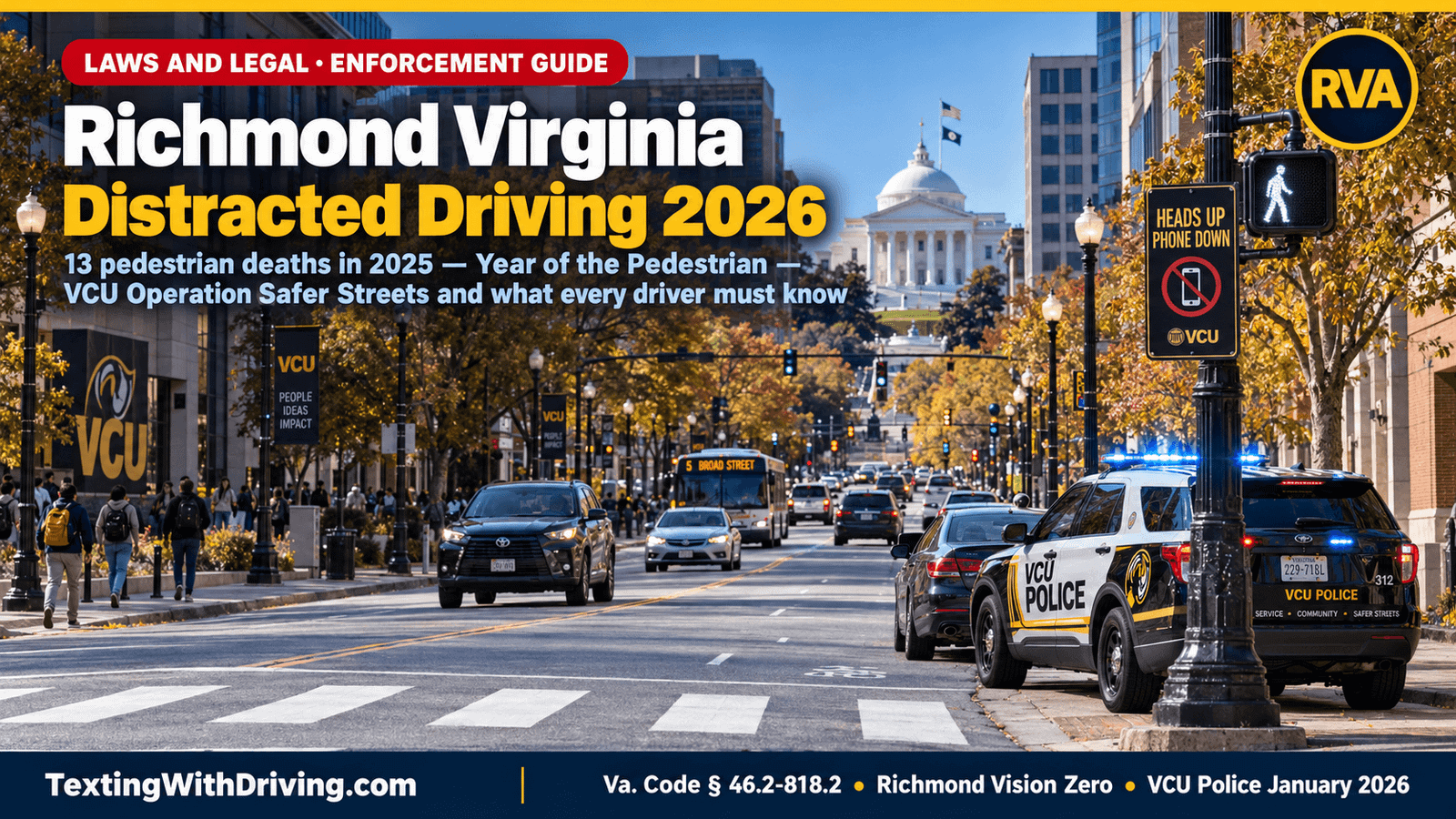
Broad Street. Richmond’s primary east-west arterial, running through the heart of the VCU Monroe Park campus from the Carytown neighborhood through the Capitol Square district. Broad Street is the corridor where Bill Martin was killed in a marked crosswalk on December 27. The “Heads Up, Phone Down” street signs that Richmond installed — visible on Broad Street and around VCU’s campus — are the street-level expression of what distracted driving means for pedestrian safety on this corridor.
Main Street. VCU’s West Main Street is one of the most pedestrian-active corridors in central Richmond, lined with restaurants, coffee shops, and bars serving the VCU student population that crosses Main Street dozens of times daily. The student pedestrian density on Main Street, combined with the restaurant and bar traffic that arrives by car from the broader Richmond area, creates the specific pedestrian-vehicle conflict environment that Operation Safer Streets targets.
Cary Street. The Carytown commercial district on Cary Street — Richmond’s most popular independent retail corridor — generates the highest density of pedestrian-vehicle conflicts from shopping-area traffic patterns: vehicles making access turns through pedestrian-dense sidewalk and crosswalk environments, drivers searching for parking while looking at their phones for the Carytown parking garage location, and the commercial delivery traffic that blocks sight lines at corner crossings.
Leigh Street, Belvidere Street, and Marshall Street. The VCU Health campus area streets that carry the specific combination of patient, visitor, staff, and student traffic on the northern edge of the Monroe Park campus. The Belvidere Street corridor — connecting I-195 to the VCU campus area — carries the highest-speed through-traffic of the six Operation Safer Streets corridors, creating the specific elevated-speed distracted driver scenario where pedestrian detection failures are most deadly.
While officers are looking at speeding, they are also focusing on distracted driving, people making illegal turns, and those failing to yield to the right of way. The explicit identification of distracted driving as one of Operation Safer Streets’ three enforcement targets — alongside speeding and failure to yield — means that a driver on Broad Street, Main Street, or any of the six corridors who is holding their phone is in the specific enforcement environment that VCU Police has publicly announced. VCU Police have primary enforcement authority under Virginia Code § 46.2-818.2 on the streets within and adjacent to the VCU campus area.
The department is on track to hand out 27 percent more citations than last academic year. That citation pace increase — 27 percent above the prior year’s enforcement level — reflects the specific intensification of enforcement that the January 2026 Operation Safer Streets launch produced. For the driver who has been commuting through the VCU campus area for years without receiving a citation, the enforcement environment has materially changed in 2026.
Bill Martin and the Broad Street Crosswalk
Richmond Virginia distracted driving 2026 has a specific human face in the death of Valentine Museum Director Bill Martin on December 27, 2025 — the crash that became Richmond’s most prominent symbol of the pedestrian safety crisis and the direct precipitant of the Year of the Pedestrian declaration.
He was crossing Broad Street in a marked pedestrian walkway in the shadow of Capitol Square and Richmond’s City Hall. Bill Martin was doing everything right: crossing in a marked crosswalk, on a city block he had crossed hundreds of times in his years as one of Richmond’s most prominent cultural figures. The driver who killed him failed to see him — or failed to stop in time.
The specific mechanism that produces pedestrian deaths in marked crosswalks on major urban streets like Broad Street is the failure-to-detect scenario that inattentive driving creates. A marked crosswalk and a pedestrian WALK signal are legal protections for pedestrians. They are not physical protections. They protect pedestrians from drivers who are paying attention — drivers who scan the crosswalk before moving through it, who yield to the pedestrian already crossing before beginning their own movement, who have the attentional capacity to register a pedestrian in a crosswalk as a stop signal.
The driver who is distracted — by a phone conversation, a text notification, a GPS interaction, or any of the other phone-based activities that Virginia Code § 46.2-818.2 targets — approaches the Broad Street crosswalk with reduced attentional capacity for the pedestrian detection that the crosswalk requires. The attentional reduction is not visible from outside the vehicle. There is no visual signal to other road users that the driver has 37 percent less brain activity devoted to driving because they are in a phone conversation. The pedestrian in the crosswalk has no way to know whether the approaching driver is attentive or distracted until the vehicle’s behavior reveals which it is — often at the last moment.
The pedestrian deaths in Richmond’s marked crosswalks — Bill Martin on Broad Street, Hope Cartwright at Second and Cary, and others documented in our Virginia distracted driving and pedestrians 2026 article — are the specific expression of what distracted driving costs in an urban environment where pedestrian density is high and crosswalks are numerous.
The Year of the Pedestrian: What Mayor Avula Committed To
Richmond Virginia distracted driving 2026 has a formal policy response in Mayor Danny Avula’s Year of the Pedestrian commitment — the declaration that positioned 2026 as the year Richmond would take the specific infrastructure and enforcement actions needed to address the pedestrian death crisis.
The new actions Avula described include an expanded safety camera program, accelerated street safety improvements, and the creation of a Pedestrian Safety Task Force in partnership with VCU. Three specific commitments:
Expanded safety camera program. Richmond’s safety camera infrastructure — speed cameras in specific school zones and problem corridors — is being expanded to additional locations. The Virginia legislation that enabled photo speed enforcement in residential and commercial districts creates the framework for Richmond to deploy cameras on Broad Street, Main Street, and Cary Street — the pedestrian crash concentration corridors — independent of the SB84 school zone camera authorization documented in our Virginia distracted driving cameras 2026 article.
Accelerated street safety improvements. Infrastructure investments that directly address the pedestrian safety deficit: curb extensions at key intersections that narrow the crossing distance and slow vehicle turning speeds, leading pedestrian intervals at signal-controlled crossings, additional crosswalk markings on the Broad Street and Cary Street corridors, and bump-outs at pedestrian crossing points on high-volume streets. VCU’s own infrastructure response — modular curbs at four on-campus intersections reducing left-turn speeds — is a specific example of the street-level engineering that accelerated improvements are scaling.
Pedestrian Safety Task Force with VCU. The formal institutional partnership between the City of Richmond and VCU — bringing together city government, VCU Police, VCU transportation planning, and community advocates — creates the sustained organizational focus that Year-of-the-Pedestrian declarations need to produce durable change beyond the declaration year.
The program has taken a few main courses of action: building infrastructure that promotes pedestrian safety such as curb extensions and crossing signs, increased police presence to ramp up speed enforcement, and initiatives such as “Heads Up, Rams!” to educate and enhance pedestrian awareness. The Heads Up, Rams! initiative — and the companion “Heads Up, Phone Down” street signage — is the specific distracted driving awareness component of Richmond’s pedestrian safety response. The street signs that Richmond installed on Broad Street are the most direct physical reminder to drivers that they are in a pedestrian-dense environment where their phone use creates lethal risk.
The VCU Campus Environment: Why Students Are Especially Vulnerable
Richmond Virginia distracted driving 2026 has a specific university campus dimension that makes VCU’s Monroe Park campus one of the most dangerous pedestrian environments in Virginia.
VCU data shows crashes involving pedestrians, bicyclists and scooters are on pace to increase over last academic year. The VCU campus’s specific pedestrian vulnerability factors:
High pedestrian density from campus activity. VCU’s Monroe Park campus enrolls approximately 28,000 students, with thousands crossing the campus-area streets between classes, dormitories, dining facilities, and the surrounding commercial districts dozens of times each day. The pedestrian density on Broad Street, Main Street, and the intersecting streets is among the highest of any urban block in Virginia during the academic day.
Multiple distracted pedestrians. There are both distracted motorists and distracted pedestrians, and it’s simple enough to complain about people never looking up from their phones. The specific VCU campus dynamic creates mutual distraction: students who are looking at their phones while crossing, and drivers who are looking at their phones while navigating campus-area streets. Neither side has full attentional capacity for the crossing interaction — creating the compounded mutual failure-to-detect scenario that is most likely to produce a crash.
The commuter traffic through campus. The VCU campus area is not a closed campus — Broad Street, Cary Street, and the other campus-adjacent arterials carry the full range of Richmond commuter and through traffic alongside the campus pedestrian environment. A driver from suburban Henrico County navigating Broad Street to reach I-195 is sharing the road with the 28,000-student pedestrian environment of a major urban research university. The commuter’s navigation behavior — checking GPS for the quickest I-195 on-ramp while traversing the VCU campus block — is primary offense territory at exactly the point where Operation Safer Streets has four dedicated enforcement officers.
VCU student fatalities. The deaths of two VCU students in the first three months of 2025 — which precipitated Operation Safer Streets in January 2026 — established the specific human cost of the VCU campus distracted driving environment. VCU police say failing to yield was the cause in those two recent crashes — the specific behavioral failure of a driver who did not stop for a pedestrian with the right of way, which is the behavioral expression of the failure-to-detect mechanism that distracted driving produces.
Hull Street, Broad Street and the High-Risk Corridors Beyond VCU
Richmond Virginia distracted driving 2026 extends beyond the VCU campus area into the broader Richmond road network — the surface streets of the Church Hill, Manchester, North Side, and Southside neighborhoods that produce Richmond’s pedestrian crash concentration outside the university district.
The Hull Street Corridor Revitalization Plan — a multi-year infrastructure project closing out in 2026 — addresses one of Richmond’s most crash-intensive pedestrian corridors on the city’s south side. The Hull Street corridor through Manchester and the Southside communities carries commercial and residential traffic on a road design that concentrates pedestrian crossing in limited crosswalk locations, creating the same crosswalk gap problem documented for Route 1/Richmond Highway in Fairfax County in our Virginia distracted driving and pedestrians 2026 article.
The pedestrian crash concentration on Broad Street, Hull Street, and Semmes Avenue — the three corridors most frequently documented in Richmond’s pedestrian death record — shares a specific characteristic: high vehicle through-traffic on roads that also serve dense pedestrian populations from adjacent residential neighborhoods and commercial activity. The driver who is moving through these corridors at commuter speeds, managing a phone call or checking a navigation update, is in an environment where pedestrian crossings occur at every intersection and where the failure-to-detect scenario produces the deaths that Richmond recorded in 2025.
Richmond’s Vision Zero: A Progress Assessment
Richmond Virginia distracted driving 2026 sits within Richmond’s Vision Zero commitment — the formal pledge to eliminate all traffic deaths on Richmond streets that the city adopted and that has produced a mixed record since 2017.
Richmond’s overall traffic fatality count increased in 2017, the year after adopting the Vision Zero pledge. Its pedestrian mortality count increased by 87 percent in that year. The record since 2017 shows that Vision Zero declarations without the infrastructure and enforcement investment to back them produce no improvement — and may produce a false assurance effect that retards more aggressive intervention.
The Year of the Pedestrian 2026 represents a more concrete commitment than the 2017 Vision Zero declaration: specific infrastructure investments, specific enforcement operations, specific camera deployments, and specific partnership structures with VCU. The difference between 2017’s declaration and 2026’s Year of the Pedestrian is the specificity of the committed actions — and whether those actions are implemented at the scale and speed the pedestrian death toll demands.
Richmond’s situation is not unique nationally. The broader pattern of Vision Zero declarations producing limited results in American cities is documented across the country. But Richmond’s specific disproportionality — the state capital, with a fraction of the population of Virginia’s largest counties, leading the state in pedestrian deaths — creates a specific urgency for the enforcement and infrastructure investment that 2026’s Year of the Pedestrian commits to.
What Every Richmond Driver Must Know in 2026
Richmond Virginia distracted driving 2026 creates specific compliance obligations for every driver on Richmond’s roads — commuter, student, visitor, and resident.
Broad Street is under active VCU Police enforcement targeting distracted driving. Operation Safer Streets’ four dedicated traffic enforcement officers are actively deployed on Broad Street and five additional corridors. VCU Police have explicitly identified distracted driving as one of three enforcement targets. A driver on Broad Street who is holding their phone — at any point from the Carytown end to the Capitol Square end — is in the active enforcement environment that VCU Police has publicly announced. On track for 27 percent more citations than the prior year.
The “Heads Up, Phone Down” signs on Broad Street are a legal reminder, not a suggestion. The street signage that Richmond installed on Broad Street and around the VCU campus area is the physical expression of Virginia Code § 46.2-818.2’s legal standard. The sign does not create a new law — it reminds drivers that the law already prohibits phone use in exactly the pedestrian-dense environment where the sign is posted.
Bill Martin’s crosswalk on Broad Street requires the attentive driving that a marked crosswalk legally demands. The marked pedestrian crosswalk near Capitol Square on Broad Street — where a respected museum director was killed in December 2025 — requires every driver to yield to pedestrians crossing with the right of way. Virginia Code § 46.2-924 requires vehicles to yield to pedestrians in marked crosswalks. A driver who is looking at their phone as they approach a Broad Street crosswalk where a pedestrian is legally crossing is committing both a § 46.2-818.2 hands-free violation and a § 46.2-924 failure to yield — simultaneously, at the same crosswalk.
Richmond’s riskiest driver designation applies to the commuter, not just the stereotyped “Richmond driver.” The commuter from suburban Henrico County who drives through the VCU campus area to reach I-195 is contributing to Richmond’s riskiest driver statistics when they check their phone on Main Street. The riskiest driver data reflects aggregate behavior across everyone who drives Richmond’s streets — resident and commuter alike.
$125 first offense for hands-free violation on any Richmond road. Virginia Code § 46.2-818.2 applies identically on Broad Street, Hull Street, Cary Street, and every other Richmond public road. The three-year real cost including insurance impact documented in our Virginia distracted driving insurance rate increase 2026 article ranges from approximately $1,000 to $1,600 from a single first-offense citation.
For the complete Virginia law that applies on every Richmond road, our Virginia distracted driving law covers Va. Code § 46.2-818.2. For the statewide pedestrian death context that places Richmond’s 13 deaths within Virginia’s broader 153-death picture, our Virginia distracted driving and pedestrians 2026 article covers every Virginia locality. For the VCU campus brain science that explains why campus-area drivers face the highest pedestrian detection demands, our distracted driving brain science 2026 covers the cognitive mechanism. And for the technology setup that makes Broad Street compliance automatic, our hands-free while driving complete setup guide covers iPhone, Android, Bluetooth, and CarPlay.
Sources Used in This Article
All links verified working before publication.
WWBT / 29 News: VCU Police Target Traffic Enforcement New Safety Operation — Operation Safer Streets four dedicated officers, distracted driving illegal turns failure to yield three targets, VCU data pedestrians bicyclists scooters on pace increase, 27% more citations than prior year, six corridors Broad Leigh Main Cary Belvidere Marshall, failing to yield cause two recent crashes, January 15 2026
Virginia Mercury: Pedestrian Deaths Especially in Virginia’s Capital Cry Out for Real Solution — 13 pedestrian deaths Richmond 2025 highest any Virginia locality, one more than Fairfax County population 5x larger, accounted for tenth of commonwealth 136 pedestrian fatalities, pedestrian mayhem trifecta, Bill Martin Broad Street marked crosswalk Capitol Square December 27, Vision Zero 87% increase pedestrian mortality year after pledge, Bob Lewis column, February 2026
Commonwealth Times via CODOT: Richmond Has a Pedestrian Safety Problem — Mayor Avula expanded safety camera program accelerated street improvements Pedestrian Safety Task Force VCU, curb extensions crossing signs increased police speed enforcement, Heads Up Rams! campaign, 13 pedestrian deaths 2025 crisis classification, Vision Zero VCU collaboration, February 2026
WRIC: Walking is Dangerous in Richmond and Getting Worse — Nine pedestrian fatalities first three months of year including two VCU students 160+ injured, speed inattentive driving biggest factors, riskiest drivers nationwide Axios, traffic deaths declined since 2022 record-high 26 but average still higher
VCU Ink Magazine: VCU vs. the Pedestrian — Both distracted motorists and distracted pedestrians phones, two VCU student deaths, Vision Zero graph increasing deaths since 2015, Hull Street Corridor Revitalization closing out 2026, West Broad Street to Carytown hot spots pedestrian foot traffic
NHTSA: Distracted Driving — 3,208 deaths 2024, national context
TextingWithDriving.com is professionally built and maintained to ensure accurate, accessible safety information reaches every driver who needs it. Website development and ongoing support is handled by Budgetic, a digital agency specializing in purpose-driven WordPress websites.


