

Distracted Driving Brain Science 2026: 50% of Hazards Missed, 27 Seconds and the Complete Science

Distracted Driving Brain Science 2026: 50% of Hazards Missed, 27 Seconds and the Complete Science
Distracted driving brain science 2026 begins with a number that reframes everything most drivers believe about their ability to manage a phone conversation while driving: during a phone call while driving, a driver can fail to process up to 50 percent of the information in their driving environment — even when their eyes are pointed directly at the road.
Not 10 percent. Not 20 percent. Up to half of what is visually present in the driver’s field of view may not register as consciously processed information during an active phone conversation. The stop sign is there. The pedestrian stepping off the curb is there. The brake lights of the car ahead are there. The driver’s eyes are pointed at all of them. And still, the phone conversation’s cognitive demand can prevent the brain from converting those visual inputs into conscious awareness and motor response.
This phenomenon — inattentional blindness, also called cognitive tunnel vision — is the most important brain science finding for understanding distracted driving brain science 2026. It explains why hands-free phone calls create crash risk even when the driver’s hands are on the wheel and their eyes are on the road. It explains why 537,000 drivers are visibly distracted at any daylight moment on American roads, and why 3,208 of them die in crashes each year despite the widespread knowledge that distracted driving is dangerous.
This guide covers the complete distracted driving brain science 2026 picture: the neurological mechanism of inattentional blindness, the Carnegie Mellon fMRI research that measured the 37 percent brain activity reduction from listening to phone calls while driving, the University of Utah research that established why passengers are safer conversation partners than phone callers, the AAA Foundation’s 27-second cognitive recovery window research, how sleep deprivation compounds distraction, and what the brain science says about the limits of hands-free compliance as a safety solution.
Inattentional Blindness: Why Your Eyes Cannot Save You
The central insight of distracted driving brain science 2026 is the distinction between looking and seeing — between having visual information enter the eye and having the brain consciously process that information into awareness.
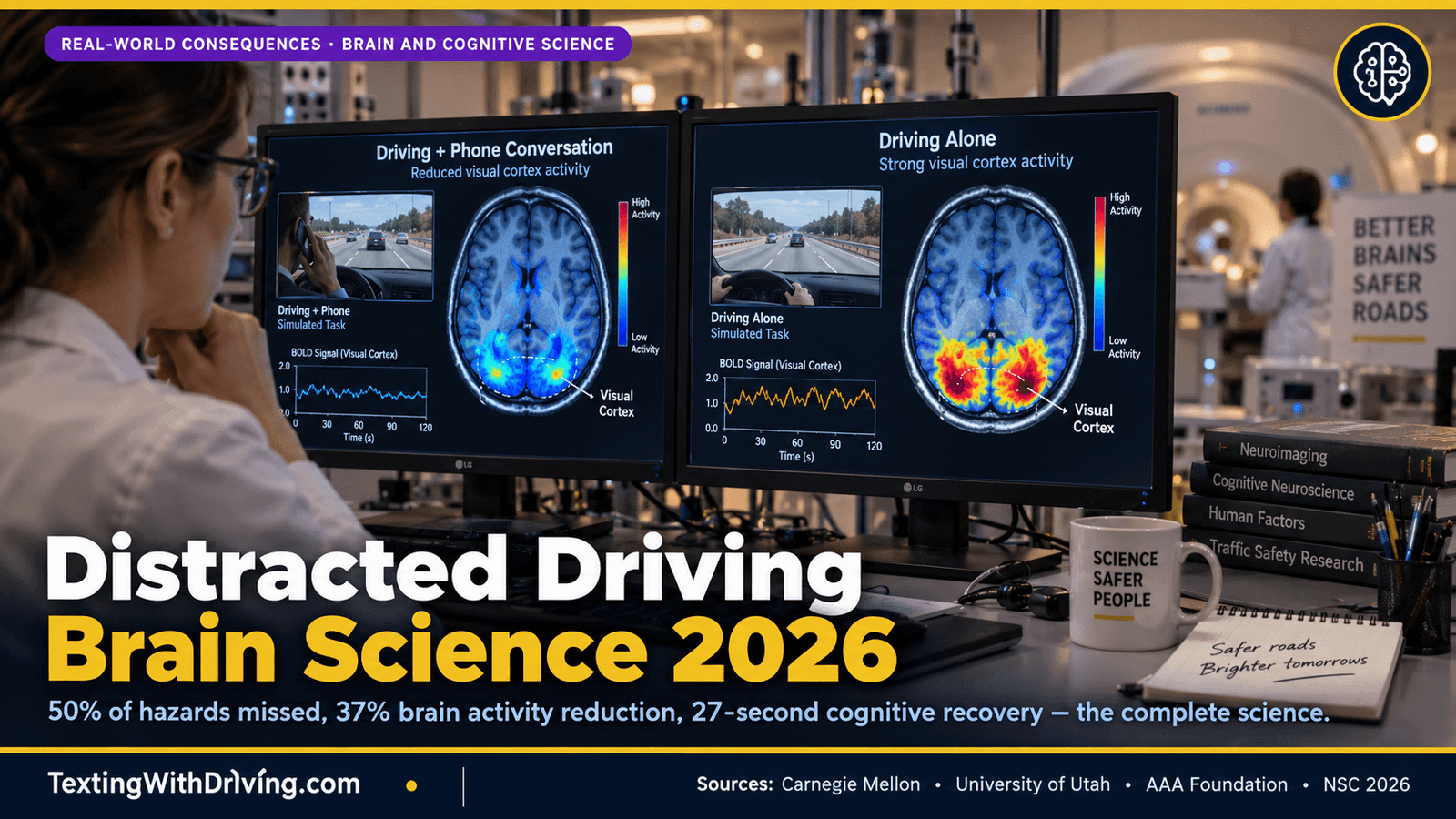
Drivers can experience inattentional blindness — failing to comprehend or process information from objects in the roadway even when they are looking at them. Researchers have found that brain activity associated with visual processing and attention is suppressed when drivers are cognitively distracted.
The mechanism operates through the brain’s limited attentional resources. The human brain can only allocate a finite amount of attentional capacity at any given moment. Driving — even routine highway driving — requires continuous allocation of attentional resources: processing road geometry, monitoring surrounding vehicles, detecting traffic signals, anticipating pedestrian movement, and maintaining vehicle control. These driving sub-tasks consume attentional capacity.
A phone conversation — particularly an emotionally engaging, cognitively demanding, or unpredictable conversation — simultaneously demands attentional capacity from the same finite pool. The conversation requires linguistic processing, working memory to maintain the conversation thread, social cognition to manage the relationship with the caller, and the specific type of focused attention that conversation demands.
When two high-demand tasks compete for the brain’s finite attentional capacity, the brain does not split capacity evenly between them. It allocates preferentially — and the task that receives less allocation receives it inadequately. Visual information from the driving environment enters the eyes but does not receive sufficient attentional processing to be consciously registered. The driver looks at the stop sign and does not see it. Looks at the pedestrian and does not see them. Looks at the brake lights and processes them too slowly to brake in time.
Drivers using cell phones can experience inattentional blindness, failing to see up to 50 percent of their driving environment. Up to 50 percent. The statistic from National Safety Council research is not a measurement of how often drivers fail to look at hazards. It is a measurement of how often drivers who are looking at hazards fail to process them consciously — because the phone conversation has allocated insufficient attentional capacity to the visual processing system.
The parietal lobe of the brain shuts down by approximately 40 percent and redirects cognitive energy to the temporal lobes associated with language when a driver is engaged in a phone conversation. This 40 percent parietal lobe reduction is the neurological mechanism behind the inattentional blindness behavior. The parietal lobe handles spatial awareness and the integration of visual information with action. When the temporal lobe demands resources for language processing, the parietal lobe’s spatial attention functions are reduced — producing the tunnel vision effect that limits the driver’s effective visual processing field.
The Carnegie Mellon fMRI Evidence
The most directly measurable evidence in distracted driving brain science 2026 comes from Carnegie Mellon University’s functional magnetic resonance imaging research — which placed drivers in a driving simulator inside an fMRI scanner and measured actual brain activity while they drove with and without phone conversations.
Talking on a cell phone reduces the amount of brain activity devoted to driving by 37 percent.
37 percent. The Carnegie Mellon fMRI data provides the specific, measured, neurological basis for the inattentional blindness that the behavioral research documents. When a driver in the scanner is engaged in a phone conversation, the brain regions associated with spatial processing, navigation, and driving-related visual attention show 37 percent less activity compared to driving without a phone conversation.
The fMRI finding is significant in two specific ways for understanding distracted driving brain science 2026. First, it establishes that the brain activity reduction is real, measurable, and occurs in the specific brain regions that driving safety depends on. This is not self-reported distraction or simulated driving performance — it is direct neuroimaging of what the brain does during phone-concurrent driving. Second, the 37 percent reduction occurs during listening, not just speaking. The driver who is listening to a caller tell a story is experiencing brain activity reduction in driving-relevant regions even when they are not speaking, generating no text, and making no manual phone contact.
The 37 percent reduction applies to Bluetooth calls as well as handheld calls. The cognitive distraction mechanism operates through the auditory and language processing systems, not through the manual phone-holding that the hands-free law prohibits. A driver with both hands on the wheel, eyes on the road, phone in a mount, conducting a Bluetooth call is experiencing a 37 percent reduction in driving-devoted brain activity throughout the duration of that call.
This is the scientific foundation for the NSC white paper and the AAA Foundation research conclusions that hands-free does not mean risk-free. The specific brain mechanism is documented: the language processing systems that phone conversations engage compete directly with the spatial processing and visual attention systems that safe driving requires. Legal compliance with hands-free law does not eliminate this competition.
The Passenger Conversation Distinction: Why the Caller Is Different
Distracted driving brain science 2026 includes one of the most important and most misunderstood findings in cognitive distraction research: passenger conversations are significantly less cognitively distracting than phone conversations — and the reason explains exactly why.
When people are cognitively busy, their pupils expand, giving researchers an indicator of cognitive load. University of Utah research led by Dr. David Strayer specifically examined the cognitive load difference between passenger conversations and phone conversations during driving tasks.
The finding: phone conversations produce significantly higher cognitive load and significantly worse driving performance than passenger conversations at comparable levels of conversational engagement. The impairments associated with using a cell phone while driving can be as profound as those associated with driving while drunk under some conditions — a comparison that does not apply to comparably engaging passenger conversations.
The explanation is specific and non-intuitive: passengers share the driving context with the driver, while phone callers do not. A passenger who is conversing with the driver can observe heavy traffic, approaching intersections, and demanding driving situations — and naturally modulates the conversation in response. Passengers pause when driving becomes demanding. They point out hazards. They shift to silence when they notice the driver needs to concentrate. The shared situational context allows the conversation to adapt to the driving demands.
The phone caller has no situational awareness. The caller on the other end of the phone does not know the driver is approaching a complex intersection, does not see the heavy traffic that just intensified, does not know that the driving situation just became demanding. The caller continues talking. The conversation demand remains constant regardless of the driving environment’s complexity. The driver must allocate attentional resources to the conversation even when the driving environment is simultaneously demanding maximum attentional resources.
This passenger versus caller distinction has a specific practical implication for the hands-free law framework. Virginia Code § 46.2-818.2 and comparable state laws permit hands-free calls while prohibiting handheld calls. The brain science research shows that the prohibited behavior (handheld call) is dangerous and the permitted behavior (hands-free call) is also dangerous, for the same neurological reason — but the research also shows that neither is as cognitively impairing as it might seem compared to the baseline of a passenger conversation that adapts to the driving context.
For the safest communication while driving: the passenger who can share the road context and naturally pause when driving becomes demanding is the least cognitively demanding conversational companion. No call at all — phone in back seat, Driving Focus active — eliminates the 37 percent brain activity reduction entirely. A hands-free call retains the 37 percent reduction while removing the manual and visual distraction of handheld use. A handheld call adds visual distraction of the screen and manual distraction of device contact to the same 37 percent cognitive reduction.
The 27-Second Recovery Window: Distraction Does Not End When the Call Does
Distracted driving brain science 2026 includes the most counterintuitive finding for drivers who believe that ending a phone interaction immediately restores full driving attention: distraction depleted participants’ ability to pay attention to their driving for at least half a minute after the distraction ended.
That extended effect implies that the number of traffic accidents caused by distracted driving could be substantially higher than current estimates indicate.
Half a minute. Thirty seconds of residual cognitive impairment after the phone interaction ends. The AAA Foundation for Traffic Safety and University of Utah joint study that produced the 27-second figure tested drivers in multiple vehicles and with multiple smartphone voice-assistant systems. The findings were consistent: potentially unsafe mental distractions can persist for as long as 27 seconds after dialing, changing music, or sending a text using voice commands.
At the 25 mph test speed, drivers traveled the length of nearly three football fields during this 27-second impairment window. At 60 mph on an interstate, 27 seconds covers 2,376 feet — nearly half a mile — of travel during which the driver is nominally attentive but neurologically running below full driving attention capacity.
The 27-second figure challenges a specific driving behavior that many drivers consider safe: completing a voice interaction while stopped at a red light, then proceeding normally when the light turns green. A driver who finishes a voice-activated text message while stopped at a red light and then begins moving when the light turns green is in the first 27 seconds of their cognitive recovery window during the most critical moment of the intersection transition.
The reaction time dimension confirms the 27-second finding’s practical relevance. Distraction depleted participants’ ability to pay attention to their driving for at least half a minute — including reaction time. A driver in the first 20 seconds of post-interaction cognitive recovery who encounters a pedestrian crossing has a slower response than their fully recovered baseline. The pedestrian who was struck in the crosswalk because the driver began moving on a green light was struck not because the driver was actively on their phone — but because they had just finished a voice interaction and had not yet recovered full attentional capacity.
The Cognitive Load Scale: Not All Distractions Are Equal
Distracted driving brain science 2026 includes a specific finding from the AAA Foundation research that helps drivers understand which phone interactions create the most dangerous cognitive load.
By creating a first-of-its-kind rating scale of driver distractions, the AAA study showed that certain activities place a high cognitive burden on drivers. The scale runs from Category 1 (least distracting — comparable to listening to the radio) through Category 5 (most distracting — a scientific test designed to overload driver attention).
The category ratings from the AAA scale:
Category 1: Radio listening. The least cognitively demanding common driving companion, because radio content does not demand conversational response, does not require the driver’s active cognitive engagement, and does not produce unpredictable demands on attentional resources.
Category 2: Passenger conversation. Categorized in the research as a moderate cognitive load — demanding enough to be measurable, but modulated by the passenger’s shared situational awareness.
Category 2-3: Handheld phone conversation. At or above the AAA’s Category 2 threshold that the researchers consider unsafe for concurrent driving.
Category 3+: Hands-free phone conversation. All of the 13 voice systems tested were found to be Category 2 or higher, and 10 of 13 were Category 3 or higher. None of the systems met the threshold of Category 1 — the level that the researchers considered safe for concurrent driving.
Category 3+: Speech-to-text systems and voice-activated infotainment. Driver interactions with in-vehicle speech-to-text systems create the highest level of cognitive distraction among the tasks assessed. The in-vehicle infotainment systems that are marketed as hands-free alternatives to phone use are, by the AAA measurement, among the most cognitively distracting activities studied.
This finding is particularly significant for drivers who use the increasingly sophisticated in-vehicle voice systems in modern vehicles — the same systems that ADAS-equipped 2025-2026 model year vehicles are integrating with voice-activated AI assistants. A driver who uses their vehicle’s in-car AI assistant to compose a message while driving may be engaging Category 3 or higher cognitive distraction through a feature that is marketed as a safe, hands-free alternative to phone texting.
Sleep Deprivation and Distraction: The Hidden Compounding Factor
Distracted driving brain science 2026 includes the specific interaction between sleep deprivation and phone distraction that most drivers do not consider — and that produces disproportionately dangerous conditions during the early morning commute and late-night return trip driving windows.
Sleep deprivation produces cognitive impairment that compounds with phone distraction through overlapping neurological mechanisms. A driver who slept only five hours the previous night is already operating with reduced prefrontal cortex function, reduced working memory capacity, and reduced attentional resource availability — exactly the cognitive resources that phone distraction further depletes.
The compounding effect is not additive — it is multiplicative. A driver who is mildly sleep-deprived and engaging in a hands-free phone call is not experiencing the sum of two mild impairments. They are experiencing the interaction of two impairments that draw on the same limited cognitive resource pool, depleting a resource that was already below baseline before the call began.
The Labor Day return trip scenario we documented in our Labor Day driving safety 2026 article is the most directly applicable context for the sleep-distraction compounding effect: a driver who spent the holiday weekend at a beach or campground with reduced sleep, who is returning home on Sunday evening, who is in a hands-free phone call coordinating dinner plans — is experiencing the specific three-way compound of sleep deficit, highway-speed driving, and cognitive phone distraction that produces the most dangerous attentional conditions of any common driving scenario.
The Texting Addition: When Cognitive Adds Manual and Visual
Distracted driving brain science 2026 reaches its most acute danger level when cognitive distraction is combined with the visual and manual distraction of texting — the full three-category distraction profile that represents texting while driving’s specific danger.
The three seconds of eyes-off-road during a texting interaction — during which the vehicle covers 264 feet at 60 mph — is the visual and manual distraction component. Simultaneously, the cognitive demand of composing or reading the message creates the inattentional blindness effect. And the 27-second post-interaction cognitive recovery period begins after the phone is put down.
A texting-while-driving event produces: three to five seconds of visual blindness (eyes on phone screen), three to five seconds of manual impairment (hand on screen rather than wheel), the 37 percent brain activity reduction from the cognitive demand of message content processing, and then 27 seconds of residual cognitive impairment after the interaction ends. Total: potentially 32 seconds or more of elevated crash risk from a single texting interaction.
At 55 mph, 32 seconds covers approximately 2,570 feet — nearly half a mile of road traveled during which the driver’s attentional resources have been significantly compromised. The specific comparison to alcohol impairment from the University of Utah research establishes the scale: the cognitively demanding and texting conversations were similar to blood alcohol concentration levels of 0.07 to 0.10 in their effect on driving simulation performance.
0.07 to 0.10 BAC. That is above the legal limit for driving in every US state. The comparison does not mean texting is legally equivalent to drunk driving in every respect. It means the driving performance impairment from cognitively demanding texting is comparable in magnitude to the impairment from blood alcohol concentrations that are legally classified as intoxicated driving.
The National Law Framework and the Brain Science Gap
Distracted driving brain science 2026 reveals a specific gap between what the law prohibits and what the science shows is dangerous. State hands-free laws — including Virginia’s § 46.2-818.2, Iowa’s SF2237, Maryland’s § 21-1124, and the laws of all 33-plus states with primary enforcement handheld bans — prohibit the manual-and-visual distraction categories: holding the phone, looking at the screen, typing on the device.
These laws permit the cognitive distraction category: the hands-free call that produces the 37 percent brain activity reduction throughout its duration, the voice-activated text that produces 27 seconds of post-interaction cognitive impairment, and the in-vehicle infotainment interaction that the AAA categorizes as among the most cognitively distracting activities assessed.
The law has addressed the most visible and most easily enforced manifestation of phone distraction. The brain science research shows that the remaining permitted behaviors retain meaningful crash risk. IIHS notes that crash avoidance technology may be the most promising avenue for reducing crash risks related to distractions of any type — a conclusion that reflects the regulatory gap between what the law can practicably enforce and what the science shows is neurologically unsafe.
The practical guidance for every driver from the complete distracted driving brain science 2026 evidence:
Phone in back seat eliminates all three distraction categories. No visual, no manual, no cognitive phone distraction if the phone cannot be reached, heard, or responded to.
Hands-free calls permit but do not eliminate cognitive distraction. A Bluetooth call while driving is legal. It is not neurologically safe. The 37 percent brain activity reduction applies throughout the call. The 27-second recovery window applies after. The pedestrian who steps off the curb during the call or within 27 seconds after it ends may not be consciously detected — not because the driver’s eyes aren’t pointing at them, but because the attentional resources required to process that visual input are allocated elsewhere.
In-vehicle voice systems are higher-risk than they appear. The Category 3 cognitive load of voice-activated infotainment systems — rated higher than phone calls by the AAA scale — is an underappreciated distraction risk in modern vehicles. Setting a navigation destination through the in-vehicle voice system while moving creates more cognitive load than the same action through a mounted phone’s navigation app.
The passenger conversation is the safest social driving companion. The shared situational context that allows a passenger to modulate their conversation with the driver’s attentional demands makes passenger conversations significantly less cognitively impairing than phone calls. A driver who needs to make a phone call during a route would be better served by waiting until they arrive — or if they must communicate during transit, by having a passenger make the call on their behalf.
For the Virginia-specific context of the VTTI naturalistic driving research that captures these brain science mechanisms in real-world driving data, our Virginia distracted driving and the brain 2026 article covers the VTTI findings. For the teen brain science that explains why the same mechanisms affect developing brains even more severely, our Virginia teen distracted driving brain science 2026 article covers the prefrontal cortex and working memory framework. For the AI technology that is now detecting the behavioral expressions of these cognitive mechanisms, our distracted driving AI technology 2026 article covers roadside cameras, DMS, and fleet AI. And for the technology setup that eliminates all three distraction categories simultaneously, our hands-free while driving complete setup guide covers iPhone, Android, Bluetooth, and CarPlay.
Sources Used in This Article
All links verified working before publication.
IIHS: Distracted Driving Research Area — Inattentional blindness researchers confirmed visual processing suppressed, 1.9% drivers handheld phone at intersections 2024 observational survey National Center Statistics Analysis 2026, crash avoidance technology most promising avenue, August 2026
AAA Foundation: Measuring Cognitive Distraction in the Automobile — Hands-free does not mean risk-free, suppressed brain activity missed cues slower reaction times tunnel vision, speech-to-text highest cognitive distraction among tasks assessed, distraction rating scale Category 1-5, all 13 voice systems Category 2 or higher
AAA/University of Utah: Hands-Free Distraction Study — 27 seconds persistent distraction after voice commands, 10 vehicles 3 smartphones tested, all cognitively taxing enough to be potentially dangerous, Category 3 or higher 10 of 13 systems, practice reduced but did not eliminate distraction
Scientific American: Distracted Driving Is More Dangerous Than People Realize — Cognitive distraction depleted attention for at least half a minute after distraction ended, pupils expand when cognitively busy, Strayer University of Utah lead researcher, implications for higher traffic accident numbers than current estimates, May 2025
Joe Zaid: Why Your Brain Misses 50% of Hazards — NSC 50% driving environment missed, Carnegie Mellon fMRI 37% brain activity reduction, University of Utah passenger vs phone caller distinction, eyes on road brain not processing, September 2025
Ben Levitan Distracted Driving Studies — Strayer et al University of Utah cognitive impairment profound as drunk driving, naturalistic conversation 0.04 BAC, texting 0.07-0.10 BAC comparable, even when looking directly at objects less likely to create durable memory
ULG Law: How to Prevent Distracted Driving 2026 — Legal does not mean safe hands-free inattentional blindness, 50% driving environment missed, cognitive burden impairs safe driving, February 2026
NHTSA: Distracted Driving — 3,208 deaths 2024, 537,000 distracted drivers any daylight moment, national context
TextingWithDriving.com is professionally built and maintained to ensure accurate, accessible safety information reaches every driver who needs it. Website development and ongoing support is handled by Budgetic, a digital agency specializing in purpose-driven WordPress websites.

About Texting With Driving
TextingWithDriving.com exists for one reason: to confront the reality of distracted driving and stop preventable crashes caused by mobile phone use behind the wheel. Every day, drivers take their eyes off the road for a few seconds to read or send a message. Those few seconds are enough to cause life-altering consequences. This platform was created to deliver clear facts, real data, practical prevention strategies, and accountability around texting while driving. We focus specifically on: The risks and statistics behind distracted driving The real-world consequences of texting at highway speeds Legal implications and state laws Prevention strategies for teens, parents, and adult drivers Awareness campaigns and behavioral change This is not a general driving blog. It is a focused awareness initiative built around one critical issue: phone distraction behind the wheel. Our content is direct, research-driven, and practical. We prioritize accuracy over opinion and education over sensationalism. The goal is simple — reduce distracted driving incidents by increasing awareness and responsibility. If one article causes one driver to put their phone down, the mission is working. For inquiries or partnerships, contact: privacy@textingwithdriving.com
View all posts by Texting With Driving