

Virginia Distracted Driving Cameras 2026: SB84 Passes, AI Arrives and What’s Coming Next

Virginia Distracted Driving Cameras 2026: SB84 Passes, AI Arrives and What’s Coming Next
Virginia distracted driving cameras 2026 marks a turning point in how the Commonwealth enforces traffic safety — and specifically in how close Virginia is to the kind of AI-powered automated distracted driving detection that Maryland has been testing with Obvio cameras detecting 2,500 violations per day.
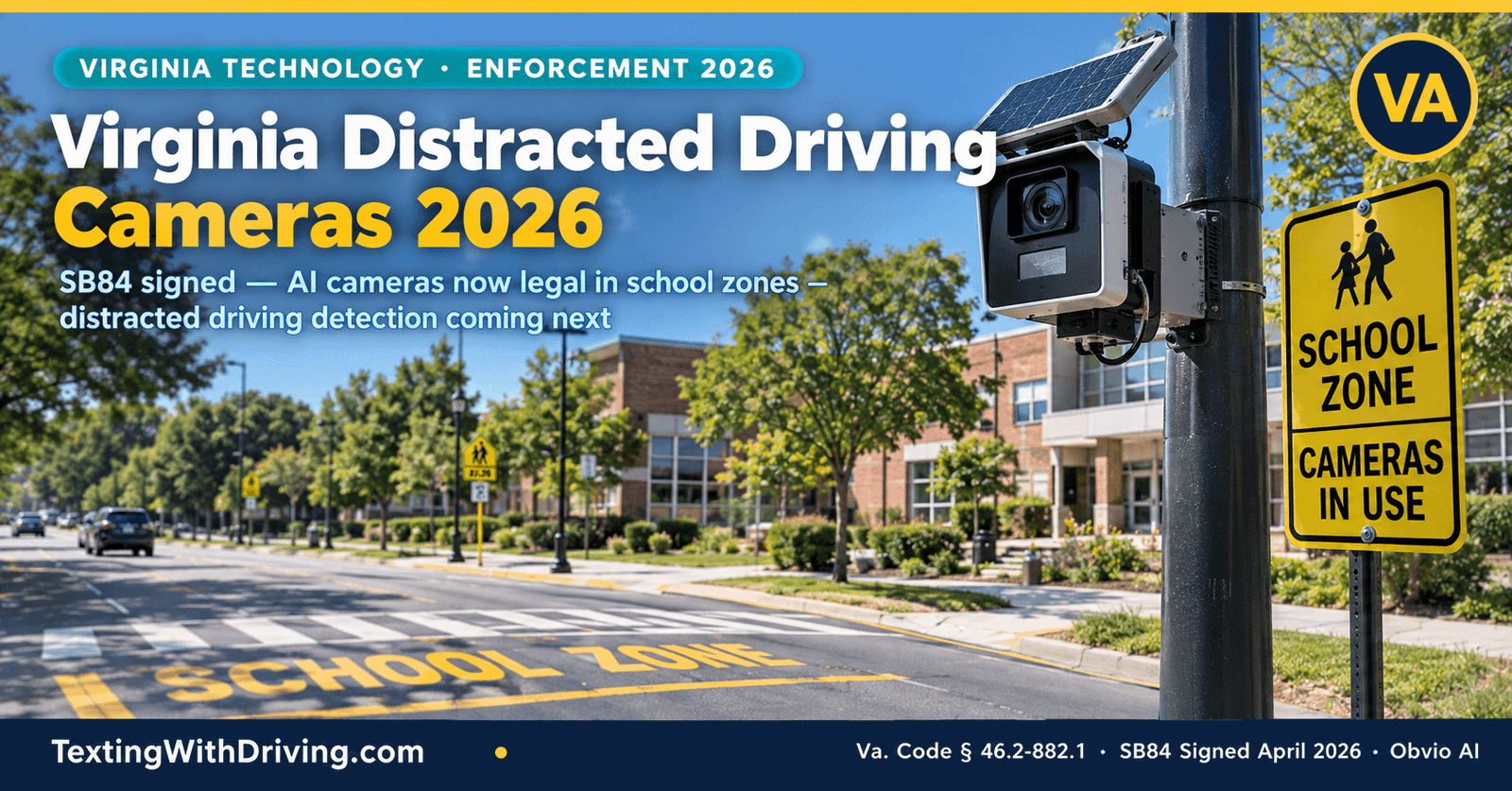
Virginia is among the first states in the country to allow automated enforcement at stop signs and crosswalks after Governor Abigail Spanberger signed SB84 into law in April 2026. The law took effect July 1, 2026, amending Virginia Code § 46.2-882.1 to authorize AI-powered cameras in school zones and work zones for two specific violations: running a stop sign, and failing to yield to a pedestrian in a crosswalk.
But here is the most significant detail for Virginia distracted driving cameras 2026: the technology Virginia just authorized can do far more than catch stop sign violations. Company officials say the Obvio systems can also identify distracted driving and speeding, though only violations authorized under state law can be enforced.
The cameras can see distracted driving. Virginia has not yet authorized them to ticket for it. That gap — between what the technology is capable of and what the law currently permits — is the central story of Virginia distracted driving cameras 2026 and the most important camera-related development coming for Virginia drivers in 2026 and 2027.
This guide covers exactly what SB84 does and does not authorize, where Obvio cameras are being deployed in Virginia, what Chesterfield County’s school bus AI camera program means for drivers across the Richmond metro, how the technology compares to Maryland’s active distracted driving camera pilot, and what the legislative pathway to authorized AI distracted driving enforcement in Virginia looks like.
What SB84 Actually Authorizes: The July 1 Change
Senate Bill 84, sponsored by State Senator Angelia Williams Graves and signed by Governor Spanberger in April 2026, made two specific expansions to Virginia’s automated traffic enforcement framework under § 46.2-882.1.
Beginning July 1, a new law allows communities across the state to deploy automated enforcement aimed at improving safety in school zones and other designated areas. Senate Bill 84 amended Virginia Code § 46.2-882.1 to authorize automated systems that detect two specific violations: running a stop sign, and failing to yield to a pedestrian in a crosswalk. These join the photo speed monitoring devices Virginia localities were already permitted to operate.
The two authorized violation categories are specific and limited to pedestrian-protection scenarios. The AI cameras authorized by SB84 can issue civil citations for:
Running a stop sign — specifically flagrant stop sign violations where the driver fails to stop at a designated stop sign, particularly in school zones and work zones.
Failing to yield to a pedestrian in a crosswalk — where a driver passes through a crosswalk without yielding to a pedestrian who has the right of way.
These are not the distracted driving violations that the cameras are technically capable of detecting. They are the specific pedestrian-safety violations that the Virginia legislature authorized, based on documented data: three out of every five drivers refused to yield for pedestrians at West Main Street and Davis Street in Richmond’s Fan District per a traffic study cited by Obvio’s co-founder. Virginia recorded 126 pedestrian deaths and 1,719 pedestrian injuries in 2024. The pedestrian protection focus of SB84 reflects the specific crisis that drove it.
The Distracted Driving Gap: What the Cameras Can Detect But Cannot Currently Enforce
The most important element of Virginia distracted driving cameras 2026 for drivers and advocates to understand is the detection-enforcement gap created by SB84’s specific violation authorization.
Company officials say the Obvio systems can also identify distracted driving and speeding, though only violations authorized under state law can be enforced.
Obvio’s AI camera system — the same technology being deployed in Virginia school zones — uses machine learning to analyze what is happening inside and around a vehicle at a monitored intersection. The system can detect multiple behavioral categories simultaneously: the driver who runs a stop sign, the driver who fails to yield to a pedestrian, AND the driver who is holding a phone or visually distracted at the time of any of these events.
The AI detection capability for distracted driving exists in the cameras now being deployed. The legal authority to issue citations for distracted driving based on camera evidence does not yet exist in Virginia law.
This gap is precisely the situation that Maryland occupied before SB613 proposed the AI camera pilot for Montgomery and Prince George’s Counties. Maryland’s Obvio testing produced 2,500 distracted driving violations detected per day from nine cameras, as we documented in our Maryland work zone distracted driving 2026 article — before any fines were being issued, during the pure data-collection phase. Virginia’s SB84 cameras are now in place. The question is whether a future Virginia bill will authorize the distracted driving citation capability that the cameras already possess.
How the Obvio Technology Works in Virginia
One company preparing to offer the technology in Virginia is Obvio, whose solar-powered cameras can detect stop sign violations and failure-to-yield incidents. The cameras use artificial intelligence to process images and identify potential violations before they are reviewed by law enforcement officers.
The Obvio system operates through a specific workflow designed to address both enforcement effectiveness and civil liberties concerns:
Detection. The AI analyzes the vehicle and intersection in real time. When a potential violation is detected — stop sign running, pedestrian yielding failure, or any of the other behavioral categories the camera is capable of identifying — the system flags the event.
Privacy protection. The AI serves both for detection and privacy. The camera automatically blurs faces in light of privacy concerns. The footage captures the violation — the vehicle’s position, the stop sign, the pedestrian in the crosswalk — without capturing or storing the driver’s face in identifiable form.
Cloud upload for human review. If there is a violation, it uploads to the cloud for human review and officer review. An officer must determine whether a citation should be issued before it is mailed to the vehicle owner.
Civil penalty by mail. Citations remain civil penalties and do not affect insurance rates. Local governments must approve camera programs before deployment. The citation is sent to the registered vehicle owner — based on license plate identification — rather than requiring identification of the specific driver.
Violator-funded program. The program is considered fully violator-funded, meaning citation revenue pays for the cameras. Any extra revenue must be used for traffic safety per the legislation. This financing structure eliminates the upfront cost barrier that might prevent smaller localities from participating.
The violator-funded model is the same approach used by Chesterfield County’s school bus camera program and Maryland’s work zone camera expansion — creating a self-sustaining enforcement infrastructure that grows through the revenue generated by the violations it catches.
Where Cameras Are Deploying in Virginia Right Now
Virginia distracted driving cameras 2026 deployment is already underway in multiple locations as of September 2026.
AI traffic cameras in Virginia became legal on July 1, 2026, and with Fairfax County Public Schools back in session, the first wave of them is now watching school crossing zones across the Commonwealth.
The early deployment is concentrated in the areas that the SB84 pedestrian-protection rationale most directly supports: school crossing zones where the combination of child pedestrian vulnerability and driver behavior patterns creates the highest urgency for automated enforcement.
Fairfax County — Virginia’s highest-distracted-driving-crash jurisdiction as documented in our Fairfax County distracted driving 2026 article — is among the first localities deploying cameras at school crossing zones. With 228 public schools and 187,000 students across a 395-square-mile road network, Fairfax County’s school zone camera deployment represents one of the largest early implementations of the SB84 framework in the Commonwealth.
Richmond’s Fan District — specifically the West Main Street and Davis Street intersection where the traffic study found three out of five drivers refusing to yield to pedestrians — is one of the locations specifically identified in the Obvio co-founder’s discussions with Virginia lawmakers and media as a deployment target.
Norfolk and Virginia Beach — both within the Hampton Roads corridor that is one of Virginia’s top distracted driving crash concentration regions — are positioned to be early adopters given the documented pedestrian fatality rates in the Hampton Roads corridor.
Chesterfield County: AI Cameras on Every School Bus
The most immediate and operationally significant development in Virginia distracted driving cameras 2026 for Richmond-area drivers is Chesterfield County’s deployment of AI cameras on its entire school bus fleet — approximately 700 buses.
Every school bus in Chesterfield County is getting an AI-powered camera. The cameras are there to catch drivers who do not stop for the school bus and will automatically issue violators a $250 fine after a 30-day grace period.
Chesterfield is adding the cameras to its fleet of nearly 700 buses in an effort to combat what the school district describes as reckless driving behavior. In a one-day survey conducted in March 2025, Chesterfield bus drivers reported 384 instances of drivers illegally passing stopped school buses — in a single day.
384 illegal school bus passings in a single Chesterfield survey day. Applied to 180 school days, this rate projects to approximately 69,120 illegal passings per year in Chesterfield County alone. As we documented in our back to school driving safety 2026 article, NHTSA estimates 43.5 million illegal school bus passings annually across the entire United States — Chesterfield’s one-day count, if representative, suggests the national figure is plausible.
Chesterfield’s camera program is a partnership between county schools, police, and BusPatrol, a Virginia-based, public safety-focused software company. Richmond Public Schools has had BusPatrol AI bus cameras since 2017. Chesterfield is the new and much larger expansion.
BusPatrol uses a proprietary AI engine called AVA to detect when the bus stops and extends its arm, then starts recording potential violators. BusPatrol doesn’t issue tickets — officer review is required before any citation is mailed. The $250 fine aligns with Virginia’s mandatory minimum for illegal school bus passing violations that we documented in our Virginia back to school driving safety 2026 article.
Chesterfield’s bus-arm cameras began issuing fines on October 13, 2026. The October 13 date follows the 30-day grace period that began when cameras were installed in September. For every driver in Chesterfield County who has been passing stopped school buses without consequence — the 384-in-one-day survey figure suggests this has been a widespread behavior — October 13 marks the beginning of documented, enforceable accountability.
The bus camera program has a direct connection to distracted driving. The driver who passes a stopped school bus displaying flashing red lights and a stop arm is frequently the driver who simply did not see the bus — because they were looking at their phone. The camera that catches the illegal passing also captures the behavioral context in which it occurs, creating the evidentiary record that, when a pattern emerges, supports both the traffic citation and the distracted driving civil liability case.
How Virginia Compares to Maryland: The Most Important Context
Understanding Virginia distracted driving cameras 2026 requires understanding how much further along the same technology pathway Maryland is — because Maryland’s experience previews what Virginia’s camera enforcement landscape may look like in 2027 and 2028.
Maryland’s SB613 AI camera pilot — covered in detail in our Maryland work zone distracted driving 2026 article — explicitly authorizes the Obvio cameras to detect and cite phone-holding while driving in Montgomery and Prince George’s Counties. The AI cameras are the same Obvio technology being deployed in Virginia. The detection capability is the same. The difference is that Maryland’s legislature authorized distracted driving citations from the cameras, and Virginia’s has not yet done so.
Maryland’s test phase data: nine Obvio cameras caught 2,500 distracted driving violations per day before any fines were issued. Nearly 30 percent of drivers observed at certain intersections were on their phones. These figures were captured in Maryland before the pilot formally began issuing citations.
In Maryland, Obvio said violations dropped nearly 70 percent in four months after the technology was installed, and police in Prince George’s County credited Obvio for a significant reduction in traffic violations in just two months.
70 percent violation reduction in four months. Virginia has exactly this technology now deployed in school zones and capable of detecting distracted driving. The question that Virginia’s next legislative session must answer is whether to authorize citations for the distracted driving violations the cameras are already detecting — or to continue authorizing only the stop sign and crosswalk violations while the cameras silently observe the phone use that occurs at the same intersections.
The Legislative Pathway: What a Virginia Distracted Driving Camera Bill Would Look Like
Virginia distracted driving cameras 2026 legislative development is at the exact stage where Maryland was before SB613: the enabling technology is in place, documented behavioral data is being collected, and the specific legislative language needed to extend from current authorized violations to distracted driving citations is the next step.
Based on the SB84 framework already enacted and the Maryland SB613 precedent, a Virginia distracted driving camera authorization bill would likely include:
Extension of § 46.2-882.1 to add handheld device violation as an authorized camera-enforceable violation type, similar to the stop sign and crosswalk violations already authorized.
Civil penalty structure. Maryland’s SB613 proposes a $40 civil fine for AI-camera-detected distracted driving violations — not affecting insurance rates and addressed to the vehicle owner rather than requiring driver identification. Virginia could follow the same structure, maintaining consistency with the civil penalty framework of SB84.
Privacy protections mirroring SB84. The face-blurring and human officer review requirements already in SB84 would extend to distracted driving citations. The citation would be based on vehicle identification, not facial recognition.
Warning period before fines begin. SB84 requires localities to conduct public awareness and warning periods before issuing citations. The same standard would likely apply to distracted driving camera citations.
Local government approval requirement. SB84 requires local governments to approve camera programs before deployment. The same local approval gate would maintain community oversight of where distracted driving cameras are deployed.
The structural framework exists. The technology is deployed. The behavioral data is being generated. The specific language authorizing distracted driving as a camera-citable violation is the legislative addition that converts Virginia’s current camera infrastructure from stop-sign-and-crosswalk enforcement into the full distracted driving automated detection capability that the cameras already possess.
The ISA Connection: Virginia’s Other 2026 Technology Development
Virginia distracted driving cameras 2026 is not the only technology development in Virginia’s traffic enforcement landscape for 2026. As we documented in our Virginia reckless driving and distracted driving criminal guide, Virginia’s ISA (Intelligent Speed Assistance) law took effect July 1, 2026, requiring ISA device installation for drivers convicted of reckless driving by speed over 100 mph.
The ISA law and the SB84 camera law together represent a 2026 Virginia legislative trend toward technology-based enforcement tools that operate independently of real-time officer presence. ISA devices limit vehicle speed for specific high-risk drivers after conviction. AI cameras detect specific violations at specific high-risk locations and generate the evidence that officer review then converts into citations.
These two technologies address different dimensions of dangerous driving: ISA addresses the chronically speeding driver after a conviction event. AI cameras address all drivers at specific high-risk locations regardless of prior record. Together they represent a significant expansion of Virginia’s technology-assisted enforcement capability in a single calendar year.
What Virginia Drivers Need to Know Right Now
The Virginia distracted driving cameras 2026 landscape creates specific compliance implications for every Virginia driver in September 2026.
AI cameras are now active in Virginia school zones. The SB84 cameras are monitoring stop sign and crosswalk violations in school crossing zones across Virginia as of July 1, 2026. A driver who rolls through a school zone stop sign during active school hours is within the detection range of these cameras. The citation arrives by mail. It is a civil penalty that does not require a traffic stop.
Chesterfield school buses are fining from October 13. Every Chesterfield County school bus has an AI camera. The 30-day grace period ends October 13 for buses that were instrumented in September. Any driver in Chesterfield County who passes a stopped school bus with red lights flashing on or after October 13 faces a $250 civil fine by mail.
The cameras can detect distracted driving even when not currently authorized to cite for it. The behavioral data the cameras are collecting about what is happening inside and around vehicles at monitored intersections — including phone use — is generating the evidentiary foundation that a future Virginia legislative session could use to extend camera citation authority to distracted driving violations. Drivers who assume that only the authorized violations are being documented may be underestimating what the technology infrastructure is capturing.
The same pre-drive setup that eliminates citation risk from officer enforcement eliminates citation risk from camera enforcement. Phone in back seat. GPS pre-set before moving. Driving Focus active. Stop completely at all stop signs including in school zones. Yield completely to pedestrians in crosswalks. These behaviors eliminate both the existing camera violation exposure and the potential future distracted driving camera citation exposure simultaneously.
For the complete Virginia hands-free law that applies on every Virginia road and creates the legal exposure that future camera citations would enforce, our Virginia distracted driving law covers Va. Code § 46.2-818.2 in full. For the Maryland comparison where the same technology is already citing distracted drivers, our Maryland work zone distracted driving 2026 covers the complete SB613 pilot. And for the technology setup that makes Virginia compliance automatic, our hands-free while driving complete setup guide covers iPhone, Android, Bluetooth, and CarPlay.
Sources Used in This Article
All links verified working before publication.
WTVR: Why AI Cameras Are Coming to Virginia Stop Signs — SB84 signed Governor Spanberger April 2026, 3 of 5 drivers refused to yield Fan District, 140 pedestrians killed, 70% violation reduction Maryland 4 months, June 2026
13 News Now: New Virginia Law Will Allow AI Cameras Stop Sign Crosswalk Violations — Obvio solar-powered cameras, AI detection includes distracted driving and speeding only authorized violations enforced, officer review before citation, June 2026
Carscoops: Roll a Stop Sign in Virginia July 1 AI Camera Can Mail You the Ticket — Civil penalties not affecting insurance rates, local government approval required, violator-funded program, faces blurred for privacy, June 2026
Hilton and Somer: AI Traffic Cameras in Virginia — Virginia Code § 46.2-882.1 amended by SB84, Fairfax County Public Schools deployment, 126 pedestrian deaths 1,719 injuries 2024, September 2026
Yahoo News: New Virginia Law Allow AI Cameras Stop Sign Crosswalk — Obvio Dhruv Maheshwari AI for good quote, cloud upload officer review process, June 2026
WAVY: Virginia Law Permits AI Cameras Enforce Traffic Rules Pedestrian Safety — Norfolk Hampton Roads context, pedestrian safety framing, June 2026
Axios Richmond: AI Cameras on Buses Will Ticket Chesterfield Drivers — 700 Chesterfield buses, BusPatrol AVA engine, 384 illegal passings one-day survey, $250 fine October 13, $225 per bus monthly fee, September 2025 (program details carried forward to 2026 implementation)
CMU Safety21: New Virginia Law AI Cameras Stop Sign Crosswalk — Carnegie Mellon Safety21 coverage, technology verification, July 2026
NHTSA: Distracted Driving — 3,208 deaths 2024, national context
TextingWithDriving.com is professionally built and maintained to ensure accurate, accessible safety information reaches every driver who needs it. Website development and ongoing support is handled by Budgetic, a digital agency specializing in purpose-driven WordPress websites.

About Texting With Driving
TextingWithDriving.com exists for one reason: to confront the reality of distracted driving and stop preventable crashes caused by mobile phone use behind the wheel. Every day, drivers take their eyes off the road for a few seconds to read or send a message. Those few seconds are enough to cause life-altering consequences. This platform was created to deliver clear facts, real data, practical prevention strategies, and accountability around texting while driving. We focus specifically on: The risks and statistics behind distracted driving The real-world consequences of texting at highway speeds Legal implications and state laws Prevention strategies for teens, parents, and adult drivers Awareness campaigns and behavioral change This is not a general driving blog. It is a focused awareness initiative built around one critical issue: phone distraction behind the wheel. Our content is direct, research-driven, and practical. We prioritize accuracy over opinion and education over sensationalism. The goal is simple — reduce distracted driving incidents by increasing awareness and responsibility. If one article causes one driver to put their phone down, the mission is working. For inquiries or partnerships, contact: privacy@textingwithdriving.com
View all posts by Texting With Driving