

Loudoun County Distracted Driving 2026: Dulles Corridor, Route 28 and Virginia’s Fastest-Growing County

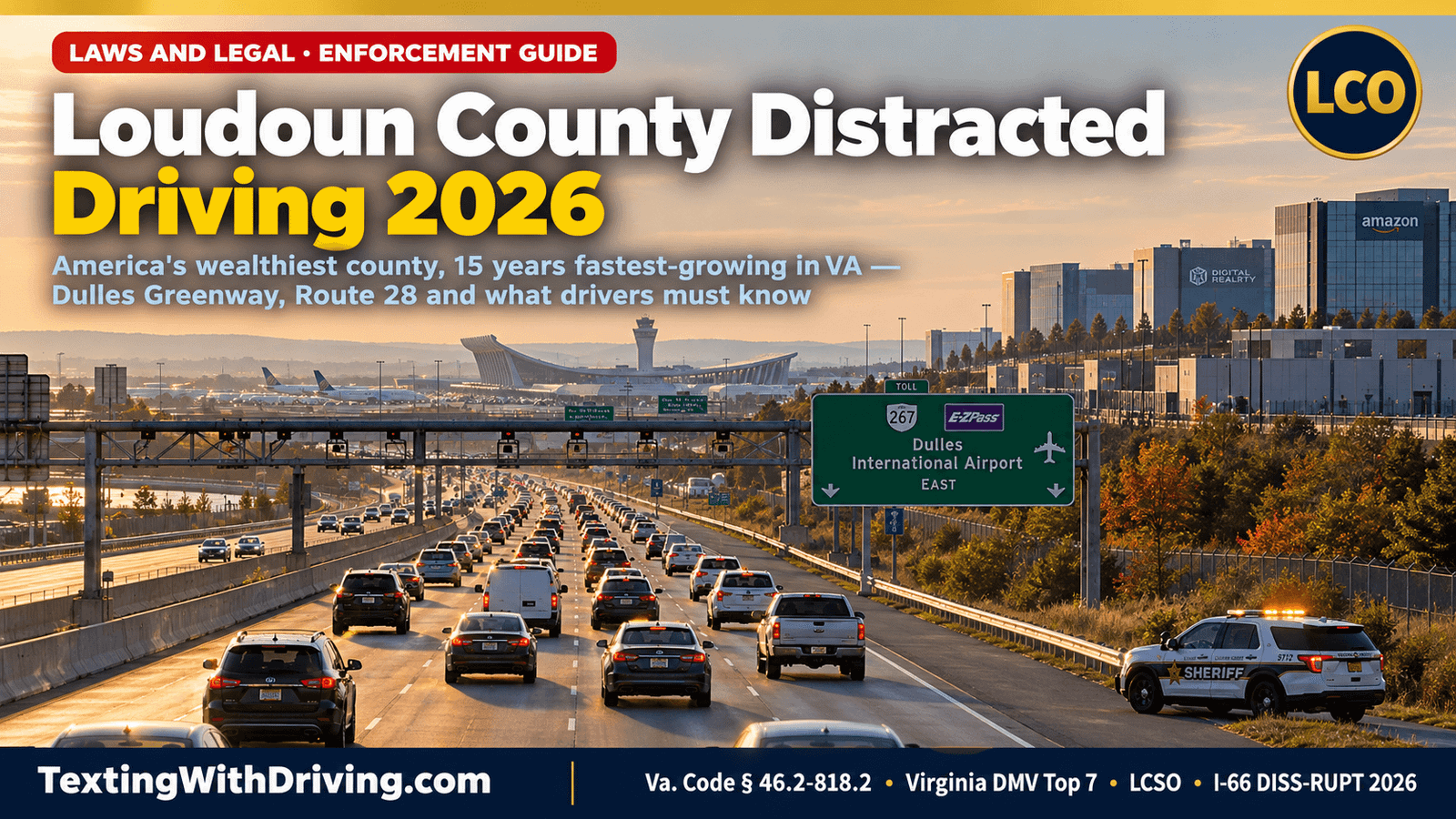
Loudoun County Distracted Driving 2026: Dulles Corridor, Route 28 and Virginia’s Fastest-Growing County
Loudoun County distracted driving 2026 presents a paradox that is unique among all Virginia jurisdictions: the county is simultaneously America’s wealthiest by median household income, Virginia’s fastest-growing for 15 consecutive years, the host of the world’s largest concentration of data centers — and one of Virginia’s top seven most dangerous distracted driving counties, named explicitly by the Virginia DMV’s Highway Safety Office alongside Fairfax, Prince William, Henrico, Richmond, Norfolk, and Virginia Beach.
The connection between Loudoun’s extraordinary growth and prosperity and its top-seven distracted driving designation is not coincidental. It is structural. Loudoun County’s population exceeded 465,000 in 2025, growing 46 percent between 2010 and 2025. Its median household income exceeds $140,000 — more than twice the national median of $81,604. Its Data Center Alley hosts the world’s largest concentration of data centers, processing an estimated 70 percent of global internet traffic. Every one of these growth metrics corresponds to a road network that was not built for the population it now serves, a workforce that commutes primarily by personal vehicle, and a demographic profile — young, high-income, technology-connected professionals — that NHTSA’s behavioral data identifies as among the highest phone-use-while-driving risk groups.
We are definitely seeing frequent crash activity around our area. That assessment from Loudoun County Supervisor Matt Letourneau at a March 2026 traffic safety town hall in the Dulles South district captures the community reality behind the Virginia DMV’s data. The fastest-growing county in Virginia is also one of its most crash-concentrated.
This guide covers the complete Loudoun County distracted driving 2026 picture: what the Virginia DMV data shows about Loudoun’s crash concentration, Route 28’s 85,000-vehicle-per-day congestion, the Dulles Greenway and I-66 corridor enforcement, the LCSO’s enforcement framework, the Crosstrail Boulevard project addressing Loudoun’s most congested corridor, and what every Loudoun County resident, Dulles corridor commuter, and technology worker must know under Virginia Code § 46.2-818.2.
Why Loudoun Is in Virginia’s Top 7 Distracted Driving Counties
Loudoun County distracted driving 2026 in the Virginia DMV’s top-seven most dangerous distracted driving jurisdictions reflects several specific structural factors that distinguish Loudoun from the other six counties and cities on the list.
The technology workforce demographic. Loudoun County’s primary workforce is the technology and defense contracting sector — young, high-income, smartphone-native professionals employed by Amazon, Microsoft, IBM, and the hundreds of smaller technology companies that operate in and around Data Center Alley. As we documented in our distracted driving statistics 2026 article, the 21-35 age group is the Virginia DMV’s identified primary distracted driving demographic — the age group most frequently engaged in distracted driving crashes. Loudoun County’s technology workforce is overwhelmingly within this demographic range.
The commute structure. Loudoun County’s residential communities are largely in the northern and western portions of the county — Ashburn, Sterling, Leesburg, Brambleton, Lansdowne — while the employment centers are concentrated along the Route 28/Dulles Greenway/I-66 corridor in the eastern portion. This east-west commute dynamic produces high daily vehicle miles traveled per resident and extended time in the vehicle — both factors that correlate with higher phone interaction frequency during driving. A commuter who drives 25 miles each way, twice per day, on the Dulles Greenway has significantly more opportunity to check their phone during a commute than a commuter with a five-mile drive.
The growth-infrastructure gap. Loudoun County’s population grew 46 percent between 2010 and 2025. Its road network did not grow proportionally. The result is chronic congestion on the corridors that serve the most-traveled commute routes — Route 28, the Dulles Greenway, and Route 7 — that produces the stop-and-go traffic rhythm where phone-checking behavior is highest and where the Virginia DMV’s distracted driving crash data concentrates.
The Data Center Alley truck traffic. The data centers of Loudoun County’s eastern corridor require continuous equipment delivery, construction support, and service vehicle access. The commercial vehicle traffic on Route 28 and the adjacent county roads — mixing with high-speed tech worker commuter traffic — creates the vehicle-type diversity and speed differential that makes the Dulles corridor specifically crash-prone.
Route 28: 85,000 Vehicles Per Day
Loudoun County distracted driving 2026 has its highest-concentration crash corridor on Route 28 — Loudoun County Parkway, running north-south through the heart of the county’s data center district.
Route 28 carries approximately 85,000 vehicles per day through its busiest segment near the Dulles Greenway interchange. That volume — 85,000 vehicles on a single county parkway — exceeds many Virginia interstate segments in daily traffic count. The specific congestion that this volume produces on a road designed for far lower traffic counts creates the stop-and-go driving pattern that VTTI’s naturalistic driving research documented as producing the highest phone-interaction frequency of any driving environment.
Drivers currently use Route 7 to travel between Leesburg and the Dulles Greenway because Route 28 is too congested. The congestion on Route 28 is so severe that it has redirected traffic to Route 7 — creating the secondary congestion on Route 7 that residents of western Loudoun experience daily. A road network under this much pressure from population growth that has outpaced infrastructure development is a network where driver frustration, phone-checking during stopped traffic, and the specific distracted driving crash pattern of rear-end collisions in congested conditions are the expected outcomes.
The March 2026 traffic safety town hall in the Dulles South district — where residents raised concerns about reckless driving and specifically asked for more enforcement — is the community expression of what the VMD data shows statistically. Residents experiencing frequent crash activity around our area are experiencing the specific intersection of 85,000 vehicles per day on Route 28, a high-speed technology workforce demographic, and the insufficient enforcement density relative to the violation volume that primary enforcement laws require to fully deter.
The Dulles South district town hall also highlighted specific enforcement data from Loudoun County Sheriff’s Office Dulles South station commander Robert Brown, who walked participants through traffic enforcement strategies and statistics. The LCSO’s role in Loudoun traffic enforcement — as the primary county law enforcement agency distinct from Virginia State Police’s interstate authority — covers Route 28, Route 7, the Dulles Greenway’s county-maintained access roads, and the county’s extensive local road network.
The Dulles Greenway and I-66: Loudoun’s Interstate Corridors
Loudoun County distracted driving 2026 has specific interstate coverage through two of Northern Virginia’s most significant highway corridors.
The Dulles Greenway (Route 267) is the primary highway connection between Loudoun County’s residential communities and Dulles International Airport and the Dulles Toll Road/I-66 interchange at the Fairfax County line. The Greenway is a privately owned toll road — operated under a Virginia state franchise — carrying Loudoun commuters eastbound to jobs in Tysons, Reston, Falls Church, and DC and westbound to Leesburg and the growing communities of western Loudoun. The E-ZPass overhead gantry collection system on the Greenway eliminates the stop-and-go of cash toll plazas — but it also creates the specific driver attention demand of confirming E-ZPass account status via phone during approach to gantry points.
Interstate 66 enters Loudoun County from Fairfax County at the eastern boundary near Centreville and runs through the northern edge of the county toward the I-66/Route 15 interchange near Haymarket. The I-66 corridor through Loudoun is the western extension of the same highway that carries the highest-volume Northern Virginia commuter traffic and that was the subject of Operation DISS-RUPT’s August 22-24, 2026 enforcement deployment.
During that August 22-24 I-66 DISS-RUPT deployment covering all 76 miles of I-66 — including the Loudoun County section from the Fairfax County line to the Route 15 interchange — Virginia State Police cited 53 drivers for distracted driving in two days. The 53 distracted driving citations from a two-day enforcement window on 76 miles of I-66 establish that primary enforcement contacts are being made on the specific interstate corridor serving Loudoun County commuters.
Preliminary data from January 1, 2026 to August 15, 2026, shows 443 persons have died in traffic crashes on Virginia roadways, compared to 499 during the same period in 2025 — a continuing improvement in Virginia’s overall 2026 trajectory. The I-66 DISS-RUPT enforcement that covers Loudoun County’s section of I-66 is a specific contributor to this improvement trajectory.
The Crosstrail Boulevard Project: Addressing the Route 28 Crisis
Loudoun County distracted driving 2026 is directly addressed by the most significant road infrastructure investment in the county’s recent history: Crosstrail Boulevard — a new four-lane divided arterial connecting Sycolin Road near Leesburg to the Dulles Greenway (Route 267).
Crosstrail Boulevard is a new four-lane divided arterial road in Loudoun County that will connect Sycolin Road near Leesburg to the Dulles Greenway. The project addresses a fundamental gap in the county’s road network: the lack of a direct north-south arterial connecting the Leesburg area to the Dulles Greenway without forcing drivers through the chronically congested Route 28 corridor.
The Crosstrail Boulevard groundbreaking in 2026 begins the construction period during which the new road will be built. During construction, the adjacent roads will carry the construction traffic as well as the commuter traffic that Crosstrail is designed to ultimately relieve. Construction zones along the Crosstrail Boulevard corridor carry the mandatory $250 Virginia distracted driving fine — the enhanced work zone fine that applies when workers are present and warning signs are posted, as documented in our distracted driving work zones 2026 article.
When complete, Crosstrail Boulevard will provide a direct north-south routing option that reduces the Route 28 congestion that currently forces 85,000 vehicles per day through the data center district interchange. The traffic relief that Crosstrail provides will reduce the stop-and-go congestion on Route 28 that currently creates the specific driving environment where phone-checking behavior is highest and distracted driving crashes are most frequent.
Data Center Alley: The Infrastructure Behind Loudoun’s Crash Risk
Loudoun County distracted driving 2026 has a specific economic geography that makes it unlike any other Virginia county in terms of the workforce characteristics that drive its distracted driving risk.
Loudoun County hosts the world’s largest concentration of data centers, earning the region the nickname “Data Center Alley.” These facilities process an estimated 70 percent of global internet traffic, generating billions in economic activity and making Loudoun one of the wealthiest counties in America by median household income. Companies including Amazon, Microsoft, and IBM have a strong presence in Loudoun County, with major facilities and data centers.
The data center workforce — highly compensated technology professionals who manage the physical infrastructure of the internet itself — represents the specific demographic intersection of high income, high smartphone dependency, and the 21-35 age range that Virginia DMV identifies as the primary distracted driving demographic. A data center operations engineer commuting to a Ashburn data center facility on Route 28 at 7 AM is within the specific age, income, and technology-connectivity profile that makes them statistically among the most likely Virginia drivers to be using their phone during the commute.
The data center commute pattern has a specific rush-hour geography: because data centers operate 24 hours per day with shift-based staffing, the Route 28 and Dulles Greenway corridors carry data center commuter traffic across all hours of the day — not just the standard morning and afternoon peaks. The 3 AM data center shift change that sends workers onto Route 28 in the middle of the night is a specific enforcement gap for standard daytime enforcement calendars — and a specific high-risk window where fatigued workers and low-light conditions compound the phone distraction risk.
The Leesburg and Western Loudoun Dimension
Loudoun County distracted driving 2026 extends beyond the eastern data center corridor into the county’s western and northern communities — Leesburg, Purcellville, Lovettsville, Round Hill, and the Blue Ridge foliage corridors of Route 7 and Route 15.
Leesburg — Loudoun County’s county seat, with approximately 60,000 residents — sits at the junction of Route 7, Route 15, and the Dulles Greenway’s western terminus. The commercial district of downtown Leesburg, the King Street corridor, and the intersection-dense Route 7/Route 15 interchange create the urban surface road distracted driving environment within a county that is primarily known for its highway corridors.
Route 7 westbound from Leesburg toward Purcellville and Berryville traverses the rolling horse country and vineyard landscape of western Loudoun — and as we documented in our Virginia fall driving safety distracted driving 2026 article, this is one of October’s primary fall foliage corridors, drawing weekend visitors from DC and Northern Virginia through a road environment where deer crossings, wet leaves, and the visual distraction of foliage create the October compound risk.
Route 15 south from Leesburg to Haymarket — running through the Loudoun Valley through Point of Rocks and Waterford — is the western Loudoun connection to I-66 and the Route 28 corridor. The Route 15/I-66 interchange at Haymarket is a specific LCSO enforcement location where commuters from the western Loudoun communities enter the high-speed I-66 express lane network.
The LCSO Enforcement Framework
Loudoun County distracted driving 2026 enforcement is carried out by the Loudoun County Sheriff’s Office — the primary law enforcement agency for traffic enforcement on county-maintained roads throughout Loudoun.
The LCSO’s traffic enforcement approach, described by Dulles South station commander Robert Brown at the March 2026 town hall, includes the standard primary enforcement authority under Virginia Code § 46.2-818.2 that allows any LCSO deputy to stop any driver observed holding a personal communications device on any county road. The Intersection Improvement Program that the county is implementing — upgrading signal timing and intersection geometry at key crash-concentration nodes — complements LCSO enforcement by reducing the engineering contribution to crash risk at specific intersections.
Personally, I’d like to see some more enforcement. That resident request from the Dulles South town hall — expressing frustration with the current enforcement density relative to the perceived violation volume — captures the gap between primary enforcement authority (which every LCSO deputy has) and the enforcement density required to produce the sustained behavioral deterrence that changes driving patterns across 85,000 daily Route 28 commuters. Road Shark in Fairfax County addresses this gap through dedicated traffic enforcement unit deployment. Loudoun County’s equivalent investment in dedicated traffic enforcement resources is a continuing community priority.
Virginia State Police’s Operation DISS-RUPT covers I-66 and the Dulles Greenway’s connection to I-66 — the interstate corridors where VSP has primary jurisdiction. LCSO covers the county road network. Together they create the enforcement infrastructure that applies Virginia Code § 46.2-818.2 across Loudoun County’s full road network.
The I-66 Express Lane Distraction Dynamic
Loudoun County distracted driving 2026 has a specific toll road distraction dimension that the Dulles Greenway and I-66 Express Lane networks create.
The I-66 Insider Express Lanes — which extend from the DC boundary to Route 243 (Nutley Street) in Fairfax County, with future extension planned — carry a subset of I-66 commuters who have paid the variable toll for the managed lane access. Loudoun County commuters using the I-66 Express Lane tolling system manage their toll accounts through smartphones and receive notifications about toll amounts, E-ZPass account balance, and express lane access eligibility in real time during commutes.
The specific phone interaction that toll lane management generates — checking E-ZPass account balances, reviewing toll rate notifications during peak-priced periods, responding to low-balance alerts — is a primary offense under Virginia Code § 46.2-818.2 if conducted on a held phone while the vehicle is moving. The irony is specific: a driver paying a premium toll to use a managed lane for a faster, more efficient commute is creating the primary enforcement violation risk if they check their toll account on their phone during the commute.
The Amazon HQ2 and Technology Corridor Connection
Loudoun County distracted driving 2026 has a specific technology corridor connection to the Amazon HQ2 build-out documented in our Alexandria Virginia distracted driving 2026 article. Amazon employees who live in Loudoun County — in the Ashburn, Sterling, and Brambleton communities closest to Dulles — commute south on the Dulles Greenway and south along Route 28 to the I-395 corridor toward Amazon’s Pentagon City headquarters.
Amazon Web Services’ primary data center operations are in Loudoun County’s Data Center Alley — meaning that the Loudoun County technology workforce includes both the employees who commute out of the county to HQ2 in Arlington and the AWS operations workforce that commutes within Loudoun to the data center facilities. Both segments of this workforce operate within the specific age and technology-connectivity demographic that produces Loudoun’s top-seven distracted driving designation.
The Amazon delivery driver population also operates extensively in Loudoun County — delivering to the dense residential communities of Ashburn, Sterling, and eastern Loudoun. As we documented in our Virginia rideshare distracted driving 2026 article, delivery drivers face the highest per-trip app management distraction risk of any driving category. Amazon Flex drivers delivering in Loudoun County on Route 7 and the residential streets of Ashburn are subject to the same Virginia Code § 46.2-818.2 primary enforcement as every other driver.
What Every Loudoun County Driver Must Know in 2026
Loudoun County distracted driving 2026 creates specific compliance obligations for Loudoun’s residents, commuters, and technology workforce.
Virginia Code § 46.2-818.2 applies on Route 28 at 85,000 vehicles per day. The congestion that makes Route 28 the most frustrating road in Loudoun County is the same congestion that creates the highest-frequency phone-checking impulse. Stop-and-go traffic on Route 28 at the Dulles Greenway interchange is not a legal window for phone use — it is a primary offense location where every LCSO deputy has stop authority.
Crosstrail Boulevard construction zones carry $250 mandatory fines. The Crosstrail Boulevard groundbreaking in 2026 begins a multi-year construction period. Any Route 28 area distracted driving violation in an active construction zone carries $250 mandatory fine rather than $125. Workers adjacent to the construction corridor are the specific vulnerability this enhanced fine is designed to protect.
I-66 through Loudoun County had 53 distracted driving citations in two days during DISS-RUPT. The August 22-24 deployment was not a theoretical enforcement warning. It produced real citations. Future DISS-RUPT deployments will produce real citations again. The I-66 section from Centreville through the Loudoun County portion to Route 15 near Haymarket is within the 76-mile I-66 DISS-RUPT coverage area.
The technology worker demographic is the Virginia DMV’s primary distracted driving risk group. Loudoun County’s 21-35 technology workforce is the Virginia DMV’s most frequently engaged distracted driving demographic. The county that produces 70 percent of global internet traffic employs tens of thousands of workers in the specific age range that Virginia’s own crash data shows is most likely to be distracted while driving. That statistical reality changes nothing about the law — it simply makes clear that the law’s primary target demographic commutes on Route 28 every morning.
Residents seeking more enforcement should report violations. The Dulles South town hall’s resident request for more enforcement reflects a community priority that individual drivers can contribute to through the *77 Virginia State Police reporting system on interstates, and through direct LCSO contact for county road violations. A driver who observes a Route 28 commuter holding a phone at the Dulles Greenway interchange can report the vehicle to LCSO.
For the complete Virginia law that applies on every Loudoun County road, our Virginia distracted driving law covers Va. Code § 46.2-818.2. For the I-66 corridor context from Loudoun through Fairfax County toward DC, our Northern Virginia distracted driving guide covers the full I-66 picture. For the Operation DISS-RUPT data that documented 53 I-66 distracted driving citations in two days, our Virginia distracted driving September 2026 article covers the complete DISS-RUPT calendar. And for the technology setup that makes Virginia compliance automatic on the Dulles Greenway, Route 28, and every Loudoun County road, our hands-free while driving complete setup guide covers iPhone, Android, Bluetooth, and CarPlay.
Sources Used in This Article
All links verified working before publication.
Virginia DMV: Distracted Driving Toolkit — Loudoun County named top 7 highest distracted driving crash jurisdictions Virginia, ages 21-35 most frequent demographic distracted driving crashes
Foxes Sell Faster: Crosstrail Boulevard Loudoun County Groundbreaking 2026 — Population exceeded 420,000 residents 2025 fastest-growing county Virginia 15 consecutive years, Route 28 carries approximately 85,000 vehicles per day busiest segment Dulles Greenway interchange, Data Center Alley world’s largest concentration data centers 70% global internet traffic, Crosstrail Boulevard new 4-lane divided arterial Sycolin Road to Dulles Greenway, Route 28 too congested drivers use Route 7 instead, 2026
Loudoun County Fiscal Trends PDF — Population 465,884 2025, 2026 forecast 461,312, grew 46% between 2010 and 2025, fastest-growing county nation since late period, median household income among highest nation, more than twice national median $81,604 nearly twice Virginia’s median $92,090, February 2026
Best of Loudoun 2026 Highlights — Growing population over 420,000, median household income over $140,000, Amazon Microsoft IBM strong presence data centers, Dulles Tech Corridor proximity Washington DC Dulles International Airport, technology industry thriving cloud computing cybersecurity, 2026
Loudoun Times: Traffic Safety Town Hall Dulles District — Supervisor Letourneau frequent crash activity area quote, LCSO Dulles South station commander Robert Brown traffic enforcement strategies statistics, resident Caluori more enforcement quote, Intersection Improvement program sidewalks streetlight installation, March 2026
FFXNow: Virginia State Police DISS-RUPT I-66 — 53 distracted driving citations 53 reckless 66 speeding February I-66 DISS-RUPT, August 22-24 2026 all 76 miles I-66 Fairfax and Culpeper divisions, 443 deaths January to August 15 2026 vs 499 same period 2025, Virginia hands-free law prohibits holding personal communications device
NHTSA: Distracted Driving — 3,208 deaths 2024, national context
TextingWithDriving.com is professionally built and maintained to ensure accurate, accessible safety information reaches every driver who needs it. Website development and ongoing support is handled by Budgetic, a digital agency specializing in purpose-driven WordPress websites.
