

Texas Hands-Free Driving Law 2026: Did SB 47 Finally Become Law?

Texas Hands-Free Driving Law 2026: Did SB 47 Finally Become Law?
The short answer is no.
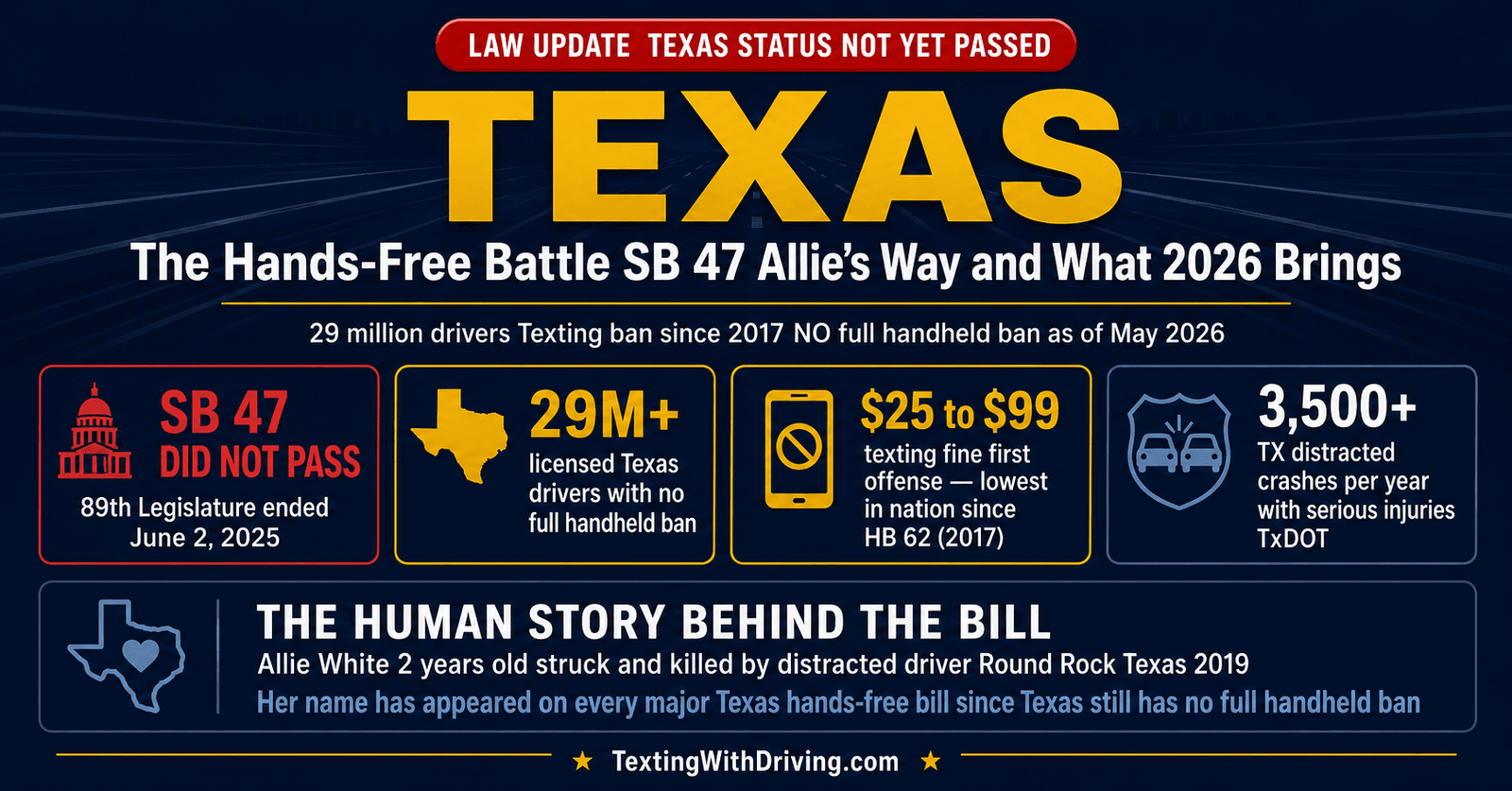
As of mid-2026, Texas remains without a comprehensive hands-free driving law. Despite multiple legislative attempts over several sessions, despite strong polling support from Texas drivers, despite advocacy from AAA Texas, distracted driving victims, and safety researchers, the 89th Texas Legislature ended on June 2, 2025 without passing SB 47 or any equivalent full handheld device ban.
That means 29 million Texas drivers continue operating under a texting-only ban with fines starting at $25, no restriction on holding a phone to make calls or use apps, and no primary enforcement authority for police to stop a vehicle solely for phone use.
This article covers what the current Texas law actually says, the history of how SB 47 came to be and why it keeps failing, the human story behind the bill’s name, and what Texas drivers need to know right now.
What Texas Law Currently Says About Phone Use While Driving
Texas has had a texting ban since September 1, 2017, when Governor Greg Abbott signed House Bill 62 into law. At the time, it made Texas the 47th state to ban texting while driving.
Governor Greg Abbott announced on June 6, 2017, that he signed House Bill 62 into law, making Texas the 47th state to officially ban the dangerous practice of texting while driving. Beginning September 1, 2017, texting while driving within the state of Texas became punishable by a fine of $25 to $99 for first-time offenders and $100 to $200 for repeat offenders, though no points are assigned to the license. The law states that if an accident caused by texting and driving results in the death or serious bodily injury of another person, the driver can be charged with a Class A misdemeanor punishable by a fine up to $4,000 and up to one year in jail. AgencyAnalytics
That $25 to $99 first-offense fine is one of the lowest in the country. For comparison, Alaska’s first-offense fine can reach $10,000. California’s starts at $162. Pennsylvania’s Paul Miller’s Law, which we covered in our Pennsylvania distracted driving law 2026 guide, starts at $50 but carries an additional five-year prison enhancement for violations causing a fatality. Texas’s fine structure barely registers as a financial deterrent.
The Texas texting law only addresses reading, writing, or sending electronic messages via a wireless communication device. It is still legal for motorists in most Texas cities to use their phone held to their ear for voice calls, to hold the phone while using navigation, or to interact with apps while driving, unless a city has passed its own stricter local ordinance. AgencyAnalytics
This is the legal gap that hands-free advocates have been trying to close. The texting ban prohibits a specific behavior with a narrow definition. A driver holding their phone to make a voice call, holding it to adjust music, holding it to check a navigation map, or holding it to scroll social media is not violating Texas state law in 2026. Only the specific act of reading, writing, or sending an electronic message is restricted.
The Texas Department of Public Safety has indicated it may pursue stricter enforcement and potential penalty enhancements for distracted driving, particularly for repeat offenses. However, without legislative action, DPS cannot create new legal restrictions beyond what the Legislature has authorized. SearchAtlas
The Story Behind the Bill’s Name: Allie White
Every major Texas hands-free bill of the past several years carries the name Allie’s Way. Understanding why matters for understanding the bill’s significance.
The Allie’s Way Act is named for two-year-old Allie White, who was struck and killed by a distracted driver in Round Rock, Texas, in 2019. Representatives for AAA Texas, high school teens, and distracted driving victims rallied at the Texas State Capitol in support of the bill. AAA Texas spokesperson Kara Thorp stated the organization encourages all Texans to contact their local legislators in support of the legislation, calling it time to stop the unnecessary and completely preventable death and injury caused by distracted driving.
Allie White was two years old. She was not in a vehicle. She was killed because a driver was looking at a phone instead of the road. Her name has appeared in Texas legislative chambers in bill after bill as advocates push for a law that would prevent others from dying the same way.
The persistence of advocacy organizations in attaching her name to legislation reflects a strategy that has worked in other states. Missouri’s Siddens Bening Hands-Free Law, which we covered in our Missouri hands-free driving law 2026 guide, is named for two Missouri residents killed by distracted drivers. Pennsylvania’s Paul Miller’s Law bears the name of a 21-year-old killed by a distracted commercial truck driver. Named bills create a human accountability that anonymous legislation does not. Texas’s advocates have used the same approach. The law just has not passed.
The Legislative History: Why SB 47 Kept Failing
Texas has an unusual legislative structure that makes passing bills of this type more difficult than in most states. The Legislature meets for only 140 days every two years, creating a narrow window in which all legislation must advance or die. Bills that pass one chamber but fail to advance in the other before the session ends must be reintroduced entirely in the next session.
Senate Bill 47, supported by Senator Judith Zaffirini, would expand the existing texting ban into a broader hands-free law, allowing phone usage only through voice or mounted systems. SB 47 gained media attention and moved through committees during the 2025 legislative session. The bill would include primary enforcement, meaning handheld use alone justifies a traffic stop, and emergency call exceptions allowing 911 use when hands-free is not possible. Cmtelematics
The bill had Senate support. It had committee momentum. It had public polling behind it. Multiple surveys of Texas drivers have consistently shown majority support for a comprehensive hands-free law. And it had the named advocacy of Allie White’s family and major organizations including AAA Texas.
Texas lawmakers filed thousands of bills during the 2025 legislative session. However, most of those bills did not become law. Lawmakers spent the final weeks before the session ended on June 2 trying to push through their priorities, with bills either being approved by both chambers and sent to the governor, or failing to advance through procedural delays and missed deadlines. Morris Bart and Associates
SB 47 was not among the laws signed during the 89th Legislature’s regular session, which ended June 2, 2025. The 89th Texas Legislature’s special sessions focused on abortion medication, restroom policies, education testing, and other specific issues called by Governor Abbott. Distracted driving legislation was not included in the special session agenda. Wikipedia
The next regular legislative session will be in 2027. Until then, Texas law will remain what it has been since 2017 unless a special session is called specifically to address this issue, which is not currently indicated.
Why Texas’s House Has Repeatedly Blocked the Bill
The pattern in Texas’s hands-free bill history is consistent. The Senate, which is the more institutionally conservative chamber, has passed versions of a hands-free bill. The House has been where the legislation stalls.
The opposition in the Texas House has historically centered on two arguments. The first is a libertarian concern about government overreach into individual behavior and personal vehicle use. Texas has a strong political culture of skepticism toward new regulatory requirements, and a bill telling Texans specifically how they must use their phones in their own vehicles encounters genuine ideological resistance that does not exist in most other states.
The second concern is about enforcement disparity. Some Texas House members have raised questions about whether hands-free enforcement would be applied inequitably across different communities, particularly in communities of color where other traffic enforcement disparities are well documented. This concern has some validity and has been addressed in other states through mandatory data collection provisions, like the ones included in Pennsylvania’s Paul Miller’s Law.
Neither concern has produced a legislative compromise that advances the bill fully through both chambers.
What Research Shows About What Texas Is Missing
The consequences of not having a comprehensive hands-free law are not theoretical.
Research suggests that laws banning handheld device use reduce driver distraction. Colorado saw a 19 percent drop in inattentive-driving crashes within five months of its hands-free law, which became effective January 1, 2025, according to the Colorado Department of Transportation. Data from New York show sustained reductions in handheld phone use after the initial law went into effect. Cmtelematics
Missouri saw a 7.8 percent reduction in distracted driving after its Siddens Bening Hands-Free Law took effect, as we documented in our Missouri hands-free driving law 2026 guide. Iowa saw a 3.9 percent drop in phone distraction within the first month after its hands-free law passed in July 2025. Ohio, Alabama, and Michigan all showed measurable improvement after enacting hands-free legislation.
Texas crash data reveals what the absence of such a law produces. In 2016 alone, there were 109,658 traffic crashes in Texas involving distracted driving, leading to over 3,000 serious injuries and at least 455 fatalities. The sobering truth is that texting while driving makes a crash 23 times more likely to occur. AgencyAnalytics
Since 2016, both Texas’s population and its smartphone adoption rates have grown substantially. The scale of the distracted driving problem on Texas roads has grown with them.
The Patchwork Problem: Local Ordinances vs. State Law
One of the less-understood aspects of Texas’s legal landscape on this issue is the role of local ordinances.
At least 45 Texas cities have enacted their own hands-free ordinances that go beyond state law. Dallas, Austin, San Antonio, and other major cities have passed local rules that restrict handheld phone use more comprehensively than state law requires. AgencyAnalytics
This creates a genuine compliance challenge for Texas drivers. A driver who is legally using their phone while driving through a rural area of Texas may be violating a city ordinance the moment they enter Houston, San Antonio, or Austin. The rules change at city limits. And unlike state laws, which are broadly publicized when they pass, local ordinances vary significantly in how well they are communicated to the general public.
This patchwork problem is one of the most practical arguments for a statewide law. When the rule is the same everywhere in the state, every Texas driver knows what is required regardless of which city they are passing through. The inconsistency of 45 different city ordinances with 45 different enforcement approaches is not a functional safety system.
As of mid-2025, 30 states and DC enforce laws prohibiting the handling of devices while driving, with 19 states remaining without full coverage. Texting is illegal in nearly every state. Texas remains among the states without a full handheld ban despite ongoing legislative efforts. Cmtelematics
What Texas Drivers Should Do Right Now
In the absence of a comprehensive state law, Texas drivers are not without practical options for keeping themselves and others safe.
The behavioral and technology tools are the same regardless of what the law requires. Placing your phone in the back seat before driving removes the physical temptation entirely. Activating Driving Focus on iPhone or Android’s driving mode silences notifications before they arrive. Using your vehicle’s Bluetooth system for calls keeps your hands on the wheel. Our step-by-step guide to setting up Do Not Disturb While Driving on iPhone and Android covers all of this in under two minutes of setup time.
If you drive in any of the 45-plus Texas cities with their own hands-free ordinances, you are subject to those rules regardless of state law. Check whether your city has a hands-free ordinance at your local city government website. The consequences of an ordinance violation depend on the city but typically include fines and in some cases misdemeanor charges.
For teen drivers specifically in Texas, the law does include an all-driver provision for novice drivers. Texas’s Graduated Driver Licensing program restricts teen drivers from using any handheld device while driving, which is a stricter standard than what applies to adult drivers. For the full discussion of teen driver distracted driving risk and the parent conversations that actually change behavior, see our parent’s guide to talking to your teen about phone use while driving and our overview of why teen drivers are the most at-risk group.
What the National Picture Shows About Where Texas Stands
As of mid-2025, 31 jurisdictions have full-time handheld bans, including 30 states plus the District of Columbia. This number has grown from 29 states in 2022 with the most recent additions being states like Pennsylvania and Iowa. Texas is among the 19 states without a complete handheld prohibition. Cmtelematics
Pennsylvania passed Paul Miller’s Law. Iowa passed its hands-free law in July 2025. Missouri passed Siddens Bening in 2023. The legislative momentum across the country is unmistakably in one direction. The question for Texas is not whether a comprehensive hands-free law is likely to eventually pass. The question is how many more sessions it takes and how many more crashes happen in the meantime.
For a full comparison of where Texas stands relative to every other state in the country on phone use restrictions, fine structures, and enforcement types, see our hands-free driving laws by state 2026 guide. For the national death toll that provides context for why these laws matter, see our distracted driving statistics 2026 overview.
What Comes Next for the Legislation
The 90th Texas Legislature will convene in January 2027. A version of the Allie’s Way Act is expected to be reintroduced, as it has been in multiple consecutive sessions. The political environment in 2027 will depend significantly on the November 2026 elections and any shifts in the composition of the Texas House.
Advocacy organizations including AAA Texas, Families for Safe Streets, and distracted driving victim advocacy groups have stated their intention to continue pushing for the legislation. The bill’s Senate support has been relatively consistent. The challenge remains the House.
For Texas drivers and advocates who want to support a comprehensive hands-free law, the most effective actions are direct contact with Texas House members, particularly those on the Transportation Committee, and participation in AAA Texas advocacy campaigns at aaa.com/texas which tracks the bill’s progress and provides advocacy tools.
Allie White was two years old. She should be seven now. Her name on a bill that cannot get through the Texas House is not an abstraction. It is an accounting of a specific preventable failure that repeats itself on Texas roads every day the law does not exist.
Sources Used in This Article
All links verified working before publication.
KVUE Austin: Distracted Driving Victims and AAA Texas Advocate for Hands-Free Bill — Allie’s Way Act rally coverage
Versus Texas: New Texas Laws 2025 Legislative Update — 89th Legislature summary of what passed and failed, September 2025
Texas Tribune: Texas Legislature Ends Session 2025 — June 2, 2025 session end coverage
Texas Tribune: 2025 Texas Bill Tracker — Official bill status tracking
Rasansky McKenzie Law: Texting and Driving Laws in Texas 2026 — Current Texas law detail including HB 62 history, October 2025
DrivingQuest: Texas Driving Laws 2026 — 2026 Texas driver law changes, December 2025
Scott Vicknair Injury Lawyers: Which States Have Hands-Free Driving Laws — State comparison including SB 47 movement, June 2025
GHSA: Distracted Driving State Laws — Governors Highway Safety Association national state law reference
Consumer Shield: Texas Driving Laws 2026 — February 2026 Texas law overview
NHTSA: Distracted Driving — National data context
AAA Texas: Traffic Safety Resources — AAA Texas advocacy and safety information
TextingWithDriving.com is professionally built and maintained to ensure accurate, accessible safety information reaches every driver who needs it. Website development and ongoing support is handled by Budgetic, a digital agency specializing in purpose-driven WordPress websites.

About Texting With Driving
TextingWithDriving.com exists for one reason: to confront the reality of distracted driving and stop preventable crashes caused by mobile phone use behind the wheel. Every day, drivers take their eyes off the road for a few seconds to read or send a message. Those few seconds are enough to cause life-altering consequences. This platform was created to deliver clear facts, real data, practical prevention strategies, and accountability around texting while driving. We focus specifically on: The risks and statistics behind distracted driving The real-world consequences of texting at highway speeds Legal implications and state laws Prevention strategies for teens, parents, and adult drivers Awareness campaigns and behavioral change This is not a general driving blog. It is a focused awareness initiative built around one critical issue: phone distraction behind the wheel. Our content is direct, research-driven, and practical. We prioritize accuracy over opinion and education over sensationalism. The goal is simple — reduce distracted driving incidents by increasing awareness and responsibility. If one article causes one driver to put their phone down, the mission is working. For inquiries or partnerships, contact: privacy@textingwithdriving.com
View all posts by Texting With Driving