

Is Voice-to-Text Actually Safe While Driving? The Science Says No

Is Voice-to-Text Actually Safe While Driving? The Science Says No
Here is the belief most drivers hold confidently: using voice-to-text while driving is safe. Hands are on the wheel. Eyes are on the road. The phone is mounted or sitting on the seat. Nothing about the physical situation looks like distracted driving.
The research says otherwise. Definitively, repeatedly, and with a specificity that should change how every driver thinks about their voice-activated assistant.
The AAA Foundation for Traffic Safety, in a landmark series of studies conducted with researchers at the University of Utah, produced the most comprehensive measurement of cognitive distraction from in-vehicle technologies ever assembled. Their finding on voice-to-text is the most striking result in the entire dataset: voice-to-text is not the safest technology tested. It is the most dangerous. More distracting than a handheld phone call. More distracting than a hands-free phone call. More distracting than any other secondary task in their study.
This article explains what the research actually shows, why voice-to-text produces such high levels of cognitive impairment, what the 27-second finding means for drivers who use it, and what all of this tells us about the limits of hands-free legislation.
The AAA Foundation Research: What They Measured and How
The AAA Foundation for Traffic Safety partnered with researchers from the University of Utah to test the visual and cognitive demand created by in-vehicle technologies. Using cutting-edge methods for measuring brain activity and assessing indicators of driving performance, this research examines the mind of the driver and highlights the mental distractions caused by a variety of tasks that may be performed behind the wheel. NHTSA
The methodology went beyond self-reported survey data or simple reaction time tests. Researchers used instrumented vehicles with cameras tracking eye and head movement, EEG systems measuring brainwave activity to assess mental workload, driving simulators for controlled scenario testing, and real-world driving with external observers. This level of measurement rigor is what gives the findings their authority.
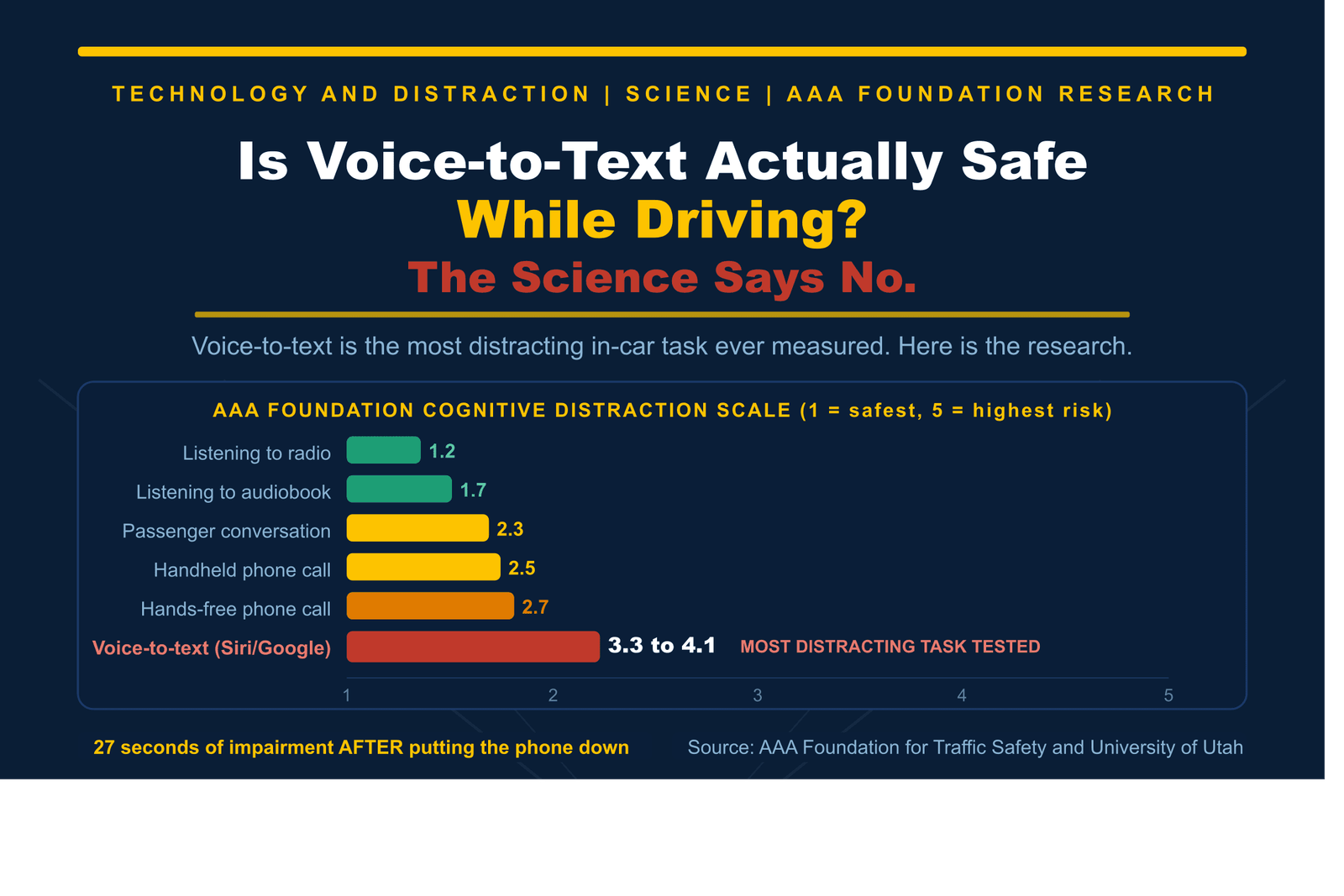
By creating a first-of-its-kind rating scale of driver distractions, the AAA Foundation study rated tasks from 1 (least distracting) to 5 (most distracting, equivalent to a highly challenging scientific test designed to overload driver attention). Listening to the radio scored approximately 1.2. Listening to an audiobook scored 1.7. Talking with a passenger scored 2.3. Making a handheld phone call scored 2.5. Making a hands-free phone call scored 2.7. Wikipedia
Up to this point, the results confirm what most people would expect: phone use creates more distraction than radio, handheld use creates slightly more distraction than hands-free. The differences are meaningful but not surprising.
Then comes the voice-to-text result.
Using the phones to send texts significantly increased the level of mental distraction. While sending voice-activated texts, Google Now rated as a category 3.3 distraction, while Apple Siri and Microsoft Cortana rated as category 3.7 and category 4.1 distractions respectively. Berkeley
Apple Siri at 3.7. Microsoft Cortana at 4.1. These are not marginal differences from a hands-free phone call at 2.7. Voice-to-text through Siri produces a cognitive distraction level 37 percent higher than a standard handheld phone call. Cortana produces distraction 52 percent higher than a handheld call, approaching the upper end of the scale.
The principal finding that driver use of in-vehicle speech-to-text technologies is the most distracting of the six tasks has important implications given the skyrocketing growth in voice-activated infotainment and other dashboard systems available to consumers. NHTSA
The most distracting of all tasks tested. Not among the most distracting. The most distracting.
Why Does Voice-to-Text Create More Distraction Than a Phone Call?
This is the question that surprises most people, because intuitively it does not make sense. A phone call requires the same voice-to-voice conversation as voice-to-text. Why would composing a message by voice be more cognitively demanding than having a conversation?
The answer lies in the specific cognitive processes involved.
During a phone conversation, you are listening and speaking naturally. The exchange follows the rhythms of normal conversation. Your brain has been doing this efficiently since childhood. The cognitive overhead is relatively low because the task is familiar and the format is forgiving. If you mishear something, the other person repeats it. If you take a moment to think, silence is socially acceptable.
Voice-to-text is a fundamentally different cognitive task. You are not having a conversation. You are composing written language by speaking it aloud. This requires you to hold the intended message in working memory, translate conversational thought into written sentence structure, monitor the system’s transcription for accuracy in real time, mentally preview the message for clarity and tone, and decide when the composition is complete and whether to send, edit, or discard it.
Each of these steps draws on working memory and executive function resources that are simultaneously needed for safe driving. The result is a much higher cognitive load than a conversation, even though both involve speaking aloud.
Increased mental workload and cognitive distractions can lead to a type of tunnel vision or inattention blindness where motorists do not see potential hazards right in front of them. The research finds that as mental workload and distractions increase, reaction time slows, brain function is compromised, drivers scan the road less and miss visual cues, potentially resulting in drivers not seeing items right in front of them including stop signs and pedestrians. Morris Bart and Associates
The phrase inattention blindness is worth pausing on. This is not a metaphor. Research on cognitive distraction shows that when mental resources are sufficiently consumed by a secondary task, the visual information from the road stops being processed even when the driver’s eyes are physically pointed at it. The eyes are open. The road is visible. But the brain is not registering it. Stop signs, pedestrians, and swerving vehicles in the driver’s field of view go unnoticed because the cognitive bandwidth to process what the eyes are seeing has been consumed elsewhere.
The 27-Second Problem: Why Putting the Phone Down Is Not Enough
This is the finding that most changes how people think about voice-to-text use at red lights or during traffic pauses.
Twenty-seven seconds of additional distraction after utilizing the voice-activated technology is significant. At the 25 mile per hour limit of the study, drivers travel the length of almost seven football fields. At 65 miles per hour it is half a mile. Even the least distracting systems, according to the study, result in more than 15 seconds of concentration after completing a task. NHTSA
After using voice-to-text, a driver’s cognitive engagement with the task does not immediately disappear when they put the phone down or stop speaking. The brain continues processing the completed task, holding the sent message in working memory, evaluating whether the response was what was intended, anticipating a reply. This cognitive tail extends up to 27 seconds after the voice interaction ends.
At 65 miles per hour, 27 seconds of residual cognitive impairment means the driver travels approximately half a mile of highway in a state of reduced hazard detection and slowed response time. The phone is down. The voice interaction is complete. The impairment is still active.
This explains why the common practice of using voice-to-text during a red light and then putting the phone away before the light changes does not produce the safety outcome drivers assume it does. The residual distraction carries well past the moment the interaction ends, into the first stretch of driving after the light turns green, when full cognitive engagement with the road is exactly what is needed.
We covered this 27-second residual effect in our article on the real danger of texting while driving, but the finding applies with equal or greater force to voice-to-text, which produces longer interaction durations and higher peak cognitive loads than a simple glance at a text.
How In-Vehicle Infotainment Systems Perform
The AAA Foundation’s follow-up research specifically tested the infotainment systems built into vehicles, not just smartphone voice assistants. The results revealed that these integrated systems, which manufacturers often market as the safer alternative to using a handheld phone, are not reliably safer.
The Chevrolet Equinox performed the best with a cognitive distraction rating of 2.4. The Mazda 6’s system required the most concentration, resulting in a rating of 4.6. Voice activated phone systems were worse at best but better at worst. While talking on the phone, the best system, Google Now, had a distraction rating of 3.0. Apple Siri earned a 3.4 and Microsoft Cortana had a 3.8. NHTSA
The range within a single product category is striking. The best in-vehicle infotainment system tested produced a distraction rating of 2.4, meaning it was roughly equivalent to a handheld phone call. The worst produced a rating of 4.6, approaching the maximum on the scale. Two vehicles in the same market segment, both marketed as featuring integrated hands-free safety technology, produced distraction outcomes nearly two full rating points apart.
This variation tells drivers something important: the presence of an in-vehicle voice system does not automatically mean you are safer than using a phone. The cognitive demand of any voice interface depends heavily on how well it works, how many interaction steps it requires, how accurately it transcribes, and how much working memory the driver must dedicate to navigating its error-recovery processes.
Based on the limits of working memory capacity, the number of items in any given menu should be limited to four or five. Ranking the systems according to interaction errors yields precisely the same ordering as when ranking by overall distraction score, and the correlation is statistically significant. Trafficsafetymarketing
That correlation between error rate and distraction score is important. When a voice system misunderstands a command, the driver must repeat it, correct it, or navigate a new interaction sequence. Each error adds cognitive load on top of the already substantial load of the original task. Systems with higher error rates produce higher distraction scores, which is why the least accurate voice systems are also the most dangerous.
What This Means for Hands-Free Laws
The hands-free laws that now exist in 33 states plus DC represent meaningful road safety progress. They restrict the specific behavior, holding a phone while driving, that research consistently associates with the highest rates of observed phone manipulation and the most severe distraction events. These laws are worth having and the crash data from states that have implemented them shows measurable improvement.
But the AAA Foundation research creates an important caveat that legislators, drivers, and road safety advocates should understand clearly.
These findings challenge prevailing public assumptions that hands-free devices are safer than their handheld counterparts. Hands-free technologies might make it easier for motorists to text, talk on the phone or even use Facebook while they drive, but the findings show dangerous mental distractions exist even when drivers keep their hands on the wheel and their eyes on the road. Gagemathers
A law that bans holding the phone creates a real safety improvement by eliminating the most severe and most common form of phone distraction: the combination of all three distraction types simultaneously as described in our article on the three types of distraction. But compliance with a hands-free law does not eliminate cognitive distraction. It reduces the total distraction profile from three simultaneous types to primarily one, which is a meaningful improvement but not an elimination of risk.
The driver who believes they are driving safely because they are using Siri through their car’s speakers rather than texting on a held phone is driving in a genuinely less dangerous way. But they are not driving without distraction. And at a cognitive distraction rating of 3.4 to 4.1, they are operating in a meaningfully impaired state that reduces their hazard response capability compared to fully attentive driving.
What the Research Recommends
Based on this research, AAA urges limiting use of voice-activated technology to core driving-related activities such as climate control, windshield wipers, and cruise control, and to ensure these applications do not lead to increased safety risk due to mental distraction while the car is moving. Morris Bart and Associates
The specific recommendation from AAA and the University of Utah researchers is to limit voice-activated technology to functions that are directly driving-related and that require minimal working memory engagement. Adjusting the climate control by voice, for example, requires a simple command and produces minimal cognitive load. Composing a text message by voice, managing a playlist by voice, or navigating a multi-step menu system by voice requires the kind of extended cognitive engagement that the research identifies as unsafe.
The practical implications for drivers are specific.
Use Driving Focus on iPhone or Android’s driving mode to silence incoming notifications before the drive begins. This eliminates the motivation to use voice-to-text in the first place by preventing the incoming messages that trigger the desire to respond. Our step-by-step setup guide is at how to set up Do Not Disturb While Driving.
If you must use voice navigation, set your destination before you start moving and let the system handle all guidance passively through audio directions, requiring no active interaction on your part during the drive.
For communication needs that feel urgent during a drive, the safest approach is still to pull over, park, and handle the interaction completely before returning to the road.
The Broader Lesson
Voice-to-text exists because engineers found a way to let drivers send messages without holding a phone. That is a genuine technological improvement over handheld texting. But the problem with texting while driving was never fundamentally about the physical act of holding a device. It was about the cognitive demand of composing a message while simultaneously navigating a vehicle.
Voice-to-text addresses the holding part. It does not address the composing part. And as the AAA Foundation research shows, the composing part is where the cognitive danger lives.
The safest position on this for any driver is the one the research consistently supports: no message composition while driving, regardless of the technology used. Navigation passively. Music passively. Climate control passively. Everything that requires active cognitive composition, including voice-to-text messages, reserved for when the vehicle is stopped and parked.
For the full picture of what cognitive distraction means physically, see our article on the three types of distraction. For how the national death toll relates to all of these findings, see our distracted driving statistics 2026 overview. And for the complete range of technology tools that make phone-free driving genuinely automatic, see our guide to the best apps to block texting while driving.
Hands-free is not risk-free. That is not a safety slogan. It is what the measurements show.
Sources Used in This Article
All links verified working before publication.
AAA Foundation: Measuring Cognitive Distraction in the Automobile — Original landmark study, University of Utah
AAA Foundation: Measuring Cognitive Distraction in the Automobile II — Follow-up study on in-vehicle voice systems
AAA Foundation: Cognitive Distraction Something to Think About — Technical report, Hamilton and Grabowski
University of Utah: Hands-Free Talking and Texting Are Unsafe — Dr. David Strayer original press release
ScienceDaily: Hands-Free Talking and Texting Are Unsafe for Drivers — Study summary with tunnel vision data
EurekAlert: Hands-Free Talking and Texting Are Unsafe — Research findings including email system distraction ratings
Oregon AAA: New Distracted Driving Research Hands-Free Not Risk-Free — AAA recommendations post-study
BestRide: Voice Activated Technology Distracting Even With Eyes on the Road — Distraction scale ratings by system including Siri Cortana Google Now
AAA Newsroom: In-Vehicle Infotainment Systems Most Distracting to Older Drivers — 2019 follow-up with 2018 vehicle infotainment testing
AAA Foundation: Research on Distracted Driving Overview — Full research library
NHTSA: Distracted Driving — National data context
GHSA: Distracted Driving State Laws — Hands-free law context
TextingWithDriving.com is professionally built and maintained to ensure accurate, accessible safety information reaches every driver who needs it. Website development and ongoing support is handled by Budgetic, a digital agency specializing in purpose-driven WordPress websites.

About Texting With Driving
TextingWithDriving.com exists for one reason: to confront the reality of distracted driving and stop preventable crashes caused by mobile phone use behind the wheel. Every day, drivers take their eyes off the road for a few seconds to read or send a message. Those few seconds are enough to cause life-altering consequences. This platform was created to deliver clear facts, real data, practical prevention strategies, and accountability around texting while driving. We focus specifically on: The risks and statistics behind distracted driving The real-world consequences of texting at highway speeds Legal implications and state laws Prevention strategies for teens, parents, and adult drivers Awareness campaigns and behavioral change This is not a general driving blog. It is a focused awareness initiative built around one critical issue: phone distraction behind the wheel. Our content is direct, research-driven, and practical. We prioritize accuracy over opinion and education over sensationalism. The goal is simple — reduce distracted driving incidents by increasing awareness and responsibility. If one article causes one driver to put their phone down, the mission is working. For inquiries or partnerships, contact: privacy@textingwithdriving.com
View all posts by Texting With Driving