

Virginia Distracted Driving and Pedestrians 2026: Richmond, Arlington and the Walking Crisis

Virginia Distracted Driving and Pedestrians 2026: Richmond, Arlington and the Walking Crisis
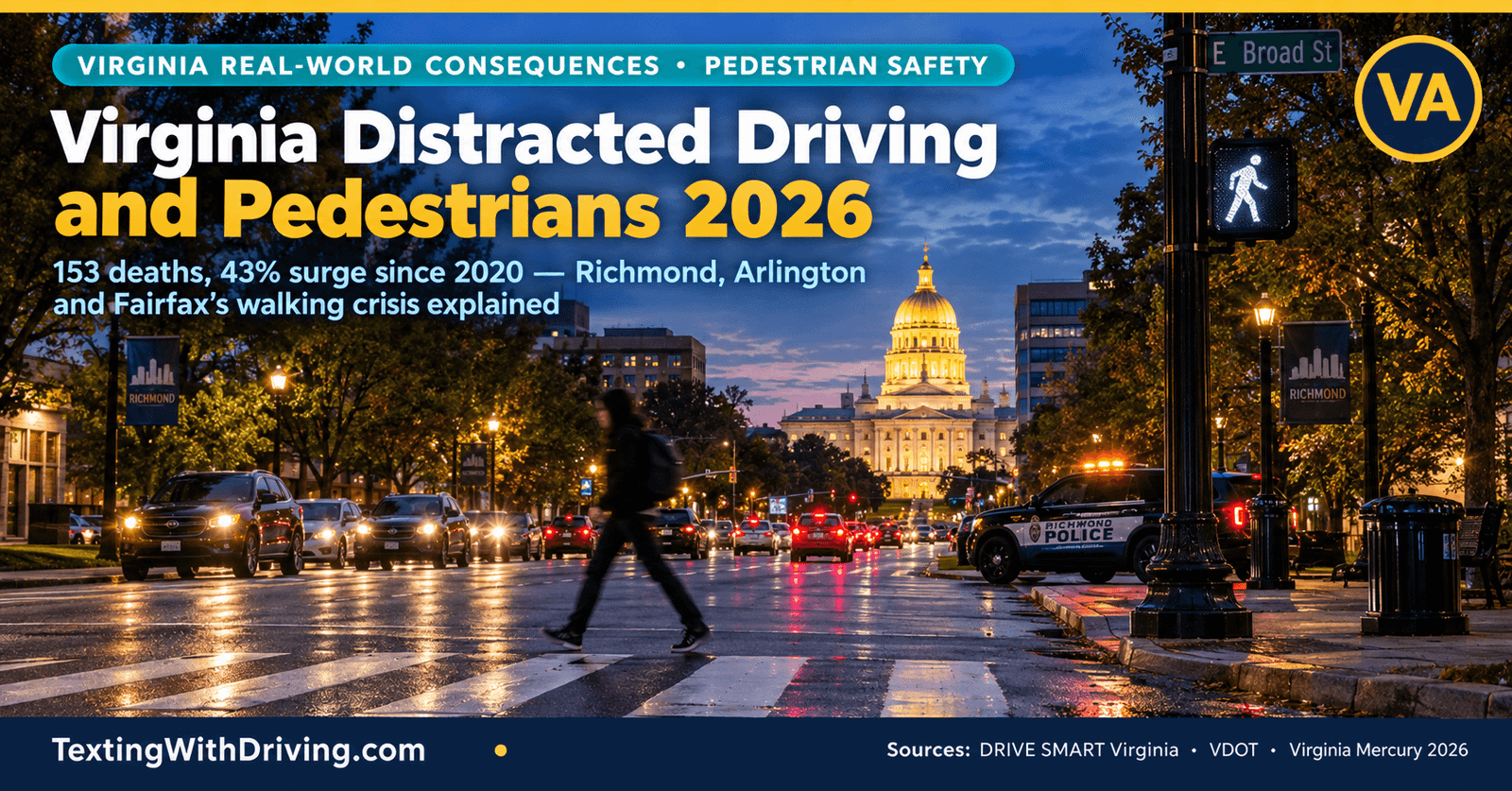
Virginia distracted driving pedestrian deaths 2026 is a crisis being documented in real time, with a trajectory that has moved steadily in the wrong direction for six consecutive years. Pedestrian fatalities have surged 43 percent in Virginia since 2020, with more than 1,300 people killed walking on Virginia roadways in the past decade. In 2025, 153 Virginians died while walking or cycling — 138 pedestrians and 15 bicyclists — according to DRIVE SMART Virginia’s 2025 Annual Report.
The human stories behind these numbers are specific and named. Valentine Museum Director Bill Martin, killed crossing Broad Street in a marked pedestrian crosswalk in the shadow of Richmond’s Capitol Square on December 27. Hope Cartwright, 23, killed in a crosswalk at Second and East Cary Streets on February 16, 2026. Kristin Tolbert, 26, struck by a hit-and-run driver while walking her dog on Semmes Avenue on January 3, 2026. Three deaths on Richmond roads, in marked crosswalks and on ordinary streets, by drivers who did not see the person they killed.
Most of the time, when we look at behavior and pedestrian injury, usually it is the driver that is causing problems. A lot of times it is impaired driving; a lot of times it is distracted driving.
That assessment from Arryn Robbins — a cognitive scientist at the University of Richmond and former research psychologist for NHTSA — places distracted driving directly at the center of Virginia’s pedestrian death surge. Not road design alone. Not pedestrian behavior alone. Driver behavior. Specifically the same driver behavior — inattention, phone distraction, impairment — that Virginia’s enforcement campaigns and hands-free law target for vehicle-to-vehicle crashes. The same behavior, the same drivers, producing a different category of victim: pedestrians who have no protective cage, no crumple zones, and no airbags between their bodies and the vehicle.
This guide covers the complete Virginia distracted driving pedestrian deaths 2026 picture: the statewide statistics, the Richmond City crisis, the Fairfax County Route 1 corridor, the Arlington and Northern Virginia pedestrian safety investments, and what every driver must understand about how phone distraction specifically creates the failure-to-detect scenario that kills pedestrians.
The Statewide Picture: 153 Deaths and a 43% Surge Since 2020
The scale of Virginia distracted driving pedestrian deaths 2026 starts with two numbers that define the crisis.
In 2025, 153 people died walking or cycling on Virginia roadways — 138 pedestrians, 15 bicyclists.
Pedestrian fatalities have surged 43 percent in Virginia since 2020, with more than 1,300 occurring across the state in the past decade.
43 percent. From 2020 to 2025, pedestrian deaths in Virginia did not merely increase — they surged by nearly half. This happened in a period when Virginia enacted a comprehensive primary enforcement hands-free law (January 2021), when VDOT launched one of the most extensive awareness campaign deployments in the state’s history, and when Fairfax County’s Road Shark campaign expanded to its highest-ever citation volumes. The law, the campaigns, and the enforcement did not prevent the pedestrian death surge.
The 153 deaths in 2025 represent 18.6 percent of Virginia’s total 825 road deaths that year — nearly one in five of all Virginians killed in traffic crashes was on foot or on a bicycle. And unlike vehicle-occupant deaths, where seatbelts, airbags, and crumple zones provide meaningful crash protection, pedestrian deaths represent the full kinetic force of a vehicle-pedestrian contact absorbed by a human body with no protection.
Approximately 45 percent of pedestrian deaths happen within 150 feet of an intersection. Of those, about 70 percent occur during darkness, making fall and winter seasons especially hazardous.
Within 150 feet of an intersection. The intersection is exactly where distracted driving creates maximum pedestrian death risk — because intersections are where pedestrians have the right of way in crosswalks, where vehicles make turning movements that require drivers to check for pedestrians, and where the specific failure-to-detect scenario that phone distraction produces most directly leads to fatal pedestrian contacts. The left-turn crash that we documented as the most lethal intersection of distracted driving and motorcycles in our distracted driving motorcycles 2026 article applies with equal force to pedestrians: the driver making a left turn who is cognitively loaded by a phone interaction may not register the pedestrian who is crossing legally in the crosswalk.
70 percent occurring during darkness adds the specific September-November risk escalation that every Virginia driver needs to understand entering fall 2026. As daylight saving time ends and commuting hours shift into darkness, the pedestrian who was visible in summer daylight is now crossing in darkness. A driver whose attention is divided by a phone loses the marginal visual processing capacity that detecting a pedestrian in reduced-visibility conditions requires.
Richmond: The Highest Per-Capita Pedestrian Death Rate in Virginia
Richmond City holds the grim distinction of having more motor vehicle crashes involving pedestrians per capita than any locality in the Commonwealth during the decade of the 2020s, with an especially devastating 2025. The city recorded 13 pedestrian deaths in 2025, outpaced only by Fairfax County’s 14 — though Fairfax County’s population is approximately five times larger than Richmond’s.
13 pedestrian deaths in a city of approximately 230,000 people. Fairfax County’s 14 pedestrian deaths in a jurisdiction of 1.2 million people. The per-capita comparison places Richmond’s pedestrian death rate at more than five times Fairfax County’s — the starkest measure of how concentrated Richmond’s pedestrian crisis is.
Richmond has the grim distinction of having more motor vehicle crashes involving pedestrians per capita than any locality in the Commonwealth during the decade of the 2020s. Most of Richmond’s crashes did not occur randomly. For years, they have been clustered on the same roads, near the same neighborhoods and among the same populations.
The clustering pattern is essential context. Richmond’s pedestrian deaths do not occur randomly distributed across the city’s road network. They concentrate on specific corridors — Broad Street, Hull Street, Semmes Avenue, Midlothian Turnpike — that share specific road design characteristics: high speeds, limited crosswalk spacing, inadequate lighting, and high pedestrian activity from populations without vehicle access who walk to transit stops and daily destinations.
These corridors are also where distracted driving crashes concentrate because they share the same road design characteristics that produce both types of crashes: high speed combined with complex access patterns and high pedestrian activity. A driver running a red light or failing to yield while distracted on Broad Street in Richmond’s downtown core — where pedestrian and vehicle density are both highest — creates the specific crash scenario that produced Bill Martin’s death on December 27.
The high-profile nature of Martin’s death — the director of Richmond’s beloved Valentine Museum, killed in a marked crosswalk in the shadow of Capitol Square — placed Richmond’s pedestrian crisis in Virginia-wide consciousness in a way that the preceding 12 deaths of less prominent Richmonders had not. His death was the coup de grâce to a bloody 2025 when 13 pedestrians perished on Richmond roads.
Richmond has declared 2026 the Year of the Pedestrian — a declaration detailed in our Richmond Virginia distracted driving 2026 article — but as of mid-2026, enforcement has remained fairly lax across the city since its staggering reductions during COVID-19, according to cognitive scientist Arryn Robbins. The enforcement gap between the declaration and the operational reality is the specific challenge that Richmond faces.
Virginia Commonwealth University’s response to the crisis — implementing modular curbs at four on-campus intersections in 2025 to reduce left-turn speeds and prevent drivers from corner-cutting — demonstrates what targeted engineering interventions can accomplish at specific high-crash locations. VCU’s modular curbs force vehicles to slow turn speeds and widen the pedestrian visibility zone, directly addressing the specific conditions where distracted driver left-turn crashes kill pedestrians. The four intersections represent a fraction of Richmond’s high-crash pedestrian network, but they establish the engineering precedent for what the Year of the Pedestrian initiative is attempting to scale citywide.
Fairfax County: The 2026 Pedestrian Death Surge
Virginia distracted driving pedestrian deaths 2026 has produced an even more alarming trajectory in Fairfax County than in Richmond during 2026 specifically.
Fairfax County has matched its full-year totals for pedestrian and vulnerable road user deaths from both 2024 and 2025 in under seven months. As of July 29, 2026, the death toll for non-drivers had climbed to 14, already equaling the full 2024 and 2025 annual totals.
14 pedestrian and vulnerable road user deaths in Fairfax County by July 29. Matched full-year totals for two consecutive years in less than seven months. This acceleration — occurring simultaneously with the 136 percent increase in overall Fairfax County traffic deaths documented in our Fairfax County distracted driving 2026 article — places Fairfax County’s 2026 road safety trajectory among the most alarming of any Virginia jurisdiction.
The specific geographic concentration of Fairfax County’s 2026 pedestrian crisis is Richmond Highway (Route 1) — the 25-mile primary north-south arterial connecting the Wilson Bridge at the DC border through Hybla Valley, Mount Vernon, and Lorton to Prince William County. Back-to-back fatal collisions in July along Richmond Highway in Hybla Valley renewed calls for systemic roadway safety improvements across Northern Virginia.
The Richmond Highway corridor’s pedestrian crisis is documented in a comprehensive 2026 analysis by Northern Virginia Families for Safe Streets: the report identified and evaluated 62 fatal or serious-injury crashes involving pedestrians and bicyclists on the Richmond Highway corridor from 2017 through 2025. Safe Streets data shows over 80 percent of Route 1 pedestrian fatalities occurred near crosswalk gaps of up to half a mile long.
Half-mile crosswalk gaps. A pedestrian trying to cross Route 1 at a location with the nearest marked crosswalk half a mile away faces an impossible compliance burden: a half-mile detour in each direction to cross legally, or a mid-block crossing without the crosswalk infrastructure that gives drivers any visual cue that pedestrians may be present. Mid-block pedestrian crossings — necessitated by infrastructure gaps — in front of drivers who are managing the navigation complexity of a high-speed arterial creates exactly the distracted-driver failure-to-detect scenario at its most lethal.
Distracted driving was specifically tagged as a contributing factor in crashes on Richmond Highway in 2026. Both pedestrian deaths on Richmond Highway in early 2026 involved speed and distracted driving as contributing factors, according to Virginia Department of Transportation data.
Despite securing $754 million in regional support, the $987 million Richmond Highway multimodal project — which would address the crosswalk gaps, lighting deficiencies, and speed management issues that produce the pedestrian death concentration — faces a multi-hundred-million-dollar funding gap. The infrastructure solution is identified, funded in part, and stalled. The deaths continue.
The Distracted Driving Connection: How Phone Use Kills Pedestrians
The mechanism connecting Virginia distracted driving pedestrian deaths 2026 to phone use while driving is identical to the mechanism we documented for motorcycle fatalities in our distracted driving motorcycles 2026 article: inattentional blindness.
A driver whose attentional capacity is reduced by phone use — by the cognitive load of a call, by the visual distraction of reading or sending a message, by the manual distraction of holding a device — experiences a reduction in their ability to detect and consciously register objects in their peripheral visual field. Pedestrians, like motorcycles, occupy a relatively small visual signature compared to vehicles. Under conditions of full attentional capacity, drivers see pedestrians. Under conditions of reduced attentional capacity, pedestrians may not register as consciously detected objects even when they are within the driver’s visual field.
The failure-to-detect pedestrian crash follows the same sequence as the failure-to-detect motorcycle crash: the driver moves through an intersection or along a corridor without consciously detecting the pedestrian who is legally present, and the contact occurs without any braking or evasive action because there was no conscious detection that would trigger either response.
NHTSA’s national data shows that in 2024, 76,000 pedestrians were injured and 7,522 were killed in traffic crashes nationally. The US pedestrian fatality rate has increased approximately 50 percent since 2013 — one of the steepest sustained increases of any traffic safety metric in the modern era — coinciding almost exactly with the period during which smartphone ownership and usage while driving normalized across the adult driving population.
The correlation between smartphone adoption timelines and pedestrian death rate increases is not causal proof, but it is consistent with the mechanism: the specific attentional impairment that phone distraction creates is the specific impairment that most directly produces pedestrian deaths through the failure-to-detect pathway.
Most of the time, when we look at behavior and pedestrian injury, usually it is the driver that is causing problems. A lot of times it is impaired driving; a lot of times it is distracted driving. The expert assessment aligns with the mechanism. The driver behavior — specifically distracted and impaired driving — is the primary cause of Virginia’s pedestrian deaths. Not pedestrian behavior, not road design alone. The driver who is looking at their phone as they approach the crosswalk where Bill Martin was crossing Broad Street on December 27.
Arlington County: The Northern Virginia Counterpoint
Virginia distracted driving pedestrian deaths 2026 has a specific Northern Virginia counterpoint in Arlington County — which has invested more heavily in pedestrian infrastructure than any other Northern Virginia jurisdiction and shows how targeted engineering investment produces measurable safety improvement.
Arlington County’s Vision Zero program has completed 14 school Slow Zone retrofits — reducing speed limits and adding high-visibility crosswalk markings, leading pedestrian intervals, and speed feedback signs within 600 feet of school entrances. These 14 locations represent the most concentrated school-zone pedestrian safety infrastructure in Northern Virginia.
Arlington’s Columbia Pike corridor — which runs parallel to Richmond Highway about five miles north — has significantly more crosswalk infrastructure, pedestrian signal timing, and traffic calming than the Richmond Highway corridor in Fairfax County. The pedestrian safety outcome difference between these two similar-use corridors reflects the infrastructure investment difference. Arlington’s pedestrian death rate is substantially lower than Fairfax County’s Route 1 corridor despite comparable population density and transit dependency in the corridors’ pedestrian populations.
The Arlington precedent demonstrates what the Richmond Highway multimodal project would accomplish for Fairfax County’s Route 1 if fully funded and completed: the crosswalk gaps, lighting deficiencies, and speed management issues that produce the pedestrian death concentration are engineering problems with engineering solutions. The solutions cost money and political will, but they work. Arlington’s 14 school Slow Zones are the evidence.
What the 2025 Virginia Data Shows About Where Pedestrian Deaths Concentrate
The Virginia distracted driving pedestrian deaths 2026 geographic distribution follows the same pattern that VDOT’s Virginia DMV Highway Safety Office documents for all distracted driving crashes — concentration in the specific jurisdictions that are simultaneously Virginia’s most populous and most complex road environments.
Richmond City leads in per-capita pedestrian deaths. Fairfax County leads in absolute pedestrian death counts (14 in 2026 through July versus Richmond’s 13 in all of 2025). Prince William County’s Route 1 and US-29 corridors appear in pedestrian crash data. Norfolk City’s Atlantic Avenue and Monticello Avenue corridors produce pedestrian crashes in the Hampton Roads region.
The localities that lead Virginia’s pedestrian death data are the same localities that lead Virginia’s distracted driving crash data — because they are the same road environments, the same drivers, and the same behavior producing both outcomes. The distracted driver who fails to detect a motorcycle in a left-turn scenario and the distracted driver who fails to detect a pedestrian in a crosswalk are exhibiting the same impaired attentional capacity from the same phone distraction, in many cases on the same roads.
The Legislative Response: SB84, HB819 and the 2026 Bills
Virginia distracted driving pedestrian deaths 2026 has generated a legislative response beyond the hands-free law. The 2026 General Assembly session saw multiple pedestrian safety bills connected to the distracted driving crisis in Richmond.
Several bills churned through the Virginia General Assembly including Senate Bill 84, House Bill 819, HB 1220, and HB 1330, which use automated speed and stop sign monitoring technology plus public engagement to persuade drivers to slow down, pay attention to roads and intersections, and give pedestrians a brake.
SB84 — the AI camera law that took effect July 1, 2026 and that we documented in our Virginia distracted driving cameras 2026 article — explicitly addresses the failure-to-yield pedestrian crashes that account for a significant share of Virginia’s pedestrian deaths. The Obvio cameras authorized by SB84 can detect distracted driving (though not yet authorized to cite for it), and the stop-sign and crosswalk-yielding violations they can cite directly target the driver behaviors that kill pedestrians.
The legislative response has been more focused on automated enforcement and engineering investment than on the hands-free law revision — an acknowledgment that the hands-free law’s primary enforcement structure, while producing measurable improvements in distracted driving crash frequency, has not produced proportional improvements in pedestrian death rates.
What Every Virginia Driver Must Know Before Every Drive
The Virginia distracted driving pedestrian deaths 2026 data delivers a specific, actionable message to every Virginia driver — in Richmond, in Fairfax County, in Arlington, and in every other Virginia locality where pedestrians share roads with vehicles.
45 percent of pedestrian deaths happen within 150 feet of an intersection. Every approach to every intersection is a pedestrian-risk window. At the specific moment when a distracted driver is most likely to miss a pedestrian — the approach to an intersection where they may be checking their navigation, responding to a notification, or visually distracted by a screen — the pedestrian risk is statistically highest.
70 percent of pedestrian deaths occur during darkness. September through November, as daylight saving time ends and commute hours shift into darkness, is Virginia’s highest-risk pedestrian death window. The phone-in-hand driver who would have detected a pedestrian in summer daylight may not detect the same pedestrian crossing at dusk in October. The additional attentional resource that nighttime pedestrian detection requires makes phone distraction specifically more lethal as fall progresses.
Richmond Highway (Route 1) in Fairfax County is the most dangerous pedestrian corridor in Northern Virginia. Drivers on Route 1 between the DC border and Woodbridge are on the corridor that produced 62 pedestrian deaths and serious injuries in nine years, where crosswalk gaps of up to half a mile force pedestrians to cross mid-block, and where distracted driving was specifically tagged as a contributing factor in 2026 deaths. Route 1 requires maximum attentiveness, minimum distraction, and speed appropriate for the pedestrian-dense environment the corridor hosts.
Broad Street in Richmond is the corridor where pedestrians have been killed in marked crosswalks. A marked crosswalk and a WALK signal are not sufficient protection against a distracted driver who fails to detect a pedestrian in the crosswalk. Bill Martin was in a marked crosswalk. Hope Cartwright was in a marked crosswalk. Legal protection and physical protection are different things, and phone distraction converts legal protection into physical vulnerability.
The pre-drive setup that prevents pedestrian deaths is identical to the pre-drive setup that prevents vehicle-to-vehicle distracted driving crashes. Phone in back seat. GPS pre-set before moving. Driving Focus active. No phone contact while moving. These behaviors eliminate the attentional reduction that produces failure-to-detect pedestrian crashes exactly as they eliminate the attention reduction that produces vehicle-to-vehicle crashes.
For the complete Virginia law that applies on every road where pedestrians walk, our Virginia distracted driving law covers Va. Code § 46.2-818.2. For the Richmond-specific context including the Year of the Pedestrian declaration and the Broad Street and Semmes Avenue crash locations, our Richmond Virginia distracted driving 2026 article covers the city-level picture. For the Fairfax County enforcement response to the pedestrian death surge, our Fairfax County distracted driving 2026 covers Road Shark and the 136 percent traffic death increase. And for the technology setup that makes distracted-driving-free driving automatic, our hands-free while driving complete setup guide covers iPhone, Android, Bluetooth, and CarPlay.
Sources Used in This Article
All links verified working before publication.
DRIVE SMART Virginia: 2025 Annual Report — 153 pedestrian and cyclist deaths 2025 (138 pedestrians 15 bicyclists), 825 total Virginia road deaths 2025, 33 teen deaths, 80% crashes attributed to distraction VTTI, May 2026
VDOT: VDOT Urges Virginians to Look Left Right Up and Out as Pedestrian Deaths Climb — 43% pedestrian fatality surge since 2020, 1,300 deaths past decade, 45% within 150 feet of intersection, 70% in darkness, October 2025
Virginia Mercury: Pedestrian Deaths in Virginia’s Capital Cry Out for Real Solution — 13 Richmond pedestrian deaths 2025 most any Virginia locality, Bill Martin killed December 27 marked crosswalk Capitol Square, Hope Cartwright Second and Cary, Kristin Tolbert Semmes Avenue January 3, February 2026
WRIC: The Driving Factors Behind Richmond’s Pedestrian Safety Crisis — Arryn Robbins cognitive scientist University of Richmond former NHTSA psychologist quote, VCU modular curbs four intersections 2025, Richmond highest per capita pedestrian deaths state, enforcement lax since COVID reductions, May 2026
CODOT via Commonwealth Times: Richmond Has a Pedestrian Safety Problem — 13 pedestrian deaths Richmond 2025, Year of Pedestrian declaration, Mayor Avula response, February 2026
FFXNow: Range of Factors Driving Richmond Highway Pedestrian Safety Crisis — NoVA FSS report 62 fatal serious-injury crashes 2017-2025 Richmond Highway, distracted driving contributing factor January 2026 crash, 47% alcohol factor, May 2026
NoVA FSS: Range of Factors Driving Richmond Highway Pedestrian Safety Crisis — Northern Virginia Families for Safe Streets report, Backlick Pohick Huntington Avenue Lockheed Beacon Hill intersections redesign recommendations, May 2026
Springfield Connection: Pedestrian Fatalities Surge in Fairfax County — 14 pedestrian deaths Fairfax County by July 29 2026 already matching full-year 2024 and 2025 totals, 80% Route 1 fatalities near half-mile crosswalk gaps, $987M Richmond Highway project $754M regional support funding gap, Mike Doyle Safe Streets quote, August 2026
NHTSA: Pedestrian Safety — 7,522 pedestrians killed 2024, 76,000 injured, 50% increase since 2013
NHTSA: Distracted Driving — 3,208 deaths 2024, national context
TextingWithDriving.com is professionally built and maintained to ensure accurate, accessible safety information reaches every driver who needs it. Website development and ongoing support is handled by Budgetic, a digital agency specializing in purpose-driven WordPress websites.

About Texting With Driving
TextingWithDriving.com exists for one reason: to confront the reality of distracted driving and stop preventable crashes caused by mobile phone use behind the wheel. Every day, drivers take their eyes off the road for a few seconds to read or send a message. Those few seconds are enough to cause life-altering consequences. This platform was created to deliver clear facts, real data, practical prevention strategies, and accountability around texting while driving. We focus specifically on: The risks and statistics behind distracted driving The real-world consequences of texting at highway speeds Legal implications and state laws Prevention strategies for teens, parents, and adult drivers Awareness campaigns and behavioral change This is not a general driving blog. It is a focused awareness initiative built around one critical issue: phone distraction behind the wheel. Our content is direct, research-driven, and practical. We prioritize accuracy over opinion and education over sensationalism. The goal is simple — reduce distracted driving incidents by increasing awareness and responsibility. If one article causes one driver to put their phone down, the mission is working. For inquiries or partnerships, contact: privacy@textingwithdriving.com
View all posts by Texting With Driving