

Gen Z texting while driving statistics: Why 68% Still Text While Driving Despite Knowing the Risks

Gen Z texting while driving: Why 68% Still Text While Driving Despite Knowing the Risks
This is the most frustrating paradox in road safety research right now.
Generation Z grew up with the statistics. They had the school assemblies. They watched the PSA videos in health class. They know that texting while driving kills. They are not uninformed. They are, by almost every measure, the most information-saturated generation in history.
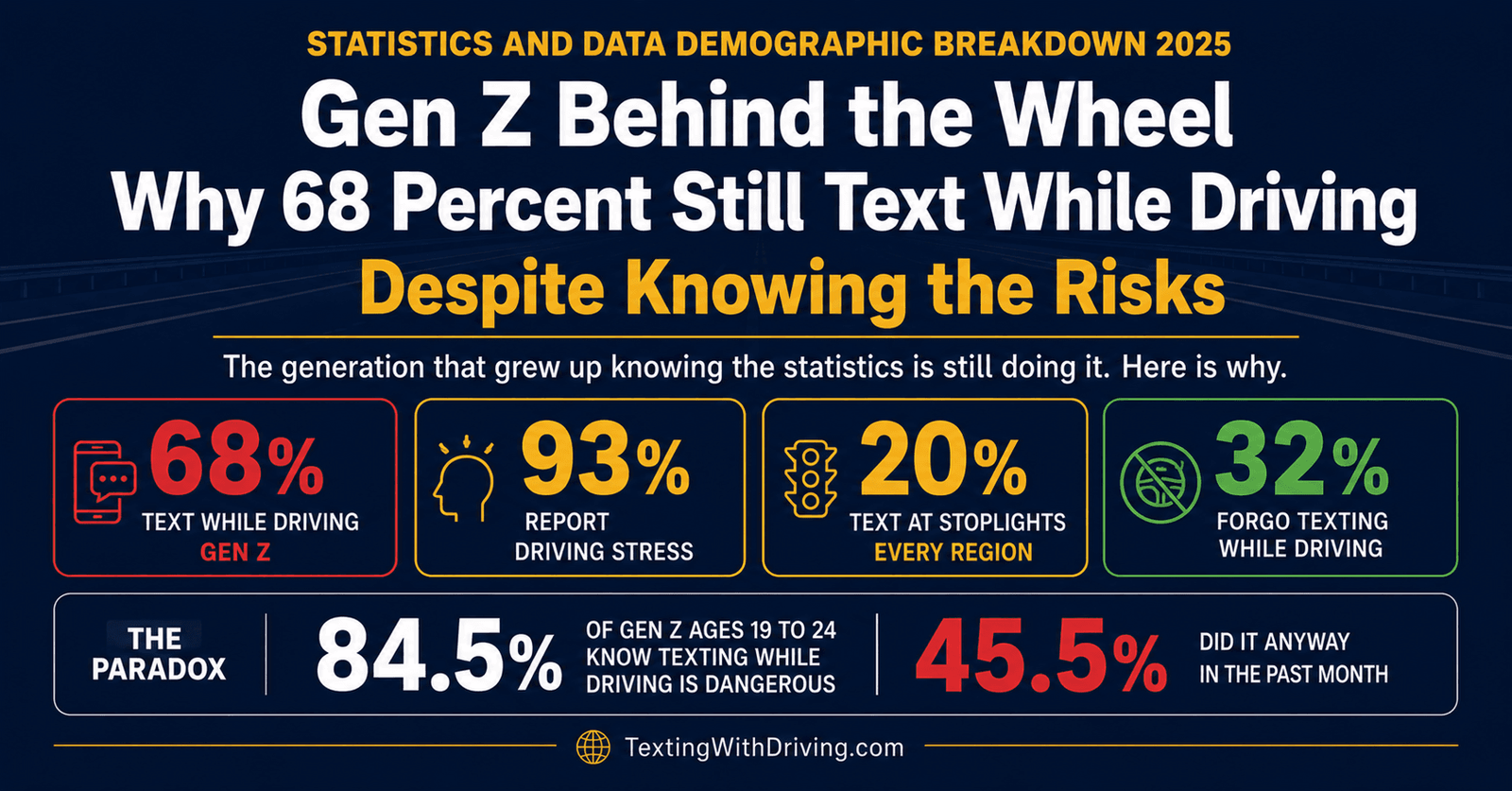
And yet 68 percent of them admit to texting or interacting with texts while driving.
This article does not exist to blame Gen Z. It exists to understand what is actually happening, because the answer to that question is the only way to change the outcome. And the answer turns out to be more interesting and more actionable than simply saying young people do not care about safety.
The 68 Percent Figure: Where It Comes From
According to an Insurify survey conducted and published in 2025, 68 percent of Gen Z drivers text or interact with texts while driving. Midwest Gen Z drivers are the most cautious, with 37.5 percent waiting until parked to respond to texts. Gen Z has the highest accident rate at 7 percent and the highest DUI rate at 1 percent among all generations surveyed. Michigan Auto Law
That 68 percent figure comes from a proprietary Insurify survey of Gen Z drivers, cross-referenced with NHTSA crash data for the same age cohort. It is the number that has circulated widely since the report’s August 2025 publication, and it holds up under scrutiny because it aligns with what other research shows from different methodologies.
Research shows that 84.5 percent of drivers aged 19 to 24 recognize that texting while driving is dangerous, yet 45.5 percent admitted to engaging in this behavior within the past month. This disconnect between knowledge and behavior demonstrates a troubling pattern where understanding risks does not translate into safe driving practices. Zutobi
Two different studies. Two different sample populations. Consistent conclusion. More than half of young adult drivers know texting while driving is dangerous and do it anyway. The knowledge is not the problem. Something else is.
Just 32 percent of surveyed Gen Z drivers forgo interacting with a text while driving, despite state laws banning texting and driving, as well as many studies showing the dangers of interacting with a text while behind the wheel. Nearly all Gen Z drivers, 93 percent, report experiencing driving-related stress. Reckless drivers are cited as the leading cause of that driving stress. AgencyAnalytics
This creates a striking internal contradiction in Gen Z’s own reported experience. 93 percent are stressed by reckless drivers around them. 68 percent are doing the exact thing that makes a driver reckless. The disconnect is real, consistent, and worth examining rather than simply condemning.
What Gen Z Drivers Are Actually Doing Behind the Wheel
The 68 percent figure covers a range of behaviors that are worth unpacking individually.
Insurify’s data reveals that nearly 20 percent of Gen Z drivers in every region admit to reading or responding to texts at stoplights, showing that this behavior is common nationwide despite laws against the practice. Others attempt to delay their responses: 15 percent glance at texts but do not reply until later, and 14 percent respond only if the message feels urgent. Just 21 percent use voice-to-text tools, introducing a cognitive distraction that can be just as dangerous as manual texting. Baderlaw
The stoplight behavior is particularly worth flagging. Nearly one in five Gen Z drivers in every region of the country believes that a red light creates a safe window to check their phone. As we covered in our article on the real danger of texting while driving, AAA Foundation research shows that cognitive distraction from phone use persists for up to 27 seconds after a driver puts the phone down. Even if the light is red when they look down, the distraction carries into the next stretch of driving after the light changes green.
Most states with hands-free laws, including Pennsylvania, whose Paul Miller’s Law we covered in detail in our Pennsylvania distracted driving law 2026 guide, explicitly define operating a vehicle to include being stopped at a red light. The stoplight loophole does not exist legally in most states. It is a rationalization, not a reality.
Thirty-seven percent of rural Gen Z drivers wait until they have fully parked their cars before checking or responding to texts, the highest among location types. In contrast, only 32 percent of suburban drivers and 30 percent of urban drivers exercise the same caution. Baderlaw
That rural versus urban difference is interesting and counterintuitive. Rural drivers, who tend to drive at higher speeds on roads with fewer intersections where stopping is possible, are paradoxically more likely to wait until they are fully parked. Urban drivers, who spend more time in stop-and-go traffic where checking a phone feels less dangerous, are more likely to use that traffic as an opportunity.
The Regional Picture Across the US
Gen Z drivers in the Northeast at 25.6 percent and South at 24.6 percent were the most likely to have texted while driving. South Carolina at 44 percent and North Carolina at 38 percent show particularly high levels of Gen Z drivers admitting to texting at stoplights specifically, highlighting that even in states with laws against it, the behavior persists widely. Baderlaw
South Carolina’s 44 percent rate of Gen Z drivers texting at stoplights is extraordinary. Nearly half of young drivers in that state admit to this specific behavior. As we noted in our worst states for distracted driving 2026 analysis, South Carolina consistently appears in the worst-performing tier of states for distracted driving severity, and the behavioral data from this survey shows why.
The company which provides telematics technology to many top auto insurers found that 30.6 percent of drivers aged 18 to 29 admitted to using FaceTime while driving, 68 percent higher than the general population. In 2023, 21 percent of distracted drivers involved in fatal crashes were 15 to 24 years old, and 23 percent were 25 to 34. NAHB
FaceTime while driving. Not a voice call. Not a text. A live video call while operating a vehicle. 30.6 percent of drivers aged 18 to 29 admit to this specific behavior. This is the form of distraction that is genuinely new to this generation, enabled by smartphone cameras and social platforms that did not exist in the same form when older drivers formed their habits.
The Crash Statistics That Make This Personal
In 2023, over 203,256 individuals aged 15 to 24 were injured in vehicle crashes, representing a concerning trend among younger motorists. While drivers under 20 represent only 5.1 percent of all licensed drivers, they account for 12.6 percent of all collisions. This disproportionate representation indicates that young drivers crash at more than twice the rate of their representation in the driving population. Zutobi
That crash rate disproportion is significant. Twice the crash rate relative to their share of the driving population. Some of that disproportion reflects inexperience and the learning curve of new drivers, which we covered in our article on why teen drivers are the most at-risk group for distracted driving. But the distraction component compounds the experience gap in a way that makes it more dangerous than either factor alone.
Apps like TikTok, Snapchat, and Instagram have created dangerous incentives to capture moments while driving, leading to risky behaviors and distraction-based crashes. Despite these new distractions, teen driver fatalities have decreased over the last decade. Several factors are likely to have contributed to this trend including stricter Graduated Driver Licensing programs which have become stricter in many states. Cmtelematics
The coexistence of increasing distraction behaviors and decreasing teen fatalities is important context. GDL laws, safer vehicle technology, and improved emergency medical response have all contributed to fewer deaths even as distraction has increased. This does not mean distraction is not dangerous. It means other safety improvements are partially compensating for increasing distraction risk, which is a fragile position that depends on those other factors continuing to improve.
The Real Reason: It Is Not Carelessness
Here is the finding that changes how this problem should be approached.
Most Gen Z drivers who text while driving are not making a considered decision to accept risk. They are responding to a neurological mechanism that was designed by the most sophisticated technology companies in the world to override exactly this kind of rational decision-making.
Smartphones are made to keep you hooked. Notifications and messages release dopamine, a brain chemical that makes you feel good. Over time this creates a habit. Constant phone use trains the brain to want quick rewards. Dopamine from notifications makes ignoring your phone harder. The brain craves more dopamine, making the habit stronger. For many, this makes ignoring the phone tough, even while driving. Federal Motor Carrier Safety Administration
Gen Z is not unique in this neurological experience. Every smartphone user’s brain has been conditioned by years of notification-response loops before they ever got behind the wheel. What is different for Gen Z is the duration and intensity of that conditioning. They started using smartphones in childhood, often before age 10. By the time they are driving at 16 or 17, their phone-response habit is a decade old and deeply embedded.
Millennials and Gen Z are 32 percent more likely than older generations to blame their heightened distraction behind the wheel to their phones. Six out of ten Millennial and Gen Z drivers admit to reading texts while driving. 83 percent of Millennials and Gen Z say they check their phones at least once every hour. Federal Motor Carrier Safety Administration
Checking a phone once per hour is already a strong habit in a non-driving context. During an average 30 to 60-minute commute, that habit is going to assert itself. The question is whether the driver’s environment has been set up to prevent it or to facilitate it.
The Lemonade and Talker Research survey conducted for Distracted Driving Awareness Month in April 2025 added important nuance to the generational picture. The survey revealed that Gen Z respondents led nearly every age group in risky or distracted driving behaviors. But that may have less to do with generational habits and more to do with experience. After all, Gen Z includes many of the newest drivers on the road, still building the muscle memory and confidence that often comes with time behind the wheel. Governor’s Traffic Safety Committee
That framing is worth holding onto. Some of what looks like a Gen Z behavior problem is actually a new driver behavior problem that happens to align generationally. Newer drivers of any generation are more likely to engage in distracted behaviors because they have not yet developed the automatic driving routines that free up enough cognitive capacity to resist additional demands. When the phone buzzes, an experienced driver has the automatic processes of lane-keeping and speed management running in the background. A new driver is consciously managing all of those things, and the phone arrives as a competitor for limited attention.
What Generational Data Says About What Works
If fear campaigns and statistics do not close the knowledge-behavior gap for Gen Z, what does?
The research on effective interventions for younger drivers points consistently toward three approaches that work better than awareness alone.
Identity-based framing outperforms fear. Gen Z responds more strongly to messaging that aligns with their self-image than to messaging that threatens their safety. Campaigns that frame phone-free driving as a form of personal agency and competence, rather than compliance with rules designed to protect them from themselves, produce stronger behavioral response. The most successful Gen Z-targeted safety campaigns treat their audience as capable adults making smart choices, not as reckless young people who need to be scared into compliance.
Pre-commitment works better than in-moment willpower. The behavioral science behind phone-free driving is consistent regardless of generation: decisions made before temptation arrives are more reliable than self-control in the moment. For Gen Z, whose dopamine response to incoming notifications is conditioned and strong, the practical implication is that setting up Driving Focus on iPhone or Android driving mode before every drive is far more effective than deciding each time not to look. We have a complete step-by-step guide to setting this up in our article on how to set up Do Not Disturb While Driving on iPhone and Android.
Peer norms shift behavior. Gen Z is sensitive to what their peer group considers normal and acceptable. The social norms around drunk driving shifted for younger generations largely because the social permission structure changed, not because the danger became better understood. A similar shift in social norms around phone-free driving, where checking your phone while driving is as socially unacceptable among friend groups as drunk driving, would be more effective than any campaign aimed at individual behavior.
The most practical application of this for any Gen Z driver reading this: make your own phone-free driving habit visible and explicit within your friend group. “I put my phone in the back seat before I drive” is a social statement as much as a personal one. When one person in a friend group makes this explicit, it changes what others consider normal.
The 30 Percent Who Are Getting It Right
In a report dominated by concerning statistics, one figure deserves specific attention.
Thirty-seven percent of rural Gen Z drivers wait until they have fully parked their cars before checking or responding to texts, the highest rate among location types. Baderlaw
Just 32 percent of surveyed Gen Z drivers forgo interacting with a text while driving, despite state laws banning texting and driving. AgencyAnalytics
Roughly a third of Gen Z drivers are doing this right. They are not putting themselves or others at risk. And they are doing it despite the same neurological conditioning, the same social media habits, and the same driving environments as the 68 percent who are not.
What makes the difference for that third? Research suggests it is predominantly the presence of a strong pre-drive habit, often established by a parent conversation or a specific moment of commitment, combined with an environment that removes the temptation before it arrives. Phone in the back seat. Driving mode on. Decision made before the car starts.
These are not complicated strategies. They are not expensive. They require a one-time decision and a two-minute setup. The gap between the 32 percent who consistently avoid distracted driving and the 68 percent who do not is largely a gap between those who have made that decision and those who have not.
For Gen Z drivers: make the decision. Set up the feature. Put the phone where you cannot reach it. You already know the statistics better than any generation before you. Now act on them.
For parents of Gen Z drivers: your conversation matters more than the data. Our parent’s guide to talking to your teen about phone use while driving gives you the specific, research-backed conversation that actually produces behavior change.
For the complete national picture of distracted driving deaths and injuries that provide context for all of these behavioral statistics, see our distracted driving statistics 2026 overview. And for the legal consequences in every state that make this behavior increasingly costly beyond the safety risk, see our hands-free driving laws by state 2026 guide.
Sources Used in This Article
All links verified working before publication.
Insurify: Texting and Driving Statistics Key Trends and Insights in 2025 — August 2025
Insurify: Survey Driving Stresses 93 Percent of Gen Zers — Gen Z self-driving survey 2025
Lemonade and Talker Research: The Gen Z Driving Shift You Did Not See Coming — April 2025 Distracted Driving Awareness Month survey
Talker Research: New Generation New Rules How Gen Z Drives Differently — June 2025
Rolling Out: 7 Dangers Facing Gen Z Drivers on Roads Today — August 2025
Kustom Signals: Are High Tech Gen Z Drivers a More Dangerous Generation — April 2025
DontGetHitTwice: Why 1 in 5 Drivers Still Text While Behind the Wheel — March 2026
Aceable: Millennials and Gen Z Need to Shape Up Behind the Wheel — Generational phone checking frequency data
NHTSA: Distracted Driving Statistics — 2023 and 2024 crash data
NHTSA CrashStats: Distracted Driving in 2023 — DOT HS 813 703, April 2025
GHSA: Distracted Driving State Laws — National legislative context
The Zebra: Distracted Driving Statistics 2026 — January 2026 update
TextingWithDriving.com is professionally built and maintained to ensure accurate, accessible safety information reaches every driver who needs it. Website development and ongoing support is handled by Budgetic, a digital agency specializing in purpose-driven WordPress websites.

About Texting With Driving
TextingWithDriving.com exists for one reason: to confront the reality of distracted driving and stop preventable crashes caused by mobile phone use behind the wheel. Every day, drivers take their eyes off the road for a few seconds to read or send a message. Those few seconds are enough to cause life-altering consequences. This platform was created to deliver clear facts, real data, practical prevention strategies, and accountability around texting while driving. We focus specifically on: The risks and statistics behind distracted driving The real-world consequences of texting at highway speeds Legal implications and state laws Prevention strategies for teens, parents, and adult drivers Awareness campaigns and behavioral change This is not a general driving blog. It is a focused awareness initiative built around one critical issue: phone distraction behind the wheel. Our content is direct, research-driven, and practical. We prioritize accuracy over opinion and education over sensationalism. The goal is simple — reduce distracted driving incidents by increasing awareness and responsibility. If one article causes one driver to put their phone down, the mission is working. For inquiries or partnerships, contact: privacy@textingwithdriving.com
View all posts by Texting With Driving