

What Happens to Your Car Insurance After a Distracted Driving Ticket?

What Happens to Your Car Insurance After a Distracted Driving Ticket?
Most drivers think about the ticket fine when they get caught texting at the wheel. They calculate $150 or $50 or whatever their state charges, decide it is manageable, and move on.
What they do not calculate is what happens next. Because the fine is the smallest financial consequence of a distracted driving conviction.
The real cost lands on your insurance premium. It stays there for three to five years. And it adds up to a number that dwarfs the original ticket by a factor of ten or more.
Here is exactly what happens, how much it costs, how long it lasts, and what your options are once a violation is on your record.
How Insurance Companies Treat a Distracted Driving Ticket
Before getting to the numbers, it helps to understand how insurers classify this type of violation and why it triggers a rate increase at all.
Most states consider distracted driving a moving violation and issue tickets to drivers who are not paying attention to the road. In addition to fines, a distracted driver can see higher insurance rates for three to five years. Distracted driving includes texting, making a phone call, and eating, and car insurance rates increase after a distracted driving ticket for three to five years. NHTSA
The reason insurers respond to moving violations with rate increases is purely actuarial. Insurance companies price policies based on the statistical likelihood that a driver will file a claim. A driver with a texting while driving violation has already demonstrated, on record, that they engage in a behavior known to increase crash risk by 240 percent according to the September 2025 GHSA and Cambridge Mobile Telematics report. From the insurer’s perspective, that is not an abstract risk. It is a documented behavioral pattern.
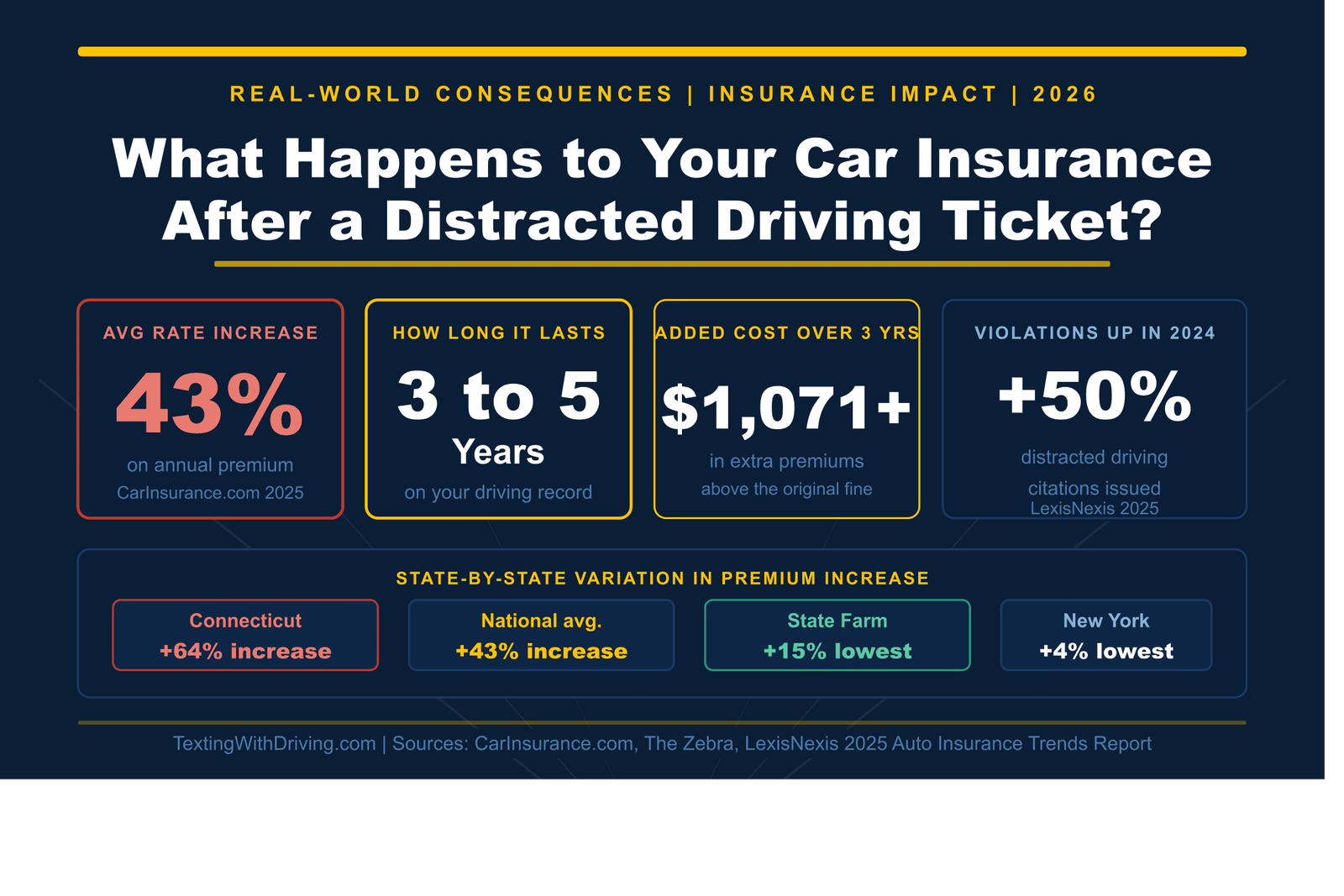
Distracted driving violations surged by 50 percent from 2023 to 2024, according to the 2025 LexisNexis US Auto Insurance Trends Report. This sharp increase in citations has contributed to upward pressure on insurance rates across all driver categories, as insurers adjust their risk models to reflect the growing frequency of distraction-related claims.
That 50 percent surge in distracted driving citations in a single year is a significant data point. More drivers are being caught. More violations are entering driving records. And insurers are adjusting rates accordingly, not just for individual violators but in response to the broader trend.
The Average Rate Increase: What to Expect in 2026
The range of reported average increases across different studies and methodologies varies, but all of them point in the same direction.
A texting while driving ticket raises car insurance rates by an average of 43 percent, and in some states the hike can exceed 50 percent, according to a CarInsurance.com analysis commissioned from Quadrant Information Services in September 2025. The analysis was based on sample profiles of 40-year-old male and female drivers carrying full coverage policies with limits of 100/300/100 and a $500 deductible.
The Zebra reports that a distracted driving violation raises rates an average of 23 percent, adding approximately $357 per year to the average policy. At a three-year duration on the driving record, that adds $1,071 in cumulative extra premiums above what the driver would have paid with a clean record, on top of whatever fines and court costs the original ticket carried. World Population Review
eInsurance reports the average increase at 27 percent, adding approximately $516 per year to the typical policy. Across three years, that represents $1,548 in additional insurance costs attributable to a single distracted driving citation. NHTSA
Some analyses place the average rate increase higher, at approximately 49 percent, equivalent to an extra $864 per year for full coverage policies. These heightened rates lead to higher insurance costs for years and potential policy cancellations for repeat offenders.
The variation between these figures reflects different sample populations, methodologies, and the state mix included in each analysis. But even using the most conservative figure available, a single distracted driving ticket adds roughly $350 to $500 per year to your insurance costs for at least three years. That translates to $1,050 to $1,500 in cumulative additional premiums, often for a violation that carried an original fine of $50 to $200.
The math is stark. The fine is the headline. The insurance increase is the actual cost.
How Long the Ticket Stays on Your Record
Car insurance rates increase after a distracted driving ticket for three to five years. The duration depends on your insurance company and the laws in your state, with some insurers keeping violations on the rating record longer than others. NHTSA
The distinction between how long a violation stays on your driving record and how long an insurer uses it to rate your premium is important and often misunderstood.
Your driving record is maintained by the state DMV. Depending on your state, a texting or distracted driving violation remains on your official driving record for one to five years. However, insurers do not necessarily use only what is currently on your driving record. Some carriers look back three years when calculating premiums. Others look back five. When you renew your policy or switch carriers, they run a motor vehicle report that captures the violation for however long they choose to look back.
In practice, most drivers experience elevated premiums for the three years immediately following a citation. At renewal after year three, many carriers reassess and the surcharge begins to reduce or disappear. But this is not guaranteed. Some insurers maintain elevated rates for the full duration that a violation appears anywhere in their lookup window.
The practical advice: do not assume your rates will normalize at renewal three years after the ticket. Check explicitly with your insurer what their lookback period is and when they will recalculate your risk tier.
State-by-State Variation: The Difference Is Dramatic
One of the most important things to understand about insurance rate increases after a distracted driving ticket is how wildly the impact varies by state.
Drivers in Connecticut pay the biggest insurance penalties for distracted driving, with rate increases averaging 64 percent and an average of $1,083 in additional annual premiums. Drivers in New York pay the smallest distracted driving insurance penalties of only 4 percent increase, averaging $62 in additional annual premiums. These impacts vary widely from state to state due to a broad variety of factors including state insurance laws and regulations, population density, local car repair costs, and more. World Population Review
The same violation in Connecticut and New York produces radically different financial outcomes, not because the behavior was different but because state insurance regulatory frameworks, market competition, and actuarial baselines differ enormously between markets.
High base premiums in states like Connecticut, Michigan, and Louisiana mean that a percentage-based surcharge produces a larger absolute dollar increase than the same percentage applied to lower base premiums in states like Iowa or Vermont. A 43 percent increase on a $1,200 annual policy adds $516. The same 43 percent on a $2,500 policy adds $1,075. Same violation, more than double the dollar impact.
State law also affects how insurers can use violations. Some states restrict how long or how heavily a single moving violation can be weighted in premium calculations. Others give insurers broad discretion. Understanding your state’s insurance regulatory environment is part of understanding your total exposure.
Which Insurers Penalize Most and Which Penalize Least
Among the carriers analyzed by CarInsurance.com, State Farm offers drivers the lowest car insurance rates after a texting violation, with approximately a 15 percent or $295 increase in yearly premiums on average. Other carriers apply significantly higher surcharges for the same violation.
The variation between insurers for the same violation in the same state can be significant. One carrier might apply a 15 percent surcharge while another applies 60 percent for identical profiles and identical violations. This creates a strong argument for shopping around after a distracted driving ticket rather than simply accepting your current carrier’s renewal rate.
When a violation hits your record, most insurers do not immediately increase your rates. The rate adjustment typically happens at your next renewal, not mid-policy. This gives you a window, often three to six months, to shop for a new policy at a lower rate before your current carrier’s renewal surcharge takes effect. Using that window strategically is one of the most practical financial responses available to a driver who has received a distracted driving citation.
How It Affects Teen Drivers and Family Policies
For teen drivers added to a parent’s policy, the insurance impact of a distracted driving violation is even more severe.
Teen drivers already carry the highest insurance surcharges of any age group simply because of their statistical crash risk. A violation on top of the baseline teen driver surcharge compounds the premium impact significantly. In some cases, a teen driver with a distracted driving citation triggers not just a rate increase but a policy review, and some insurers will refuse to cover the teen driver or offer coverage only at a substantially elevated rate that applies to the entire family policy.
Teens are especially susceptible to texting and driving, which can have long-term consequences if there is an accident or someone is injured. A texting while driving violation for a teen driver creates insurance premium impacts that can persist on that driver’s record into their early to mid-twenties, affecting the rates they pay when they eventually obtain their own independent policy. NHTSA
This multi-year record consequence is one of the reasons the parent conversation about phone-free driving is so financially important, not just safety-important. A distracted driving ticket on a teen driver’s record follows them through the highest-premium years of their driving life. We covered the behavioral research on that conversation in our parent’s guide to talking to your teen about phone use while driving.
If You Cause a Crash While Distracted: A Different Tier of Consequences
Everything above relates to the insurance impact of a citation alone, without a crash. If a distracted driver causes an accident, the financial picture changes category entirely.
An at-fault accident on a driving record typically triggers a larger surcharge than a moving violation citation alone. The combination of a distracted driving violation and an at-fault accident places a driver into a high-risk tier that carries some of the highest premiums in the insurance market.
Distracted driving significantly increases auto insurance premiums, with an average 49 percent rate hike after an incident, and potential policy cancellations for repeat offenders. Legal consequences for distracted driving can vary by state but may include substantial fines, license penalties, and even criminal charges in extreme cases.
Beyond insurance, an at-fault crash while distracted creates civil liability exposure. Personal injury lawsuits arising from distracted driving crashes have produced settlements in the tens of thousands to millions of dollars depending on the severity of injuries. Even if insurance covers the immediate claim, the insurer may seek subrogation and the driver may face policy non-renewal after a serious at-fault claim. For the full picture of what a crash involving distracted driving means legally, our article on texting while driving vs drunk driving covers the legal treatment of both behaviors in comparative detail.
What You Can Do If You Already Have a Violation on Your Record
A distracted driving citation is not the end of the road financially. There are concrete steps that can reduce the impact.
Shop your policy at renewal. As noted above, the variation between carriers for the same violation profile is dramatic. Getting quotes from multiple insurers before your current carrier’s renewal surcharge takes effect is the single most financially effective response.
Ask about defensive driving courses. Many states allow drivers to complete a state-approved defensive driving course to offset points on their record or qualify for insurance discounts. Whether this applies to distracted driving violations specifically depends on your state and your insurer. Ask both your DMV and your insurer before paying for a course.
Avoid additional violations. A second moving violation within the same policy period compounds the surcharge disproportionately. Some insurers move a driver from a preferred tier to a non-standard tier after two violations, which involves a much larger rate adjustment than the sum of two individual surcharges.
Document clean driving going forward. Insurers that offer telematics programs, where a device or app monitors your driving and adjusts rates based on actual behavior, sometimes allow drivers with violations to demonstrate improved behavior and qualify for discounts that partially offset the surcharge. If your insurer offers this, it may be worth enrolling.
The True Total Cost of a Single Distracted Driving Ticket
Here is the honest math that most drivers never do when they get caught.
A distracted driving ticket in a typical state might carry a base fine of $100 to $200. Add court costs and administrative fees, which often double the base fine, and the initial financial hit is $200 to $400.
Now add the insurance impact. At a 28 percent average increase on a $1,500 annual premium over three years, that is an additional $1,260 in cumulative premiums. Using the higher estimate of 43 percent, it is $1,935.
Total cost of one distracted driving ticket over three years: $1,460 to $2,335, for a violation that might have carried a headline fine of $100.
And that is for a citation without a crash. If a crash resulted, the numbers increase by an order of magnitude.
In 2011, a driver cited for distracted driving would pay only 0.4 percent more, or about $5, for car insurance than a driver with a clean driving record. Now a distracted driving violation raises rates an average of 23 percent or $357 more annually. That represents a penalty increase of 7,040 percent over the same period, reflecting how seriously insurers now treat distracted driving as a risk indicator. World Population Review
That historical comparison is striking. In 2011, distracted driving violations barely registered with insurers. In 2026, they are among the more heavily weighted moving violations in most actuarial models. The insurance industry’s treatment of phone use while driving has caught up to what the crash data has been showing for fifteen years.
For the full picture of the national death toll that drives all of this, see our distracted driving statistics 2026 overview. For what your state’s laws say about phone use specifically, the hands-free driving laws by state 2026 guide covers all 50 states. And for the most practical steps you can take right now to make phone-free driving automatic rather than dependent on willpower, see our guide to the best apps to block texting while driving.
The ticket cost is the opening line. The insurance cost is the chapter that follows for the next three to five years.
Sources Used in This Article
All links verified working before publication.
CarInsurance.com: How Much Car Insurance Goes Up After a Texting Ticket — Quadrant Information Services analysis, September 2025
CarInsurance.com: Sharp Rise in Driving Violations — LexisNexis 2025 Auto Insurance Trends Report summary, December 2025
The Zebra: Distracted Driving Insurance Impact — Rate increase analysis by state
Insurance.com: Does Distracted Driving Increase Insurance — August 2025 update
Insurance.com: How Much Does a Texting Ticket Increase Auto Insurance — August 2025 update
eInsurance: How Much Does a Texting While Driving Ticket Increase Premiums — August 2025
Scholle Law: How Distracted Driving Can Affect Insurance — June 2025
GHSA: Distracted Driving Raises Crash Risk 240 Percent — September 2025 report
NHTSA: Distracted Driving — National data context
TextingWithDriving.com is professionally built and maintained to ensure accurate, accessible safety information reaches every driver who needs it. Website development and ongoing support is handled by Budgetic, a digital agency specializing in purpose-driven WordPress websites.

About Texting With Driving
TextingWithDriving.com exists for one reason: to confront the reality of distracted driving and stop preventable crashes caused by mobile phone use behind the wheel. Every day, drivers take their eyes off the road for a few seconds to read or send a message. Those few seconds are enough to cause life-altering consequences. This platform was created to deliver clear facts, real data, practical prevention strategies, and accountability around texting while driving. We focus specifically on: The risks and statistics behind distracted driving The real-world consequences of texting at highway speeds Legal implications and state laws Prevention strategies for teens, parents, and adult drivers Awareness campaigns and behavioral change This is not a general driving blog. It is a focused awareness initiative built around one critical issue: phone distraction behind the wheel. Our content is direct, research-driven, and practical. We prioritize accuracy over opinion and education over sensationalism. The goal is simple — reduce distracted driving incidents by increasing awareness and responsibility. If one article causes one driver to put their phone down, the mission is working. For inquiries or partnerships, contact: privacy@textingwithdriving.com
View all posts by Texting With Driving