

Hands-Free Driving: What It Means, What It Covers and What It Does Not

Hands-Free Driving: What It Means, What It Covers and What It Does Not
The term “hands-free” has become so widely used in the context of distracted driving laws that many drivers assume they understand it. They do not.
A driver who finishes a call and puts their phone in their lap while the GPS map displays is not hands-free. A driver who uses voice-to-text while physically holding their phone is not hands-free. A driver who picks up their phone with one hand while turning down the radio with the other is not hands-free. And a driver who stops at a red light and picks up their phone to check a notification has violated hands-free laws in every state that has them, regardless of whether the vehicle is moving.
The confusion is understandable. The term suggests that keeping hands on the wheel is sufficient. The law says something more specific than that, and the gap between what drivers assume is allowed and what the law actually permits is where most violations occur.
As of June 2026, 33 states plus the District of Columbia have enacted hands-free driving laws. Iowa became the most recent major addition in July 2025. South Carolina moved to full citation enforcement on February 28, 2026. Pennsylvania reached full enforcement on June 6, 2026. This is the most comprehensive legal landscape around phone use while driving that has ever existed in the United States, and the number of drivers entering states with these laws without fully understanding them is significant.
This article explains exactly what hands-free means legally, what is permitted under these laws, what remains prohibited regardless of whether hands are on the wheel, and what the research shows about the limits of hands-free technology as a safety solution.
The Legal Definition: What Hands-Free Actually Means in Law
A strong hands-free law includes primary enforcement banning holding or manipulating an electronic device while operating a motor vehicle and bans the use of electronic devices by all novice drivers, according to State Farm’s advocacy position and analysis of hands-free legislation. AAA Newsroom
The legal core of every hands-free law is the same: prohibition on holding or physically supporting a phone or electronic device while operating a vehicle. The law is about physical contact with the device, not about the content of the interaction.
This is the clarification that changes everything for most drivers. Hands-free laws do not just restrict certain activities, like texting, while allowing others, like phone calls. They restrict the physical act of holding the device for any activity. A driver who holds their phone to their ear for a voice call is violating a hands-free law in every state that has one, even though the voice call itself is a permitted activity when handled through Bluetooth.
The newly expanded hands-free law in Iowa addresses this challenge by allowing officers to take action whenever a driver is holding a phone, without needing to determine the specific activity. Before the expanded law, it was hard to know if the driver was reading a text message, making a call, or setting up navigation. EurekAlert!
Iowa’s framing is important because it explains the legislative logic behind all hands-free laws: the phone-in-hand observation is the violation. Officers do not need to determine what the driver was doing with the phone. The fact that it was in their hand while the vehicle was on a public road is sufficient for a citation.
This simplification of enforcement is partly what makes these laws work. Secondary enforcement texting bans required officers to determine that a driver was specifically texting before initiating a stop. Primary enforcement hands-free laws require only that the officer observe the phone in the driver’s hand. The observation is the evidence. This is both simpler to enforce and harder to dispute.
What Hands-Free Driving Laws Permit
Understanding what is legal under hands-free laws helps drivers configure their in-vehicle technology appropriately before the drive begins.
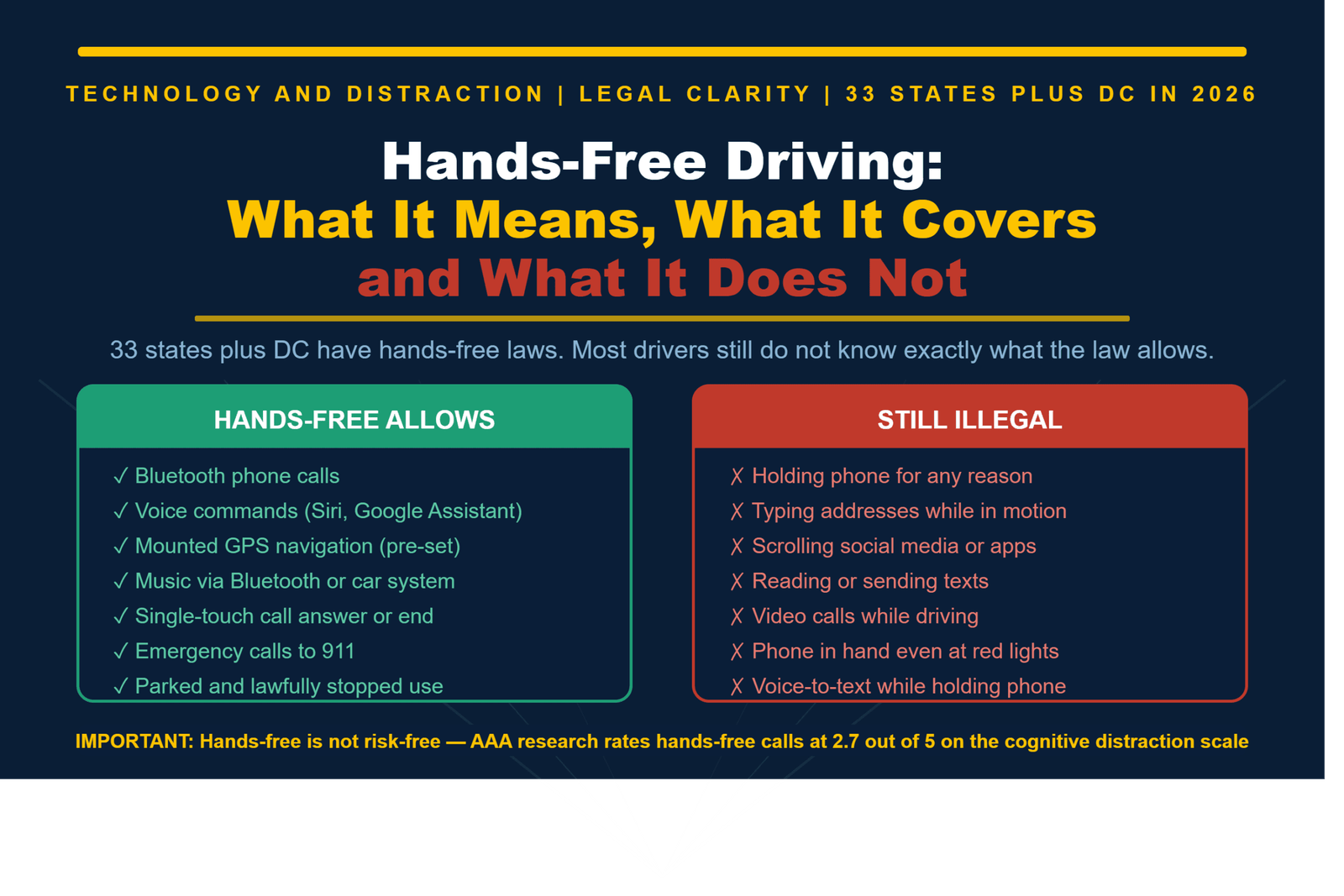
Bluetooth phone calls. Making or receiving phone calls through a Bluetooth-connected car audio system, a Bluetooth speakerphone mounted in the vehicle, or a wireless earpiece all qualify as hands-free. The phone must not be physically held or supported. Bluetooth calls from a phone that is mounted, in a cup holder, or in a bag all qualify as long as the driver’s hands do not touch the device to initiate or manage the call beyond the permitted single-touch exception.
Voice commands. Using Siri, Google Assistant, or any vehicle-integrated voice assistant is fully legal under every hands-free law. These interactions do not require touching the phone and produce no visual distraction as long as the phone screen is not being watched. The cognitive distraction from voice commands is real, as we documented in our article on whether voice-to-text is safe while driving, but the behavior is legal.
Mounted GPS navigation. A phone mounted on a dashboard or windshield mount displaying GPS directions is legal under hands-free laws. The phone must be mounted in a secure holder, not balanced on the dashboard or held between the seat and the driver’s leg. The navigation must be pre-set before the vehicle moves. Touching the screen to enter a new destination while driving is a violation even if the phone is mounted.
Music and audio via Bluetooth. Playing music, podcasts, or audio books through Bluetooth to the car’s audio system is legal. Scrolling through a playlist by touching the phone screen while driving is not. Voice commands to skip tracks or adjust volume are legal. Touch interactions with the phone screen are not.
A driver may use an interactive mobile device if the driver moves the vehicle to the side of or off a highway and halts in a location where the vehicle can safely remain stationary, according to Pennsylvania’s Paul Miller’s Law provisions. Fsalaw
Parked use. Every hands-free law includes an exemption for drivers who have pulled completely off the road and are parked. If you need to type a destination, send a text, or handle any phone interaction that requires touching the screen, pull into a parking lot or side street, stop completely, and handle it before resuming driving.
Emergency calls. Every hands-free law includes an explicit exception for emergency calls to 911 and emergency services. A driver who needs to report an accident, a crime in progress, or a medical emergency can use their phone for that purpose regardless of whether the vehicle is moving.
What Remains Illegal Under Hands-Free Laws
The list of what is prohibited under hands-free laws is longer than many drivers assume, because the prohibition is not limited to texting.
Holding the phone for any reason. This is the foundation of every hands-free law. Holding the phone to make a call, holding it to display a map, holding it to show a passenger something, holding it against your ear without speaking — all are violations. The physical holding is the violation, not the specific activity.
Typing while in motion. Entering a GPS destination, composing a text, typing a search query, entering a password — any activity that requires typing on the phone screen while the vehicle is on a public road is prohibited. This includes doing these things at a red light or in a traffic backup in most states, because the law covers all road use while operating a vehicle, not just while moving.
Scrolling apps and social media. Scrolling through Instagram, checking a news feed, browsing a browser, managing an email inbox — all prohibited under hands-free laws because all require physical interaction with the phone screen.
Video calls. FaceTime, Zoom, Teams, WhatsApp video — any video call while driving is prohibited. This is a specific exclusion in most laws because video calls require the phone to be positioned to display the driver’s face, which means it is either held or propped in a non-legal position.
Voice-to-text while holding the phone. This is a common misconception. Voice-to-text through a properly mounted phone using Siri or Google Assistant is generally legal because the phone is mounted and not held. Voice-to-text while holding the phone is not legal because the holding itself is the violation.
Phone in hand at red lights. This is the most contested and most universally misunderstood element of hands-free laws.
Have you ever picked up your phone at a red light to check directions or silence a notification? Beginning February 28, 2026, South Carolina drivers face real enforcement for violations under the Hands-Free and Distracted Driving Act. The law applies even at traffic lights. Traffic lights and congestion do not create loopholes. DontGetHitTwice
Red lights do not create a legal window for phone use under hands-free laws. The vehicle is operating on a public road. The driver is in control of the vehicle. The law applies. This is explicitly confirmed in the legislative language of every major hands-free law enacted in 2025 and 2026 including Pennsylvania’s Paul Miller’s Law, Louisiana’s HB 519, South Carolina’s Hands-Free Act, and Iowa’s expanded law.
The New States: What Changed in 2025 and 2026
The past twelve months have produced the largest single-year expansion of hands-free law coverage in American history.
As of 2026, 33 states plus the District of Columbia enforce hands-free driving laws that prohibit all handheld cell phone use behind the wheel. The most recent states to enact hands-free laws include Iowa, South Carolina, Louisiana, Pennsylvania, Colorado, and Kansas, all in 2025. Best Online Traffic School
Colorado enacted its hands-free law on January 1, 2025. Colorado reported a 19 percent decrease in inattentive-driving crashes and a 135 percent increase in distracted driving citations within the first few months of enforcement.
Iowa enacted its hands-free law effective July 1, 2025, with a warning period running through December 31, 2025. Citations began January 1, 2026. Iowa first offense carries a $100 fine, rising to $500 if the violation causes an injury and $1,000 if it causes a death.
In July 2025, Iowa passed a hands-free law that limits drivers from handling their phones while driving. According to data from Cambridge Mobile Telematics, phone distraction fell 3.9 percent in the first month after the law took effect. AAA Newsroom
Louisiana enacted HB 519 effective August 1, 2025 with full citation enforcement from January 1, 2026, as we covered in our complete Louisiana hands-free law 2025 guide.
South Carolina enacted the Hands-Free and Distracted Driving Act effective September 1, 2025. A 180-day warning period ran through February 27, 2026, with full citation enforcement beginning February 28, 2026.
The South Carolina Hands-Free and Distracted Driving Act took effect on September 1, 2025. A 180-day warning period was required before citations begin on February 28, 2026. The second and subsequent offenses within a three-year period carry a $200 fine and two points on the driving record. Allen, Allen, Allen & Allen
Pennsylvania enacted Paul Miller’s Law with full citation enforcement from June 6, 2026, covered in full detail in our Pennsylvania Paul Miller’s Law Day 1 article and our earlier Pennsylvania distracted driving law 2026 guide.
Kansas also enacted a hands-free law in 2025, joining the growing majority of US states with comprehensive handheld bans.
North Carolina has the Hands Free NC bill active in its 2025-2026 legislative session. North Carolina saw a 12 percent decrease in crashes linked to phone use after full hands-free enforcement began in 2025.
The States Still Without Full Hands-Free Laws
These states ban texting but still allow handheld phone calls for adult drivers: Alaska, Arkansas, Florida, Kentucky, Mississippi, Montana, Nebraska, New Mexico, North Dakota, Oklahoma, South Dakota, Texas, Utah, West Virginia, Wisconsin, and Wyoming. Montana has no statewide texting ban or hands-free law. Best Online Traffic School
Montana remains the only state with no statewide phone restrictions at all for adult drivers. Texas remains without a comprehensive handheld ban despite multiple legislative attempts including SB 47, which we covered in our Texas hands-free driving bill 2026 article.
For drivers who travel across state lines, the variation is practically important. A driver who is legally holding their phone while driving through Texas may be committing a primary offense the moment they cross into Arkansas, which has been refining its handheld ban to close previous loopholes. Knowing the law of each state you drive through is a practical requirement for multi-state travel in 2026.
What Hands-Free Does Not Fix: The Cognitive Distraction Problem
Here is the element of hands-free driving that the legal conversation often omits and that the research makes impossible to ignore.
Complying with a hands-free law by putting your phone in a mount and conducting calls through Bluetooth makes you legally compliant in every state with a hands-free law. It does not make you cognitively undistracted.
As we covered in our dedicated article on whether voice-to-text is safe while driving, the AAA Foundation for Traffic Safety produced the most comprehensive cognitive distraction scale of in-vehicle technology ever assembled. Hands-free phone calls rate 2.7 on a 1-to-5 scale where 1 is undistracted driving and 5 is maximum measurable cognitive impairment. Voice-to-text through Siri rates 3.7. These ratings occur even when hands are on the wheel and eyes are on the road.
The visual processing suppression that distraction produces in the brain, which we documented in our article on how distracted driving affects your brain, occurs under cognitive load regardless of where the phone is located. A driver who is deeply engaged in a complex or emotionally demanding hands-free call is experiencing measurable reduction in hazard response capability even while appearing perfectly attentive to an outside observer.
This is why the most honest summary of hands-free law compliance is this: it is necessary, it is significant, and it is not sufficient. Hands-free compliance moves a driver from the most dangerous category of phone use, physical phone handling with its visual and manual distraction components, into a still-impaired but less severely impaired category of cognitive-only distraction. The legal standard and the safety standard are not the same.
For the standard that safety research actually supports, any phone interaction during a drive including hands-free calls is a distraction that reduces driving performance. The safest driving is driving with no phone interaction at all, which the technology solutions in our Do Not Disturb while driving setup guide make completely automatic.
Practical Compliance: What to Set Up Before Every Drive
Given the legal landscape described above, here is the specific setup that produces both legal compliance and the best achievable safety outcome in any state with a hands-free law.
GPS destination entered by voice or touch before the car starts moving. Phone mounted in a dashboard or windshield holder if used for GPS. Bluetooth connected and active for any calls that must be taken during the drive. iPhone Driving Focus or Android driving mode activated to silence incoming notifications. Phone placed in a location that the driver will not reach for during the drive, whether that is the mount itself, the back seat, or the glove box.
This five-component setup takes approximately two to three minutes and handles every phone interaction scenario legally and safely: GPS navigation runs passively through audio directions, Bluetooth handles any necessary calls without physical phone interaction, driving mode prevents incoming notifications from creating the temptation to check, and the phone’s physical location removes the impulse reach.
For a complete step-by-step guide to both the iPhone and Android setup components, our Do Not Disturb while driving setup guide covers everything from initial configuration to the passenger override feature. And for the full national picture of which states have which laws with current fine structures, our hands-free driving laws by state 2026 guide covers all 50 states.
Sources Used in This Article
All links verified working before publication.
State Farm: Hands-Free Driving Laws Save Lives — Iowa 3.9% first-month improvement, State Farm advocacy position, April 2026
Iowa Injury Prevention Research Center: Hands-Free Law Goes Into Effect in Iowa — Iowa law details and rationale, June 2025
PennDOT: Distracted Driving and Paul Miller’s Law — Pennsylvania legal provisions
SCDPS: Hands Free SC — South Carolina Hands-Free Act official page, fine schedule
911 Driving School: South Carolina Hands-Free Driving Law Explained — February 28 2026 full enforcement details, February 2026
Road Law Guide: Hands-Free Law by State 2026 — 33 states plus DC, complete state list, February 2026
Scott Vicknair Injury Lawyers: Which States Have Hands-Free Driving Laws — States without full bans, Colorado 19% crash reduction
Vasquez Law: Hands-Free Driving Laws Explained for 2026 — North Carolina 12% crash reduction, March 2026
AAA Foundation: Measuring Cognitive Distraction in the Automobile — Hands-free calls rated 2.7 on cognitive distraction scale
GHSA: Distracted Driving State Laws — National state law reference, October 2025
TextingWithDriving.com is professionally built and maintained to ensure accurate, accessible safety information reaches every driver who needs it. Website development and ongoing support is handled by Budgetic, a digital agency specializing in purpose-driven WordPress websites.

About Texting With Driving
TextingWithDriving.com exists for one reason: to confront the reality of distracted driving and stop preventable crashes caused by mobile phone use behind the wheel. Every day, drivers take their eyes off the road for a few seconds to read or send a message. Those few seconds are enough to cause life-altering consequences. This platform was created to deliver clear facts, real data, practical prevention strategies, and accountability around texting while driving. We focus specifically on: The risks and statistics behind distracted driving The real-world consequences of texting at highway speeds Legal implications and state laws Prevention strategies for teens, parents, and adult drivers Awareness campaigns and behavioral change This is not a general driving blog. It is a focused awareness initiative built around one critical issue: phone distraction behind the wheel. Our content is direct, research-driven, and practical. We prioritize accuracy over opinion and education over sensationalism. The goal is simple — reduce distracted driving incidents by increasing awareness and responsibility. If one article causes one driver to put their phone down, the mission is working. For inquiries or partnerships, contact: privacy@textingwithdriving.com
View all posts by Texting With Driving