

Distracted Driving Insurance Statistics 2026: What Insurers Know That Drivers Do Not

Distracted Driving Insurance Statistics: What Insurers Know That Drivers Do Not
When a driver receives a distracted driving citation, they calculate the fine. They might calculate the insurance impact. Almost none of them know the full scope of what their insurer already knows and is actively using to price their policy right now.
The insurance industry is one of the most data-intensive sectors in the American economy. Insurers aggregate driving violation records, telematics data from in-vehicle sensors and smartphone apps, claims histories, and behavioral patterns from hundreds of millions of policyholders. The picture they have of American driving behavior is significantly more detailed and more current than what appears in government crash statistics, and it is revealing a distracted driving problem that is getting worse, not better, among demographic groups that most drivers would not expect.
On May 19, 2026, LexisNexis Risk Solutions released its 2026 US Auto Insurance Trends Report, drawing on comprehensive market data from prior years including driving behavior, policy shopping activity, claims metrics, and vehicle mix data. The findings on distracted driving are among the most striking in the report.
The Headline Finding: 57 Percent More Violations Since 2022
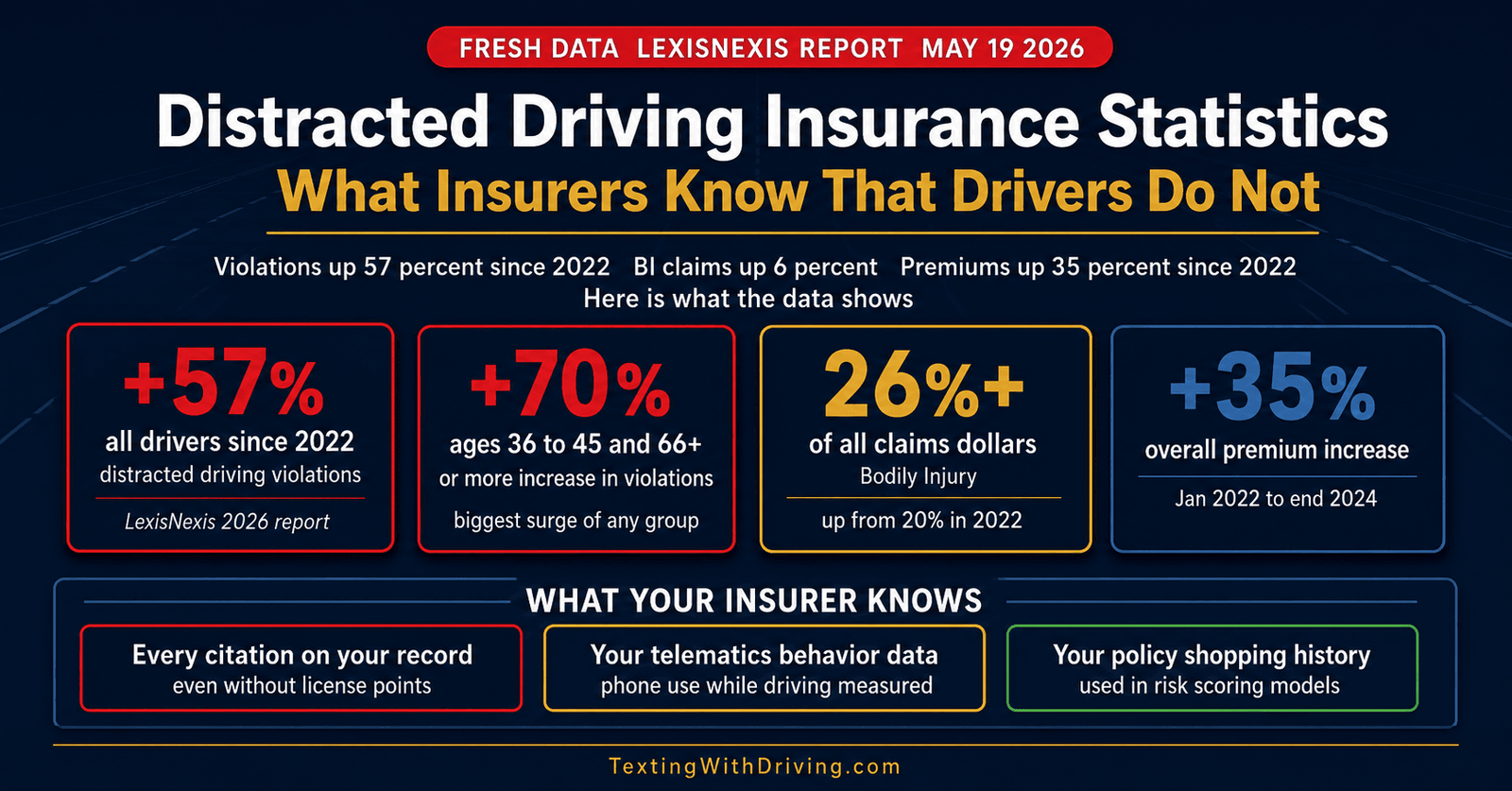
Distracted driving violations are up by 57 percent across all age groups compared to 2022, according to the 2026 LexisNexis US Auto Insurance Trends Report released on May 19, 2026. Over the same time period, distracted driving violations increased by 70 percent or more among age groups 36 to 45, while those 66 and older increased to 73 percent. NHTSA
57 percent more distracted driving violations across all driver ages compared to just four years ago. This is not a statistic about crashes or injuries. It is a statistic about enforcement: actual citations issued by police officers to actual drivers, documented on actual driving records, and compiled in the LexisNexis motor vehicle data system that insurers use to price policies.
This data is distinct from, and in some ways more alarming than, the NHTSA crash statistics we covered in our distracted driving statistics 2026 overview. NHTSA data measures crash outcomes. LexisNexis data measures violation outcomes: the documented instances where enforcement caught up with behavior. The two data sources together tell a story that neither tells alone.
The surge in violations reflects two simultaneous trends. First, behavior has genuinely become more dangerous, with device manipulation up 104 percent since 2015 according to NSC data we covered in our distracted driving statistics 2025 mid-year update. Second, enforcement has intensified, with primary enforcement laws now active in more than 33 states plus DC and high-visibility campaigns like NHTSA’s Put the Phone Away or Pay producing coordinated enforcement spikes every April and during targeted enforcement windows throughout the year. More dangerous behavior being caught by more aggressive enforcement produces the 57 percent violation surge.
The Age Group Finding That Rewrites the Narrative
The most surprising data point in the LexisNexis 2026 report is the age group breakdown of where the violation increase is concentrated.
One of the most significant findings is the sharp increase in distracted driving violations, which have surged by 57 percent since 2022. This rise is not confined to younger drivers. Those aged 36 to 45 and seniors 66 and older experienced increases exceeding 70 percent. Federal Communications Commission
The dominant public narrative about distracted driving focuses on young drivers, particularly teenagers and young adults in their twenties. That focus is legitimate: the research consistently shows that younger drivers have the highest observed rates of device manipulation and the highest crash rates per mile driven. We covered this in depth in our articles on why teen drivers are the most at-risk group and Gen Z texting while driving statistics.
But the LexisNexis data reveals that the fastest-growing violation categories in 2026 are middle-aged adults aged 36 to 45 and older drivers aged 66 and above. Both groups saw violations increase by 70 percent or more. That exceeds the already-alarming 57 percent all-ages average.
For the 36 to 45 age group, this finding may reflect the intersection of high smartphone dependency, demanding professional communication expectations, and the false confidence of experienced drivers who believe their skills compensate for distraction. Research on optimism bias in risk assessment consistently finds that experienced drivers are among the most likely to believe they can safely manage phone use that would be clearly dangerous for a new driver.
For the 66 and older group, the finding is both surprising and consistent with other data. Despite only a modest 2 percent rise in miles driven, violations have returned to pre-pandemic levels and even surpassed them in some categories, indicating changing driver behaviors rather than just more time spent on the road. Older drivers are adopting smartphones at increasing rates and their phone use patterns while driving are catching up with younger cohorts. NHTSA
The insurance implication is direct: insurers are now pricing the risk of middle-aged and older drivers differently than they did five years ago, specifically because the violation data is showing elevated distracted driving risk across the entire age spectrum, not just among young drivers.
Bodily Injury Claims: The Most Financially Significant Insurance Trend
Beyond the violation count data, the LexisNexis report documents a claims pattern that is directly relevant to every driver’s insurance costs.
Bodily injury claims now account for more than 26 percent of total claims dollars, up from less than 20 percent in 2022, as BI frequency and severity continue to rise. Claims severity continues to evolve, as bodily injury severity jumped 9.2 percent year over year, and property damage severity climbed 2.5 percent year over year. Nhtsa
Bodily injury claims as a share of total claims dollars have risen from under 20 percent in 2022 to over 26 percent in 2025. That 6-plus percentage point increase represents an enormous shift in the risk composition of the insurance portfolio and is a primary driver of the premium increases that every American driver has experienced over the past several years.
The connection between distracted driving and bodily injury claims is direct and documented. Crashes involving phone distraction produce higher-severity injuries than crashes of comparable vehicle speeds without distraction, partly because distracted drivers provide no pre-crash response that might reduce impact force, and partly because the crash types most associated with distraction, rear-end collisions and lane departures at speed, are among the highest-injury crash types.
When a bodily injury claim is filed following a crash where the at-fault driver was using their phone, the claim is substantially larger than a property-damage-only claim. Medical expenses, lost wages, pain and suffering damages, and rehabilitation costs combine to produce settlements and verdicts that can reach into the tens of thousands or millions of dollars. We documented specific examples of this in our article on whether you can be sued for texting while driving, including the $4.75 million Ohio settlement in a case involving a distracted truck driver.
The 9.2 percent year-over-year increase in bodily injury severity means each BI claim is costing significantly more than it did a year ago. Combined with the increase in BI frequency, this produces the premium pressure that the LexisNexis report documents across the entire market.
The Premium Impact: What 35 Percent in Four Years Actually Means
Overall industry rate levels increased by 35 percent from January 2022 to the end of 2024. These rate increases helped US insurers address profitability issues, as direct written premiums grew 13.6 percent to $359 billion in 2024. Nhtsa
A 35 percent increase in auto insurance premiums across the entire industry in approximately three years. This is the cumulative impact that the combination of increased distracted driving violations, higher bodily injury claim severity, and broader claims trends has imposed on every American driver’s insurance costs.
The average US auto insurance premium was approximately $1,500 per year in 2021. A 35 percent increase applied to that baseline produces a 2024 average of over $2,000. Not every driver experienced exactly this increase, as individual risk profiles, coverage levels, and state-specific regulation produce significant variation. But the directional impact is universal: the industry had to raise prices substantially to remain financially viable given the claims environment it was experiencing.
Rate increases in auto insurance are not arbitrary decisions made to increase insurer profits. They are actuarial responses to claims costs. When the population of insured drivers produces more claims, more severe claims, and more distracted driving-related claims, the premium pool must increase to cover them. Every driver pays more because the behavioral choices of distracted drivers create costs that are distributed across the entire insured population.
This is the real financial story of distracted driving that the citation fine figures do not capture. The $50 to $200 in headline fines. The $1,000 to $3,000 in individual premium increases for cited drivers over three years, which we covered in our article on car insurance after a distracted driving ticket. And the broader premium increase for every driver in the market, whether they have received a distracted driving citation or not.
What Insurers Know That Drivers May Not Realize
The insurance industry’s understanding of individual driver risk is substantially more detailed than most policyholders assume. Understanding what data insurers access helps drivers make more informed decisions about their behavior and their coverage.
Violation records without license points. As we covered in the Paul Miller’s Law enforcement article, Pennsylvania’s law carries no license points for non-commercial drivers. Some drivers assume that a no-points citation does not affect their insurance. This is incorrect in practice. Insurers access motor vehicle records through LexisNexis and similar data aggregators that capture violation records directly from state DMVs, regardless of whether points were assessed. A distracted driving citation without points is still a documented violation that insurers can see and use in pricing.
Telematics behavior data. Usage-based insurance programs, where a driver allows their insurer or a third-party telematics provider to monitor their driving behavior through a smartphone app or vehicle device, are now enrolled by a significant and growing share of American drivers. These programs monitor phone handling events, hard braking, speed, and other risk indicators. Drivers who use their phones while enrolled in a telematics program are providing direct evidence of their distraction behavior to their insurer. This data is used in premium calculations and is increasingly portable between insurers as drivers shop for coverage.
The LexisNexis consumer survey showed that insurance is now firmly part of vehicle purchase decisions. Fifty-six percent of respondents said insurance cost is a key factor when buying a vehicle, second only to the importance of the monthly payment at 63 percent. NHTSA
Policy shopping history. LexisNexis’s own data now includes insurance shopping activity as a risk factor. Drivers who frequently shop for insurance are associated, in aggregate, with higher risk profiles. This does not mean shopping for a better rate is harmful, but it does mean that the shopping activity itself is visible to insurers and may be factored into how they price new business.
The claim linkage data. When a crash produces a bodily injury claim and insurers investigate the circumstances, any distracted driving citation history from the at-fault driver becomes part of the claim file. The violation record does not just affect premiums going forward. It can affect how an insurer responds to a claim and whether they pursue subrogation against the at-fault party.
The Telematics Revolution: How Behavioral Data Is Changing Insurance Pricing
One of the most significant structural changes in auto insurance over the past five years is the expansion of telematics-based pricing, which directly links distracted driving behavior to premium costs at the individual driver level rather than relying solely on violation records.
Cambridge Mobile Telematics, whose distracted driving data we referenced throughout this series, is a major provider of telematics infrastructure to auto insurers. Their finding that distracted driving dropped 8.6 percent in 2024, preventing 105,000 crashes, reflects in part the behavioral change produced by telematics insurance programs. When drivers know their phone handling behavior is being measured and linked to their premiums, the behavior changes.
Jeff Batiste, senior vice president at LexisNexis Risk Solutions, emphasized the evolving nature of risk in auto insurance. He noted that insurers must adapt by using more detailed data analytics and refined pricing models to manage these emerging trends effectively. Enhanced segmentation strategies incorporating violation records, insurance shopping behaviors, and vehicle data will be critical for navigating this dynamic market. Federal Communications Commission
The direction of insurance pricing innovation is toward more granular, more behavioral, and more real-time risk assessment. A driver who today receives a broad premium increase because their cohort has a high violation rate may within a few years receive a highly individualized premium that reflects their specific phone use behavior during the past 90 days of driving. The technology already exists. The regulatory and consumer acceptance frameworks are evolving.
For drivers who use their phones while driving and are enrolled in telematics programs, this evolution represents an accelerating financial incentive to change behavior. For drivers who do not use their phones while driving, it represents an opportunity to document and receive credit for the behavioral advantage their safe habits create.
The Consumer Response: Record Policy Shopping
Policy shopping reached historic highs in Q4 2025, with more than 47 percent of policies-in-force shopped at least once in the previous 12 months. In response to four years of sustained rate increases, many policyholders adjusted their coverage to manage insurance premiums. The share of policies with deductibles of $1,000 or greater increased from 23 percent in 2022 to 33 percent in 2025. Nhtsa
Nearly half of all insured drivers shopped their auto insurance at least once in the past year. Record policy shopping reflects consumer price sensitivity after four years of substantial premium increases. Drivers are looking for better rates, and a growing share are raising their deductibles to reduce premiums, accepting more financial risk in exchange for lower monthly costs.
For distracted drivers with citation records, this shopping behavior creates a specific challenge. Premium increases following a distracted driving citation are carrier-specific, and as we noted in our car insurance after a distracted driving ticket article, the variation between carriers for the same violation profile is substantial. Shopping after a citation is often the single most financially effective response available to a cited driver, because finding a carrier whose rating model applies a lower surcharge for the specific violation can reduce the premium impact significantly.
The corollary is also true: insurers who develop better behavioral risk models through telematics and enhanced data analytics will be able to price their good-risk customers more competitively, attracting the safe drivers who generate fewer claims. This competitive dynamic is an additional market force pushing insurance pricing toward behavioral measurement and away from demographic approximation.
What All of This Means for Individual Drivers
The LexisNexis 2026 report documents a market in which distracted driving behavior is more visible to insurers, more consequential for premiums, and more closely tracked across every demographic group than most drivers assume.
The practical implications are specific.
Every distracted driving citation, regardless of fine level or point assignment, is visible to your insurer and will be used in premium calculations. This is true regardless of which state you are in and regardless of whether your state’s law assigns license points.
Telematics program enrollment creates direct evidence of behavior. If you use your phone while enrolled in a telematics program, your insurer has documentation of that behavior and can price it accordingly.
The broader market premium increase of 35 percent since 2022 is partly driven by the behavior of distracted drivers across the insured population. The costs of distracted driving are shared by all drivers through premium pricing, regardless of individual behavior.
And the demographic finding, that middle-aged and older drivers are seeing the fastest-growing violation rates, is a reminder that distracted driving is not a young-driver problem that adults have outgrown. It is a behavioral pattern that the LexisNexis data shows is accelerating fastest among the demographic groups most likely to believe they have already addressed it.
For the full picture of what a citation specifically costs in premium terms over three years, see our car insurance after a distracted driving ticket article. For the national crash data that explains why insurers are pricing distraction so aggressively, our distracted driving accident statistics article has the complete breakdown. And for the technology tools that make phone-free driving automatic and documentable, our guide to the best apps to block texting while driving covers the full range including telematics-integrated solutions.
Sources Used in This Article
All links verified working before publication.
PR Newswire: 2026 LexisNexis US Auto Insurance Trends Report — May 19, 2026, full report release
Repairer Driven News: 56 Percent of Consumers Consider Insurance Costs When Buying Vehicle — May 20, 2026
Insurance Business: LexisNexis Flags Surge in Distracted Driving and BI Costs — May 2026
OurAutoWorld: 2026 Report Shows Distracted Driving and BI Claims Reshape Car Insurance Market — May 2026
LexisNexis: 2025 US Auto Insurance Trends Report — Prior year baseline data including 50 percent violation rise
The Auto Channel: 2026 LexisNexis Report — Full report details including age group breakdown
QuoteWizard: 5 Key Auto Insurance Trends Every Agent Needs to Know — Bodily injury severity increase context, December 2025
NHTSA: Distracted Driving — National crash data context
TextingWithDriving.com is professionally built and maintained to ensure accurate, accessible safety information reaches every driver who needs it. Website development and ongoing support is handled by Budgetic, a digital agency specializing in purpose-driven WordPress websites.

About Texting With Driving
TextingWithDriving.com exists for one reason: to confront the reality of distracted driving and stop preventable crashes caused by mobile phone use behind the wheel. Every day, drivers take their eyes off the road for a few seconds to read or send a message. Those few seconds are enough to cause life-altering consequences. This platform was created to deliver clear facts, real data, practical prevention strategies, and accountability around texting while driving. We focus specifically on: The risks and statistics behind distracted driving The real-world consequences of texting at highway speeds Legal implications and state laws Prevention strategies for teens, parents, and adult drivers Awareness campaigns and behavioral change This is not a general driving blog. It is a focused awareness initiative built around one critical issue: phone distraction behind the wheel. Our content is direct, research-driven, and practical. We prioritize accuracy over opinion and education over sensationalism. The goal is simple — reduce distracted driving incidents by increasing awareness and responsibility. If one article causes one driver to put their phone down, the mission is working. For inquiries or partnerships, contact: privacy@textingwithdriving.com
View all posts by Texting With Driving