

Distracted Driving Awareness Month 2026: Put the Phone Away or Pay, $5M Campaign and What Changed

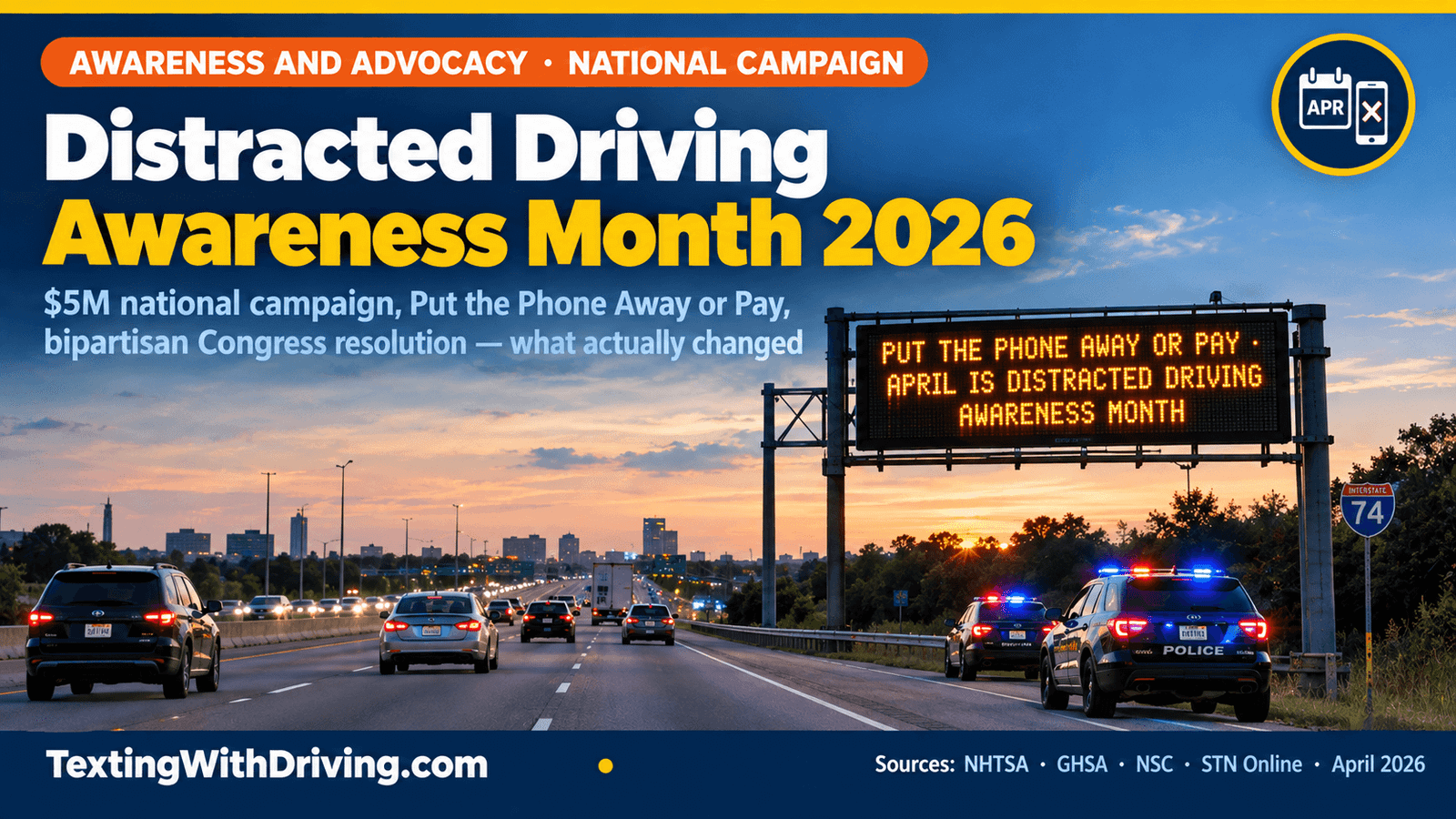
Distracted Driving Awareness Month 2026: Put the Phone Away or Pay, $5M Campaign and What Changed
Distracted Driving Awareness Month 2026 launched on April 1 with the most coordinated national response in the awareness month’s history — a $5 million national media campaign, a dedicated enforcement window that paired federal messaging with high-visibility state enforcement, a bipartisan congressional resolution, simultaneous state gubernatorial proclamations in more than a dozen states, and the first sustained public appearance by a new NHTSA administrator on the distracted driving issue.
Distracted driving is 100 percent preventable, yet too many people give the road far less than 100 percent of their attention.
Those words from NHTSA Administrator Jonathan Morrison at the April 1 kickoff press event established the 2026 Distracted Driving Awareness Month’s foundational message: the 3,208 people killed and 315,167 injured in 2024 distracted driving crashes did not have to die or be hurt. Every one of those deaths and injuries was preventable. The choice to pick up the phone while driving was not inevitable. And that means the choice to put it down is always available.
This guide covers the complete Distracted Driving Awareness Month 2026 picture: the national campaign’s specific elements and reach, what NHTSA’s enforcement data shows about April’s effectiveness, the congressional resolution and its specific language, the state-level campaigns that amplified the national effort, the survivor testimony that put a human face on the statistics, and — most importantly — what actually changed in driver behavior after April’s intensive month of awareness and enforcement.
The National Campaign: Put the Phone Away or Pay
Distracted Driving Awareness Month 2026‘s primary campaign vehicle was NHTSA’s “Put the Phone Away or Pay” — the national enforcement and education initiative that has become the standard banner under which NHTSA coordinates federal and state distracted driving responses.
NHTSA officials kicked off National Distracted Driving Awareness Month and unveiled a renewed national enforcement and education effort aimed at curbing one of the most persistent dangers on U.S. roadways.
The 2026 campaign’s specific components:
$5 million national media buy. The Put the Phone Away or Pay campaign was supported by a $5 million national media on television, radio, and digital platforms. This is the largest documented federal media spend for a single distracted driving awareness campaign since the campaign’s launch. The $5 million figure, spanning television, radio, and digital platforms, placed distracted driving prevention messaging across every major media category that reaches the target demographic.
Target demographic: Ages 18 to 34. NHTSA’s high-visibility enforcement targeted drivers aged 18 to 34 who, according to NHTSA data, are more likely to die in distraction-affected crashes than any other age group. The 18-to-34 demographic focus reflects the crash data’s consistent finding that young adults — not teenagers — constitute the highest absolute number of distracted driving fatalities. While teen drivers have higher per-mile crash rates, the larger licensed population of the 18-to-34 cohort produces more total distracted driving deaths.
Put the Phone Away or Pay enforcement campaign: April 9-13, 2026. NHTSA’s high-visibility enforcement window ran during this five-day period — the midpoint of the awareness month, paired with the national media push to create simultaneous messaging and enforcement presence. NHTSA’s enforcement campaigns coordinate state highway patrol agencies, local law enforcement, and in 2026 for the first time some AI-camera-equipped jurisdictions, into a week of intensified citation activity.
“Eyes Forward. Don’t Drive Distracted” messaging. The U.S. Department of Transportation’s National Highway Traffic Safety Administration called on drivers to take a proactive role in road safety by following and spreading this message: Don’t Drive Distracted. Eyes Forward. The two-word “Eyes Forward” command is the 2026 campaign’s most distilled behavioral instruction — not “put the phone down” (which can be interpreted as temporary), not “be careful” (which is too vague to act on), but “eyes forward” — the specific physical state that the campaign’s target behavior produces.
FMCSA Administrator Derek Barrs at the April 1 launch. FMCSA’s presence at the NHTSA kickoff reflects the specific commercial driver context for the awareness month: as we documented in our FMCSA commercial driver distracted driving rules article, commercial drivers are subject to federal $2,750 maximum fines for first offense handheld violations, CSA score impacts, and the specific driver-facing AI cameras that fleet telematics deploy. FMCSA’s joint appearance with NHTSA signals that April’s enforcement included commercial vehicle enforcement alongside passenger vehicle campaigns.
The Human Story: Patty Kruszewski at the April 1 Press Event
Distracted Driving Awareness Month 2026‘s most powerful element was not the $5 million media buy or the enforcement window. It was Patty Kruszewski — who lost her daughter in a distracted driving crash — standing at the NHTSA press event on April 1 and putting the human face on the statistics that the awareness month exists to humanize.
Patty Kruszewski, who lost her daughter in a distracted driving crash, spoke at the press event alongside Administrator Morrison and FMCSA Administrator Barrs.
The survivor and victim family advocacy tradition in distracted driving awareness campaigns follows the same pattern documented across the awareness campaigns we covered in our distracted driving awareness campaigns that worked article: named victims and survivor testimony produce behavioral change that statistics alone cannot. The campaign that shows 3,208 deaths in a year produces limited behavioral change in the individual driver who does not emotionally connect the number to a specific person. The parent who lost a child, the spouse who lost a partner, the friend who lost a friend — these narratives convert the abstraction into the specific loss that makes the risk feel real.
Behind every statistic, that’s a human life. That assessment from FMCSA Administrator Barrs captures the function that survivor testimony in awareness campaigns serves: translating the aggregate statistics into the specific human reality that changes the calculation a driver makes when they reach for their phone.
The Congressional Resolution: Bipartisan Awareness Month Designation
Distracted Driving Awareness Month 2026 received its highest-profile congressional recognition on April 20, when Representatives Chris Pappas (NH-01) and Tracey Mann (KS-01) introduced a bipartisan resolution to officially designate April 2026 as Distracted Driving Awareness Month.
Distracted driving kills over 3,000 people every year, and injures more than 300,000. These losses are preventable, and it’s up to all of us to make sure everyone traveling on our roads makes it to their destination safely. I’m proud to partner with Representative Mann to mark Distracted Driving Awareness Month.
The bipartisan pairing — a New Hampshire Democrat and a Kansas Republican from the House Transportation and Infrastructure Committee — established the cross-party nature of the distracted driving safety message that GHSA CEO Jonathan Adkins has consistently emphasized. Distracted driving does not have a political constituency. It has only victims, survivors, and the prevention community that is trying to reduce a death toll that is preventable.
GHSA commended Congressman Mann for recognizing April as Distracted Driving Awareness Month and for shining a much-needed spotlight on one of the most pervasive and preventable threats on our roads. Jonathan Adkins, CEO of GHSA, also cited the need for stronger state laws — reflecting the policy gap that awareness months cannot close on their own. Awareness campaigns change some behavior. Laws change more behavior. The congressional resolution recognizes the awareness month’s value while the GHSA advocacy continues to push for the comprehensive primary enforcement laws that produce measurable behavioral change beyond what campaigns alone generate.
The NSC’s Lorraine Martin added the specific behavioral call-to-action: just drive — by making distraction-free driving the norm, not the exception. The “just drive” framing is the 2026 awareness month’s behavioral objective stated most simply: not “be more aware of distracted driving as a problem,” but “don’t do it yourself, right now, every drive.”
Brandy Nannini of SAFE (Safety and Advocacy for Empowerment) connected distracted driving to the broader impaired driving context: whether it’s a phone in hand or alcohol in the system, distraction behind the wheel leads to the same tragic outcome — preventable crashes. The connection to impaired driving reflects the same cognitive impairment comparison we documented in our distracted driving brain science 2026 article, where phone calls produce BAC-equivalent cognitive impairment.
The Undercounting Problem: What the NSC Says the Real Numbers Are
Distracted Driving Awareness Month 2026 confronted the most significant data challenge in the entire distracted driving policy conversation: the massive undercount of actual distracted driving deaths in official statistics.
NHTSA reports that 3,275 people died in distraction-related crashes in 2023, in addition to more than 289,000 serious injuries. The National Distracted Driving Coalition says distracted driving is grossly under-reported, estimating between 25 and 30 percent of all fatal crashes involve distracted driving, which translates to an estimated 11,500 to 13,800 deaths every year.
11,500 to 13,800. The NDDC’s estimate — based on the same type of analysis that produced the AAA Foundation’s drowsy driving finding that actual drowsy driving deaths are 10 times the official count — places distracted driving deaths at three to four times NHTSA’s reported figure.
The undercount mechanism is the same as drowsy driving’s undercount: a crash investigator who arrives after the fact cannot definitively establish that a driver was looking at their phone without phone records or camera evidence. The driver’s post-crash self-report is unreliable. Phone records require subpoenas. And the coding of “distraction” as a contributing factor requires the investigating officer to positively determine that distraction was present — a burden of proof that produces systematic undercoding.
According to NHTSA, 16,384 people died and about 1.7 million people were injured in distraction-affected crashes from 2019 to 2023. The five-year cumulative figure — 16,384 deaths, 1.7 million injuries — is the official NHTSA count. Applied to the NDDC’s undercount estimate, the real five-year total may be 57,000 to 68,000 deaths and millions more injuries over the same period.
Whichever statistics you choose, the numbers are simply too high. That assessment from Michelle Anderson, Director of Operations at the National Road Safety Foundation, frames the undercounting debate correctly: the precise number matters less than the recognition that all estimates — the conservative official figures and the higher NDDC estimates — represent deaths that were 100 percent preventable.
State-Level Campaigns: From Michigan to South Carolina
Distracted Driving Awareness Month 2026 was amplified by state-level gubernatorial proclamations, enforcement campaigns, and public outreach efforts across the country.
Michigan: Governor Gretchen Whitmer proclaimed April 2026 as Distracted Driving Awareness Month in Michigan, citing Michigan State Police data showing 14,439 distracted driving crashes and 65 fatalities in Michigan during 2025. Michigan’s gubernatorial proclamation specifically noted the responsibility of reducing injuries and fatalities caused by distracted driving falls on every driver — the individual behavioral responsibility framing that NHTSA’s “Eyes Forward” campaign also centered.
South Carolina: The South Carolina solicitor network required all regular enforcement subgrantees to support and conduct enforcement and educational activities during Distracted Driving Awareness Month as a special condition of their grant awards. South Carolina’s April 2026 campaign built on the first-year momentum of the new hands-free law that took effect September 2025 — as documented in our South Carolina distracted driving law 2026 article, SC was in its active enforcement phase with 13,814 citations in six months. The April awareness month overlapped with SC’s active enforcement calendar, creating the dual messaging and enforcement presence that produces the largest behavioral effect.
Kansas: The Iowa State Patrol — in neighbor Iowa — issued 551 citations and 329 warnings during a concentrated Distracted Driving Awareness Month enforcement week of April 6-10, as documented in our Iowa distracted driving law 2026 article. Iowa’s April enforcement wave was the most specifically documented state-level awareness month enforcement campaign of any state, producing the April enforcement data that contributed to the 8,489 six-month citation total.
Virginia: Virginia’s Distracted Driving Awareness Month activities in April 2026 were documented in our Virginia distracted driving awareness campaigns 2026 article — DRIVE SMART Virginia’s 12th Annual Summit planning for August 2026 launched during April, and Road Shark’s Fairfax County enforcement citations continued at their Wave 2 pace of 11,791 citations per deployment.
The DRIVE SMART Virginia Connection
Distracted Driving Awareness Month 2026 had specific connections to Virginia’s coordinated safety infrastructure that we have documented throughout September’s article series.
DRIVE SMART Virginia — whose 12th Annual Summit we documented bringing together more than 75 traffic safety professionals in Williamsburg in August 2026 — uses April’s national awareness month as a programmatic launchpad for the year’s school visit campaigns. The simulator program that reached 6,000 teens in 28 Virginia high schools in 2025 plans its school year calendar with April as the public visibility window and September’s back-to-school period as the highest-impact deployment window.
The specific Virginia enforcement data from April 2026 reflects both Road Shark’s continued operation and the additional awareness month enforcement focus: Virginia State Police headquarters messaging during Distracted Driving Awareness Month specifically cited Operation DISS-RUPT’s year-round interstate coverage and the SB84 camera deployment in school zone crosswalks as complementary enforcement tools operating year-round, with April’s awareness month providing the public education context.
What the 2026 Awareness Month Was Responding To
Distracted Driving Awareness Month 2026 was responding to a specific backdrop of data developments that make 2026 a pivotal year for distracted driving policy.
The data context that April 2026 awareness activities addressed:
The LexisNexis 2026 violation increase data: 57 percent increase in distracted driving violations since 2022, as documented in our distracted driving statistics 2026 article. The violation increase — from both expanded primary enforcement law coverage and telematics monitoring growth — established that the behavior is increasing despite growing awareness and enforcement infrastructure.
NHTSA 2024 data release (3,208 deaths, 315,167 injuries): The most recent annual NHTSA data, released in the weeks before the April 2026 awareness month, provided the current-year statistics that NHTSA’s campaign materials used. The 2024 figures showed 3,208 deaths — marginally lower than 2023’s 3,275 — suggesting very modest improvement in the aggregate fatality count even as violation rates increased dramatically.
The 2026 state law wave: Iowa’s January 2026 full enforcement launch, South Carolina’s February 2026 full enforcement launch, Kansas’s April 2026 SB366 signing, and the ongoing comprehensive law implementation in Ohio, Colorado, Pennsylvania, and other recently enacted states all converged in the weeks surrounding April 2026 — creating a legislative wave backdrop that April’s awareness activities could address specifically.
The GHSA $100,000 IIHS grant for Maryland pilot data: As documented in our distracted driving news August 2026 article, the GHSA Annual Meeting in 2026 spotlighted the Maryland AI camera pilot’s preliminary data showing 2,500 violations detected per day. The technology landscape that April 2026’s “Put the Phone Away or Pay” messaging was targeting is different from the technology landscape of prior year campaigns: AI cameras, fleet telematics producing 73 percent event reductions, DMS in new vehicles, and the behavioral monitoring infrastructure that makes the “Pay” in “Put the Phone Away or Pay” increasingly literal and certain.
What Actually Changed After Distracted Driving Awareness Month 2026
Distracted Driving Awareness Month 2026 — as with all awareness campaigns — raises the specific question that behavioral research requires we ask: did anything actually change?
As we documented in our distracted driving awareness campaigns that worked article, awareness campaigns alone produce modest, temporary behavioral change. The behavioral change research on awareness month effectiveness shows:
Short-term enforcement effects are real but fade. The specific enforcement window — April 9-13, five days — produces documented citation increases and associated short-term behavior changes from drivers who perceive higher enforcement probability. The CMT telematics data from prior awareness month periods shows phone-motion event reductions during heavy enforcement windows that partially reverse in the weeks following.
Media campaigns combined with enforcement produce better outcomes than either alone. The $5 million media buy combined with the April 9-13 enforcement window creates the dual-channel effect that NHTSA’s campaign design is built around: the media buy raises awareness of the enforcement campaign, and the enforcement campaign creates the deterrent effect that the media buy communicates. Together they produce more behavior change than either component alone.
The behavioral change that matters is post-month persistence. Awareness months are effective when they produce habits that persist beyond April. The driver who activates Driving Focus for the first time during April’s campaign and maintains the habit in May, June, and beyond has produced a permanent behavioral change. The driver who drives more carefully for the enforcement window week and returns to previous habits on April 14 has not.
The behavioral improvement in Iowa — which ran its April 2026 enforcement week during this awareness month and documented 551 citations — is measurable because Iowa’s law creates the year-round enforcement and behavioral monitoring infrastructure that makes April’s acceleration meaningful rather than isolated. The awareness month’s most durable impact is as an acceleration of the year-round enforcement and behavioral change ecosystem that primary enforcement hands-free laws create.
The Organizational Coalition Behind Distracted Driving Awareness Month
Distracted Driving Awareness Month 2026 represents the coordinated effort of a broad coalition of organizations that advance distracted driving prevention throughout the year, with April as the public visibility peak.
The key organizations whose 2026 contributions we have documented throughout this series:
NHTSA: Federal regulatory authority, campaign operator, and primary data source. The Put the Phone Away or Pay campaign, the $5 million media investment, and the Administrator’s April 1 press event.
GHSA: Governor’s Highway Safety Association, coordinating state highway safety offices that manage enforcement grants, running the Annual Meeting that spotlighted AI and telematics technology, and supporting the IIHS $100,000 Maryland pilot grant.
NSC: National Safety Council, providing the 25-30 percent fatal crash estimate, the $109 billion societal cost of fatigue-related crashes, and the “just drive” behavioral call-to-action. NSC CEO Lorraine Martin’s statement at the congressional resolution announcement.
NDDC: National Distracted Driving Coalition, providing the broader distracted driving undercount estimate and operating the August 2026 webinar series that released the TIRF 2026 teen survey findings we documented in our teen distracted driving behavior change 2026 article.
DRIVE SMART Virginia: State-level advocacy organization whose simulator program, annual summit, and parent-teen programming represent the school and community engagement that April’s awareness month’s national campaign cannot reach at the local level.
StopDistractions.org: Jennifer Smith’s advocacy organization, whose testimony in state legislatures including Kansas’s 2024 and 2025 sessions contributed to SB366’s passage, and whose presence at awareness month events nationwide puts the survivor community’s voice in the policy process.
What Every Driver Should Take From Distracted Driving Awareness Month 2026
Distracted Driving Awareness Month 2026 delivers a specific action agenda — not just awareness, but the specific behavioral changes that the month’s research, campaigns, and enforcement are designed to produce.
Activate Driving Focus or Android DND permanently. Not for April. For every drive. The April 9-13 enforcement week ends. The enforcement probability that Put the Phone Away or Pay communicates is real year-round — 33-plus states have primary enforcement hands-free laws, AI cameras are expanding, and telematics is monitoring behavior across millions of enrolled drivers every trip. The behavioral setup that makes April’s compliance automatic should be in place before April ends.
Share the awareness month’s data with someone who doesn’t know it. The NSC’s estimate of 11,500-13,800 real annual distracted driving deaths versus NHTSA’s 3,208 reported figure is a data point that most drivers have never seen. The person who learns that the official figure may be three to four times undercounting the real toll has new information that changes the perceived risk of the behavior.
Recognize that enforcement is year-round. Put the Phone Away or Pay’s enforcement window ran April 9-13. But Road Shark in Fairfax County ran 11,791 citations in a single deployment. Virginia State Police issued 53 distracted driving citations in two days on I-66. Iowa issued 8,489 citations in six months. South Carolina issued 13,814 citations in six months. The enforcement is not concentrated in April. April’s value is not creating enforcement where there is none — it is amplifying enforcement that is ongoing year-round.
The “Eyes Forward” instruction is for every drive, not every April. NHTSA’s 2026 campaign slogan is the clearest behavioral instruction in the awareness month’s history: Eyes Forward. Two words. One permanent behavioral standard. Every drive.
For the comprehensive distracted driving statistics that provide the data context for April 2026’s awareness activities, our distracted driving statistics 2026 article covers the full picture. For the state law landscape that the awareness month is designed to support, our distracted driving laws all 50 states 2026 covers every jurisdiction. For the Virginia-specific campaigns that parallel April’s national effort year-round, our Virginia distracted driving awareness campaigns 2026 article covers Road Shark, DRIVE SMART, and Operation DISS-RUPT. And for the technology setup that makes “Eyes Forward” automatic on every drive, our hands-free while driving complete setup guide covers iPhone, Android, Bluetooth, and CarPlay.
Sources Used in This Article
All links verified working before publication.
STN Online: NHTSA Kicks Off Distracted Driving Awareness Month with Campaign — Administrator Jonathan Morrison April 1 press event, distracted driving 100% preventable, FMCSA Administrator Derek Barrs behind every statistic human life quote, Patty Kruszewski daughter lost distracted driving crash, national enforcement and education effort, April 2026
eDriving: National Campaign Highlights Dangers of Distracted Driving — Put the Phone Away or Pay April 10-14 enforcement, $5 million national media television radio digital, ages 18-34 most likely to die distraction-affected crashes, Peter Simshauser NHTSA Chief Counsel quote, April 2026
NHTSA Traffic Safety Marketing: Put the Phone Away or Pay — April 1-30 2026 Distracted Driving Awareness Month, April 6-13 national enforcement, 3,275 killed 2023 324,819 injured, 8% fatal crashes 13% injury crashes distraction-affected
SafeTREC Berkeley: April Is Distracted Driving Awareness Month — 3,208 killed 315,167 injured 2024 distracted driving, NHTSA tips phone in trunk designated texter Do Not Disturb, 8% fatal crashes 13% injury crashes, April 17 2026
Pappas House: Bipartisan Distracted Driving Awareness Month Resolution — Rep. Chris Pappas NH-01 Rep. Tracey Mann KS-01 bipartisan resolution, 3,000+ killed annually 300,000 injured, Lorraine Martin NSC just drive quote, Jonathan Adkins GHSA quote, Brandy Nannini SAFE phone alcohol same tragic outcome, April 20 2026
StreetInsider: April Is National Distracted Driving Awareness Month — NDDC 25-30% all fatal crashes = 11,500-13,800 deaths annually, Michelle Anderson National Road Safety Foundation quote numbers too high, survivor advocacy, April 1 2026
SC Solicitor District 11: April Distracted Driving Prevention Month — NHTSA SCDPS Don’t Drive Distracted Eyes Forward campaign, 16,384 deaths 1.7 million injured 2019-2023, grant subgrantee requirement enforcement activities April 2026
Michigan.gov: April 2026 Distracted Driving Awareness Month — Governor Whitmer proclamation Michigan, 14,439 crashes 65 fatalities 2025 Michigan State Police, 9 killed 1,000 injured daily nationwide NHTSA, April 1 2026
Acusensus: National Distracted Driving Awareness Month 2026 — Daily choice road safety personal responsibility, NHTSA focus distracted driving costs lives, collective effort shift behaviours, April 30 2026
NHTSA: Distracted Driving — 3,208 deaths 2024, 537,000 distracted drivers any daylight moment, national context
TextingWithDriving.com is professionally built and maintained to ensure accurate, accessible safety information reaches every driver who needs it. Website development and ongoing support is handled by Budgetic, a digital agency specializing in purpose-driven WordPress websites.

About Texting With Driving
TextingWithDriving.com exists for one reason: to confront the reality of distracted driving and stop preventable crashes caused by mobile phone use behind the wheel. Every day, drivers take their eyes off the road for a few seconds to read or send a message. Those few seconds are enough to cause life-altering consequences. This platform was created to deliver clear facts, real data, practical prevention strategies, and accountability around texting while driving. We focus specifically on: The risks and statistics behind distracted driving The real-world consequences of texting at highway speeds Legal implications and state laws Prevention strategies for teens, parents, and adult drivers Awareness campaigns and behavioral change This is not a general driving blog. It is a focused awareness initiative built around one critical issue: phone distraction behind the wheel. Our content is direct, research-driven, and practical. We prioritize accuracy over opinion and education over sensationalism. The goal is simple — reduce distracted driving incidents by increasing awareness and responsibility. If one article causes one driver to put their phone down, the mission is working. For inquiries or partnerships, contact: privacy@textingwithdriving.com
View all posts by Texting With Driving

