
Teen Distracted Driving Behavior Change 2026: New Research on What Actually Works

Teen Distracted Driving Behavior Change 2026: New Research on What Actually Works
Teen distracted driving behavior change 2026 has a new evidence foundation from a landmark national survey that the Traffic Injury Research Foundation USA published in February 2026 — and the primary finding challenges the assumption that has dominated teen driver safety programming for two decades.
The assumption: if teens know distracted driving is dangerous, they will not do it. The finding: teen perceptions of cognitive risk in particular are a key target for change — because most teens already know distracted driving is dangerous, significantly underestimate how cognitively demanding the tasks they consider routine actually are, and make behavioral decisions based on social norms and parental modeling rather than on knowledge of crash statistics.
TIRF USA’s national survey of 1,217 youth from 26 states, conducted in partnership with the National Distracted Driving Coalition with support from State Farm, produced the most comprehensive recent dataset on what actually shapes teen distracted driving behavior — and what does not. The findings are specific, actionable, and in some ways counterintuitive.
Teens underestimate the risks associated with common activities like using navigation, managing music, and other everyday smartphone tasks while driving. They do not underestimate texting — they know texting is dangerous. They systematically underestimate the cognitive demand of the phone activities they consider benign: adjusting the music playlist, entering a destination in navigation, glancing at a notification that is not a text.
The implication for teen distracted driving behavior change 2026 programming is direct: programs that focus entirely on texting-while-driving are addressing the behavior teens have already identified as dangerous, while leaving unaddressed the broader smartphone interaction pattern that actually produces most teen distracted driving crashes.
This guide covers the complete teen distracted driving behavior change 2026 research picture: what the TIRF 2026 national survey found, why parent modeling is the most powerful single factor in teen safe driving outcomes, how peer influence operates as both the primary risk amplifier and one of the most effective positive intervention tools, what the evidence shows about school programs, simulators, and hospital trauma tours, and what specific actions parents and schools in Virginia and across the country can take in 2026 that are supported by the research evidence.
The TIRF 2026 National Survey: What 1,217 Teens Actually Told Researchers
Teen distracted driving behavior change 2026 has a specific new evidence foundation from the TIRF USA February 2026 survey — the largest recent nationally representative study of teen driver distraction behavior and the social factors that shape it.
New research from the Traffic Injury Research Foundation USA analyzed results of a national survey of 1,217 youth from 26 states. It investigated how risky behaviors evolve as teens age and they gain driving experience, taking a closer look at age-related patterns in teen smartphone use, risk perception, and social influences to target prevention strategies.
The survey’s key findings, relevant for every parent, educator, and traffic safety advocate working on teen distracted driving behavior change 2026:
Distracted driving is part of a broader risky behavior pattern. Research shows how distracted driving is often part of a broader pattern of risky behaviors, including speeding, aggressive driving, driving while tired, and inconsistent seatbelt use. This finding has significant programming implications: interventions that address only distracted driving in isolation, without addressing the broader risk-taking behavioral tendency, may produce limited results. Teens who text while driving are more likely to also speed, less likely to use seatbelts, and more likely to drive while fatigued — suggesting that the most effective interventions address the underlying risk tolerance rather than individual behaviors.
Cognitive risk perception is the key target. When it comes to distraction, a key takeaway is that teen perceptions of cognitive risk in particular are a key target for change. The TIRF finding distinguishes between physical risk perception (teens know crashes are dangerous) and cognitive risk perception (teens do not recognize how cognitively demanding specific phone interactions are). A teen who genuinely understands that adjusting a Spotify playlist requires 2 to 4 seconds of visual and manual engagement — equivalent to driving the length of a football field at 55 mph with eyes off the road — has a more accurate cognitive risk model than a teen who classifies music adjustment as a quick, safe action.
Risk perception changes with age and experience — in the wrong direction. The TIRF survey examined how behaviors evolve as teens age and gain driving experience. The finding is counterintuitive: as teens gain more driving experience, some risk behaviors increase rather than decrease — because accumulated violation-free driving produces the false confidence that the teen can “handle” phone interactions behind the wheel. The teen who has driven for 18 months without a crash partly attributes their safety record to their ability to multitask, rather than to the statistical reality that their crash risk has remained elevated even as their crash count has happened to be zero.
Social norms and parental modeling, not knowledge, drive behavior. An overview of the powerful role parents, peers, and social norms play in shaping teen driving habits shows why positive role modeling matters long before teens begin driving independently. The TIRF finding that social environment — what parents do, what peers do, what the social norm around phone use while driving is within the teen’s immediate circle — is more predictive of teen distracted driving behavior than knowledge of crash statistics has profound implications for what type of programming produces behavioral change.
Parent Modeling: The Single Most Powerful Factor
Teen distracted driving behavior change 2026 research is unambiguous about the most powerful available behavioral intervention: parent behavior.
Parents are the number one influencer of their teens’ attitudes and behaviors. Parents and guardians: model distraction-free driving consistently and engage in active coaching.
The parental modeling effect on teen distracted driving is documented across multiple research streams — and the effect size is larger than any school program, awareness campaign, or fine structure that has been studied.
The mechanism is the same observational learning mechanism that explains why children acquire language, social norms, and behavioral patterns from their caregivers. A teen who has ridden as a passenger in a parent’s car for 14 years while the parent answers calls, adjusts the music, and checks navigation on a handheld phone has received 14 years of observational data establishing that this behavior is what responsible adult drivers do. The parent’s behavior, repeated thousands of times across the teen’s childhood, is the norm against which the teen calibrates their own driving behavior.
Parents and guardians model distraction-free driving consistently and engage in active coaching. This recommendation — from the most comprehensive recent research — contains two distinct requirements: modeling (what the parent does when the teen is in the car) and active coaching (what the parent explicitly says about safe driving before, during, and after driving experiences with the teen).
The modeling requirement is the most challenging for parents who believe they can safely multitask with a phone while driving. As we documented in our Virginia distracted driving and the brain 2026 article, the research does not support the belief that adults can safely manage phone interactions while driving — the 37 percent brain activity reduction from Carnegie Mellon’s research applies to adults as well as teens. A parent who models hands-free Bluetooth calling as the standard while occasionally checking their phone at red lights is modeling a compliance standard that their teen will apply with less discipline.
The most effective modeling standard for parents whose teen will be driving is the complete phone-free standard — not just the legal standard, but the standard that eliminates the teen’s normalization of phone-while-driving as an adult behavior.
The NHTSA data on combined feedback: Teens with electronic feedback alone had 65 percent fewer unsafe driving events compared to teens who received no feedback. Teens with combined electronic and parental feedback based on event monitoring had 85 percent fewer unsafe driving events. The 65 to 85 percent improvement from adding parental engagement to electronic monitoring is the most directly quantified measurement of what parent involvement contributes to teen safe driving outcomes. Electronic monitoring alone changes behavior significantly. Adding active parent engagement to the electronic monitoring changes behavior 30 percent more.
Peer Influence: Risk Factor and Intervention Tool
Teen distracted driving behavior change 2026 research identifies peer influence as the most paradoxical factor in the teen distracted driving equation: it is simultaneously the strongest behavioral risk factor and one of the most powerful available positive intervention tools.
The risk dimension: Having passengers is a serious distraction for teen drivers. Carrying three or more passengers increases the risk of a crash for 16 and 17 year olds three-fold compared to driving alone. The peer passenger effect — the three-fold crash risk increase that three-plus passengers creates — is the most dramatic single behavioral risk factor in teen driver research.
The mechanism has three components. First, passengers create social pressure that teen drivers respond to with risk-taking behavior — acceptance of phone requests, faster driving, less attention to hazard detection. Second, passengers create direct distraction through conversation, noise, and the social monitoring that peer presence activates. Third, passengers create the specific phone coordination demand of social coordination messaging — the group chat that coordinates pickup logistics, the texts that establish meeting points — that generates the highest-frequency phone interaction of any teen driving scenario.
Virginia’s GDL passenger restriction — one non-family under-21 passenger in the first year — addresses the peer passenger risk factor directly through legislative design. As we documented in our Virginia teen distracted driving 2026 article, the first-year restriction limits the peer passenger effect during the period when the teen has the least driving experience and the highest per-mile crash risk.
The intervention dimension: Programs that integrate peer-led discussions, such as those focusing on shared accountability for safety, have shown promise in countering negative peer influences. By promoting a culture of safe driving within social groups, these programs aim to mitigate risk factors associated with peer pressure.
Peer-to-peer influence: empower teens to speak up and model safe behaviors among their friends. The positive peer influence finding means that a teen who establishes a personal phone-free driving identity — who is known among their friend group as someone who does not check their phone while driving — exercises a social influence on their peers that adult campaigns cannot replicate. The peer social norm is more powerful than the adult safety message, which is exactly why the TIRF research emphasizes peer-to-peer empowerment as a prevention strategy component.
The specific peer influence intervention that research supports: programs where teens themselves develop and communicate safe driving commitments to each other — rather than receiving adult-communicated messages — produce more durable behavioral change because they operate through the peer social norm channel that the TIRF research identifies as the primary behavioral driver.
School Programs: What the Evidence Shows Works
Teen distracted driving behavior change 2026 school programming has a specific evidence hierarchy that separates approaches with documented effectiveness from those with limited evidence.
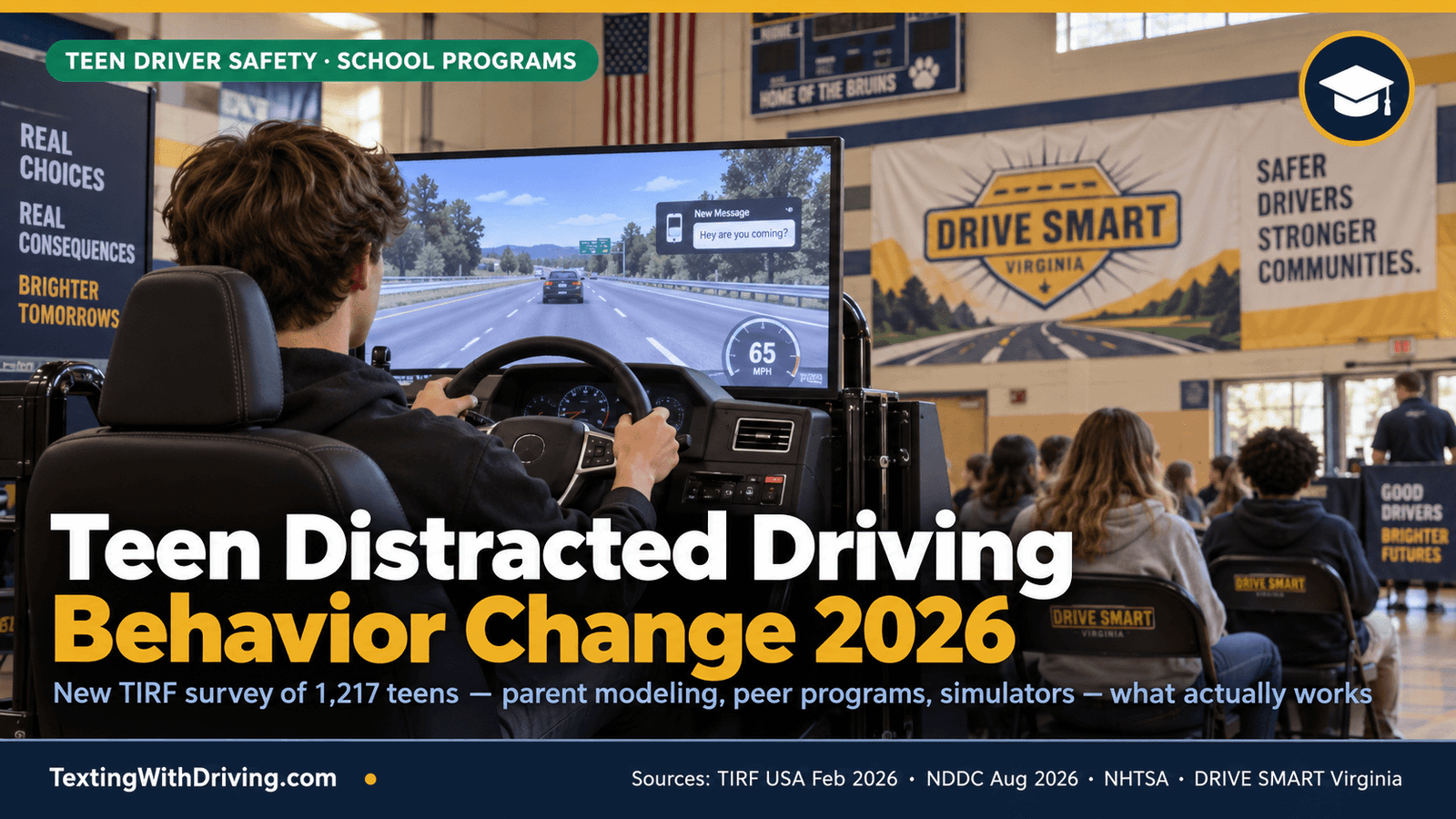
Simulator programs — strongest evidence. The DRIVE SMART Virginia interactive distracted driving simulator — which reached 6,000 teens in 28 Virginia high schools in 2025 as documented in our Virginia distracted driving awareness campaigns 2026 article — represents the school program approach with the strongest evidence base.
The simulator’s behavioral mechanism is experiential learning: the teen experiences the crash consequence of distracted driving in a consequence-free simulation environment, creating the associative learning that the classroom instruction cannot. A student who has seen their simulated vehicle drift into the opposing lane and collide with an oncoming car while they were looking at a simulated phone has experienced the consequence rather than been told about it. Experiential learning creates more durable attitude and behavior change than knowledge-based instruction for adolescent populations.
Teen driver education should not be considered or framed as a one-shot deal. The simulator approach, when integrated into a broader ongoing program rather than delivered as a single assembly event, produces more sustained behavior change because it frames safe driving as a developing skill rather than a one-time lesson.
Hospital-based programs — strong evidence for attitude change. Programs that use trauma survivor testimony or hospital trauma center tours — putting teens in direct contact with the human consequences of distracted driving crashes — produce significant attitude shifts in documented studies. A need exists for effective evidence-based distracted driving interventions. Hospital-based programs that provide consistent content delivery, persuasive messaging, and trauma survivor testimony, reinforced by first-hand knowledge of injury outcomes from healthcare professionals, have demonstrated post-program reductions in projected phone use while driving.
The crash survivor testimony component is specifically effective for teen audiences because it converts the abstract crash risk into a specific, named person whose life trajectory was changed by a driving distraction event. Abstract statistics — 3,208 deaths in 2024 — do not engage the adolescent social brain the same way that one person’s specific story does.
Knowledge-based classroom instruction — limited evidence. Standard classroom instruction about distracted driving statistics, legal consequences, and crash risk — the type of content in most driver education curricula — has documented limitations in producing behavioral change. Few programs have achieved effectiveness through knowledge-based approaches alone. This does not mean knowledge is unimportant — accurate cognitive risk perception is the TIRF survey’s identified target for change. But knowledge delivered in lecture format without experiential reinforcement or social norm engagement produces limited behavioral change for adolescent audiences.
Parent-teen programming — strongest evidence for sustained change. Programs designed to enhance parental engagement have demonstrated significant improvements in safety outcomes by promoting communication, supervision, and reinforcement of safe driving behaviors.
The Share the Keys (STK) program in New Jersey demonstrated over 85 percent of participating parents reporting increased ability to enforce GDL restrictions after participating in the 90-minute orientation where parents and teens develop contracts addressing GDL compliance, curfews, and passenger restrictions.
Programs where structured GDL programs require parental involvement in supervised driving logs and permit application processes have contributed to reductions in crash rates by as much as 38 percent in some regions. The 38 percent crash rate reduction from GDL programs with active parental involvement is the largest documented outcome of any teen driver safety intervention — larger than simulator programs, larger than awareness campaigns, larger than fine structures.
The Technology Solution in the Teen Context
Teen distracted driving behavior change 2026 has a technology dimension that the TIRF research specifically endorses: parental role modeling of safe driving behaviors, selecting vehicles for teens that are equipped with crash prevention technologies and have good crash test ratings, and participation in telematics-based insurance programs.
Cell phone-blocking technology may be particularly helpful for adolescent drivers who find it hard to resist distraction. The technology solution is particularly valuable for teens because it addresses the neurological limitation we documented in our Virginia teen distracted driving brain science 2026 article: the still-developing prefrontal cortex that makes resisting the phone’s notification pull physiologically more difficult for teens than for adults.
The specific technology hierarchy for teen drivers:
Phone in back seat — the most effective single behavioral intervention. Physical separation from the phone eliminates the reach impulse that even a perfectly configured Driving Focus cannot address if the phone is in the cupholder. For a Virginia teen driver whose phone cannot legally be used for any purpose while driving — not even hands-free under the under-18 complete ban — the back seat is the correct location.
Driving Focus or Android DND set for complete blocking. For Virginia’s under-18 drivers, the setup must block all calls — not just notifications — because the Virginia GDL law prohibits even hands-free calls for drivers under 18 as documented in our Virginia teen distracted driving 2026 article. Parent-configured complete blocking before the first school year drive is more effective than teen-configured partial blocking.
Telematics monitoring apps. DriveWell Go’s family dashboard, LifeSaver’s parental monitoring, or EyezUP’s administrator-controlled enforcement — reviewed in our best apps to stop texting while driving 2026 article — create the electronic monitoring component that the NHTSA data shows produces 65 percent fewer unsafe events on its own, before adding the parental engagement component that brings the total to 85 percent.
The 85 percent insight reframed: The combined electronic monitoring plus parental engagement approach is producing 85 percent fewer unsafe driving events. Applied to Virginia’s 33 teen driver deaths in 2025, an 85 percent reduction would represent approximately 28 fewer teen driver deaths — if the approach were consistently implemented. The technology is available. The parental engagement framework is documented. The 85 percent improvement is achievable for every family that implements it.
What the GDL Research Shows About Law Effectiveness
Teen distracted driving behavior change 2026 has a specific legislative dimension in the GDL passenger restriction evidence that parents and advocates need to understand.
Major legislative efforts in Graduated Licensing Systems that include passenger restrictions have shown positive effects. The crash rate reduction from GDL with parental involvement reaching 38 percent is the most robust evidence of any teen driver safety intervention.
The GDL research establishes that law structure matters for teen behavioral outcomes. States with the most restrictive GDL frameworks — the longest permit holding periods, the most restrictive nighttime curfews, the strictest passenger limitations — have the best teen driver crash outcomes. As we documented in our distracted driving laws teen drivers state guide for parents article, Virginia’s GDL framework — with its one-year provisional period, midnight curfew, and one non-family under-21 passenger restriction — is among the more restrictive in the country.
The passenger restriction’s specific evidence base is the most compelling in the GDL literature. Carrying three or more passengers increases the risk of a crash for 16 and 17 year olds three-fold compared to driving alone. Virginia’s restriction to one non-family under-21 passenger in the first year directly addresses the mechanism that produces this three-fold crash risk increase.
The research also shows that GDL restrictions are more effective when parents actively enforce them — which is why the parental engagement component amplifies the legislative effect beyond what the law alone produces. A teen whose parents know the GDL restrictions, explain them explicitly, and actively monitor compliance has better outcomes than a teen whose parents are unaware of the specific restrictions their teen’s provisional license carries.
The Social Norming Approach: What Peer-Led Programs Demonstrate
Teen distracted driving behavior change 2026 has a specific programming insight from the social norming approach — the behavioral change methodology that changes behavior by changing what behavior appears normal within a social group.
The standard awareness campaign approach communicates: distracted driving is dangerous. The social norming approach communicates: distracted driving is not what most teens in your specific peer group do. The first approach addresses knowledge. The second addresses social norm perception — and social norm perception is what the TIRF research identifies as the primary driver of teen behavioral choices.
Peer-to-peer programs that have teens themselves communicate safe driving commitments — through classroom discussions, through safe driving pledges that peers sign together, through peer mentor programs where safe drivers work with new drivers — operate through the social norm channel that adults cannot access as effectively as peers.
The NDDC’s resources for parents, educators, and youth programs specifically include evidence-based strategies that parents, educators, and youth programs can use to help teens build safer driving habits, improve attention management, and reduce distraction before unsafe behaviors become routine. The emphasis on “before unsafe behaviors become routine” reflects the research finding that early intervention — before the first year of driving establishes behavioral patterns — produces more effective outcomes than intervention after patterns are established.
What Parents Can Do in 2026 That Actually Changes Behavior
Teen distracted driving behavior change 2026 research points toward specific, evidence-ranked actions for parents — not general awareness raising, but the specific interventions with documented behavioral change outcomes.
Rank 1 (highest evidence): Model complete phone-free driving consistently. Every drive the teen observes where the parent uses a phone — handheld or hands-free — is observational learning that normalizes phone use while driving. Every drive where the parent’s phone is in the back seat and Driving Focus is active is observational learning that normalizes phone-free driving. The parent’s behavior is the most powerful behavioral influence on the teen’s driving behavior — more powerful than any school program, any campaign, or any fine structure.
Rank 2 (highest evidence): Implement combined electronic monitoring and parental engagement. Install DriveWell Go or a comparable telematics app that provides trip-by-trip safety scores. Review the data with the teen weekly. The combined electronic plus parental feedback approach produces 85 percent fewer unsafe events — the most compelling outcome number in teen driver safety research.
Rank 3 (strong evidence): Complete the explicit GDL conversation. Sit down with your teen before the first provisional license drive and cover every GDL restriction explicitly: the one-passenger rule, the midnight curfew, the complete phone ban including hands-free for Virginia under-18 drivers. Most teens have never heard the specific under-18 complete phone ban explained as a separate stricter standard from the adult law. Most parents have not explained it explicitly.
Rank 4 (strong evidence): Develop and sign a parent-teen driving agreement. DRIVE SMART Virginia’s parent-teen driving agreement framework, the Share the Keys contract approach, and the NHTSA parent-teen pledge resources all provide structure for the explicit conversation that produces the parental engagement component of the 85 percent outcome. The contract is not about trust — it is about clarity. The teen who has explicitly agreed to specific safe driving standards, in writing, with specific consequences for violation, makes different in-the-moment decisions than the teen who received a general “be safe” reminder.
Rank 5 (moderate evidence): Support school simulator and trauma program participation. If your teen’s school has not hosted DRIVE SMART Virginia’s simulator program or a hospital-based trauma program, contact the school counselor or safety officer and request it for the 2026-2027 school year. These programs are available in Virginia and across the country, often at no cost to the school.
For the complete Virginia GDL framework that these behavioral interventions support, our Virginia teen distracted driving 2026 article covers every restriction. For the brain science explaining why these specific interventions work with the still-developing teen brain, our Virginia teen distracted driving brain science 2026 article covers the prefrontal cortex and working memory framework. For the technology apps that create the electronic monitoring component of the 85 percent outcome, our best apps to stop texting while driving 2026 article reviews LifeSaver, DriveWell Go, and EyezUP. And for the technology setup that implements complete phone-free driving for a Virginia under-18 driver, our hands-free while driving complete setup guide covers iPhone, Android, Bluetooth, and CarPlay.
Sources Used in This Article
All links verified working before publication.
Newsfile Corp via TIRF USA: All Distractions Are Not Equal When It Comes to Teen Drivers — TIRF USA February 2026 national survey 1,217 youth 26 states, NDDC State Farm partnership, cognitive risk perception key target, parent modeling peer-to-peer empowerment two key takeaways, telematics insurance programs vehicle selection crash prevention technologies, February 2026
NDDC: What Makes Teen Drivers Distracted Insights from a National Youth Survey — Distracted driving broader risky behavior pattern, teens underestimate navigation music everyday tasks, parents most powerful influencers before teens drive independently, practical research-based strategies, August 2026 webinar
NHTSA: Programs to Assist Parents and Guardians of Young Drivers — Electronic feedback alone 65% fewer unsafe events, combined electronic and parental feedback 85% fewer unsafe events, Peek-Asa et al 2019, family communication patterns Steering Teens Safe
Impact Teen Drivers: Parents Resource — Number one influencer teens attitudes behaviors, 16-year-old crash rate four times adult per mile, three passengers three-fold crash risk increase, Connor Johnson story parental engagement
ArXiv: Driving Education Advancements Novice Drivers Systematic Literature Review — Share the Keys New Jersey 85% parents increased ability enforce GDL restrictions, GDL parental involvement up to 38% crash rate reduction, peer-led accountability programs promise, FOCAL-trained teens improved attention management, Table 6 parental peer influence
PMC: Integrative Review Teen Distracted Driving Model Program Development — Few programs achieved effectiveness, hospital-based trauma survivor testimony tours effective, hazard awareness mitigation attention maintenance essential elements, theory of planned behavior framework
Journal of Adolescent Health: Young Driver Distraction State of Evidence — GDL passenger restrictions positive effects, enforcement challenging, behavior change programs needed targeting adolescents parents friends, theoretical framework risk perception social norms
DRIVE SMART Virginia: 2025 Annual Report — 33 teen deaths Virginia 2025, 28 high schools 6,000 teens simulator program, 12th Annual Summit August 6-7 Williamsburg 2026
NHTSA: Distracted Driving — 3,208 deaths 2024, national context
TextingWithDriving.com is professionally built and maintained to ensure accurate, accessible safety information reaches every driver who needs it. Website development and ongoing support is handled by Budgetic, a digital agency specializing in purpose-driven WordPress websites.

About Texting With Driving
TextingWithDriving.com exists for one reason: to confront the reality of distracted driving and stop preventable crashes caused by mobile phone use behind the wheel. Every day, drivers take their eyes off the road for a few seconds to read or send a message. Those few seconds are enough to cause life-altering consequences. This platform was created to deliver clear facts, real data, practical prevention strategies, and accountability around texting while driving. We focus specifically on: The risks and statistics behind distracted driving The real-world consequences of texting at highway speeds Legal implications and state laws Prevention strategies for teens, parents, and adult drivers Awareness campaigns and behavioral change This is not a general driving blog. It is a focused awareness initiative built around one critical issue: phone distraction behind the wheel. Our content is direct, research-driven, and practical. We prioritize accuracy over opinion and education over sensationalism. The goal is simple — reduce distracted driving incidents by increasing awareness and responsibility. If one article causes one driver to put their phone down, the mission is working. For inquiries or partnerships, contact: privacy@textingwithdriving.com
View all posts by Texting With Driving