

Distracted Driving Awareness Month 2026: Everything You Need to Know About April’s Campaign

Distracted Driving Awareness Month 2026: Everything You Need to Know About April’s Campaign
April is not just the start of spring. For road safety advocates, law enforcement agencies, and millions of American families who have been touched by distracted driving, April is the most important month of the year in the fight against phone use behind the wheel.
National Distracted Driving Awareness Month has run every April since it was formally entered into the Federal Register in 2010. Sixteen years later, the campaign has grown from a public education effort into a coordinated national operation involving thousands of law enforcement agencies, a multimillion dollar media campaign, and fresh federal data released specifically for the occasion.
Here is a complete look at what happened in April 2026, why it matters, and what you can do with this information regardless of what month you are reading it.
What Is National Distracted Driving Awareness Month?
National Distracted Driving Awareness Month is an annual April campaign run by the NHTSA in partnership with law enforcement agencies, safety organizations, and state governments across the United States. The campaign focuses particularly on mobile phone use, which is the most common and dangerous form of distraction. During April, the NHTSA runs the Put the Phone Away or Pay enforcement campaign, pairing public education with increased law enforcement activity. Wikipedia
The campaign was born out of a specific moment in American road safety history. The roots of the campaign trace back to the early 2000s, when researchers began documenting the cognitive impairment caused by mobile phone use while driving. A landmark study by the University of Utah in 2006 found that drivers using mobile phones exhibited reaction times comparable to those with a blood alcohol concentration of 0.08 percent, the legal limit in most states. Wikipedia
By 2010, smartphone adoption was accelerating rapidly and the research was unambiguous. NHTSA needed a dedicated, high-profile national moment to address what was quickly becoming one of the most dangerous behavioral shifts in American driving history. The awareness month was the result.
Sixteen years on, the format has matured considerably. What began as primarily an educational effort has evolved into a coordinated enforcement and media operation with a measurable impact on driver behavior during the campaign period.
The 2026 Campaign: What NHTSA Did This April
The 2026 edition of National Distracted Driving Awareness Month was among the most significant in the campaign’s history, not only because of its scope but because it came with a major new federal data release.
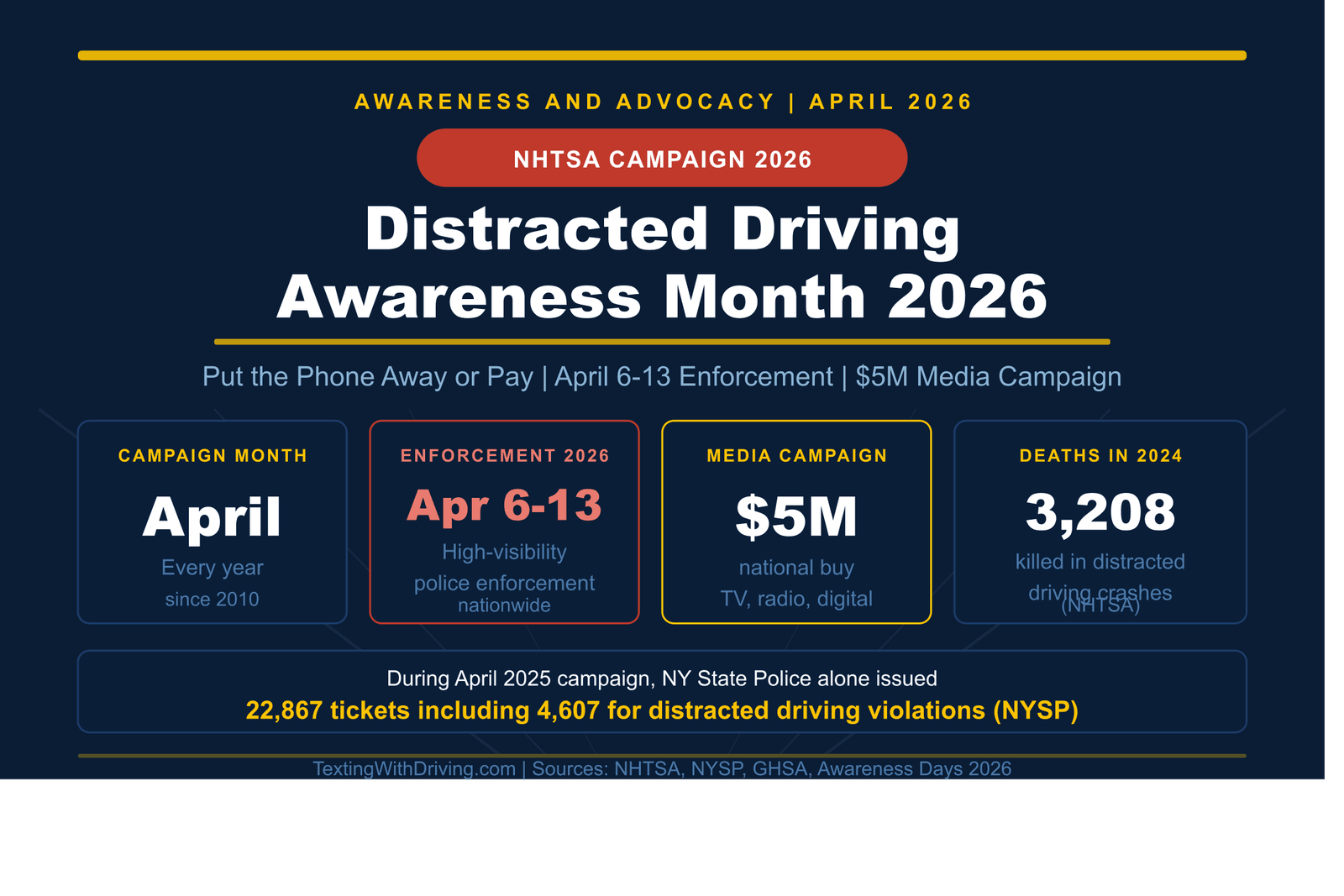
On April 1, 2026, NHTSA Administrator Jonathan Morrison opened the campaign kickoff with a direct address that included the release of 2025 traffic fatality estimates. He confirmed that 3,208 people were killed in 2024 in crashes involving a distracted driver, and that early estimates for 2025 suggest traffic fatalities have returned to pre-pandemic levels last seen in 2019, representing a significant and critical turn in the trend. The961
That news about overall traffic fatalities was genuinely encouraging. The post-pandemic spike that pushed total road deaths above 43,000 in 2022 appears to have subsided. But NHTSA was clear that distracted driving remains one of the most persistent and underreported contributors to road deaths, and that the 3,208 figure for 2024 is almost certainly a minimum estimate of the true scope.
Put the Phone Away or Pay: The 2026 Enforcement Campaign
The Put the Phone Away or Pay campaign educates drivers about the deadly dangers and legal consequences of distracted driving. NHTSA’s high-visibility enforcement of state distracted driving laws took place April 6 through April 13, 2026, and specifically targeted drivers ages 18 to 34 who, according to NHTSA data, are more likely to die in distraction-affected crashes than any other age group. Driving School
The Put the Phone Away or Pay campaign was supported by a $5 million national media buy in English and Spanish on television, radio, and digital platforms. Campaign ads ran starting April 1 through April 14.
The campaign name itself represents a clear strategic shift that NHTSA has refined over the past few years. Earlier distracted driving campaigns leaned heavily on emotional appeals and shock statistics. Put the Phone Away or Pay leads instead with legal and financial consequences, a deliberate choice informed by behavioral research showing that perceived risk of being caught and fined motivates behavior change more reliably than awareness of danger alone.
NHTSA Administrator Morrison stated that the campaign’s television advertisements illustrate how quickly tragedy can strike when someone is distracted, and that Secretary Sean Duffy featured in the campaign ads as a champion for traffic safety.
What Enforcement Actually Looked Like on the Ground
The April 6 through 13 enforcement window was not symbolic. Law enforcement agencies across every state deployed specifically to target distracted driving during this period, and the results from states that reported figures publicly were striking.
The New York State Police participated in the national campaign from April 6 through April 13, 2026, deploying both marked State Police vehicles and Concealed Identity Traffic Enforcement vehicles, which allow troopers to observe violations from an elevated vantage point while blending into everyday traffic. During the April 2025 equivalent campaign, New York State Troopers issued 22,867 tickets, including 4,607 specifically for distracted driving violations.
New York’s numbers from 2025 give a clear sense of scale. Nearly 5,000 distracted driving tickets issued by a single state’s troopers during a single eight-day enforcement period. Multiply that across 50 states with active enforcement operations and the scope of the national campaign becomes clear.
In Arkansas, law enforcement agencies statewide worked together throughout the April 6 through 13 window to enforce laws prohibiting distracted driving, as part of the broader NHTSA Put the Phone Away or Pay campaign.
The reach of the enforcement effort extended to communities far beyond major metropolitan areas. NHTSA coordinates the campaign with state highway safety offices, which in turn direct local and state law enforcement resources toward distracted driving specifically during the enforcement window. For drivers who are accustomed to thinking that phone enforcement only happens in cities, the 2026 campaign was a clear signal that this assumption is no longer safe.
What NHTSA Released: The 2024 Crash Data
One of the most significant aspects of the April 2026 campaign was the simultaneous release of the most current verified national crash data.
According to NHTSA’s Put the Phone Away or Pay campaign page updated with 2024 data: in 2024, there were 3,208 people killed and more than 315,000 people injured in traffic crashes involving distracted drivers.
These figures, released at the campaign kickoff, are consistent with the trend we covered in our distracted driving statistics 2026 overview. The death toll is declining slowly from the 2021 peak of 3,522, which is the right direction. But the pace is nowhere near what the scale of the problem demands, and NHTSA’s own analysis acknowledges that the real numbers are higher due to underreporting at crash scenes.
NHTSA noted that distraction-related injuries and deaths are likely underreported. A 2023 NHTSA report found that in 2019, distraction was involved in 29 percent of all crashes, resulting in 10,546 fatalities, 1.3 million nonfatal injuries, and $98.2 billion in economic costs.
That underreporting gap, between 3,275 officially recorded deaths in 2023 and an estimated 10,546 when all distraction-involved crashes are properly counted, is one of the most important data points in the entire distracted driving discussion. The official statistics that make headlines every April represent a fraction of the actual burden. NHTSA is actively working with states to improve crash data collection to close that gap.
The History Behind the Campaign
Understanding where Distracted Driving Awareness Month came from gives important context for why it takes the form it does today.
National Distracted Driving Awareness Month was formally entered into the Federal Register on March 23, 2010, following growing concern about the impact of mobile phone use on road safety. The campaign was initiated by the NHTSA as smartphone adoption surged across the United States, creating an entirely new category of driving hazard that existing safety campaigns did not adequately address. Wikipedia
In 2010, smartphones had only been mainstream for about three years. The iPhone launched in 2007. Android followed in 2008. By 2010 there were approximately 60 million smartphone users in the United States. Today there are over 270 million. The distraction risk that prompted the creation of awareness month in 2010 has grown proportionally with the device penetration since then.
The NHTSA’s enforcement campaigns have grown from primarily educational efforts into coordinated national operations involving thousands of law enforcement agencies. The Put the Phone Away or Pay campaign, which pairs advertising with enforcement, has become a signature element of the month. Many states have introduced or strengthened distracted driving laws during April, using the awareness month as a catalyst for legislative action. Wikipedia
This legislative catalysis function is one of the less-discussed but genuinely significant outcomes of the annual campaign. State lawmakers are more likely to advance distracted driving legislation when the issue is receiving national media attention, and the April campaign reliably produces that attention. Several states have timed major distracted driving bills to pass during or immediately after Distracted Driving Awareness Month specifically to capitalize on that visibility.
Who the 2026 Campaign Was Targeting
The 2026 Put the Phone Away or Pay enforcement campaign specifically targeted drivers ages 18 to 34 who, according to NHTSA data, are more likely to die in distraction-affected crashes than any other age group. Driving School
This demographic targeting reflects where the data points most urgently. The 18 to 34 age group combines the phone habits and social media engagement of the youngest adult drivers with the volume of miles driven by working adults. They are the most-connected demographic on the road and, by the crash statistics, the most at-risk.
The $5 million media buy in English and Spanish reflects a second targeting priority: reaching Hispanic drivers, who are underserved by English-only campaigns and represent a significant portion of the American driving population. NHTSA’s bilingual approach to the 2026 campaign represents an important evolution from earlier years when Spanish-language safety content was considerably less prominent.
What the Research Says About Awareness Campaigns
Here is the honest picture on how effective campaigns like this actually are.
The research on awareness campaigns alone shows modest and often temporary effects on behavior. Drivers who see a NHTSA advertisement during April show some short-term behavioral improvement, but without enforcement and without legislative backing, the effect fades relatively quickly after the campaign period ends.
What makes the Put the Phone Away or Pay model more effective than a pure awareness campaign is the integration of high-visibility enforcement during the campaign window. Drivers who see the advertising and also know that officers are actively looking for phone use are more likely to change their behavior than drivers who see the advertising alone.
NHTSA’s Media Work Plan for the campaign provides an overview of the research and trends that inform the national paid media plan. The campaign is designed specifically to remind drivers of the legal consequences of distracted driving and is intentionally paired with increased law enforcement to make those consequences feel immediate and real rather than abstract.
The combination of public messaging and visible enforcement during a specific, publicized window is what the behavioral research supports as the most effective structure for producing measurable behavior change. April is when this combination is most concentrated. But its actual impact depends heavily on whether individual drivers internalize the message and carry it beyond the campaign month.
Beyond April: What Year-Round Awareness Looks Like
Distracted Driving Awareness Month is a concentrated dose of attention to a problem that needs year-round attention. The crashes that happen in July, October, and December are just as preventable as the ones that happen in April.
The most effective thing any driver can do with the energy of awareness month is to treat it as the moment to establish a habit that carries forward permanently, not just for 30 days.
The NSC Distracted Driving Awareness Month resources page from the National Safety Council offers year-round employer and workplace resources, policy templates, and community engagement tools that extend the conversation beyond April.
For organizations that want to run their own internal awareness campaigns outside of April, NHTSA makes their campaign materials, social media toolkits, and talking points freely available at the Traffic Safety Marketing Put the Phone Away or Pay resource page. Everything there is free to download and deploy.
How You Can Participate Right Now
Whether you are reading this in April or in the middle of August, there are specific actions that extend the value of this awareness month beyond a passive scroll.
Share the data from this article with the people in your life who drive. The 3,208 death figure, the $98.2 billion economic cost, the enforcement numbers from New York: these are the kind of specifics that cut through in a way that general warnings do not. For the full picture of all available statistics, our distracted driving statistics 2026 overview has everything in one place.
If you have teen drivers in your household, use the campaign as a natural conversation opener. “Did you see the NHTSA campaign this month?” is a less confrontational entry point than a direct safety lecture, and it opens the door to the specific conversations about pre-drive phone habits that research shows actually work. For more on why teen drivers specifically carry the highest risk, see our article on why teen drivers are the most at-risk group for distracted driving.
If you manage or employ drivers, the April campaign is the right moment to introduce or reinforce a workplace distracted driving policy. The NSC resources above include policy templates for exactly this purpose.
And if you want to go deeper on the prevention tools available to any driver right now, from built-in iPhone and Android features to app-based blockers, the options we cover in our guide to the best apps to block texting while driving are all free or low-cost and available today.
The Campaign’s Core Message
NHTSA’s campaign carries a direct message: if you are in the driver’s seat, driving is the only thing you should be doing. No distractions. If your driver is texting or otherwise distracted, tell them to stop and focus on the road. Ask your friends to join you in pledging not to drive distracted. You could save a life.
That message is not complicated. It does not require new technology or new legislation or a new app. It requires one decision, made before the car starts, to put the phone out of reach and keep it there until the destination.
April gives that message the loudest national platform it receives all year. What happens the other eleven months is what actually determines the death toll.
Sources Used in This Article
All links verified working before publication.
NHTSA: April Is Distracted Driving Awareness Month — National Highway Traffic Safety Administration
NHTSA: Put the Phone Away or Pay Campaign — Official campaign page with 2024 data
NHTSA: Put the Phone Away or Pay Press Release — Campaign launch details
NHTSA: April 2026 Awareness Month Kickoff Speech — Administrator Jonathan Morrison, April 1, 2026
NHTSA: Kickoff Event Registration Page — April 2026 event details
Traffic Safety Marketing: Put the Phone Away or Pay Resources — Free campaign materials for organizations
New York State Police: 2026 Campaign Announcement — Enforcement details and 2025 ticket data
NSC: Distracted Driving Awareness Month Resources — National Safety Council year-round resources
Awareness Days: National Distracted Driving Awareness Month 2026 — Campaign history and 2026 dates
GHSA: Distracted Driving State Laws — Governors Highway Safety Association
TextingWithDriving.com is professionally built and maintained to ensure accurate, accessible safety information reaches every driver who needs it. Website development and ongoing support is handled by Budgetic, a digital agency specializing in purpose-driven WordPress websites.

About Texting With Driving
TextingWithDriving.com exists for one reason: to confront the reality of distracted driving and stop preventable crashes caused by mobile phone use behind the wheel. Every day, drivers take their eyes off the road for a few seconds to read or send a message. Those few seconds are enough to cause life-altering consequences. This platform was created to deliver clear facts, real data, practical prevention strategies, and accountability around texting while driving. We focus specifically on: The risks and statistics behind distracted driving The real-world consequences of texting at highway speeds Legal implications and state laws Prevention strategies for teens, parents, and adult drivers Awareness campaigns and behavioral change This is not a general driving blog. It is a focused awareness initiative built around one critical issue: phone distraction behind the wheel. Our content is direct, research-driven, and practical. We prioritize accuracy over opinion and education over sensationalism. The goal is simple — reduce distracted driving incidents by increasing awareness and responsibility. If one article causes one driver to put their phone down, the mission is working. For inquiries or partnerships, contact: privacy@textingwithdriving.com
View all posts by Texting With Driving

