

Distracted Driving Awareness Month 2026: Everything You Need to Know About April’s Campaign

Distracted Driving Awareness Month 2026: Everything You Need to Know About April’s Campaign
Every April, something different happens on American roads. More officers are watching. More media is running. More conversations are happening in classrooms, workplaces, and family kitchens about phone use behind the wheel.
National Distracted Driving Awareness Month is not just a line on a calendar. It is the most coordinated national effort of the year to address one of America’s most persistent and preventable road safety crises. And in 2026, it came with more urgency than ever.
This article covers everything that happened in April 2026: the NHTSA kickoff, the death and injury data released for the first time, the enforcement campaign details, the media investment, and most importantly what you can do with this information whether you read it in April or in November.
The April 1, 2026 Kickoff: What NHTSA Announced
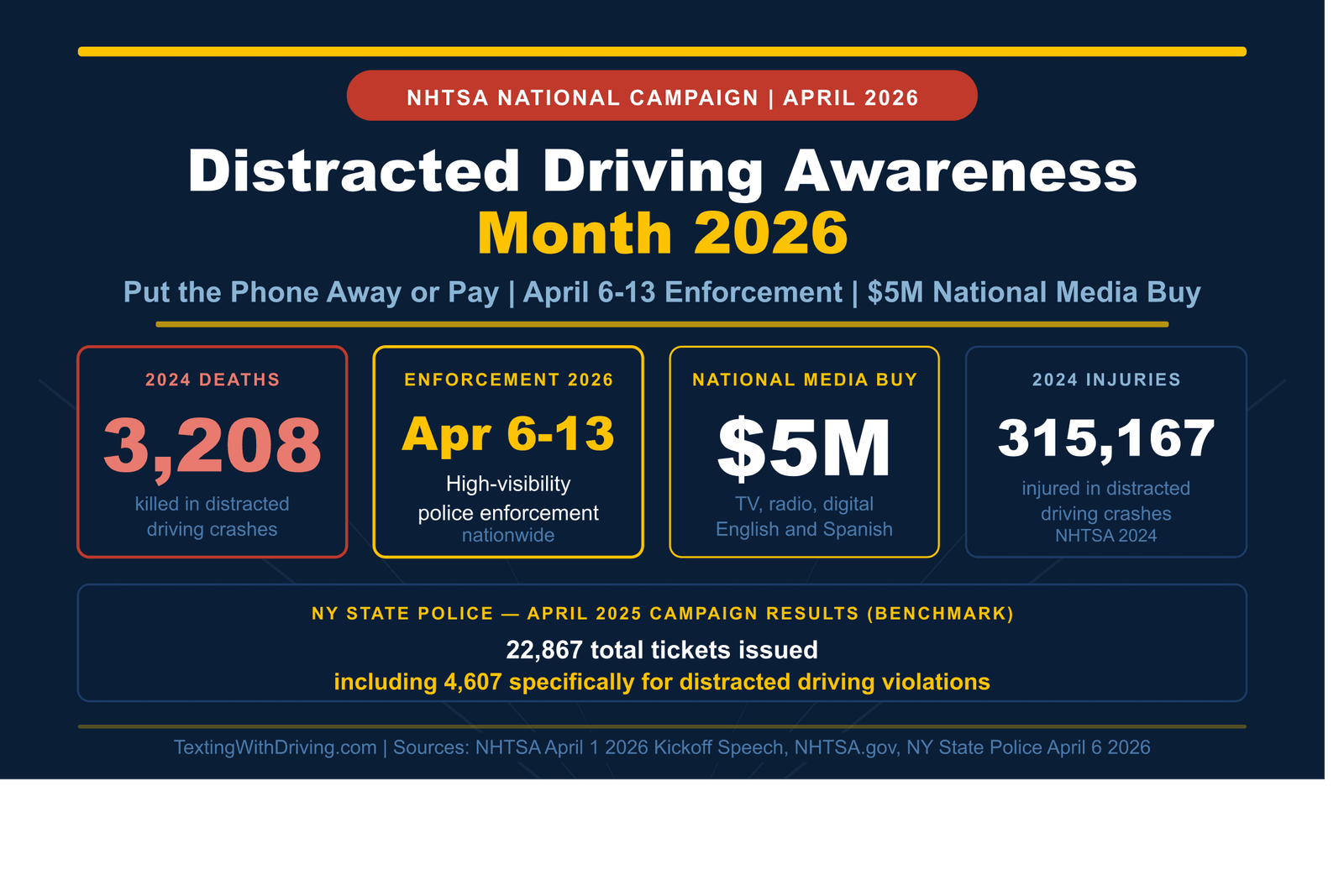
On April 1, 2026 in Washington DC, NHTSA Administrator Jonathan Morrison opened the National Distracted Driving Awareness Month kickoff with the release of the agency’s latest traffic fatality data. He confirmed that 3,208 people were killed in 2024 in crashes involving a distracted driver, with an estimated 315,167 people injured. He also announced that early estimates for 2025 traffic fatalities show fatalities have returned to pre-pandemic levels last seen in 2019, marking a critical and significant turn in the trend after years of elevated totals following the 2020 pandemic spike. Geotab
That news about the overall downward trend in traffic fatalities was genuinely encouraging. After the pandemic-era spike that pushed US traffic deaths above 43,000 in 2022, the trajectory has finally turned in the right direction. But Administrator Morrison was direct: distracted driving remains one of the most prevalent risky driving behaviors on American roads and is almost certainly more widespread than the official numbers capture.
At the kickoff event, Morrison drew attention to a display of car keys on the wall behind him. Each key represented a person injured in a distracted driving crash in 2024. The display held 4,000 keys representing those crash victims. Morrison noted that if the display were to reflect all 315,167 people injured in distracted driving crashes in 2024, the wall of keys would cover half a football field. He added that in just the 30 minutes of the event itself, another 18 people were injured in distracted driving crashes across the country. Geotab
Eighteen people injured in thirty minutes. That is the pace at which distracted driving crashes happen in the United States. Not per day. Not per hour. Per thirty-minute window, around the clock.
The kickoff event also featured Patty Kruszewski, who lost her daughter in a distracted driving crash, sharing her family’s story as part of NHTSA’s effort to put a human face on the statistics. Morrison emphasized that distracted driving is 100 percent preventable, yet too many people give the road far less than 100 percent of their attention. Geotab
The Put the Phone Away or Pay Campaign: 2026 Details
The centerpiece of every April’s Distracted Driving Awareness Month is NHTSA’s Put the Phone Away or Pay campaign, which pairs national public education with high-visibility law enforcement in a coordinated national push.
NHTSA’s Put the Phone Away or Pay campaign reminds drivers of the deadly dangers and the legal consequences including fines of texting behind the wheel. In 49 states, Washington DC, Puerto Rico, Guam, the Northern Mariana Islands, and the Virgin Islands, texting while driving is illegal. The campaign emphasizes that cell phone use, specifically texting, talking, and social media use, is the most common distraction on US roads, and that texting is considered the most dangerous type of distracted driving because it combines visual, manual, and cognitive distraction simultaneously. Federal Motor Carrier Safety Administration
The Put the Phone Away or Pay campaign educates drivers about the deadly dangers and legal consequences of distracted driving. NHTSA’s high-visibility enforcement of state distracted driving laws took place April 10-14, 2026, targeting drivers ages 18 to 34 who according to NHTSA data are more likely to die in distraction-affected crashes than any other age group. The campaign was supported by a five million dollar national media buy in English and Spanish on television, radio, and digital platforms with campaign ads running from April 1 through April 14. Baderlaw
Deputy Secretary Bradbury stated that distraction-related deaths and injuries take a major toll on the country, likely much bigger than we have realized, and that through increased traffic enforcement alongside NHTSA’s research, education efforts, and high-visibility enforcement mobilizations, the agency will continue to tackle this pervasive problem. Baderlaw
The five million dollar media investment reflects NHTSA’s recognition that law enforcement alone cannot solve a behavior problem at this scale. The television, radio, and digital advertising that ran throughout April 2026 reached audiences across all 50 states, with Spanish-language ads ensuring the campaign reached Hispanic drivers who represent a significant and historically underserved portion of the American driving population.
The Enforcement Window: April 6-13, 2026
The New York State Police participated in the national Put the Phone Away or Pay enforcement campaign running from Monday April 6, 2026 through Monday April 13, 2026. During the campaign, troopers conducted targeted enforcement details focused specifically on drivers using electronic devices while operating a motor vehicle. Troopers utilized both marked State Police vehicles and Concealed Identity Traffic Enforcement vehicles, which allow troopers to better observe violations from an elevated vantage point while blending into everyday traffic, and are clearly identifiable as emergency vehicles when emergency lighting is activated. Penske Truck Leasing
The Concealed Identity Traffic Enforcement vehicles are a particularly effective enforcement tool. Standard marked police cars create a brief behavioral change in drivers who spot them in their mirrors and put their phones down temporarily. CITE vehicles, which appear to be ordinary passenger cars until lights are activated, observe driver behavior without triggering that temporary compliance response. The combination of marked and unmarked enforcement during the campaign week is designed specifically to maximize the deterrent effect across all driver types.
During the April 2025 Put the Phone Away or Pay campaign, New York State Troopers issued 22,867 tickets, including 4,607 specifically for distracted driving violations. The 2026 campaign ran on the same structure and scale. Penske Truck Leasing
New York’s 2025 figures provide the best available benchmark for understanding the scope of what enforcement looks like in a single state during an eight-day window. Nearly 5,000 distracted driving tickets issued by one state’s troopers in eight days. Multiplied across 50 states all running similar enforcement operations, the national picture becomes clear. April’s enforcement mobilization is one of the largest coordinated traffic enforcement operations of the year.
During a portion of Distracted Driving Awareness Month, from April 9 through 13, drivers across the country saw increased law enforcement on the roadways as part of the national Put the Phone Away or Pay campaign. The campaign reminded drivers of the deadly dangers and the legal consequences including fines of texting behind the wheel. NHTSA’s message: if you are in the driver’s seat, driving is the only thing you should be doing. No distractions. Sentryroad
The Data Behind the Campaign: Why April Matters
The timing of Distracted Driving Awareness Month in April is deliberate. April marks the beginning of the warm-weather driving season, when more people are on the roads, teen drivers are gaining hours ahead of summer, and the combination of longer days and more social activity increases both driving volume and phone engagement.
NHTSA reports that in 2024, 3,208 people were killed in crashes involving distracted drivers, with an estimated 315,000 people injured. The problem is particularly pronounced among younger drivers. Federal data and campaigns continue to zero in on the 18 to 34 age group, which is overrepresented in distraction-related fatal crashes, and drivers aged 16 to 24 have the highest rate of manipulating handheld devices while driving. NAHB
A 2023 NHTSA report found that in 2019, distraction was involved in 29 percent of all crashes, resulting in 10,546 fatalities, 1.3 million nonfatal injuries, and $98.2 billion in economic costs. The officially recorded annual death figures are almost certainly an undercount of the true scope of distraction involvement in US crashes. Baderlaw
The gap between the 3,208 officially recorded distraction-related deaths in 2024 and the 10,546 estimated when all distraction-involved crashes are properly counted is something NHTSA addresses directly on its campaign pages. Distraction is hard to document at a crash scene. Unlike alcohol, which can be measured with a breathalyzer, phone distraction leaves no physical trace if the driver denies it and no witness observed it. NHTSA is actively working with states to improve crash data collection to better capture the true scope of the problem.
For the full breakdown of what those numbers mean and how they break down by age, state, and behavior type, our distracted driving statistics 2026 overview covers everything in one consolidated place.
What the Campaign’s Target Age Group Tells Us
The deliberate focus on drivers aged 18 to 34 in the 2026 campaign reflects where the data points most urgently.
NHTSA’s approach to distracted driving focuses on the partnership with states and local police, with the April campaign pairing national advertising with a law enforcement crackdown. The agency encourages teens to be the best messengers with their peers, speaking up when they see a friend driving while distracted, having friends sign a pledge to never drive distracted, and becoming involved in local Students Against Destructive Decisions chapters. Parents are encouraged to lead by example by never driving distracted and having a talk with young drivers about distraction and the responsibilities that come with driving. Governor’s Traffic Safety Committee
The campaign’s messaging acknowledges something that behavioral research has confirmed: different audiences need different approaches. For the 18 to 34 age group, the campaign leads with legal and financial consequences because research shows that perceived risk of being caught and fined motivates behavior change more reliably in this demographic than awareness of danger alone.
For teen drivers, NHTSA’s approach centers on peer influence and family conversations, reflecting what the AAA Foundation and CDC research consistently show about what actually changes teen driving behavior. We covered the research behind those conversations in detail in our parent’s guide to talking to your teen about phone use while driving.
For employers, the April campaign is an explicit reminder of workforce liability. For employers, Distracted Driving Awareness Month means their vehicles and their brand are more visible than usual during enforcement periods, and the data are clear: younger drivers are more likely to use handheld devices behind the wheel and are overrepresented in distraction-related crashes. That describes a significant part of the workforce in many industries, including entry-level workers who are often tasked with driving responsibilities. NAHB
Free Campaign Resources Available to Everyone
One of the most practical aspects of the Put the Phone Away or Pay campaign is that NHTSA makes its materials freely available to anyone who wants to extend the campaign’s reach.
NHTSA’s Traffic Safety Marketing page provides the full Put the Phone Away or Pay media work plan, talking points, sample news releases, and a social media playbook containing sample social media content in English and Spanish for easy posting to Facebook, X, and Instagram. The content is designed for seamless integration into any organization’s current social media strategy. Downloadable graphics and campaign videos are also available. Mattiacci Law
These resources are available to download and use at no cost from the Traffic Safety Marketing Put the Phone Away or Pay page. Organizations from school districts to employers to community groups can deploy the same campaign materials NHTSA uses nationally. If your organization wants to run its own awareness push, there is no need to create content from scratch. NHTSA has already done it and made it freely available.
The National Safety Council’s Distracted Driving Awareness Month resources page provides complementary employer-focused tools including workplace policy templates, employee pledge programs, and training materials that extend the campaign message into the professional environment.
The Underreporting Problem That NHTSA Is Trying to Solve
One of the most candid aspects of the April 2026 campaign was NHTSA’s direct acknowledgment of the data gap.
Administrator Morrison noted that distraction can be hard to detect and document after a crash, and that the 3,208 figure does not fully capture the scope of the problem. NHTSA is committed to working with states to better collect distracted driving data to assess the role it plays in crashes. Geotab
This transparency about data limitations is important context for anyone using distracted driving statistics in advocacy, policy, or education work. The official death tolls and injury figures represent what police reports document, not the complete picture of distracted driving’s actual contribution to road harm. The real numbers are higher. NHTSA knows it. The gap is why the agency has been investing in improved crash data collection methodology alongside the enforcement and education campaigns.
Beyond April: What the Campaign Should Produce All Year
Here is the honest assessment of what Distracted Driving Awareness Month can and cannot accomplish on its own.
A single month of heightened enforcement and advertising produces measurable short-term behavioral changes. Studies of similar enforcement mobilizations show that driver phone use typically drops during and immediately following a high-visibility campaign period. But without sustained follow-through, behavior often drifts back toward baseline within weeks.
What April does well is create a national conversation that makes it socially easier to address distracted driving in other settings throughout the rest of the year. An employer who uses April as the moment to introduce a company driving policy has an easier time doing so when the issue is in the news. A parent who has that specific conversation with their teen driver in April has the campaign’s messaging to reference. A friend group that makes a visible collective commitment to phone-free driving in April has a shared social norm to maintain for the rest of the year.
NHTSA’s message is direct: the fight to end distracted driving starts with you. Commit to never texting or using your phone while driving, and speak up when you see others distracted. Everyone has a role, from individual drivers and parents to educators, employers, and policymakers. Governor’s Traffic Safety Committee
That last part matters. April focuses national attention. What you do with that attention the other eleven months determines whether anyone’s behavior actually changes permanently.
What You Can Do Right Now
Whether you are reading this in April or in the middle of winter, the actions the campaign calls for apply equally.
Set up your phone’s driving mode before your next drive. iPhone Driving Focus and Android’s equivalent features take about two minutes to configure and run automatically after that. We have the complete step-by-step guide in our article on setting up Do Not Disturb While Driving on iPhone and Android.
If you have a teen driver at home, use the campaign as a natural conversation opener. The specific parent-teen conversation that research shows actually changes behavior is laid out in our parent’s guide to talking to your teen about phone use while driving.
If you manage employees who drive, review and update your company driving policy. The NSC resources linked above include free templates. The GHSA’s state law reference at ghsa.org/state-laws-issues/distracted-driving shows exactly what your state requires and what your employees are legally bound by.
And if you want to go deeper on any specific aspect of distracted driving — the state legal landscape, the science of why the phone is so hard to ignore, the real death toll data, or the best technology tools for prevention — everything is covered here at TextingWithDriving.com.
The campaign runs for one month. The roads are dangerous all year.
Sources Used in This Article
All links verified working before publication.
NHTSA: National Distracted Driving Awareness Month Kickoff Speech — Administrator Jonathan Morrison, April 1, 2026
NHTSA: Put the Phone Away or Pay Campaign Page — 2024 death and injury data, campaign details
NHTSA: April Is Distracted Driving Awareness Month — Official awareness month page
NHTSA: Press Release — NHTSA Launches Put the Phone Away or Pay Campaign — Campaign launch statement
NHTSA: Distracted Driving Dangers and Statistics — Full statistics and NHTSA partnership approach
NHTSA: National Distracted Driving Awareness Month Kickoff Event — Event registration and details, April 1, 2026
New York State Police: Put the Phone Away or Pay Enforcement Campaign — April 6, 2026 enforcement announcement with 2025 ticket data
Traffic Safety Marketing: Put the Phone Away or Pay Resources — Free downloadable campaign materials
NARFA: April Is Distracted Driving Awareness Month — Employer-focused campaign guidance, 2026
NSC: Distracted Driving Awareness Month Resources — National Safety Council workplace tools
GHSA: Distracted Driving State Laws — Current state law reference
TextingWithDriving.com is professionally built and maintained to ensure accurate, accessible safety information reaches every driver who needs it. Website development and ongoing support is handled by Budgetic, a digital agency specializing in purpose-driven WordPress websites.

About Texting With Driving
TextingWithDriving.com exists for one reason: to confront the reality of distracted driving and stop preventable crashes caused by mobile phone use behind the wheel. Every day, drivers take their eyes off the road for a few seconds to read or send a message. Those few seconds are enough to cause life-altering consequences. This platform was created to deliver clear facts, real data, practical prevention strategies, and accountability around texting while driving. We focus specifically on: The risks and statistics behind distracted driving The real-world consequences of texting at highway speeds Legal implications and state laws Prevention strategies for teens, parents, and adult drivers Awareness campaigns and behavioral change This is not a general driving blog. It is a focused awareness initiative built around one critical issue: phone distraction behind the wheel. Our content is direct, research-driven, and practical. We prioritize accuracy over opinion and education over sensationalism. The goal is simple — reduce distracted driving incidents by increasing awareness and responsibility. If one article causes one driver to put their phone down, the mission is working. For inquiries or partnerships, contact: privacy@textingwithdriving.com
View all posts by Texting With Driving

