

Kansas Distracted Driving Law 2026: New School Zone Ban, $60 Fine and What Every Driver Must Know

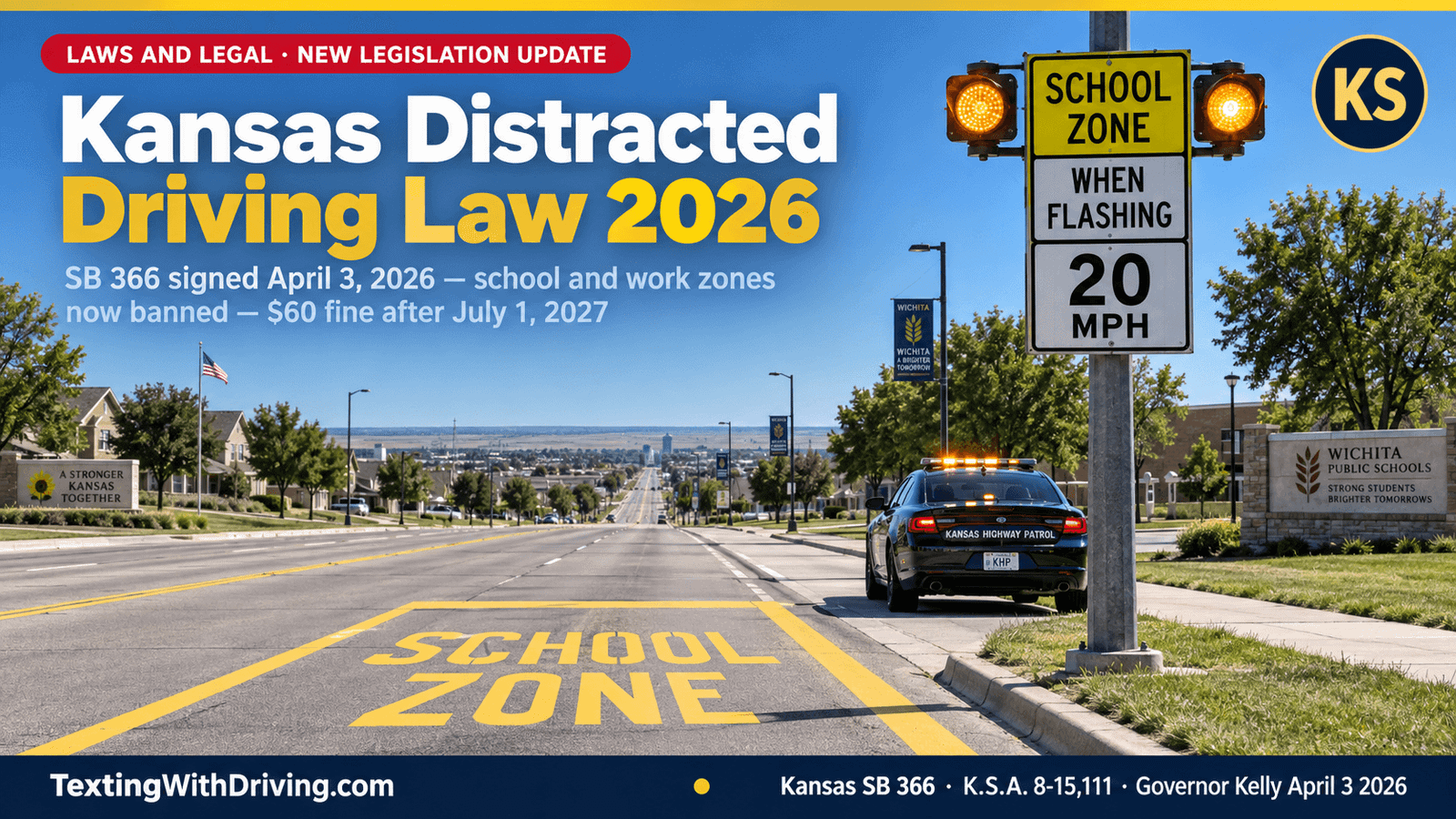
Kansas Distracted Driving Law 2026: New School Zone Ban, $60 Fine and What Every Driver Must Know
Kansas distracted driving law 2026 took a significant step forward on April 6, 2026, when Governor Laura Kelly signed House Substitute for Senate Bill 366 — a new law that bans handheld cell phone use while driving through school zones and road construction zones for all Kansas drivers. The law issues warning citations now and imposes a $60 fine for violations after July 1, 2027.
I’m pleased to sign smart, commonsense legislation that will help ensure drivers are distraction-free and schoolchildren, pedestrians, and construction workers are protected.
That statement from Governor Kelly captures the specific scope of Kansas’s new law — and its specific limitation. The SB366 law is a meaningful step forward that addresses the two highest-vulnerability environments for distracted driving crashes: school zones where children are present and construction zones where workers are roadside. But Kansas in 2026 still does not have a comprehensive statewide hands-free law for all adult drivers on all roads — the standard that 33-plus states have adopted, that Iowa enacted in 2025 and produced 13.6 percent behavioral improvement in year one, and that advocacy organizations including AAA Kansas and StopDistractions.org have explicitly called a minimum step in the right direction.
Understanding exactly what the Kansas distracted driving law 2026 requires — and what it does not yet cover — is essential for every Kansas driver, every commercial driver passing through the state, and every visitor from neighboring states whose laws are more comprehensive.
The Complete Kansas Distracted Driving Law Framework
Kansas distracted driving law 2026 consists of three distinct legal provisions that collectively govern phone use while driving in Kansas:
1. The existing texting ban (KSA 8-15,111): Kansas has prohibited text messaging while driving for all drivers for several years. The texting ban covers composing, sending, or reading written communication on a wireless device while operating a vehicle. This prohibition applies statewide, on all roads, for all drivers. First offense: $60 fine.
2. The under-18 complete ban: Kansas law prohibits drivers under 18 from using a mobile telephone while operating a motor vehicle — not just texting, but any mobile phone use. This applies statewide, on all roads. Kansas’s existing under-18 provision is already more restrictive for young drivers than the statewide adult standard.
3. SB366 — School zone and construction zone ban (new, signed April 6, 2026): The new law prohibits all drivers from using a handheld mobile telephone while driving through school zones when a reduced speed limit is in effect, and in road construction zones when workers are present and warning signs are posted. $60 fine. Warning citations issued now through July 1, 2027. Full enforcement begins July 1, 2027.
What Kansas law does NOT prohibit in 2026: handheld phone calls for adult drivers on standard roads outside school zones and construction zones. A Kansas driver on Interstate 70 through Topeka who holds their phone to their ear for a call is not violating any Kansas law in September 2026 — as long as they are not in a school zone or construction zone.
This is the gap that AAA Kansas, the Kansas Association of Chiefs of Police, the Kansas Highway Patrol, and StopDistractions.org all identified in testimony supporting HB2499 and the legislative process that eventually produced SB366: to truly be safer, the best law to save lives would be a hands-free bill, for all age drivers, on all roads, but this is a step in the right direction.
What SB366 Specifically Prohibits
Kansas distracted driving law 2026 under SB366 creates specific zone-based prohibitions that every Kansas driver must understand precisely.
Prohibited in school zones and construction zones:
Handheld use of a mobile telephone while driving through an active school zone when the reduced speed limit is in effect, or through a road construction zone when workers are present and warning signs are posted.
What constitutes a school zone violation: The reduced speed limit enforcement window — typically during school arrival and dismissal hours, indicated by flashing lights on school zone signs — is when the SB366 school zone prohibition is active. Outside the flashing-light enforcement hours, the standard adult handheld-use standard applies (texting prohibited, handheld calls permitted on open roads).
What constitutes a construction zone violation: Road construction zones with workers present AND warning signs posted are the active SB366 construction zone. A construction zone without workers present — cones and signage but no active workers — may not meet the SB366 trigger. The workers-present requirement mirrors the school zone’s active-hours requirement — the law targets the specific moments when vulnerable people are most at risk from distracted drivers.
What remains permitted under SB366:
Hands-free device use — speakerphone, Bluetooth, earpiece, hands-free attachment, or permanently installed hands-free device — is explicitly permitted in school zones and construction zones. A Kansas driver who has their phone mounted and connected to Bluetooth can make and receive calls in a school zone without violation.
GPS navigation on a hands-free mounted phone is permitted. Voice-to-text features in hands-free mode are permitted. Hands-free mode use of the phone as an entertainment system is permitted.
Who is exempt:
Law enforcement and emergency personnel acting in the course of their duties. Drivers whose vehicles are safely and lawfully stopped. Drivers using hands-free devices. Drivers using their phone to report illegal activity, prevent imminent injury, or summon emergency assistance. Transit or for-hire operators relaying information to a dispatcher via a device permanently affixed to the vehicle.
The Warning Period: What Happens Right Now
Kansas distracted driving law 2026 is currently in its warning period for the new SB366 provisions.
The law requires law enforcement officers to issue warning citations for violations until July 1, 2027. This means Kansas law enforcement can currently stop drivers who violate the school zone and construction zone phone ban — and issue a warning citation — but cannot issue a paid citation until July 1, 2027.
The warning period follows the same three-phase approach — education, warning, full enforcement — that Iowa, South Carolina, and other recently enacted state distracted driving laws have used. Iowa’s warning period (July through December 2025) produced a 5.9 percent screen-tapping reduction before full citations began January 1, 2026, which then amplified to 13.6 percent under full enforcement as we documented in our Iowa distracted driving law 2026 article. South Carolina’s warning period (September 2025 through February 2026) preceded the 13,814 citations in six months of full enforcement we documented in our South Carolina distracted driving law 2026 article.
The Kansas warning period is longer than either Iowa’s or South Carolina’s — running from the law’s effective date through July 1, 2027. This extended warning period gives Kansas drivers, law enforcement agencies, and the Kansas Highway Patrol more than a year to prepare for full citation enforcement.
For Kansas drivers: the warning period does not mean the behavior is safe. It means the $60 fine is not yet being issued. The school zone and construction zone distracted driving crashes that the law was designed to prevent — the 15,000 Kansas distracted driving crashes per year, one in four of all traffic accidents in the state — continue happening regardless of whether citations are being issued.
The $60 Fine: Where Kansas Stands
Kansas distracted driving law 2026 sets the violation fine at $60 — applicable for the texting ban under KSA 8-15,111 and for SB366 school zone and construction zone violations beginning July 1, 2027.
$60 is among the lower fine structures for distracted driving in the United States. For comparison: Oregon’s comprehensive hands-free law carries a $1,000 first offense fine. New Jersey’s is $200. Virginia’s is $125. South Carolina’s is $100. Iowa’s is $100. Kansas’s $60 places it toward the lower end of the fine range for states with any distracted driving prohibition.
The lower fine reflects Kansas’s limited-scope law rather than a lower legislative commitment to enforcement. AAA Kansas’s testimony noted that HB2499 and the bills that eventually produced SB366 were characterized as a “minimum step in the right direction” — the limited scope of the zone-based restriction is reflected in the modest fine structure relative to comprehensive hands-free states.
The fine applies per violation — each stop in a school zone or construction zone where phone use is observed constitutes a separate potential violation. A driver who travels through three construction zones on a single Kansas highway trip while holding their phone could theoretically face three separate $60 fines.
Kansas’s Distracted Driving Ranking: Why Advocates Pushed for More
Kansas distracted driving law 2026 advocacy has been driven by specific data on Kansas’s distracted driving problem that makes the limited-scope of the new law’s coverage particularly stark.
Kansas ranks among the worst states nationally for distracted driving. Distracted driving contributes to approximately 15,000 crashes annually in Kansas — one in four of all traffic accidents in the state per testimony from AAA Kansas’s Travis Lowe at the 2024 Kansas legislature hearings.
The broader national context: as we documented in our distracted driving statistics 2026 article, CMT’s behavioral data and Zendrive’s state-level analysis consistently show Kansas performing poorly on phone use while driving metrics. Mississippi, with its $100 fine and texting-only ban, ranks worst nationally at 8 percent of drive time on phones. States without comprehensive hands-free laws — including Kansas in 2026 — consistently show higher phone-use rates than states with primary enforcement comprehensive bans.
StopDistractions.org’s testimony to the Kansas legislature was explicit: to truly be safer, the best law to save lives would be a hands-free bill, for all age drivers, on all roads. The advocacy community’s position on Kansas’s legislative path is clear — SB366 is valuable but insufficient as a final legislative step.
SB324: The Senate Companion Bill Still Pending
Kansas distracted driving law 2026 has a companion bill — SB324 — that was introduced in the Senate by the Senate Committee on Transportation at the request of AAA Kansas, and that carries warning citations through July 1, 2027 with a $60 fine similar to SB366’s provisions.
SB324 represents the ongoing Senate-side legislative effort that has been moving parallel to the House-side bills through the Kansas legislative process. The supplemental note on SB324 establishes that the fine for violations would be $60 and would require law enforcement officers to issue warning citations for violations until July 1, 2027 — identical to SB366’s structure.
The existence of both SB366 (signed) and SB324 (pending) in the Kansas legislative record reflects the sustained, multi-session nature of the push for stronger Kansas distracted driving law. Governor Kelly’s signature on SB366 in April 2026 represents the first enacted expanded prohibition since the original texting ban — but the legislative momentum that produced SB366 is expected to continue in the 2027 Kansas legislative session.
Neighboring State Comparisons: What Kansas Drivers Face at State Lines
Kansas distracted driving law 2026 creates a specific legal awareness challenge for the many Kansas drivers who regularly cross into neighboring states with more comprehensive laws.
Missouri: Missouri enacted a comprehensive hands-free law with implementation beginning in 2024. An adult Kansas driver who holds their phone for a call on I-70 through Kansas is not violating Kansas law. The same driver crosses into Missouri and is subject to Missouri’s hands-free law immediately.
Colorado: Colorado’s comprehensive hands-free law — which we documented producing a 4.7 percent crash reduction in year one in our Colorado distracted driving law 2026 article — prohibits all handheld device use. A Kansas driver entering Colorado at the Kanorado border on I-70 faces immediate application of Colorado’s comprehensive standard.
Nebraska: Nebraska has a comparable distracted driving law structure to Kansas — improving but not yet comprehensive. The Nebraska-Kansas border traffic on US-75 and I-29 involves comparable legal environments.
Oklahoma: Oklahoma does not have a comprehensive hands-free law as of 2026. A Kansas driver heading south on US-81 into Oklahoma faces a comparable or less restrictive environment.
Iowa: Iowa’s comprehensive hands-free law — effective July 2025 with full citations from January 2026 — is significantly more restrictive than Kansas’s current law. A Kansas driver entering Iowa on I-29 or US-36 faces immediate application of Iowa’s $100-first-offense hands-free standard that applies on all Iowa roads, not just school zones and construction zones.
For Kansas commercial drivers and truck operators, the state line transitions are particularly significant. The FMCSA federal standard — which prohibits handheld use by CDL holders on all roads in all states regardless of state law — provides the most directly applicable standard for any Kansas commercial driver. FMCSA’s $2,750 maximum fine for first offense CDL handheld violation is far more consequential than Kansas’s $60 fine for any commercial driver on any Kansas road.
The Comprehensive Law Gap: What Kansas Still Lacks
Kansas distracted driving law 2026 leaves a significant behavioral gap that the school zone and construction zone provisions do not address: the adult driver on an open Kansas highway or city street who holds their phone for a call, scrolls social media at a red light, or video chats while cruising the flat Kansas interstates.
On a standard Kansas road outside an active school zone or construction zone, the only applicable prohibition for an adult driver is the texting ban under KSA 8-15,111. The handheld call, the social media scroll, the video call — all remain legal for adult Kansas drivers on standard roads.
This gap is the most pressing unaddressed issue in Kansas distracted driving law 2026 — and it represents precisely the behavior that CMT’s telematics data, the Nationwide/Iowa one-year study, and the LexisNexis violation tracking consistently identify as the highest-risk distracted driving behavior category. As we documented in our distracted driving brain science 2026 article, the handheld call produces the same 37 percent brain activity reduction as any other cognitively demanding phone interaction — and on the wide, flat, low-stimulus Kansas interstates and rural highways where driver attention is already challenged by monotony, the phone-in-hand call creates maximum crash risk with minimum enforcement deterrent.
The advocacy path toward a comprehensive Kansas hands-free law is documented in the legislative record. AAA Kansas testified in support of stronger legislation in 2024 and 2025 sessions. The Kansas Highway Patrol testified in support of HB2499. The Kansas Association of Chiefs of Police testified in support of expanded enforcement authority. The political path from zone-specific SB366 to a comprehensive statewide standard runs through the 2027 Kansas legislative session — when the SB366 warning period ends and the enforcement data from school zone and construction zone citations provides the behavioral evidence base for comprehensive law expansion.
What Every Kansas Driver Must Know in 2026
Kansas distracted driving law 2026 creates specific obligations that every Kansas driver, Kansas resident, and visitor to the state must understand immediately.
In school zones with active flashing lights: No handheld phone use for any driver. The flashing lights on the school zone signs are the activation signal — when they are flashing, the reduced speed limit and the SB366 phone prohibition are both in effect. A Kansas parent dropping their child off at school who checks their phone in the school zone while waiting in the drop-off line is technically in a school zone environment where the prohibition applies if the vehicle is moving.
In road construction zones with workers present and warning signs: No handheld phone use for any driver. The workers-present requirement means the prohibition applies when actual human workers are in the zone — not when cones are present but work is not actively occurring.
Warning citations are real stops. The warning period does not mean officers are not stopping violators. Law enforcement can and does stop drivers for school zone and construction zone phone violations during the warning period — they issue a warning citation rather than a $60 paid citation. A warning citation creates a documented stop record that may be relevant to second-offense determinations after July 1, 2027 full enforcement begins.
The texting ban applies statewide, year-round. KSA 8-15,111’s texting prohibition is not in a warning period. It is fully enforceable on every Kansas road, in every location, at any time. A Kansas driver composing a text on I-135 through Wichita is violating existing Kansas law regardless of SB366’s school zone scope.
Neighboring state laws apply the moment you cross the state line. The Colorado, Missouri, and Iowa hands-free laws that apply on those states’ roads take effect the moment a Kansas driver crosses into those states. The legal behavior of holding a phone for a call on the Kansas side of the Colorado border on I-70 becomes an illegal primary offense on the Colorado side of the same highway.
For the complete comparison showing Kansas within the national hands-free law landscape, our distracted driving laws all 50 states 2026 covers every jurisdiction. For the Iowa year-one behavioral change data that represents what Kansas could achieve with a comprehensive law, our Iowa distracted driving law 2026 covers the 13.6 percent reduction and 470 crashes prevented. And for the technology setup that makes voluntary compliance with the full hands-free standard automatic on every Kansas road — beyond what the law currently requires — our hands-free while driving complete setup guide covers iPhone, Android, Bluetooth, and CarPlay.
Sources Used in This Article
All links verified working before publication.
KCTV5: Put the Phone Down — Kansas Bans Cell Phone Usage in School and Construction Zones — Governor Kelly signed House Substitute for SB366 April 6 2026, school zone reduced speed limit construction zone workers present warning signs, $60 fine July 1 2027, warning citations now, hands-free permitted Bluetooth speakerphone earpiece, exemptions law enforcement stopped vehicles emergency reporting, Kelly quote smart commonsense legislation, April 2026
Community Voice KS: Kansas Cellphone Laws Schools Driving Zones — SB366 signed April 2026, Kansas school phone ban HB2299 simultaneous, bipartisan measures, March 2026
Kansas Legislature: HB2499 Full Text — Original bill text all drivers school zone construction zone, under-18 complete ban, hands-free device definition speakerphone attachment, mobile telephone definition, prima facie evidence holding
Kansas Legislature: Supplemental Note HB2499 — $60 fine uniform fine schedule, warning citations prior to July 1 2025, existing law texting ban KSA 8-15,111 farm permit KSA 8-296 restricted license KSA 8-2,101
Kansas Legislature: HB2499 Committee Minutes March 2024 — AAA Kansas Travis Lowe 15,000 Kansas crashes one in four distracted, limited hands-free bill most inexperienced drivers vulnerable bystanders, Klumpp KACP KASO KPOA detailed statistics, March 2024
Kansas Legislature: SB324 Supplemental Note — Senate companion bill AAA Kansas request, $60 fine warning citations through July 1 2027, proponent testimony KDOT KACP KPOA General Motors KHP amateur radio
Kansas Legislature: StopDistractions.org Testimony HB2499 — Truly safer best law hands-free all drivers all roads, minimum step right direction, 29 states hands-free laws Ohio Michigan Missouri recently, current texting law outdated unenforceable, March 2024
Kansas Legislature: AAA Kansas Senate Testimony — Limited hands-free bill inexperienced drivers vulnerable bystanders, two scenarios school zones construction zones, does not ban hands-free technology, AAA 350,000 Kansans served
NHTSA: Distracted Driving — 3,208 deaths 2024, national context
TextingWithDriving.com is professionally built and maintained to ensure accurate, accessible safety information reaches every driver who needs it. Website development and ongoing support is handled by Budgetic, a digital agency specializing in purpose-driven WordPress websites.

About Texting With Driving
TextingWithDriving.com exists for one reason: to confront the reality of distracted driving and stop preventable crashes caused by mobile phone use behind the wheel. Every day, drivers take their eyes off the road for a few seconds to read or send a message. Those few seconds are enough to cause life-altering consequences. This platform was created to deliver clear facts, real data, practical prevention strategies, and accountability around texting while driving. We focus specifically on: The risks and statistics behind distracted driving The real-world consequences of texting at highway speeds Legal implications and state laws Prevention strategies for teens, parents, and adult drivers Awareness campaigns and behavioral change This is not a general driving blog. It is a focused awareness initiative built around one critical issue: phone distraction behind the wheel. Our content is direct, research-driven, and practical. We prioritize accuracy over opinion and education over sensationalism. The goal is simple — reduce distracted driving incidents by increasing awareness and responsibility. If one article causes one driver to put their phone down, the mission is working. For inquiries or partnerships, contact: privacy@textingwithdriving.com
View all posts by Texting With Driving