

Prince William County Distracted Driving 2026: I-95, Route 1 and the Manassas Guide

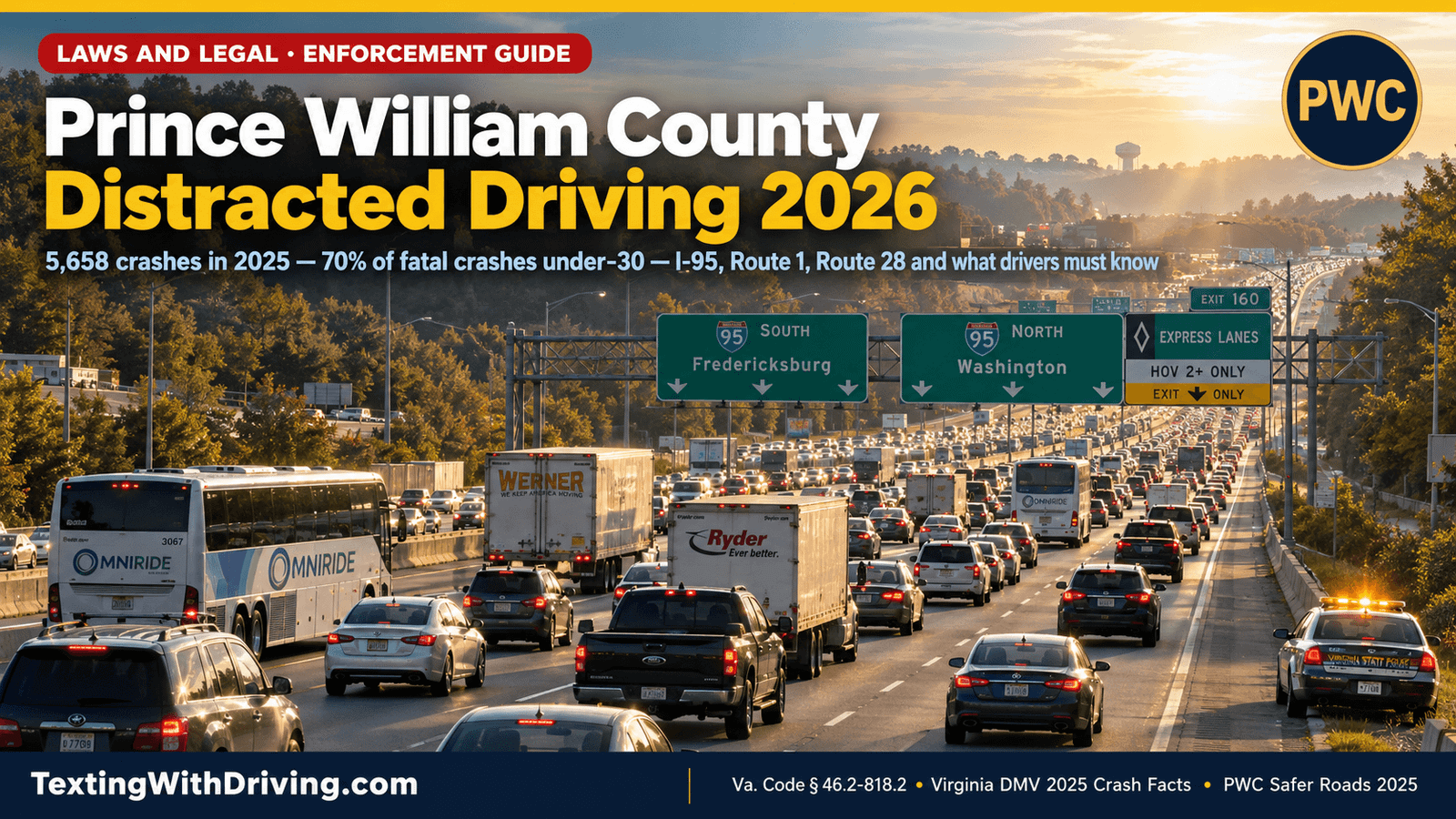
Prince William County Distracted Driving 2026: I-95, Route 1 and the Manassas Guide
Prince William County distracted driving 2026 affects Virginia’s second-largest county by population — a jurisdiction of approximately 470,000 residents that has grown faster than almost any other county in the Commonwealth over the past two decades, and whose road network bears the consequences of that growth in the form of I-95’s most congested commuter corridor south of the Capital Beltway.
The Virginia DMV’s 2025 Virginia Traffic Crash Facts report quantifies the scale: Prince William County recorded 5,658 crashes, 34 fatalities, and 3,527 injuries in 2025. Those figures place Prince William County among Virginia’s highest absolute crash-count jurisdictions — reflecting the combination of its large population, its role as a primary bedroom community for Washington DC’s federal and contracting workforce, and the specific road characteristics of I-95, Route 1, and Route 28 that concentrate distracted driving crashes.
The demographic dimension of Prince William County’s crash data is the most specific available measure of where distracted driving risk is concentrated: in 2024, over 70 percent of fatal accidents in Prince William County involved drivers under 30, many linked to speeding or distraction. 70 percent. The young adult workforce that has driven Prince William County’s growth — government contractors, technology workers, military personnel from Quantico — is also the demographic that NHTSA’s national data identifies as most likely to die in distraction-affected crashes. The same demographic that grew Prince William County into Virginia’s second-largest county is the demographic at highest distracted driving crash risk within it.
This guide covers the complete Prince William County distracted driving 2026 picture: the I-95 corridor’s specific crash concentration, Route 1 and the Woodbridge commercial strip, Route 28’s role as the county’s most congested internal arterial, the Safer Roads 2025 initiative and what it has produced, the red light camera and speed camera enforcement infrastructure, and what every Prince William County resident, commuter, and I-95 through-traveler must know under Virginia Code § 46.2-818.2.
The Virginia DMV Data: 5,658 Crashes in 2025
Prince William County distracted driving 2026 occurs against the backdrop of one of the most comprehensively documented crash records in Northern Virginia. The 2025 Virginia Traffic Crash Facts data from the Virginia DMV provides the specific county-level baseline: 5,658 total crashes, 34 fatalities, 3,527 injuries, with 327,009 licensed drivers and a 0.10 fatality rate per 100 million miles traveled.
The 0.10 fatality rate per 100 million miles — a measure of how deadly the county’s driving environment is relative to the miles traveled within it — provides context for the absolute crash count. At 0.10, Prince William County’s fatality rate is lower than many Virginia rural counties where higher speeds produce more severe crashes per mile traveled. But the absolute crash count of 5,658 — reflecting the volume of vehicle miles traveled in a nearly 500,000-person county — places it among Virginia’s highest-volume crash jurisdictions.
Traffic collisions in Prince William County increased by 12 percent compared to 2022, with rear-end and intersection crashes doubling in frequency. The 12 percent crash count increase, with rear-end crashes doubling, is the specific pattern that distracted driving produces most directly. As we documented in our distracted driving brain science 2026 article, distracted drivers are most likely to produce rear-end crashes because the failure-to-detect a slowing or stopped vehicle is the most direct behavioral consequence of attentional impairment from phone use. When rear-end crashes double over a multi-year period, the distracted driving contribution is a leading candidate explanation alongside increased vehicle miles traveled.
Distracted driving remains a leading cause in Prince William County, according to the county’s own crash trend analysis. The Virginia DMV names Prince William County explicitly in the top 7 highest distracted driving crash jurisdictions in Virginia — alongside Fairfax County, Loudoun County, Henrico County, Richmond City, Norfolk City, and Virginia Beach City. Prince William County’s crash volume places it in this top tier despite having a lower population density than Fairfax County, reflecting the specific road network and demographic characteristics that amplify distracted driving crash risk.
I-95: The County’s Most Dangerous Road
Prince William County distracted driving 2026’s most consequential crash concentration is on Interstate 95 — the primary north-south highway that carries Prince William County commuters, commercial freight from the Port of Virginia, and through-traffic between the northeastern United States and the Southeast.
I-95 through Prince William County has produced a documented pattern of fatal crashes in 2025 and 2026. A Dumfries woman was struck and killed while walking along Interstate 95 in Prince William County in a 2025 pedestrian fatality. In February 2025, a fatal two-vehicle crash occurred in the I-95 express lanes southbound near mile marker 151. A fiery crash on Interstate 95 southbound in March 2025 caused significant delays. A fatal hit-and-run from an earlier period resulted in an arrest as recently as October 2025.
The specific I-95 crash dynamic in Prince William County reflects the road’s operational characteristics at this specific geographic point in the highway:
The express lane/general purpose lane transition. I-95 through Prince William County carries both standard general purpose lanes and the I-95 Express Lanes — the variably-priced managed lanes that separate high-occupancy and toll-paying vehicles from general traffic. The transitions between general purpose and express lanes at the Woodbridge-area interchanges create the lane-change and merge complexity that produces the specific sudden-speed-change events where rear-end crashes from distracted drivers are most likely.
The Dumfries Road and Prince William Parkway interchange cluster. Multiple I-95 incidents in Prince William County are documented near the interchange cluster where I-95, US-1 (Richmond Highway), and Route 234 (Prince William Parkway) converge near Dumfries and Woodbridge. This interchange complexity — where commuters must make rapid lane selection decisions while managing the HOV/express lane entrance choices — creates the highest navigation-uncertainty driving demand of the I-95 corridor through the county.
Pedestrian vulnerability. The Dumfries woman struck and killed on I-95 in Prince William County reflects the same I-395 pedestrian vulnerability pattern we documented during Labor Day weekend in our Virginia distracted driving September 2026 article. Pedestrians on interstate highways — people walking on shoulders after vehicle breakdowns or crashes — have no protection from distracted drivers who are not scanning the shoulder.
Through-traffic from distant states. I-95 through Prince William County carries through-traffic from Florida, Georgia, the Carolinas, and other states whose hands-free law standards differ from Virginia’s. The North Carolina driver on I-95 southbound through Woodbridge — whose home state has only a texting ban, not a comprehensive handheld prohibition — is subject to Virginia Code § 46.2-818.2’s full standard from the moment their vehicle crosses the Fairfax County-Prince William County line on I-95.
Route 1 (Richmond Highway): The Commercial Strip
Prince William County distracted driving 2026 has its most concentrated surface-road crash activity on US Route 1 — the Richmond Highway corridor that parallels I-95 through the county from the Fairfax County border at Woodbridge through Dumfries and Triangle toward Stafford County.
Route 1 through Prince William County is a commercial arterial with characteristics that produce maximum distracted driving crash risk: dense retail strip development with continuous access points, stop-and-go traffic from the commercial activity that generates shopping, delivery, and pedestrian crossings throughout the day, and the specific navigation demand of a road with no clear functional hierarchy — where the through-commuter and the local shopper share lanes with the commercial truck making a delivery.
A Prince William County woman was killed in a crash while driving out of the City of Manassas in late July 2025. In a separate late July 2025 case on Dumfries Road in Prince William County, a wrong-way driver struck another vehicle head on, killing the striking driver. Wrong-way crashes — which produce the highest-severity head-on collisions — are the behavioral extreme of the impaired and distracted driving spectrum.
The Route 1 corridor through Woodbridge’s commercial district — with Potomac Mills mall and its surrounding retail generating massive vehicle volumes — creates the specific commercial-strip distracted driving environment that every Northern Virginia driver encounters on the most crash-concentrated local road in Prince William County. The driver who is checking their phone for a Potomac Mills store location while navigating Route 1’s access point complexity is creating the primary offense violation in the specific environment where that behavior is most likely to produce a crash.
Route 28: Manassas’s Most Congested Corridor
Prince William County distracted driving 2026 has a specific internal arterial dimension in Route 28 — Centreville Road, which connects Manassas and Manassas Park to I-66 to the north and Prince William Parkway to the south, and which is the county’s most heavily documented congestion and crash concentration corridor.
Route 28 connects commuters from Manassas to key routes like Interstate 66 to the north and Prince William Parkway to the south. Drivers on Route 28 express frustration with aggressive and distracted drivers — the Manassas-area community discussion captures the specific behavioral characteristics that Route 28’s congestion and stop-and-go patterns produce.
The Prince William Board of County Supervisors ended the Route 28 bypass project in 2025, instead approving a widening of Route 28 from four to six lanes between the Manassas city and Fairfax County lines. The widening project — addressing Route 28’s capacity deficit — will produce construction zone conditions throughout its implementation period. As we documented in our distracted driving work zones 2026 article, construction zone distracted driving violations carry a mandatory $250 fine in Virginia (double the standard $125 first offense), and construction workers’ proximity to live traffic makes distracted driving in work zones specifically dangerous.
VDOT held a hybrid public information meeting in May 2025 on planned innovative intersection improvements along Route 28 between Manassas Drive and Spruce Street, based on the Centreville Road STARS Study. The STARS Study intersection improvements — incorporating signal timing optimization and turning movement modifications — address the specific intersection crash patterns that distracted driving amplifies. Improved signal timing at complex Route 28 intersections provides a larger temporal window for the distracted driver to detect and respond to the changed signal state. But the engineering improvement does not eliminate the citation risk for the distracted driver who is still holding their phone in a construction zone.
The Safer Roads 2025 Initiative: PWC’s Response
Prince William County distracted driving 2026 enforcement operates within the Safer Roads 2025 initiative — Prince William County’s formal programmatic response to the crash trend data showing a 12 percent collision increase.
The Safer Roads 2025 initiative focuses on three priorities: smart intersection redesigns at busy nodes like Routes 28/143 incorporating leading-edge signal timing and dedicated left-turn phases; expanded enforcement of distracted and fatigue driving with increased police presence during peak hours and public outreach campaigns; and enhanced driver education through partnerships with local schools and DMV programs stressing realistic driving simulations.
The expanded enforcement priority is the most directly relevant to Prince William County distracted driving 2026. Increased police presence during peak hours is the operational expression of primary enforcement authority under Virginia Code § 46.2-818.2. A Prince William County Police officer who observes a driver holding their phone during morning rush hour on Route 28 or afternoon peak on Route 1 has primary stop authority without any concurrent violation — and the Safer Roads 2025 initiative specifically designates distracted driving as one of the enforcement targets that increased peak-hour police presence is directed toward.
Prince William County Sheriff Mark Ellis, who chairs the county’s Traffic Safety Task Force, has been direct about the stakes: a single text while driving at 45 mph in a zone with heavy pedestrian crossings can end in tragedy. That 45 mph scenario — a standard Route 28 or Route 1 speed — covers 66 feet per second. A five-second texting interaction at 45 mph covers 330 feet with eyes off the road and zero ability to detect a pedestrian in a crosswalk or a vehicle stopping ahead.
Early 2024 safety campaigns correlated with a 5 percent drop in weekend daytime crashes in downtown Manassas. The 5 percent improvement from the 2024 campaign cycle demonstrates that enforcement-plus-awareness initiatives produce measurable short-term behavioral change in Prince William County’s specific road environment — consistent with the broader research on enforcement campaign effectiveness we documented in our distracted driving awareness campaigns that worked article.
The Camera Enforcement Expansion
Prince William County distracted driving 2026 enforcement is expanding beyond officer-based primary enforcement into automated camera systems that create a persistent, around-the-clock detection environment.
The City of Manassas already has red light cameras to capture vehicles driving through red lights at various intersections. Prince William County is in the process of setting up its own red light camera program — expanding automated enforcement from the City of Manassas into the broader county. Prince William County has numerous speed cameras in school zones.
The red light camera program expansion — combined with the school zone speed cameras already operational — creates an automated enforcement infrastructure that complements officer-based primary enforcement. A driver who runs a red light on Route 28 in the Manassas area may face the city’s red light camera citation. A driver who is speeding in a Prince William County school zone faces the county’s speed camera. And a driver who is holding their phone for any reason on any Prince William County road faces primary enforcement citation from any Prince William County Police officer, any Virginia State Police trooper, or any other law enforcement officer with jurisdiction.
The Virginia SB84 AI camera framework — authorized by Governor Spanberger effective July 1, 2026 as documented in our Virginia distracted driving cameras 2026 article — is deploying Obvio cameras in school zone crosswalks and at stop signs statewide. Prince William County school zones and stop signs are within this deployment framework. The AI camera infrastructure that is already capturing stop sign and crosswalk violations in Prince William County may be extended to distracted driving citation authority through future legislative expansion, based on the same Obvio technology that detected 2,500 violations per day in Maryland’s SB613 pilot.
The Commuter Demographic and Distracted Driving
Prince William County distracted driving 2026 is particularly acute during the county’s massive commute windows — the morning and afternoon rush hours that move a substantial share of the county’s workforce north to jobs in Fairfax County, Arlington, and DC, and south to Marine Corps Base Quantico and its surrounding defense contracting community.
The OmniRide bus network — Prince William County’s regional transit system with express bus service to Pentagon, Crystal City, and downtown DC — serves commuters who do not own or choose not to drive. But the vast majority of Prince William County commuters drive, and the specific commute pattern — long distances on I-95 and I-66, significant stop-and-go congestion, and extended time in the vehicle — creates the sustained phone-checking impulse that produces distracted driving violations throughout the commute corridor.
The I-95 Express Lanes extend through Prince William County southbound to Exit 152 (Route 234/Prince William Parkway) and northbound to merge back into general traffic before the I-495 Capital Beltway. Managing express lane entry and exit — which requires EZPass scanning, lane selection, and speed adjustment at the transition points — creates a specific driver demand at exactly the moments where many commuters also try to manage phone calls, navigation adjustments, or work email. The Virginia Code § 46.2-818.2 prohibition on holding a phone applies at every I-95 Express Lane entry, merge, and exit point exactly as it applies anywhere else on a Virginia public road.
The Prince William Parkway and Manassas Park Corridors
Prince William County distracted driving 2026 extends into the internal circulation network that connects the county’s communities: the Prince William Parkway (Route 234) connecting I-95 near Woodbridge to I-66 near Gainesville, and the community roads around Manassas, Manassas Park, and Woodbridge.
A 19-year-old driver was clocked at 115 mph on Prince William Parkway — 85 mph over the 30 mph speed limit in a 55 mph zone — in a recent enforcement incident that resulted in a reckless driving summons. The extreme speeding incident on Prince William Parkway reflects the specific young driver demographic that the county’s fatal crash data identifies: over 70 percent of fatal accidents involved drivers under 30. While the 115 mph incident is extreme, it reflects the behavioral risk tolerance of the specific demographic that the county’s crash data shows is overrepresented in fatal outcomes — the same demographic that is also most likely to use phones while driving per national behavioral research.
The Prince William Parkway serves as the internal highway connecting the county’s western and eastern sections — from I-66 near Gainesville and Haymarket through the county’s developed interior to I-95 near Woodbridge. Its intersection density with Route 28, Dale Boulevard, and the major residential connector roads creates the stop-and-go traffic rhythm where phone-checking behavior is highest and where primary enforcement citations are most likely.
Operation DISS-RUPT and Prince William County’s Interstate Coverage
Prince William County distracted driving 2026 enforcement includes the Virginia State Police’s Operation DISS-RUPT coverage of I-95 through the county. Operation DISS-RUPT’s May 18-19, 2026 deployment covered all 179 miles of I-95 through Virginia — including every mile of I-95 through Prince William County from the Stafford County line at the south to the Fairfax County line at the north.
As documented in our Virginia distracted driving September 2026 article, Operation DISS-RUPT produces real citation volumes: the February 2026 I-66 deployment produced 53 distracted driving citations in two days. The I-95 May deployment covered Prince William County’s full I-95 corridor with the same enforcement framework — Virginia is hands-free, which prohibits drivers from holding personal communications devices while driving.
Virginia State Police troopers on I-95 through Prince William County operate with the same primary enforcement authority as PWCPD officers on Route 28. The commuter who holds their phone during a morning I-95 merge near Woodbridge has encountered Operation DISS-RUPT enforcement during the May 2026 deployment — and will encounter it again in any future DISS-RUPT deployment on I-95.
What Every Prince William County Driver Must Know in 2026
Prince William County distracted driving 2026 creates specific obligations for every driver on the county’s roads — resident, commuter, contractor, and through-traveler.
Virginia Code § 46.2-818.2 is actively enforced by both PWCPD and VSP. Prince William County’s Safer Roads 2025 initiative specifically designates expanded enforcement of distracted driving as one of three priorities. PWCPD officers are deployed with increased peak-hour presence on Route 28 and Route 1. Virginia State Police troopers with Operation DISS-RUPT authority cover I-95. Both agencies have primary stop authority. No concurrent violation is needed.
The 12 percent crash increase with doubling rear-end crashes reflects the distracted driving pattern. When rear-end crashes double, the most likely behavioral explanation is phone distraction reducing the following driver’s reaction time to sudden speed reductions. Prince William County’s 2022-to-2025 crash trend is the specific data context in which a $125 first-offense citation and three-year insurance surcharge are imposed on drivers who hold their phone during the commute.
Route 28 is a construction zone for its widening project. Any phone use while driving through an active construction zone on Route 28 — where lane restrictions, worker presence, and reduced speed limits apply — carries the mandatory $250 construction zone distracted driving fine rather than the standard $125. Workers adjacent to Route 28 during the widening project are the specific vulnerability that this fine enhancement is designed to deter.
The Manassas red light cameras document violations independently of officer observation. A driver who runs a red light on Route 28 in the City of Manassas while holding their phone potentially generates both a red light camera citation and the basis for a distracted driving primary offense stop — two separate enforcement consequences from a single behavioral choice.
The under-30 demographic concentration is the county’s most urgent safety challenge. Over 70 percent of Prince William County fatal accidents involve drivers under 30. If you are under 30 and driving in Prince William County — commuting to Quantico, to Tysons, to DC, or to any other employment center — you are statistically in the demographic with the highest fatal crash risk from speeding and distraction. The phone setup that eliminates the distraction contribution to that risk — Driving Focus, phone in back seat, GPS pre-set — is the specific behavioral intervention most available to improve the county’s most alarming crash statistic.
For the complete Virginia law that applies on every Prince William County road, our Virginia distracted driving law covers Va. Code § 46.2-818.2. For the Northern Virginia regional context placing Prince William County alongside Fairfax and Loudoun, our Northern Virginia distracted driving guide covers the I-95 and I-66 corridor. For the Virginia 2025 Crash Facts data cited in this article, our Virginia distracted driving statistics 2026 covers the complete statewide picture. And for the technology setup that makes Virginia compliance automatic on I-95, Route 28, Route 1, and every Prince William County road, our hands-free while driving complete setup guide covers iPhone, Android, Bluetooth, and CarPlay.
Sources Used in This Article
All links verified working before publication.
Virginia DMV: 2025 Virginia Traffic Crash Facts — Prince William County 5,658 crashes 34 fatalities 3,527 injuries 327,009 licensed drivers 0.10 fatality rate per 100M miles, 2025
Archive Aeon / Washingtonian Views: Prince William County Sees Surge in Car Accidents — 12% collision increase vs 2022, rear-end and intersection crashes doubled, 70% fatal accidents drivers under 30 speeding or distraction, Sheriff Mark Ellis Traffic Safety Task Force single text 45 mph pedestrian crossings tragedy quote, Lena Carter Northern Virginia Traffic Institute short reaction times distracted habits quote, 5% weekend daytime crash drop Manassas early 2024 campaigns
Archive Aeon: Debunking Safety Myths Prince William County — Safer Roads 2025 initiative three priorities smart intersection redesigns expanded enforcement distracted fatigue driving enhanced driver education, intelligent traffic sensors key bottlenecks navigation app partnerships
Patch Manassas: Reader Poll What Is the Biggest Traffic Frustration in Manassas — Route 28 connects Manassas to I-66 and Prince William Parkway, county ended Route 28 bypass 2025 now widening 4 to 6 lanes, aggressive and distracted drivers Manassas community concern, City of Manassas red light cameras, Prince William County setting up own red light camera program, speed cameras school zones, July 2025 woman killed Manassas wrong-way crash Dumfries Road, August 2025
Potomac Local: I-95 crashes Prince William County 2025 — Dumfries woman struck killed I-95 northbound PWC, February 2025 fatal crash I-95 express lanes southbound mile marker 151, March 2025 fiery crash I-95 southbound significant delays, fatal hit-and-run I-95 arrest October 2025, VSP reckless driver I-95 chase PWC into DC 2025
Yahoo News / DC News Now: Teen Clocked 115 MPH Prince William Parkway — 19-year-old 115 mph Prince William Parkway 55 mph zone reckless driving summons, PWCPD social media safety message, April 2026
Virginia DMV: Distracted Driving Toolkit — Prince William County named top 7 highest distracted driving crash jurisdictions Virginia, ages 21-35 most frequent demographic
NHTSA: Distracted Driving — 3,208 deaths 2024, 315,167 injuries, national context
TextingWithDriving.com is professionally built and maintained to ensure accurate, accessible safety information reaches every driver who needs it. Website development and ongoing support is handled by Budgetic, a digital agency specializing in purpose-driven WordPress websites.

About Texting With Driving
TextingWithDriving.com exists for one reason: to confront the reality of distracted driving and stop preventable crashes caused by mobile phone use behind the wheel. Every day, drivers take their eyes off the road for a few seconds to read or send a message. Those few seconds are enough to cause life-altering consequences. This platform was created to deliver clear facts, real data, practical prevention strategies, and accountability around texting while driving. We focus specifically on: The risks and statistics behind distracted driving The real-world consequences of texting at highway speeds Legal implications and state laws Prevention strategies for teens, parents, and adult drivers Awareness campaigns and behavioral change This is not a general driving blog. It is a focused awareness initiative built around one critical issue: phone distraction behind the wheel. Our content is direct, research-driven, and practical. We prioritize accuracy over opinion and education over sensationalism. The goal is simple — reduce distracted driving incidents by increasing awareness and responsibility. If one article causes one driver to put their phone down, the mission is working. For inquiries or partnerships, contact: privacy@textingwithdriving.com
View all posts by Texting With Driving