

Maryland Teen Distracted Driving 2026: GDL Complete Phone Ban, School Zones and Parent Guide

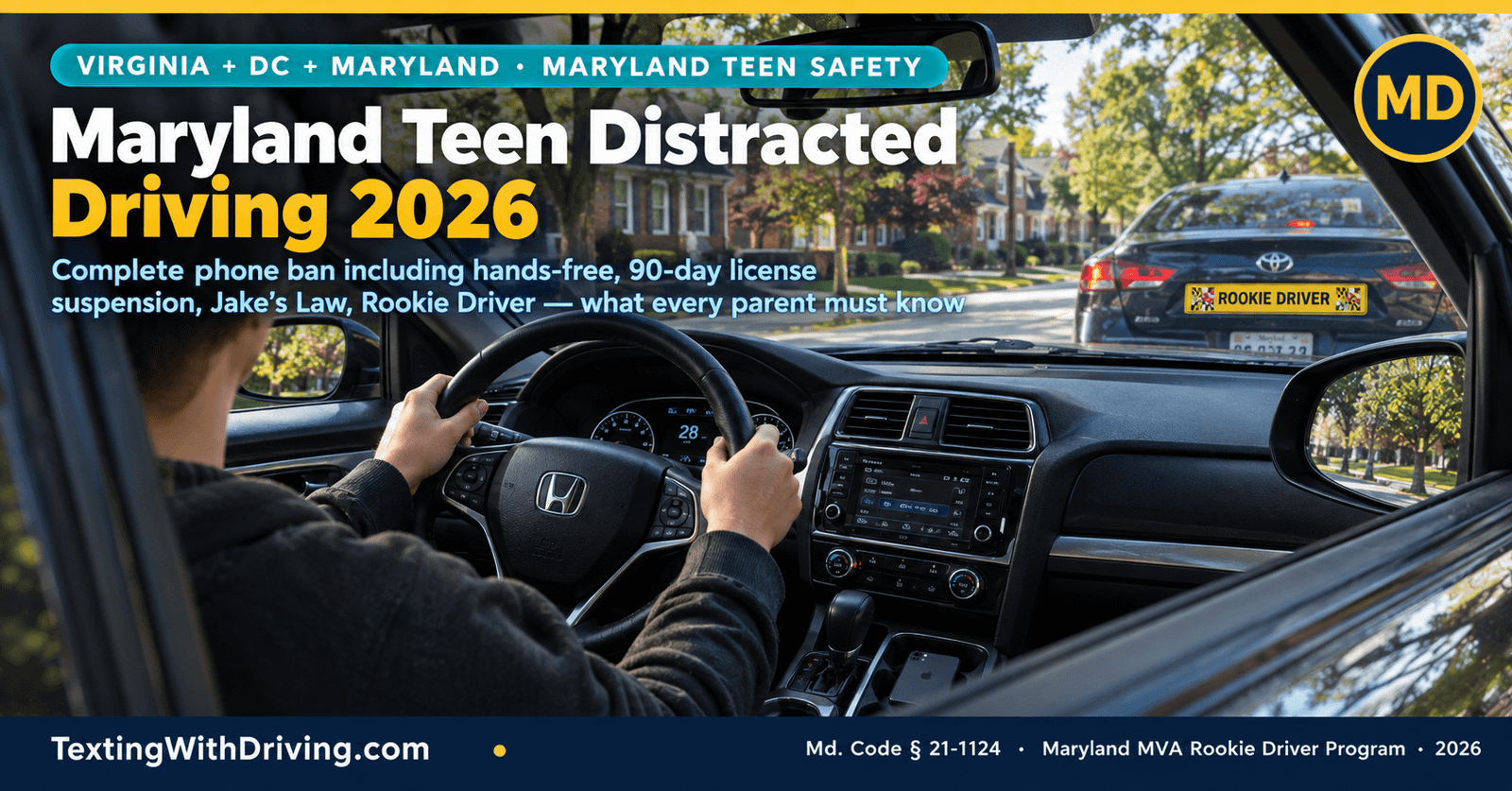
Maryland Teen Distracted Driving 2026: GDL Complete Phone Ban, School Zones and Parent Guide
Maryland teen distracted driving 2026 operates under one of the strictest youth driver phone laws in the DMV region — a complete prohibition that covers not just handheld use but hands-free calls as well, applies as a primary offense from the first day a teen sits behind the wheel with a learner’s permit, and carries a potential 90-day license suspension for a single violation.
Maryland’s wireless communication device definition makes this clarity absolute: a wireless communication device is defined as a handheld or hands-free device. So a Bluetooth call that is legal for an adult driver under Maryland’s Transportation Code § 21-1124 is a direct violation for a 17-year-old with a provisional license.
This complete under-18 prohibition exists within Maryland’s “Rookie Driver” Graduated Driver Licensing program — a structured framework that takes Maryland teens from first permit at 15 years and 9 months through an 18-month provisional period before any unrestricted full license is possible. Understanding every restriction in this framework is what this guide is for — because Maryland teen distracted driving 2026 consequences extend well beyond the standard handheld fine. They can mean a suspended license during the most critical period of a teen’s developing driving career, and through Jake’s Law, potential criminal consequences if a distracted teen causes serious injury.
The Complete Phone Ban: What Maryland’s Under-18 Law Actually Says
The Maryland teen distracted driving 2026 legal standard is established in Maryland Transportation Code § 21-1124 and § 21-1124.1, and the Maryland People’s Law Library summarizes it precisely: drivers under the age of 18 may not use a wireless communication device while driving, except to contact 9-1-1.
The law defines a wireless communication device as a handheld or hands-free device used to access telephone service. This means:
No handheld phone calls. A Maryland teen cannot hold a phone to their ear for any voice call while driving. This applies from the first day of learner’s permit operation through the entire provisional license period until the teen’s 18th birthday.
No hands-free calls. The definition’s explicit inclusion of hands-free devices closes the loophole that exists in most adult distracted driving laws. A 17-year-old Maryland driver who connects to Bluetooth and takes a call is violating § 21-1124 even though their hands are not touching the phone and even though an adult driver using the same setup is fully compliant.
No texting, messaging, or any device interaction. The texting prohibition applies to all drivers regardless of age. For under-18 drivers, the additional wireless communication device prohibition covers the full spectrum of phone interaction.
The only exception is a 911 emergency call. Phone calls placed to 9-1-1, ambulance, hospital, fire, or law enforcement agencies are allowed. A genuine emergency is the only circumstance where Maryland’s under-18 prohibition has any exception.
Primary enforcement. Use of a wireless communication device by a driver under the age of 18 is a primary offense, meaning that a police officer can enforce this law even if the driver is not committing any other offense. A Maryland State Police trooper who observes a teen driver with an earpiece in for a Bluetooth call can initiate a traffic stop based solely on that observation — because the hands-free call is a primary offense for the under-18 driver.
The hands-free prohibition is the element of Maryland teen distracted driving 2026 law that most parents and many teen drivers are unaware of. The adult standard — which permits Bluetooth calls and hands-free interaction — creates a mental model that many families incorrectly apply to their teen drivers. A parent who drives their teen to school while making Bluetooth calls, then expects the teen to follow the same standard independently, has inadvertently modeled behavior that is legal for the parent and illegal for the teen under Maryland law.
The Maryland Rookie Driver GDL Framework
Maryland teen distracted driving 2026 occurs within Maryland’s Graduated Driver Licensing program — officially called “Rookie Driver” — which structures teen licensing through specific phases with specific restrictions.
Maryland has a graduated driver licensing program. This means that if you are under 18, you must go through several phases with varying restrictions before obtaining the same driving license as an adult.
Phase 1: Learner’s Permit (Age 15 years 9 months)
Maryland teens can obtain a learner’s permit at 15 years and 9 months after passing a vision screening and knowledge test. The permit phase requires a licensed adult supervisor in the front passenger seat at all times.
In Maryland, teens can get a permit at 15 years 9 months.
During the learner’s permit phase, the complete under-18 phone prohibition applies. A teen with a learner’s permit may not use any wireless communication device — handheld or hands-free — for any purpose except calling 911. The supervisor who is legally required to be present may not treat their presence as a license to permit the teen to use their phone during supervised practice drives.
Before taking the road skills test for a provisional license, the teen must complete supervised practice driving including a documented practice log.
Phase 2: Provisional License (Age 16 years 6 months)
A provisional license is available at 16 years 6 months after holding the learner’s permit, completing the required supervised practice driving, and passing the road skills test.
After successfully completing the permit phase, a teen can take the road test to earn their provisional license. This license comes with critical restrictions that last for 18 months.
The provisional license restrictions cover:
Nighttime curfew: No driving between midnight and 5 AM. Exceptions apply for travel to or from work, a school activity, a volunteer program, accompanying a licensed adult 21-plus who has been licensed for three or more years, or a genuine emergency. The midnight-to-5-AM curfew is the same structure Virginia uses, with comparable exceptions.
Passenger restriction (first 151 days): For the first five months of provisional license holding — 151 days — the teen may not transport any passengers under age 18. The only exception is immediate family members (spouse, child, sibling). The passenger restriction is one of the most evidence-based elements of the GDL framework: peer passenger presence dramatically increases teen crash risk, and the first 151 days is when the risk elevation from peer passengers is highest relative to the teen’s limited driving experience.
Phone restriction: The complete under-18 phone ban continues throughout the entire provisional license period — 18 months from the date of provisional license issuance. A teen who receives their provisional license on September 15, 2026 is subject to the complete phone ban through approximately March 15, 2028 — several months after their 18th birthday if they received the provisional license at 16 and a half.
Full license: After holding the provisional license for at least 18 months without any moving violation convictions, the GDL restrictions are lifted, and the license becomes a full, unrestricted license. The 18 months without violations is the critical condition. A single moving violation during the provisional period — including a phone use violation — resets the period or results in license suspension depending on the circumstances.
The 90-Day License Suspension: The Consequence Most Families Don’t Know
The most serious immediate consequence of Maryland teen distracted driving 2026 violations is not the fine. It is the license suspension.
The MVA can suspend a learner’s permit or provisional driver’s license up to 90 days for a violation of this rule. Alternately, the MVA may also issue a restricted license that limits driving to specific purposes: driving to or from school, for example.
90 days. For a teen who uses their provisional license to drive to school, to an after-school job, to sports practices, and to the social activities that constitute the central daily life of a teenager — a 90-day license suspension is a profound consequence that affects every aspect of their daily routine. It falls on the family as well, because transportation that the teen was managing independently suddenly requires parental coverage for three months.
The restricted license alternative — limiting driving to school-related purposes — is less disruptive than full suspension but still represents a significant curtailment of the driving independence that the provisional license represents for the teen and for the family.
The MVA suspension can occur without a court conviction. The Maryland MVA acts on evidence of the violation, which can come from a police report of the stop or from court records if the case proceeds to court. The administrative suspension and any court proceeding are separate tracks that can produce separate consequences.
The 18+ Provisional Distinction: An Important Nuance
Maryland teen distracted driving 2026 has one nuance that the under-18 complete ban framework sometimes obscures: the rules are different for drivers who are 18 or older but still hold a learner’s permit or provisional license.
Drivers 18 or older who still hold a learner’s permit or provisional license fall under a separate provision that bans all handheld phone use outright while operating a vehicle, though they may still use hands-free systems.
An 18-year-old who has just received their learner’s permit — perhaps a late-starting driver — faces only the handheld ban, not the complete hands-free ban that applies to under-18 provisional drivers. This distinction reflects a legislative judgment that the neurological development dimension of the teen ban (the prefrontal cortex development argument we documented in our Virginia teen distracted driving brain science 2026 article) is age-based rather than license-phase-based.
For parents of Maryland teens: if your teen is under 18, they face the complete ban including hands-free regardless of their license phase. If your teen turns 18 during their provisional period, the hands-free restriction technically lifts — though the underlying safety case for maintaining a complete phone-free standard during the first two years of driving remains as strong as ever.
Jake’s Law and Teen Drivers: The Criminal Dimension
Maryland teen distracted driving 2026 reaches its most severe consequence level when a distracted teen driver causes a crash that produces serious injury or death. As we documented in our Maryland distracted driving law 2026 article, Jake’s Law — named after Jake Owen, a five-year-old killed by a phone-distracted driver — establishes criminal penalties that apply regardless of whether the at-fault driver is a teen or an adult.
Jake’s Law ramps up penalties for distracted driving if you cause serious injury or death: up to $5,000 fines and jail time.
A Maryland teen driver who causes serious bodily injury to another person while using their phone faces Jake’s Law criminal exposure on top of the standard phone violation consequences. The Jake’s Law criminal pathway does not make a distinction between adult and teen drivers for purposes of its application — a 17-year-old provisional license holder who rear-ends a vehicle at highway speed while texting and causes a spinal injury to the other driver faces the same Jake’s Law $5,000 fine and jail exposure as an adult driver who does the same.
For teen drivers in Maryland, Jake’s Law creates a specific awareness gap: many teens are aware that texting while driving can result in a fine and potentially a suspended license. Very few are aware that if their texting while driving causes someone serious harm, the consequence escalates to a criminal conviction with up to $5,000 fine and potential jail time — regardless of age. This criminal exposure is the element of Maryland’s teen distracted driving law that the parent-teen conversation must explicitly cover.
Maryland’s School Zone Provisions: The $400 Fine
Maryland teen distracted driving 2026 includes the school zone fine enhancement that applies to all Maryland drivers — teen and adult alike — and that is particularly relevant during September’s back-to-school period.
As we documented in our Maryland distracted driving law 2026 article, violations of Maryland’s handheld ban in school zones and construction areas carry a mandatory $400 fine rather than the standard $83 first-offense fine — plus the $100 trauma fund surcharge, bringing the school zone effective penalty to $500 before court fees.
For a teen provisional license holder who violates the phone ban in a school zone, the school zone enhancement applies simultaneously with the MVA suspension authority. A single school zone phone violation can produce both the $500 effective fine AND the MVA’s 90-day license suspension — a compounded consequence that exceeds what most families anticipate from a single traffic stop.
Maryland school zone speed limits range from 15 to 25 mph during active school hours. The specific hours during which school zone protections apply — typically 30 to 45 minutes before and after school start and end times — are posted on school zone signs. The AI camera systems being proposed for Montgomery and Prince George’s Counties (covered in our Maryland work zone distracted driving 2026 article) would be deployed in part in school zones — creating automated detection of school zone violations that could eventually extend to teen drivers as well as adults.
The Demographic Data: Why Maryland Focuses So Intensively on Under-25 Drivers
Maryland teen distracted driving 2026 investments in GDL restrictions and enforcement are justified by specific Maryland crash data that we documented in our Maryland distracted driving statistics 2026 article.
Drivers under 25 made up nearly 40 percent of distracted crashes in Maryland.
40 percent of all Maryland distracted crashes from drivers under 25. This figure — from Maryland’s own distracted driving crash data — establishes why the GDL framework extends as far as it does and why the under-18 complete ban is the strictest of any GDL phase’s phone restriction in the DMV region.
The under-25 concentration in Maryland distracted crashes is consistent with the national NHTSA data showing that drivers aged 15-20 account for 9 percent of all distracted-driving fatalities despite representing a smaller share of licensed drivers. The disproportionate representation of young drivers in distracted crash data is the behavioral foundation on which both Maryland’s GDL framework and the neurological research we covered in our Virginia teen distracted driving brain science 2026 article rest.
What Maryland Parents Must Do Before the School Year
Maryland teen distracted driving 2026 requires specific parent actions that go beyond the standard “talk to your teen about safe driving” advice. The Rookie Driver GDL framework creates specific legal obligations and behavioral standards that parents must understand and communicate precisely.
Verify the under-18 definition includes hands-free. Many Maryland parents are unaware that their teen’s Bluetooth call is a primary offense. Before the school year begins, have the explicit conversation: no Bluetooth calls, no voice commands that require phone connection, no any phone function while driving — only 911 for a genuine emergency.
Set up the phone before the first drive. iPhone Driving Focus: Settings → Focus → Driving → Automatic. Configure to block all calls — not just notifications — because the Maryland under-18 ban prohibits even hands-free calls. Android: Settings → Digital Wellbeing → Drive Safely → enable automatic activation. Test by calling the teen’s phone while they are sitting in a parked car with the engine running — verify that it does not ring.
Phone in back seat or glove compartment. Physical separation eliminates the reach impulse that even a perfectly configured Driving Focus cannot address if the phone is in the cupholder creating visual and tactile temptation. For Maryland provisional drivers who cannot legally take even a hands-free call, the back seat is the correct location.
Explain Jake’s Law explicitly. The teen who understands that a texting crash causing someone serious injury produces a $5,000 criminal fine and potential jail time has a more complete picture of their actual risk than the teen who thinks the worst outcome is a $83 traffic citation and possibly a suspended license.
Know the 151-day passenger restriction. For a teen who just received their provisional license at the start of the 2026 school year, the first 151 days — through approximately February 2027 — prohibit any passengers under 18 who are not immediate family. This affects carpool arrangements, friend transportation, and school activity rides. Planning around this restriction before the school year starts prevents the pressure-of-the-moment decision to violate it.
Model the complete phone-free standard. As we documented in our Virginia teen distracted driving brain science 2026 article, teen drivers who regularly observe a parent using a phone while driving are significantly more likely to use their phones while driving. For Maryland parents whose adult standard permits Bluetooth calls, the most effective modeling for a teen who is subject to a complete ban is the complete phone-free standard — no calls at all while driving — rather than the Bluetooth-permitted adult standard that creates a modeling inconsistency.
The Montgomery and Prince George’s County Context
Maryland teen distracted driving 2026 has a specific Northern Maryland context in the two counties where Maryland’s AI camera pilot is proposed: Montgomery County and Prince George’s County — both high-population suburban counties in the DC metro area with large school systems and high teen driver populations.
The AI camera pilot proposed in SB613 would detect phone holding behavior at intersections in these counties through Obvio’s technology — the same system we documented in our Maryland work zone distracted driving 2026 article detecting 2,500 violations daily in testing. The pilot citations are civil penalties that do not add MVA points — but for a teen driver whose provisional license is already subject to the 90-day suspension authority, any documented phone violation creates the evidence record that can trigger MVA action.
For families in Montgomery County’s Bethesda, Rockville, Gaithersburg, and Silver Spring communities — or Prince George’s County’s College Park, Bowie, and Upper Marlboro areas — the AI camera pilot adds an automated enforcement layer to the officer-based primary enforcement that already applies on every Maryland road. The teen driver who has been quietly violating the hands-free ban during Bethesda commutes may be producing camera-detected violation records before any officer stops them.
What the Research Says About What Works
Maryland teen distracted driving 2026 is addressed by the same research base we documented in Virginia’s teen brain science article — and that research has specific implications for what Maryland parents can do that actually changes teen driving behavior rather than just creating awareness.
All 50 states ban cell phone use for novice and teen drivers, with additional restrictions under GDL programs. Unlike adult cell phone laws that may only ban handheld use or texting, teen driver restrictions under distracted driving laws typically ban all cell phone use entirely, including hands-free calls. This stricter standard reflects the higher crash risk for inexperienced drivers and the goal of minimizing all potential distractions during the learning period.
The research consensus on what works for Maryland teen drivers:
Technology enforcement is more reliable than behavioral self-regulation. A phone that cannot receive notifications during driving does not require the teen to resist the checking impulse. The Driving Focus or Android DND setup removes the decision point rather than requiring the teen to make the right decision under pressure.
Parent modeling is the strongest predictor. Teens who see their parents make and receive phone calls while driving — even hands-free — normalize the behavior more than they internalize the prohibition. The most effective thing a Maryland parent can do is adopt a complete phone-free driving standard while their teen is in the car.
Explicit consequence conversations are more effective than general awareness. A teen who knows the specific consequence — 90-day license suspension, potential restricted license, Jake’s Law criminal exposure for injury crashes — has a more complete behavioral motivation than a teen who has heard “distracted driving is dangerous” without understanding what happens specifically if they are caught or cause a crash.
For the complete Maryland law that applies to adult drivers alongside the teen-specific provisions, our Maryland distracted driving law 2026 covers Maryland Transportation Code § 21-1124 in full including Jake’s Law. For the Maryland statistics showing where teen drivers concentrate in crash data, our Maryland distracted driving statistics 2026 covers the full data picture. For the Virginia comparison showing how Maryland’s GDL compares to the neighboring state’s teen driver provisions, our Virginia teen distracted driving 2026 article covers Virginia’s complete framework. And for the technology setup that makes compliance automatic for any teen in any state, our hands-free while driving complete setup guide covers iPhone, Android, Bluetooth, and CarPlay.
Sources Used in This Article
All links verified working before publication.
Maryland People’s Law Library: Texting or Using a Telephone While Driving — Under-18 complete wireless device ban including hands-free, primary offense, 90-day MVA suspension authority, restricted license option, 911 exception, August 2026
Maryland People’s Law Library: Drivers Licenses and Teens — Rookie Driver GDL program overview, under-16 permit requirement school attendance, court notification suspension, MVA restrictions
FlashPath: Maryland Rookie Driver Law Parent Guide — Provisional license midnight-5AM curfew, 151-day no passengers under 18 restriction, 18-month provisional period, complete phone ban definition, full license conditions
HD Attorneys: Teen Driving Maryland License Laws and Tips — Provisional license complete ban on handheld mobile devices, no passengers first five months, zero tolerance alcohol under 21, CDC motor vehicle crashes leading cause teen death
Cars Counsel: Maryland Distracted Driving Laws 2026 — Under-18 skip all calls including hands-free, fine structure $83/$140/$160, Jake’s Law $5,000 injury penalty, first offense no points assessed, May 2026
LegalClarity: Maryland Cell Phone Driving Laws and Penalties — 90-day suspension MVA, drivers 18+ with provisional handheld ban only, hands-free permitted for 18+ provisional, Jake’s Law felony consequence, May 2026
David Waranch Maryland Traffic Attorney: Maryland Cell Phone Law — Wireless device definition handheld or hands-free, handheld ban applies only in-motion distinction vs texting ban, § 21-1124 vs § 21-1124.1 nuance
Ride Legal: Maryland Driving Laws Complete Guide — Permit at 15 years 9 months, provisional at 16 years 6 months, phone banned for under-18, school zone 15-25 mph
Road Law Guide: Distracted Driving Laws by State 2026 — All 50 states ban cell phone use novice teen drivers, 41 states plus DC under-18 restrictions, 15-20 age group 9% distracted fatalities, February 2026
District Heights: Maryland Cell Phone Law — School bus driver and learner’s permit provisional holders 18+ handheld ban, 911 calls allowed, turn phone on or off permitted
NHTSA: Distracted Driving — 3,208 deaths 2024, national context
TextingWithDriving.com is professionally built and maintained to ensure accurate, accessible safety information reaches every driver who needs it. Website development and ongoing support is handled by Budgetic, a digital agency specializing in purpose-driven WordPress websites.

About Texting With Driving
TextingWithDriving.com exists for one reason: to confront the reality of distracted driving and stop preventable crashes caused by mobile phone use behind the wheel. Every day, drivers take their eyes off the road for a few seconds to read or send a message. Those few seconds are enough to cause life-altering consequences. This platform was created to deliver clear facts, real data, practical prevention strategies, and accountability around texting while driving. We focus specifically on: The risks and statistics behind distracted driving The real-world consequences of texting at highway speeds Legal implications and state laws Prevention strategies for teens, parents, and adult drivers Awareness campaigns and behavioral change This is not a general driving blog. It is a focused awareness initiative built around one critical issue: phone distraction behind the wheel. Our content is direct, research-driven, and practical. We prioritize accuracy over opinion and education over sensationalism. The goal is simple — reduce distracted driving incidents by increasing awareness and responsibility. If one article causes one driver to put their phone down, the mission is working. For inquiries or partnerships, contact: privacy@textingwithdriving.com
View all posts by Texting With Driving