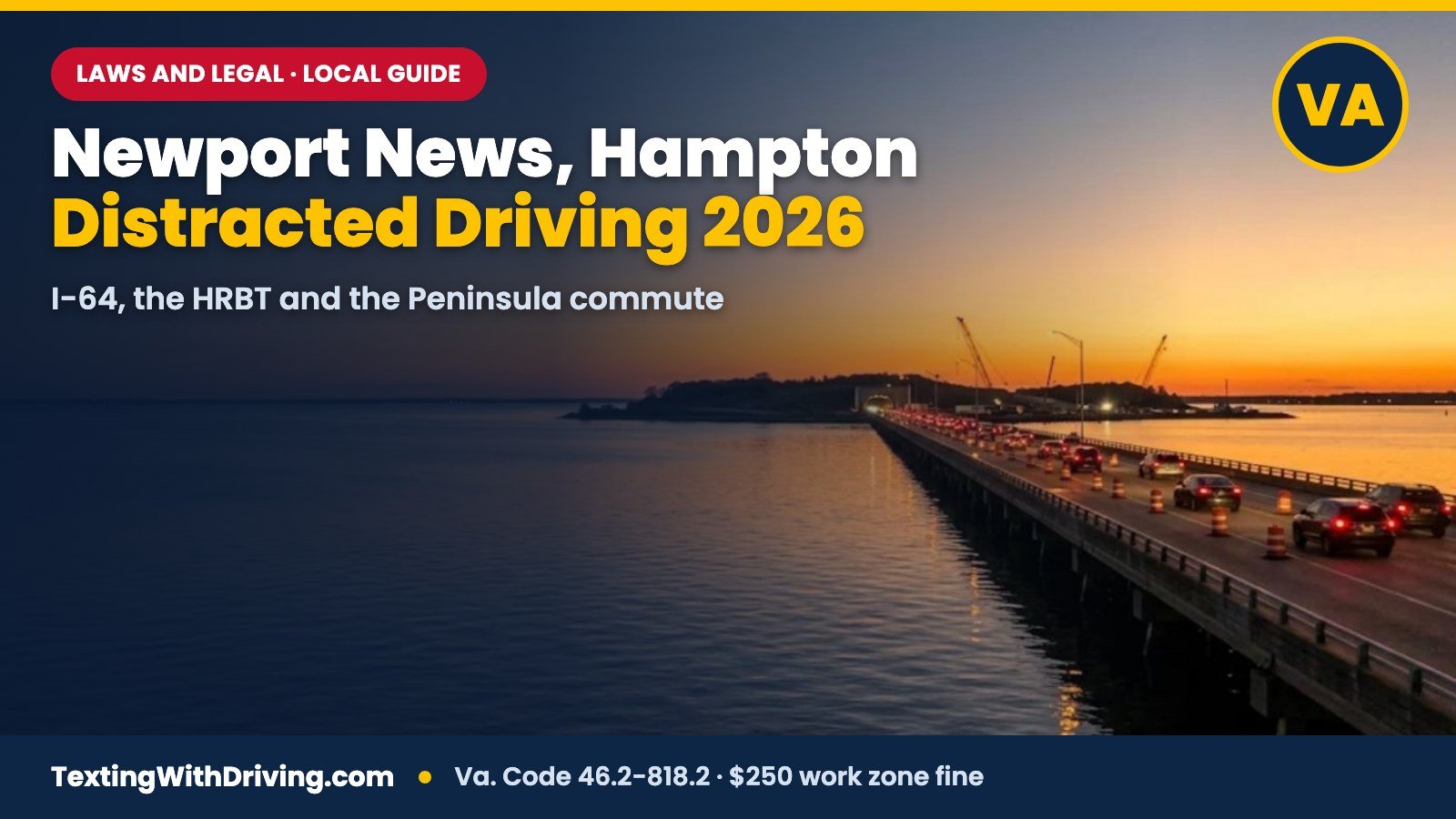
Newport News distracted driving carries a higher price than most drivers expect, because so much of the Peninsula’s commute runs through work zones. The Hampton Roads Bridge-Tunnel Expansion has kept I-64 between Hampton and Norfolk under construction for years, and Virginia law sets a mandatory $250 fine for holding a phone in a highway work zone. That is twice the usual first offense fine.
The Peninsula has a lot going on at once: major I-64 work zones, busy city corridors and regular State Police patrols. Here is where the crashes happen and what the law requires.
Key facts for Peninsula drivers
Holding a phone in a Virginia highway work zone carries a mandatory $250 fine, compared with $125 for a first offense elsewhere (Va. Code 46.2-818.2).
The new westbound North Trestle at the HRBT was on track to open in the second half of 2026, after eastbound traffic moved to the new South Trestle in November 2025 (HRBT Expansion, Spring 2026).
Virginia State Police counted 17 fatal crashes on I-64 in 2026 as of August 21, when troopers ran Operation DISS-rupt along all 299 miles of the interstate (WTKR).
VDOT counted 672 crashes from 2020 to 2024 along a 1.8-mile study area of Jefferson Avenue and Bland Boulevard in Newport News (VDOT Project Pipeline).
Virginia reported preliminary 2026 totals of 11,953 crashes and 93 deaths involving a distracted driver as of early November (Virginia DMV).
The HRBT work zone and why it changes the math
The HRBT Expansion is widening the nearly 10-mile I-64 corridor between Hampton and Norfolk and building new tunnels under the harbor. According to the project’s Spring 2026 magazine, crews shifted two eastbound lanes onto the new South Trestle in November 2025, the second new HRBT bridge in more than 50 years. The new westbound North Trestle was on track to open in the second half of 2026, and the new Mallory Street Bridge in Hampton was targeted to open all four lanes by summer 2026.
For drivers, that means lane shifts, narrow shoulders, concrete barriers and changing patterns, sometimes from one week to the next. A work zone asks more of a driver than an open highway, and a phone in your hand takes away exactly the attention a lane shift needs.
Virginia law reflects that. Under Va. Code 46.2-818.2, any violation of the hands-free law in a highway work zone carries a mandatory $250 fine. Speeding in a marked work zone when workers are present can cost up to $500 under Va. Code 46.2-878.1. And because Virginia’s Move Over law does not apply inside highway work zones, the posted work zone rules are what protect crews there.
I-64 is the spine of Peninsula travel, and it is also where State Police focus enforcement. On August 20 and 21, 2026, troopers ran Operation DISS-rupt along all 299 miles of I-64, looking for distracted, impaired and speeding drivers and unbelted occupants. As of August 21, preliminary State Police data showed 17 fatal crashes on I-64 in 2026, WTKR reported. The operation’s goals were zero fatal crashes during the two days and a 10 percent cut in fatal crashes on I-64 for the year.
Local streets matter too. VDOT’s Project Pipeline study of Jefferson Avenue and Bland Boulevard in Newport News, near the planned Denbigh I-64 interchange, found:
Jefferson Avenue and Bland Boulevard (2020 to 2024)
Figure
Total crashes in the 1.8-mile study area
672
Fatal crashes
1
Crashes at Jefferson Avenue and Denbigh Boulevard
125 (highest in the study)
Rear-end crashes
54%
Angle crashes
26%
Average daily traffic (2023)
49,147 vehicles
Rear-end crashes are the classic distraction crash. A driver looks down, traffic ahead slows at a signal, and the gap closes before they look up. More than half of the crashes in that study area were rear-end collisions, and VDOT expects traffic there to grow once the new Denbigh interchange opens.
Newport News distracted driving and the commute
The Peninsula’s commute patterns create their own risks. Shipyard shift changes, military base gates and the HRBT bottleneck all concentrate traffic into short windows. Stop-and-go traffic tempts drivers to pick up a phone, but Virginia’s law applies whenever the vehicle is moving, including crawling traffic.
Distraction also shows up on surface roads like Warwick Boulevard and Jefferson Avenue, where long commercial stretches mix signals, driveways and turning traffic. These are the same conditions that produced the rear-end pattern in VDOT’s study.
The law on the Peninsula
Newport News and Hampton follow Virginia’s statewide hands-free law. It is illegal to hold a handheld personal communications device while driving a moving vehicle.
Violation
Penalty
First offense
$125 fine
Second or later offense
$250 fine
Any offense in a highway work zone
Mandatory $250 fine
Speeding in a marked work zone with workers present
The fine is only the start. A traffic conviction can also come up when your auto insurance renews. Our report on the Virginia distracted driving insurance rate increase explains how insurers treat these tickets.
The cost climbs fast when distraction turns into a crash. If a driver’s phone use is part of conduct that endangers others, police can charge reckless driving, a Class 1 misdemeanor in Virginia that carries up to 12 months in jail and a fine of up to $2,500 (Va. Code 46.2-868 and 18.2-11). When reckless driving happens while the driver is also violating the hands-free law, the minimum fine is $250.
For the Peninsula’s many military and shipyard workers, a criminal driving charge can also create problems with base access or employer driving policies. Phone tickets are easy to avoid and expensive to carry.
New drivers on the Peninsula
Teen drivers learn on the same roads: Jefferson Avenue, Warwick Boulevard and I-64. Virginia’s provisional license rules limit young drivers’ passengers in their first year and set a midnight to 4 a.m. curfew with exceptions (Va. Code 46.2-334.01). Parents can add their own rule: the phone goes in the glove box or back seat until the car is parked. Our Virginia teen distracted driving guide has a family agreement you can copy.
Tips for the HRBT and I-64
These habits cut the risk of Newport News distracted driving crashes on the Peninsula’s busiest roads.
Set navigation before you merge. Lane shifts near the tunnel give little time to read a screen.
Watch for changed patterns. A lane that was open last week may shift this week.
Keep a long following distance. Rear-end crashes dominate Peninsula crash data.
Leave the phone alone in slow traffic. The law applies at any speed while you are moving.
Check 511 before you leave. VDOT’s 511 Virginia app shows lane closures and tunnel delays.
The rest of Hampton Roads
The Peninsula is half of Hampton Roads. For the Southside, read our guides to Norfolk, Virginia Beach and Chesapeake. Together they show the same pattern: busy interstates, long commercial corridors and work zones where a moment of distraction costs the most.
Frequently asked questions
What is the fine for using a phone in the HRBT work zone?
A mandatory $250 for any hands-free law violation in a highway work zone, under Va. Code 46.2-818.2.
What are the Newport News distracted driving laws?
Newport News and Hampton follow Virginia’s statewide hands-free law. Holding a phone while driving costs $125 for a first offense, $250 after that, and a mandatory $250 in a highway work zone.
When will the HRBT Expansion be finished?
The project’s Spring 2026 update said the westbound North Trestle was on track to open in the second half of 2026. Remaining work continues into 2027, so check VDOT’s HRBT Expansion site for current lane patterns.
Does the Move Over law apply in the HRBT work zone?
No. Virginia’s Move Over law does not apply in highway work zones. Posted work zone speed limits and the $250 work zone phone fine apply instead.
What kind of crashes are most common in Newport News?
In VDOT’s study of Jefferson Avenue and Bland Boulevard, 54 percent of crashes from 2020 to 2024 were rear-end collisions, the type most closely linked to following too closely and looking away.
This article is general information, not legal advice. For a specific ticket, talk to a licensed Virginia attorney.
TextingWithDriving.com is professionally built and maintained to ensure accurate, accessible safety information reaches every driver who needs it. Website development and ongoing support is handled by Budgetic, a digital agency specializing in purpose-driven WordPress websites.
The TextingWithDriving.com Editorial Team researches and writes every article on this site. We cover distracted driving laws in all 50 states and Washington, DC, national crash data, teen driver safety, workplace policy, and practical ways to keep phones out of drivers' hands. Every statistic and legal reference links to its original source, such as NHTSA, FMCSA, IIHS, state statutes, and state transportation departments. If you spot an error or an outdated figure, contact us and we will check it and correct it.
Vermont distracted driving law bans handheld devices while driving. See the $100 to $1,000 fines, points, work and school zone penalties and teen rules.
DC traffic cameras in 2026: what speed, red light, stop sign and bus cameras ticket, why they do not catch phone use, and how DC's phone law is enforced.
Virginia Thanksgiving traffic 2026: AAA expects 72.9 million road trips. See the worst times to drive, VDOT tools, and how to stay off your phone on I-95.
New Hampshire distracted driving law bans handheld phones. Fines rise to $250 to $1,000 with suspensions on January 1, 2027. See the rules and teen limits.
Charlottesville distracted driving in 2026: Route 29 crash data, the city's plan to end traffic deaths, student driver risks, and Virginia's phone law.