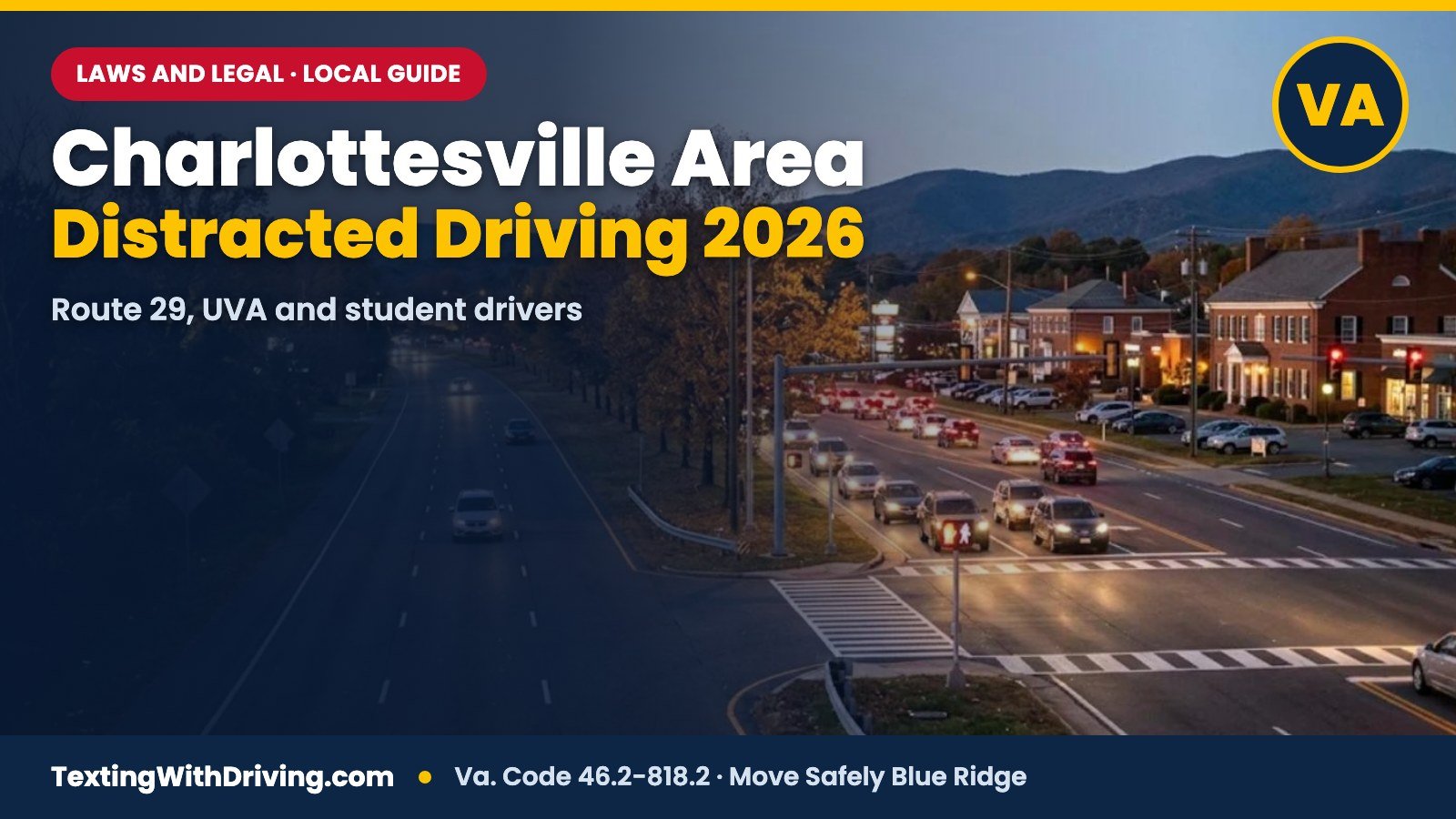
Charlottesville distracted driving matters in a city where students, commuters, visitors and people on foot share the same busy roads. Between 2018 and 2022, 13 people were killed and 195 were seriously injured in traffic crashes within the City of Charlottesville, according to the city’s 2025 resolution adopting a regional safety plan. The city has committed to eliminating roadway deaths by 2045.
Route 29 is where most of the trouble shows up. We look at the local data, how Charlottesville and Albemarle County are responding, what student and teen drivers need to know, and how Virginia’s hands-free law applies.
Key facts for Charlottesville and Albemarle drivers
13 people were killed and 195 seriously injured in traffic crashes in the City of Charlottesville from 2018 to 2022 (City of Charlottesville, 2025).
Charlottesville has committed to eliminating roadway deaths by 2045 and cutting serious injuries by at least 50% (City of Charlottesville).
VDOT counted 252 crashes from 2020 to 2024 around the US 29 and I-64 interchange, including two fatal crashes; about half were rear-end crashes (VDOT Project Pipeline, 2025).
Nationally, 6% of drivers ages 15 to 20 and 21 to 24 involved in fatal crashes were distracted in 2024, among the highest shares of any age group (NHTSA, 2026).
Holding a phone while driving in Virginia costs $125 for a first offense and $250 after that (Va. Code 46.2-818.2).
Route 29: the corridor everyone uses
US Route 29 runs through Albemarle County and the edge of Charlottesville as a major commuting and commercial road. Long signal-controlled stretches, shopping center entrances and heavy turning traffic make it the kind of corridor where a quick glance at a phone causes a rear-end crash.
VDOT’s 2025 Project Pipeline study of US 29 at the I-64 interchange shows the pattern clearly:
US 29 at I-64 (2020 to 2024)
Figure
Total crashes in the 2-mile study area
252
Fatal crashes since 2020
2
Share that were rear-end crashes
About 50%
Average daily traffic (2022)
18,000 vehicles
Speed limit
55 mph
VDOT found rear-end crashes concentrated among southbound drivers in the left lanes near the I-64 westbound off-ramp, and a short dual left-turn lane onto I-64 eastbound that backs up into through traffic. Those are conditions where a driver who looks down for a second runs out of room.
How Charlottesville is responding
In 2025, Charlottesville City Council adopted Move Safely Blue Ridge, a regional safety action plan developed by the Thomas Jefferson Planning District Commission with federal Safe Streets and Roads for All support. The city’s resolution commits it to eliminating roadway deaths by 2045 and reducing serious injuries by at least 50 percent over the same period, in line with Virginia’s Strategic Highway Safety Plan.
The city has also launched a Safer Streets Strategy. It followed the October 2024 death of Mamawa Samai, 64, who was struck and killed while crossing Elliott Avenue shortly after dusk at a crosswalk with no lights, Information Charlottesville reported. Poles were installed at the intersection soon after, and staff began studying other crossings around the city. “Obviously, in October, we learned that we have a lot of work to do,” Transportation Planning Manager Ben Chambers told council in January 2025.
That crash is a reminder of what distracted driving puts at risk. People on foot have no protection, and after the end of Daylight Saving Time on November 1, many evening walks to class, work or the bus now happen in the dark.
Student and young drivers
Charlottesville’s population includes many young drivers, from high school students to university students driving in a new city. Young drivers are overrepresented in distraction crashes. NHTSA’s 2024 data shows that 6 percent of drivers ages 15 to 20 and 21 to 24 involved in fatal crashes were distracted, tied for the highest share of any age group.
A February 2026 survey of more than 1,200 young people in 26 states, including Virginia, by the Traffic Injury Research Foundation and the National Distracted Driving Coalition found that 48 percent of 18 to 20 year olds said they had used a phone while driving in the past 30 days. Nearly half of the young people surveyed said their parents influence their driving habits the most.
For teens under 18, Virginia’s provisional license rules add limits: in the first year, only one passenger under 21 who is not a family member, and a midnight to 4 a.m. curfew with exceptions (Va. Code 46.2-334.01). Teens follow the same hands-free law as adults. Our Virginia teen distracted driving guide covers the details.
Game days, move-in weekends and visitors
Charlottesville’s traffic is not steady through the year. University move-in, football weekends, graduation and tourist seasons bring thousands of drivers who do not know the roads. Unfamiliar drivers lean on GPS, look for parking and read street signs, which are all forms of distraction even when the phone is mounted.
If you are visiting, program your route before you leave, and pull into a parking lot if you need to change it. If you live here, expect sudden lane changes and stops from out-of-town drivers on Route 29, Emmet Street and around downtown, and leave extra space.
What a distracted driving crash costs
The fine for holding a phone is small next to the cost of a crash. A rear-end collision at a Route 29 signal can mean repairs, a deductible, higher premiums and time off work. A crash with a person on foot can change lives permanently.
When a driver’s conduct endangers others, Virginia police can charge reckless driving, a Class 1 misdemeanor that carries up to 12 months in jail and a fine of up to $2,500 (Va. Code 46.2-868 and 18.2-11). For student drivers, a criminal charge can also affect scholarships, internships and future job applications. Picking up the phone behind the wheel is a choice with consequences far beyond a $125 ticket.
Charlottesville distracted driving and the law
Charlottesville and Albemarle County follow Virginia’s hands-free law, Va. Code 46.2-818.2. It is illegal to hold a handheld personal communications device while driving a moving vehicle. Hands-free calls and navigation are allowed.
Violation
Penalty
First offense
$125 fine (a court may allow a driver improvement clinic instead of a conviction)
Parents, set the rule early. Young drivers say parents influence them most.
Frequently asked questions
How many people have died in traffic crashes in Charlottesville?
The city reported 13 deaths and 195 serious injuries in traffic crashes within city limits from 2018 to 2022.
What is Move Safely Blue Ridge?
A regional safety action plan from the Thomas Jefferson Planning District Commission, adopted by Charlottesville in 2025. The city’s goal is zero traffic deaths by 2045.
What are the Charlottesville distracted driving laws?
Charlottesville follows Virginia’s statewide hands-free law. Holding a phone while driving costs $125 for a first offense and $250 after that.
Do the same rules apply to UVA students from out of state?
Yes. Virginia’s hands-free law applies to every driver on Virginia roads, regardless of where their license was issued.
Where do crashes happen on Route 29?
VDOT’s study of US 29 at I-64 counted 252 crashes from 2020 to 2024, about half of them rear-end crashes, concentrated near the I-64 ramps.
This article is general information, not legal advice. For a specific ticket, talk to a licensed Virginia attorney.
TextingWithDriving.com is professionally built and maintained to ensure accurate, accessible safety information reaches every driver who needs it. Website development and ongoing support is handled by Budgetic, a digital agency specializing in purpose-driven WordPress websites.
The TextingWithDriving.com Editorial Team researches and writes every article on this site. We cover distracted driving laws in all 50 states and Washington, DC, national crash data, teen driver safety, workplace policy, and practical ways to keep phones out of drivers' hands. Every statistic and legal reference links to its original source, such as NHTSA, FMCSA, IIHS, state statutes, and state transportation departments. If you spot an error or an outdated figure, contact us and we will check it and correct it.
Vermont distracted driving law bans handheld devices while driving. See the $100 to $1,000 fines, points, work and school zone penalties and teen rules.
DC traffic cameras in 2026: what speed, red light, stop sign and bus cameras ticket, why they do not catch phone use, and how DC's phone law is enforced.
Virginia Thanksgiving traffic 2026: AAA expects 72.9 million road trips. See the worst times to drive, VDOT tools, and how to stay off your phone on I-95.
New Hampshire distracted driving law bans handheld phones. Fines rise to $250 to $1,000 with suspensions on January 1, 2027. See the rules and teen limits.