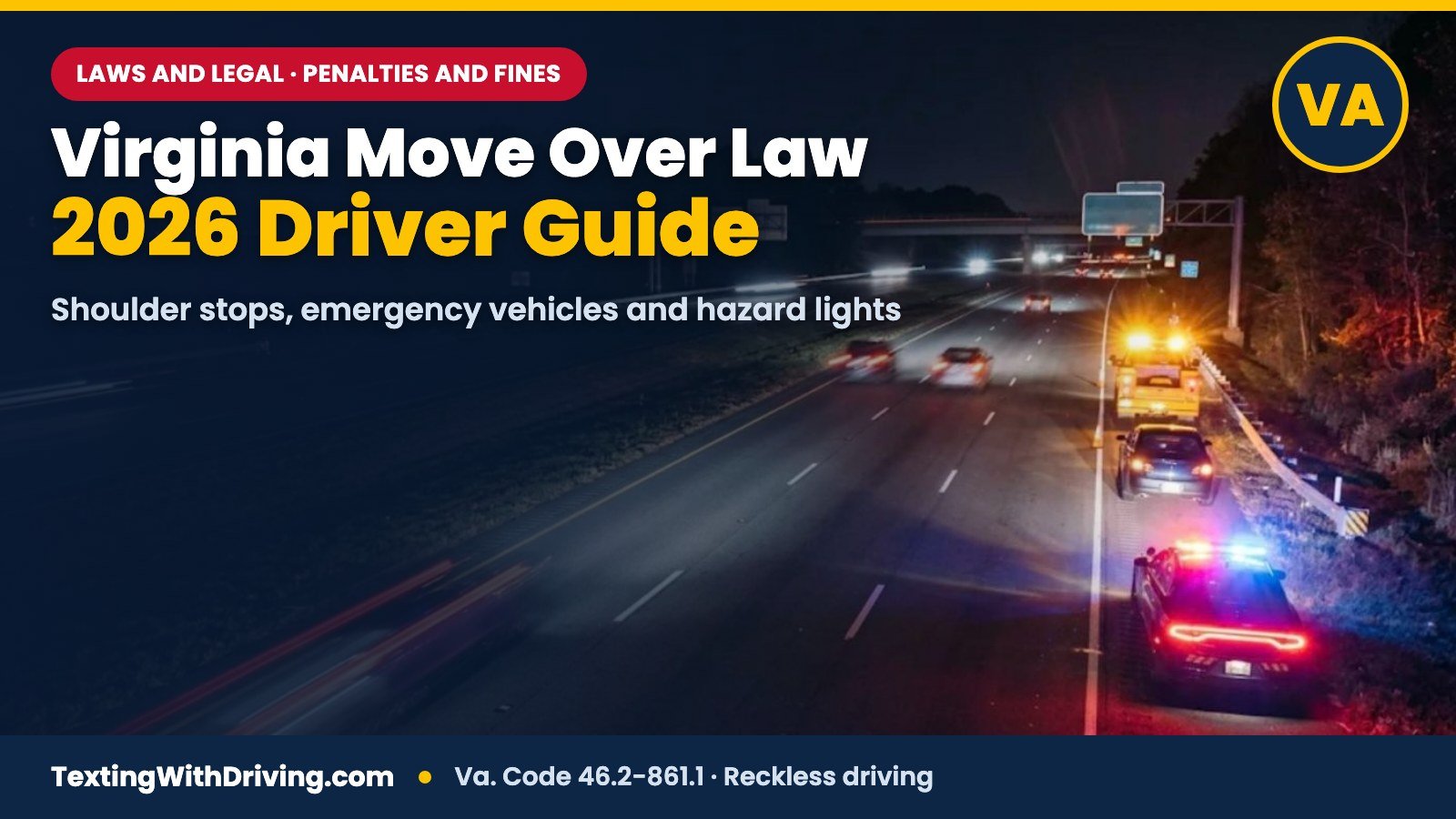
The Virginia Move Over law requires drivers to change lanes, or slow down if they cannot safely change lanes, when they approach a stopped vehicle on the roadside that is displaying flashing lights, hazard lights, warning signs or flares. For police, fire and rescue vehicles, and electric or gas utility repair trucks with amber lights, failing to move over is reckless driving, a criminal offense in Virginia.
The rule is simple, but it only works if drivers see the stopped vehicle in time, and that is exactly where distraction gets in the way. Below is what the law says, which vehicles it covers, what the penalties are, and how to make sure you never miss a shoulder stop.
Key facts on the Virginia Move Over law
The current law is Va. Code 46.2-861.1. The older section, 46.2-921.1, was repealed in 2019 and its rule moved to 46.2-861.1.
The law first took effect in 2002 and was expanded in 2023 to cover any stopped vehicle showing hazard lights, warning signs or flares (VDOT).
Failing to move over for police, fire and rescue vehicles, or for utility repair trucks with amber lights, is reckless driving, a Class 1 misdemeanor (Va. Code 46.2-861.1 and 46.2-868).
Failing to move over for tow trucks, highway service vehicles, or any vehicle with hazard lights, caution signs or flares is a traffic infraction (Va. Code 46.2-861.1).
VDOT’s Safety Service Patrol fleet was involved in 66 crashes from January 2023 to mid-2024, with three workers injured and one killed (VDOT, July 2024).
What the Virginia Move Over law requires
Va. Code 46.2-861.1 sets one duty for two groups of stopped vehicles. When you approach a stationary vehicle on a highway with at least four lanes, at least two of them going your direction, you must:
Move over into a lane that is not next to the stopped vehicle, if that is reasonable and safe given traffic, or
Slow down and proceed with due caution at a safe speed if changing lanes would be unreasonable or unsafe.
The difference between the two groups is the penalty.
Stopped vehicle
Examples
Penalty for not moving over
Flashing blue, red, or red and white lights (46.2-1022, 1023, 1024), or amber lights on electric and gas utility repair vehicles (46.2-1026 B)
Police, fire and rescue vehicles; utility crews repairing power or gas service
Reckless driving, Class 1 misdemeanor
Amber lights on tow and roadside service vehicles or highway maintenance and incident management vehicles (46.2-1025 A1 and A2), hazard flashers, caution signs, or lit flares
Tow trucks, VDOT Safety Service Patrol and maintenance trucks, any disabled car with hazards on
Traffic infraction
The 2023 expansion made the second row much broader. Any driver who pulls onto the shoulder with hazard lights on, puts out a warning triangle, or lights flares is now protected by the law.
Who the law protects
It helps to picture the people on the shoulder. A state trooper writing a ticket stands a few feet from passing traffic. A tow operator hooks up a disabled car with their back to the lane. A VDOT Safety Service Patrol operator changes a stranger’s tire. A utility crew restores power after a storm. And since 2023, the Virginia Move Over law also protects an ordinary driver standing beside a car with a flat tire and the hazards on.
None of them can get out of the way. The only protection they have is the driver approaching from behind seeing them in time and giving them a lane.
Penalties
A Class 1 misdemeanor in Virginia carries up to 12 months in jail and a fine of up to $2,500 (Va. Code 18.2-11). A traffic infraction without a specific penalty carries a fine of up to $250 (Va. Code 46.2-113).
The Virginia Move Over law also lets courts suspend a license. If the violation damages someone else’s property, the court may suspend the driver’s license for up to one year. If it injures or kills someone, the court may suspend it for up to two years, on top of any other penalty.
Outcome
Possible penalty
Not moving over for police, fire or rescue
Reckless driving: up to 12 months in jail and up to $2,500 fine
Not moving over for hazard lights, signs or flares
The Virginia Move Over law does not apply in highway work zones (Va. Code 46.2-861.1 D). Work zones have their own rules: posted work zone speed limits, fines of up to $500 for speeding when workers are present (Va. Code 46.2-878.1), and a mandatory $250 fine for holding a phone (Va. Code 46.2-818.2). Read more in our guide to distracted driving in work zones.
Why distracted drivers miss shoulder stops
Moving over takes a few seconds of planning: notice the lights, check your mirror, signal, change lanes. A driver who is looking at a phone skips the first step, and the rest never happens.
NHTSA says sending or reading a text takes a driver’s eyes off the road for about five seconds, which at 55 mph covers the length of a football field. At interstate speed, a police car or disabled vehicle on the shoulder can go from a distant glow to right beside you in that time. By the time a distracted driver looks up, it is too late to move over safely, so they pass at full speed a few feet from someone standing on the shoulder.
The people at risk are real. VDOT’s Safety Service Patrol responds to more than 212,000 incidents a year, changing tires, giving jump starts and managing crash scenes. From January 2023 to July 2024, VDOT reported 66 crashes involving Safety Service Patrol vehicles and staff, with three workers injured and one killed.
Distraction is also widespread. On November 9, 2026, the Virginia DMV reported preliminary 2026 data of 11,953 crashes and 93 deaths involving a distracted driver in Virginia so far this year.
How to move over safely
Look far ahead. Flashing lights are visible a long way off at night. Start planning early.
Check your mirror and signal. Then move over one lane when there is room.
If you cannot move over, slow down. The law allows it when a lane change is unsafe.
Do not brake hard in the travel lane unless you must. Smooth speed changes protect drivers behind you.
VDOT recommends turning on your hazard lights, moving the vehicle to a safe spot away from traffic when possible, and staying inside the vehicle if it will not start, unless standing outside is necessary. If you must stand outside, stay away from traffic. Turning on hazards also brings you under the protection of the Virginia Move Over law.
Frequently asked questions
What is the Virginia Move Over law?
Va. Code 46.2-861.1 requires drivers approaching a stopped vehicle with flashing lights, hazard lights, caution signs or flares to move to a lane not next to it, or slow down if moving over is unsafe.
Is not moving over reckless driving in Virginia?
Yes, for police, fire and rescue vehicles and for electric or gas utility repair trucks with amber lights. For tow trucks, highway service vehicles and any vehicle with hazard lights, signs or flares, it is a traffic infraction.
Does the Move Over law apply to regular cars with hazard lights?
Yes. Since the 2023 expansion, it covers any stationary vehicle with its hazard flashers on, caution signs out, or lit flares.
Does the Move Over law apply on two-lane roads?
The lane change duty applies on highways with at least four lanes, with at least two going your direction. On other roads, slow down and pass with care.
What happened to Va. Code 46.2-921.1?
It was repealed in 2019. Virginia’s Move Over rule now sits in Va. Code 46.2-861.1.
This article is general information, not legal advice. For a specific charge, talk to a licensed Virginia attorney.
TextingWithDriving.com is professionally built and maintained to ensure accurate, accessible safety information reaches every driver who needs it. Website development and ongoing support is handled by Budgetic, a digital agency specializing in purpose-driven WordPress websites.
The TextingWithDriving.com Editorial Team researches and writes every article on this site. We cover distracted driving laws in all 50 states and Washington, DC, national crash data, teen driver safety, workplace policy, and practical ways to keep phones out of drivers' hands. Every statistic and legal reference links to its original source, such as NHTSA, FMCSA, IIHS, state statutes, and state transportation departments. If you spot an error or an outdated figure, contact us and we will check it and correct it.
Vermont distracted driving law bans handheld devices while driving. See the $100 to $1,000 fines, points, work and school zone penalties and teen rules.
DC traffic cameras in 2026: what speed, red light, stop sign and bus cameras ticket, why they do not catch phone use, and how DC's phone law is enforced.
Virginia Thanksgiving traffic 2026: AAA expects 72.9 million road trips. See the worst times to drive, VDOT tools, and how to stay off your phone on I-95.
New Hampshire distracted driving law bans handheld phones. Fines rise to $250 to $1,000 with suspensions on January 1, 2027. See the rules and teen limits.
Charlottesville distracted driving in 2026: Route 29 crash data, the city's plan to end traffic deaths, student driver risks, and Virginia's phone law.




2 thoughts on “Virginia Move Over Law 2026: Shoulder Stops, Emergency Vehicles and Why Distracted Drivers Miss Them”
Comments are closed.