

Virginia Beach Distracted Driving 2026: Tourist City Rules and What Every Visitor Must Know

Virginia Beach Distracted Driving 2026: Tourist City Rules and What Every Visitor Must Know
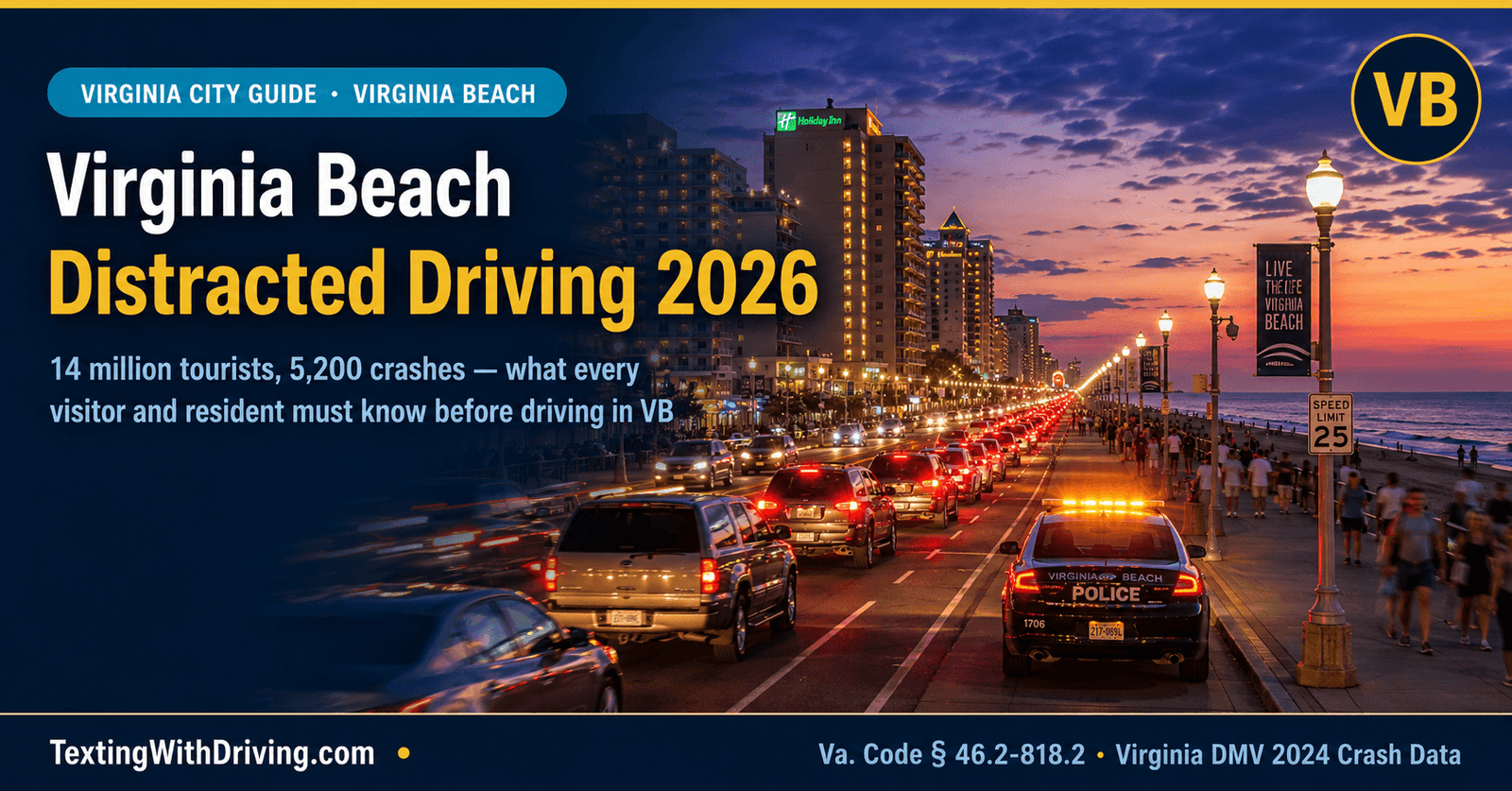
Virginia Beach distracted driving 2026 is a collision between two realities that happen simultaneously every summer: one of the most visited beach resort cities on the East Coast welcoming 14 million tourists in 2026, and one of the highest crash-concentration jurisdictions in all of Virginia producing more than 5,200 crashes and 24 fatalities in 2024 alone.
Virginia Beach City is explicitly identified by the Virginia DMV’s Highway Safety Office as one of the seven highest distracted driving crash jurisdictions in the Commonwealth. The DMV’s crash concentration data, combined with Virginia Beach’s position as Hampton Roads’ highest-crash locality in 2024, makes it the Virginia jurisdiction most urgently in need of specific guidance for the millions of out-of-state visitors who drive there every summer.
This guide covers everything every visitor and resident needs to know about Virginia Beach distracted driving 2026: the specific crash data for Virginia Beach and the Hampton Roads region, the exact Virginia hands-free law provisions that apply the moment a visitor enters Virginia, the most dangerous specific roads and intersections in Virginia Beach, the specific tourist behavior patterns that create disproportionate crash risk, and the practical pre-drive setup that eliminates that risk.
The Numbers: What Virginia Beach’s Crash Data Actually Shows
Virginia Beach is not just one of Virginia’s most visited cities. It is statistically one of Virginia’s most crash-intensive cities — and the two facts are directly connected.
Virginia Beach ranks the highest of all Hampton Roads localities, with more than 5,200 crashes and 24 fatalities in 2024. The Virginia DMV’s 2024 crash data places Virginia Beach, Norfolk, Hampton, and Newport News all within the top 10 places for the most crashes across the entire Commonwealth.
The Hampton Roads regional picture provides essential context. In 2024 alone, nearly 130,000 car crashes occurred across Virginia, with 27,000 in Hampton Roads. In Hampton Roads, 160 people died in car crashes in 2024, and almost 10,000 were injured, with roads like I-64, I-264, US 60, and US 58 seeing the most collisions.
27,000 crashes in Hampton Roads out of 130,000 statewide means Hampton Roads produces approximately 20 percent of all Virginia crashes despite containing approximately 16 percent of the state’s population. The region is disproportionately crash-intensive — and Virginia Beach, as Hampton Roads’ largest city and primary tourist destination, leads that regional crash count.
Virginia Beach is expected to host more than 14 million tourists in 2026 alone, creating enormous pressure on local roadways during peak travel months. Those 14 million tourists do not arrive by public transit. They arrive by car. They drive rental vehicles they are unfamiliar with. They navigate road networks they have never seen. They are looking at hotel names, beach access points, restaurant signs, and their phones for navigation — simultaneously. The result is a crash concentration profile that is among the most severe of any comparable city in Virginia.
The Most Dangerous Specific Roads and Intersections
Virginia Beach distracted driving 2026 risk is not uniformly distributed across the city’s road network. It concentrates on specific corridors and specific intersections that every driver — resident or visitor — needs to know.
State Route 225 and Interstate 264
The area around SR-225 near the intersections of Interstate 264 and Virginia Beach Blvd is the single highest-crash-density location in Virginia Beach. Most car accidents in Virginia Beach are concentrated on State Route 225 near the intersections of Interstate 264 and Virginia Beach Blvd. In 2024, this area alone saw nearly 600 accidents as well as hundreds of additional accidents within a few square miles.
The most dangerous intersections in Virginia Beach are the intersection of SR-225 and I-264 (with nearly 250 accidents in 2024) and the intersection of SR-225 and US-58 (with about 150). Together, these two intersections alone produced nearly 400 accidents in a single year within yards of each other — creating one of the highest per-intersection crash concentrations of any location in Virginia.
For visitors arriving from the north or west via I-264 eastbound — the most common tourist approach route from the Norfolk airport, the Hampton Roads Bridge-Tunnel, and the Richmond-Virginia Beach corridor — this SR-225 and I-264 interchange is the very first complex intersection they encounter after reaching the Virginia Beach city limits. An unfamiliar driver who is simultaneously processing I-264’s merge sequences, searching for the correct SR-225 exit, and checking their phone for confirmation of which turn leads to their hotel is exactly the distraction scenario this intersection produces in practice.
I-264 Corridor: Norfolk-Virginia Beach Expressway
The I-264 corridor connecting Norfolk to the Virginia Beach Oceanfront is one of the highest-crash-density interstate segments in the region. The combination of high travel speeds, frequent lane changes at multiple interchange connections, and the transition from highway driving to the lower-speed resort street network creates the abrupt speed change that produces rear-end crashes when drivers are not paying full attention.
In Hampton Roads, 160 people died in car crashes in 2024, with roads like I-64, I-264, US 60, and US 58 seeing the most collisions. I-264 is specifically named among the highest-crash corridors. The I-264 exit at North Birdneck Road and the Lynnhaven Parkway and Norfolk Virginia Beach Expressway (I-264) interchange are both documented high-crash intersections in Virginia Beach’s historical crash data.
For a tourist arriving from Norfolk Airport driving a rental car they have never operated before, eastbound I-264 at rush hour is among the most demanding driving environments in Virginia. Navigation confusion, rental vehicle unfamiliarity, and smartphone checking for hotel confirmation combine to produce exactly the distracted driving scenarios this corridor documents in its crash records.
Atlantic Avenue and Pacific Avenue: The Resort Strip
The resort strip along Atlantic Avenue from about 2nd Street to 40th Street is the geographic heart of Virginia Beach tourism — and the road environment where Virginia Beach distracted driving 2026 risk is most concentrated during peak tourist hours.
The Oceanfront combines several accident risk factors into one concentrated location. Unlike standard suburban traffic patterns, Oceanfront traffic is often unpredictable. Drivers may suddenly stop to look for parking, pedestrians may cross outside designated crosswalks, and tourists may become distracted while navigating unfamiliar streets. The downtown intersections of Pacific Ave and 21st and 22nd Streets are specifically identified as high-crash locations within the resort strip network.
Atlantic Avenue and Pacific Avenue operate at low posted speeds — 25 mph in the resort area — but the constant stop-and-go of summer tourist traffic, the density of pedestrian crossings at every block, and the specific driver behaviors associated with resort navigation (sudden stops for parking space sightings, U-turns looking for restaurants, three-point turns in wrong-direction selections) create rear-end and intersection crash conditions that occur at close range and produce injuries despite the low speeds.
Stop-and-go traffic along Atlantic Avenue and Pacific Avenue creates constant opportunities for rear-end impacts, especially during evenings and weekends. The Oceanfront is one of the most pedestrian-heavy areas in Virginia Beach.
The pedestrian density along the Boardwalk and the resort strip creates a specific Virginia Beach distracted driving 2026 risk that is different from highway distraction scenarios. A driver who checks their phone for two seconds at 65 mph on I-264 covers a football field blind. A driver who checks their phone for two seconds at 20 mph on Atlantic Avenue may not cover a football field, but the pedestrian density means there are people at crosswalks, between parked cars, and on the roadway edge throughout that two-second blind interval.
Rosemont Road and Holland Road
South Rosemont Road and Holland Road has been identified as the most dangerous intersection with the highest incidence of accidents in Virginia Beach in historical VDOT data. The Rosemont Road corridor — particularly at the intersections of Holland Road, Plaza Trail, and Lynnhaven Parkway — appears in Virginia Beach’s crash data as a persistent high-concentration location away from the tourist strip, reflecting the daily commuter traffic patterns of Virginia Beach’s substantial residential population.
The Law That Applies the Moment You Enter Virginia Beach
Virginia Code § 46.2-818.2 applies to every driver on every Virginia public road — including every tourist who rents a car, every visitor driving their personal vehicle, and every resident. The law does not distinguish between Virginia-registered vehicles and out-of-state vehicles. It does not distinguish between drivers with Virginia licenses and drivers from states with no handheld ban.
The full provisions of the Virginia Beach distracted driving law are covered in detail in our Virginia distracted driving law article. The core standard every visitor needs to understand before driving in Virginia Beach:
No phone in hand while the vehicle is moving. For any reason. Making a call, receiving a call, checking navigation, reading a message, photographing the beach view from the car — all prohibited while the vehicle is moving on any Virginia public road.
Red lights are not a phone window. The prohibition holds even when stopped at a red light or stop sign. A tourist stopped at the Atlantic Avenue and 22nd Street intersection who picks up their phone to confirm their next turn is in violation of Virginia Code § 46.2-818.2 regardless of how long the red light is.
The fine. $125 for a first offense. $250 for a second offense. $250 mandatory in school and work zones. As we documented in our Virginia distracted driving fines 2026 article, the reckless driving criminal upgrade pathway under § 46.2-868(C) creates a significantly more serious consequence structure for violations that accompany crash-involving dangerous driving.
It is a moving violation. A Virginia distracted driving citation adds 3 demerit points to the driver’s Virginia record and appears on the out-of-state driver’s record through the interstate compact system. The insurance consequences we documented in our how distracted driving affects car insurance article — an average 23 percent rate increase for 3-5 years — apply regardless of which state the driver is licensed in.
Why Tourists Face Elevated Distracted Driving Risk
The elevated Virginia Beach distracted driving 2026 risk for tourists is not a matter of tourists being worse drivers than residents. It is a matter of the specific conditions of tourist driving creating more opportunities for distraction than familiar local driving.
Navigation dependency. A resident of Virginia Beach knows where they are going. A tourist driving a rental car to a hotel they have never visited, on roads they have never seen, in a city with an unfamiliar grid, is navigation-dependent in a way that no regular local commuter is. Navigation dependency means phone interaction is constant — checking routes, confirming turns, searching for parking — throughout the tourist drive rather than occurring only at genuinely uncertain moments.
Virginia Beach is expected to host more than 14 million tourists in 2026 alone, creating enormous pressure on local roadways during peak travel months. Tourism is essential to the local economy, but the seasonal influx of visitors also creates a sharp increase in traffic congestion, distracted driving, pedestrian activity, and roadway confusion.
Rental vehicle unfamiliarity. A driver operating a rental car has not established the muscle memory for that specific vehicle’s controls, mirrors, blind spots, or braking characteristics. The additional cognitive load of managing an unfamiliar vehicle depletes the attentional resources available for road environment monitoring, making any additional distraction — like a phone interaction — more consequential than the same interaction would be in the driver’s own familiar vehicle.
Social coordination pressure. Vacation travel involves constant group social coordination. Where to eat, what beach access point to use, who is meeting whom at what time, which hotel entrance is correct — all of this generates continuous smartphone activity among the people in the car. The driver who is asked by their passenger to look at the restaurant location while driving is in the most common tourist distracted driving scenario, and it applies to every driver in every car in Virginia Beach’s summer traffic.
Alcohol and late-night combination. Vacation environments naturally increase alcohol consumption. Tourists visiting bars, restaurants, festivals, concerts, and nightlife districts may underestimate how impaired they are. The same late-night periods when alcohol use peaks are the periods when Virginia Beach’s resort strip generates the highest pedestrian activity on Atlantic and Pacific Avenues — creating the maximum simultaneous pedestrian risk and driver impairment window.
Local residents often notice that once spring break begins and summer approaches, roads become more dangerous almost overnight.
The Enforcement Reality in Virginia Beach
The Virginia Beach Police Department and Virginia State Police both enforce Virginia Code § 46.2-818.2 in Virginia Beach. The primary enforcement authority means an officer who observes a driver holding a phone anywhere in Virginia Beach can initiate a stop based solely on that observation — on I-264, on Atlantic Avenue, on Rosemont Road, at any red light anywhere in the city.
Virginia Beach’s tourism infrastructure includes a significant law enforcement presence during peak season on the resort strip, particularly on Atlantic Avenue, Pacific Avenue, and the surrounding Oceanfront district. The concentration of nighttime enforcement activity during resort season on these specific corridors reflects the city’s recognition that tourist-season peak hours create the highest combination of distraction and pedestrian risk.
Virginia’s hands-free law enforcement is expected to become more aggressive in 2026 across the Commonwealth, as we documented in our Northern Virginia distracted driving guide. That intensified enforcement posture applies in Virginia Beach as much as in Northern Virginia’s commuter corridors — and the combination of 14 million tourists, 5,200 annual crashes, and a city in Virginia’s top-7 distracted driving crash jurisdiction list provides the operational justification for targeted enforcement during peak tourist season.
The Pre-Drive Setup That Every Virginia Beach Visitor Needs
The specific conditions of Virginia Beach tourist driving — navigation dependency, rental vehicle unfamiliarity, resort strip pedestrian density, late-night resort atmosphere — make the pre-drive setup more important than in almost any other Virginia driving environment.
Set the navigation before leaving the hotel parking garage. Not when you’re on Atlantic Avenue looking for the restaurant. Before the car moves, destination entered, route selected, phone mounted. A tourist who pulls out of their hotel parking garage with navigation already active and phone already mounted eliminates the most common navigation-interaction scenario on Atlantic Avenue.
Connect Bluetooth in the parking garage. Pair the rental car’s Bluetooth system with your phone before leaving. Instructions are typically on the vehicle’s visor. If the rental car has no Bluetooth, an FM transmitter adapter (available at Walmart and Target on Virginia Beach Blvd) creates a hands-free solution for under $20.
Activate Driving Focus before departure. iPhone users: Settings → Focus → Driving → Automatic. Android users: Settings → Digital Wellbeing → Drive Safely. Both systems silence all notifications and send auto-replies to anyone who messages while you are driving. For a tourist whose family or travel group is in constant text communication, the auto-reply eliminates the obligation feeling that drives phone-checking in moving vehicles.
Phone in back seat or center console (closed) during resort strip driving. On Atlantic Avenue and Pacific Avenue during peak tourist hours, the pedestrian density makes distracted driving uniquely dangerous at even low speeds. No navigation check is worth a pedestrian contact in a crosswalk.
Plan parking before driving. Many Virginia Beach crash scenarios begin with a driver looking for parking while moving on Atlantic Avenue — a behavior that divides attention between vehicle operation and active scanning for a non-navigation purpose. Identify a parking garage or lot destination before leaving the hotel, navigate to it directly, and park once rather than cruising for street spots.
For the complete hands-free setup guide covering both iPhone and Android, our hands-free while driving complete setup guide covers everything in under 10 minutes. For the full Virginia hands-free law that applies throughout all Virginia roads including Virginia Beach, our Virginia distracted driving law covers Va. Code § 46.2-818.2 in complete detail.
What Every Resident Needs to Know About Tourist Season Driving
Virginia Beach residents face a specific Virginia Beach distracted driving 2026 challenge that reverses the tourist problem: they know the roads well, but they are sharing those roads with millions of drivers who do not.
The practical guidance for Virginia Beach residents during peak tourist season:
Add following distance. Tourist drivers may stop suddenly, miss exits, make unexpected turns, or pull over without warning to check navigation. Standard following distance is insufficient when the vehicle ahead may stop for reasons unrelated to traffic conditions.
Expect unexpected pedestrian crossings. Many visitors are unfamiliar with traffic signals, crosswalk locations, and local roadway layouts. Some tourists may jaywalk, cross against signals, or enter roadways unexpectedly while distracted by phones, restaurants, or beach activity. In the resort strip area especially, treat every block on Atlantic and Pacific Avenues as a potential pedestrian crossing regardless of marked crosswalk locations.
Increase alert level near resort entrances. Hotel parking garage entrances, restaurant valet zones, and beach access parking areas all create sudden vehicle movements — backing out, pulling in at unusual angles, stopping midblock — that occur with much higher frequency during tourist season than in normal traffic conditions.
The 14 million visitors who make Virginia Beach one of the most economically significant destinations on the East Coast are also the variable that makes Virginia Beach one of Virginia’s most crash-intensive cities during those specific months. Every driver — resident or visitor — who completes the pre-drive setup and maintains phone-free compliance on Virginia Beach’s roads contributes directly to reducing the crash count that the city’s data documents.
Sources Used in This Article
All links verified working before publication.
13 News Now: Hampton Roads Led the State in Vehicle Crashes in 2024 — Virginia Beach 5,200+ crashes 24 fatalities 2024, Hampton Roads 27,000 crashes 160 deaths, Virginia Beach tops Hampton Roads localities, Killorn CEO Virginia Statewide Incidents quote
Huffman and Huffman: Where Do Most Car Accidents Happen in Virginia Beach — SR-225 at I-264 nearly 250 accidents 2024, SR-225 at US-58 about 150 accidents, 600 total area accidents, Rosemont Road Holland Road most dangerous intersection, April 2025
PWC Attorneys: Why Tourist Season Increases Car Accidents in Virginia Beach — 14 million tourists 2026, tourism increases distracted driving pedestrian activity roadway confusion, rental car unfamiliarity, alcohol and late-night combination, May 2026
PWC Attorneys: Common Accident Risks Near the Oceanfront in Virginia Beach — Atlantic Avenue Pacific Avenue stop-and-go rear-end risks, Oceanfront pedestrian density, unpredictable tourist traffic patterns, June 2026
Cooper Hurley Injury Lawyers: Most Dangerous Intersections in Hampton Roads — I-64 I-264 US-60 US-58 highest collision roads, Hampton Roads regional crash data, May 2025
Shapiro Washburn and Sharp: Most Dangerous Roads and Intersections Virginia Beach — Lynnhaven Pkwy and I-264 38 accidents, Laurel Lane and First Colonial 42 accidents, I-264 and North Birdneck Road 22 accidents, Pacific Ave 21st and 22nd Street downtown
Virginia Beach Legal Examiner: Virginia’s Distracted Driving Laws — 40.6% fatality increase 2024, fewer crashes but deadlier, injuries significant TBI spinal fractures, April 2026
Virginia DMV Distracted Driving Toolkit — Virginia Beach City in top 7 highest distracted crash jurisdictions, ages 21-35 most frequent demographic
VDOT: Heads Up End Distracted Driving in Virginia — 18,688 statewide crashes 73 fatalities 10,222 injuries 2024, cell phone distraction rose 3%
NHTSA: Distracted Driving — 3,208 deaths 2024, national context
TextingWithDriving.com is professionally built and maintained to ensure accurate, accessible safety information reaches every driver who needs it. Website development and ongoing support is handled by Budgetic, a digital agency specializing in purpose-driven WordPress websites.

About Texting With Driving
TextingWithDriving.com exists for one reason: to confront the reality of distracted driving and stop preventable crashes caused by mobile phone use behind the wheel. Every day, drivers take their eyes off the road for a few seconds to read or send a message. Those few seconds are enough to cause life-altering consequences. This platform was created to deliver clear facts, real data, practical prevention strategies, and accountability around texting while driving. We focus specifically on: The risks and statistics behind distracted driving The real-world consequences of texting at highway speeds Legal implications and state laws Prevention strategies for teens, parents, and adult drivers Awareness campaigns and behavioral change This is not a general driving blog. It is a focused awareness initiative built around one critical issue: phone distraction behind the wheel. Our content is direct, research-driven, and practical. We prioritize accuracy over opinion and education over sensationalism. The goal is simple — reduce distracted driving incidents by increasing awareness and responsibility. If one article causes one driver to put their phone down, the mission is working. For inquiries or partnerships, contact: privacy@textingwithdriving.com
View all posts by Texting With Driving