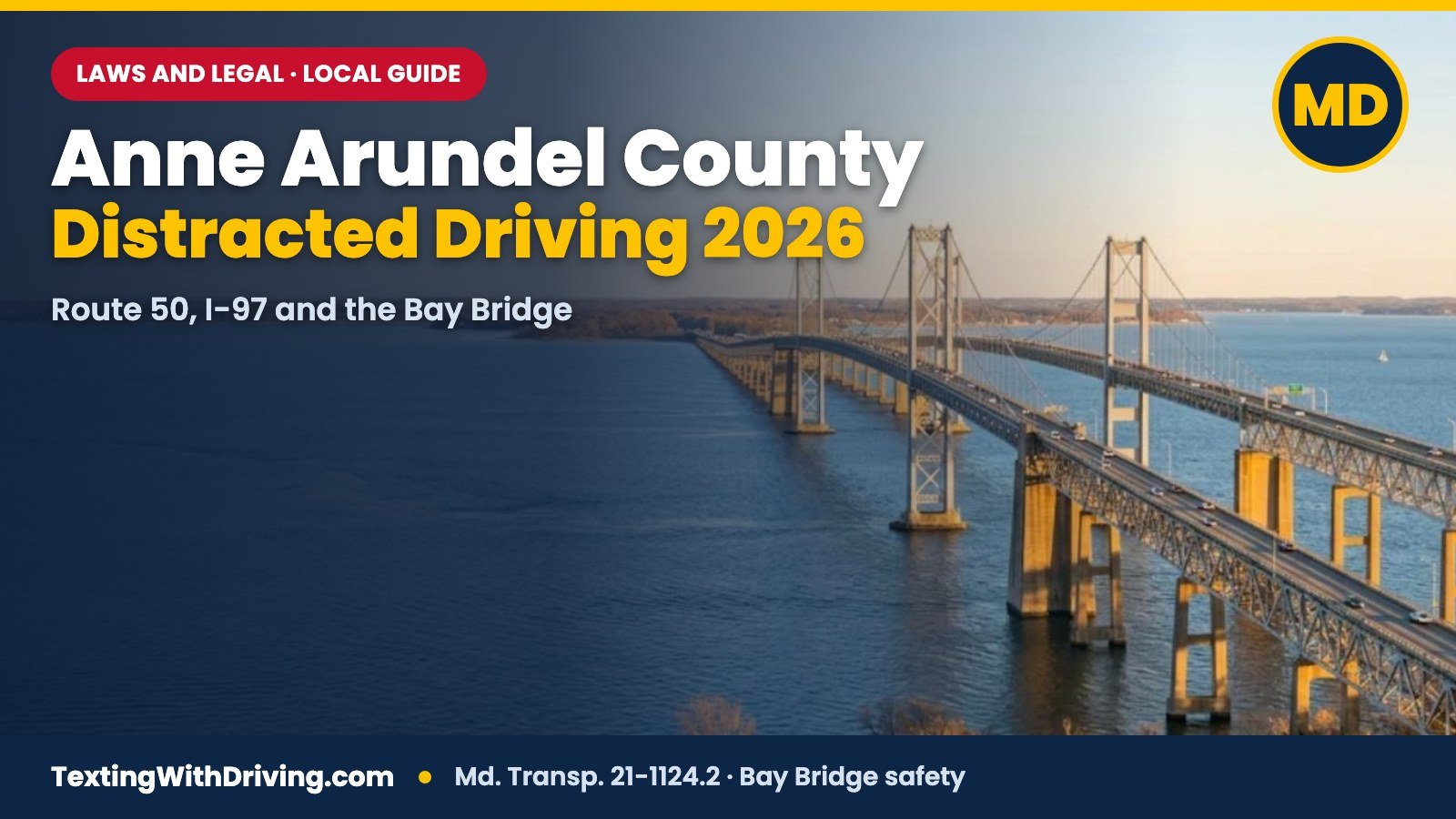
Anne Arundel County distracted driving has one especially well known setting: the Chesapeake Bay Bridge. Maryland Transportation Authority (MDTA) Police say the most common cause of crashes on the bridge is distracted driving, and the busiest travel weekends of the year, including Thanksgiving, send hundreds of thousands of drivers across it.
Below, we cover what police and state safety officials say about the county’s main roads, how to plan Thanksgiving week travel, and what Maryland law says about your phone.
Key facts for Anne Arundel County drivers
MDTA Police say the most common cause of crashes on the Bay Bridge is distracted driving, and rear-end collisions are the leading crash type (WTOP, May 2026).
Up to 335,000 drivers were expected to cross the Bay Bridge over Memorial Day weekend 2026 (MDTA Police via WTOP).
AAA expects 72.9 million Americans to drive 50 miles or more over Thanksgiving 2026 (AAA).
The State Highway Administration is designing pedestrian safety projects on MD 2 (Ritchie Highway) and MD 3 Business (Crain Highway) in the county (MDOT, December 2025).
Holding a phone while driving in Maryland carries a fine of up to $75 for a first offense (Md. Transportation 21-1124.2).
The Bay Bridge: where attention matters most
The Bay Bridge carries US 50 and US 301 from Anne Arundel County across the Chesapeake to the Eastern Shore. Ahead of Memorial Day weekend 2026, MDTA Police told WTOP that up to 335,000 drivers were expected to cross, and that the most common cause of crashes on the bridge is “completely avoidable”: distracted driving.
Lt. Col. Timothy Eikenberg, MDTA Police’s administrative bureau chief, described what officers see. “You’re looking off to your side, looking at the ships out there. You’re talking to your passengers and you’re not paying attention to the traffic in front of you,” he said.
Rear-end collisions are the leading cause of crashes on the bridge, Eikenberg said, often at the bridge’s one big curve, although they happen along its entire length. He urged drivers to keep a safe following distance and focus forward.
That matters because it shows distraction is not only about phones. Scenery, passengers and stop and go traffic all pull attention away. A phone on top of those makes a rear-end crash far more likely.
Thanksgiving week on Route 50 and I-97
Thanksgiving is one of the heaviest travel periods of the year. AAA’s 2026 forecast expects 81.5 million Americans to travel 50 miles or more between Tuesday, November 24 and Monday, November 30, with 72.9 million going by car. Transportation analytics firm INRIX projected that the Washington DC region could see more than double normal congestion during the holiday period.
For Bay Bridge trips, MDTA has historically advised traveling early in the morning, before 10 a.m., or late in the evening, after 6 or 7 p.m., as The Banner reported in its 2024 holiday coverage. AAA also told The Banner that it had responded to 13,000 stranded drivers across Maryland during the previous year’s Thanksgiving holiday.
Thanksgiving 2026 planning
Details
Travel period (AAA)
Tuesday, November 24 to Monday, November 30
Americans traveling by car (AAA)
72.9 million
Worst national driving times (INRIX)
Tuesday 2 to 8 p.m.; Wednesday 12 to 7 p.m.; Sunday 12 to 8 p.m.
Best Bay Bridge times (MDTA guidance via The Banner)
Before 10 a.m. or after 6 to 7 p.m.
Holiday backups bring the same rear-end risk MDTA Police describe on any busy weekend. Setting navigation before you leave, and keeping the phone out of reach in traffic, is the easiest way to stay out of a holiday crash. See our national Thanksgiving driving safety guide for more.
Ritchie Highway, Crain Highway and pedestrian safety
Not all of the county’s risk is on highways. The Maryland State Highway Administration (SHA) chooses corridors for its Pedestrian Safety Action Plan using crash data, and two Anne Arundel County roads are on the list, according to MDOT’s December 2025 Vision Zero report:
MD 2 (Ritchie Highway) between MD 648 (Baltimore Annapolis Boulevard) and MD 177 (Mountain Road), part of the first round of corridors identified in 2024.
MD 3 Business (Crain Highway) between I-97 and MD 100, part of the second round.
The SHA’s separate Vulnerable Road User program also includes MD 3 Business between MD 174 (Quarterfield Road) and MD 648E, now in design, and MD 2 between MD 171 (Church Street) and MD 170 (Belle Grove Road), in planning.
These are busy commercial corridors with bus stops, shopping centers and long distances between crosswalks. A driver checking a phone at a light, then accelerating, may never see a person crossing.
Annapolis streets and visitors
Annapolis adds its own challenges. The state capital draws visitors to the downtown historic district, the City Dock area and the U.S. Naval Academy, and its older streets are narrow, busy with people walking and full of turning traffic. Distraction in a downtown like this is less about high speed and more about missed details: a person stepping off the curb, a car backing out of a space, a cyclist in the lane.
Drivers who are unfamiliar with the area are the most tempted to look at a phone for directions. Setting navigation before you start, using voice guidance and pulling over safely if you need to check the route keeps both hands on the wheel and eyes on the street.
Statewide context
Maryland has made major progress. Governor Wes Moore announced in February 2026 that traffic deaths fell from 582 in 2024 to 480 in 2025, the first year below 500 since 2014, based on preliminary data. Pedestrian and bicyclist deaths fell 33%. Through July 20, 2026, Maryland recorded 213 traffic deaths, down from 252 at the same point in 2025, according to Maryland Highway Safety Office data reported by WTOP.
The governor’s office still named impairment, distracted driving, speeding and aggressive driving as leading causes of crashes. More figures are in our Maryland distracted driving statistics report.
The law in Anne Arundel County
Anne Arundel County follows Maryland’s statewide law. Under Md. Transportation 21-1124.2, a driver of a moving vehicle may not use their hands to use a handheld phone, other than to start or end a call or to turn the phone on or off. Police can stop a driver for this alone, including on the Bay Bridge.
Violation
Penalty
Handheld phone, first offense
Fine up to $75
Handheld phone, second offense
Fine up to $125
Handheld phone, third or later
Fine up to $175
Texting while driving (21-1124.1)
Separate violation; no texting in the travel portion of the road
Driver under 18 using any phone, even hands-free (21-1124)
License suspension of up to 90 days possible
Phone violation causing death or serious injury (Jake’s Law, 21-1124.3)
What causes most crashes on the Bay Bridge?
MDTA Police say distracted driving is the most common cause, and rear-end collisions are the leading crash type.
When is the best time to cross the Bay Bridge at Thanksgiving?
MDTA has advised traveling before 10 a.m. or after 6 to 7 p.m. on busy holiday days, as reported by The Banner.
How much is a phone ticket in Anne Arundel County?
Up to $75 for a first offense, $125 for a second and $175 after that, plus court costs.
Is it illegal to hold a phone in stop and go traffic in Maryland?
Yes. The handheld ban applies whenever the vehicle is moving, including slow traffic on the Bay Bridge or Route 50.
Can drivers under 18 use hands-free in Maryland?
No. Drivers under 18 may not use any wireless communication device while driving, except to call 911.
This article is general information, not legal advice. For a specific ticket, talk to a licensed Maryland attorney.
TextingWithDriving.com is professionally built and maintained to ensure accurate, accessible safety information reaches every driver who needs it. Website development and ongoing support is handled by Budgetic, a digital agency specializing in purpose-driven WordPress websites.
The TextingWithDriving.com Editorial Team researches and writes every article on this site. We cover distracted driving laws in all 50 states and Washington, DC, national crash data, teen driver safety, workplace policy, and practical ways to keep phones out of drivers' hands. Every statistic and legal reference links to its original source, such as NHTSA, FMCSA, IIHS, state statutes, and state transportation departments. If you spot an error or an outdated figure, contact us and we will check it and correct it.
Vermont distracted driving law bans handheld devices while driving. See the $100 to $1,000 fines, points, work and school zone penalties and teen rules.
DC traffic cameras in 2026: what speed, red light, stop sign and bus cameras ticket, why they do not catch phone use, and how DC's phone law is enforced.
Virginia Thanksgiving traffic 2026: AAA expects 72.9 million road trips. See the worst times to drive, VDOT tools, and how to stay off your phone on I-95.
New Hampshire distracted driving law bans handheld phones. Fines rise to $250 to $1,000 with suspensions on January 1, 2027. See the rules and teen limits.
Charlottesville distracted driving in 2026: Route 29 crash data, the city's plan to end traffic deaths, student driver risks, and Virginia's phone law.