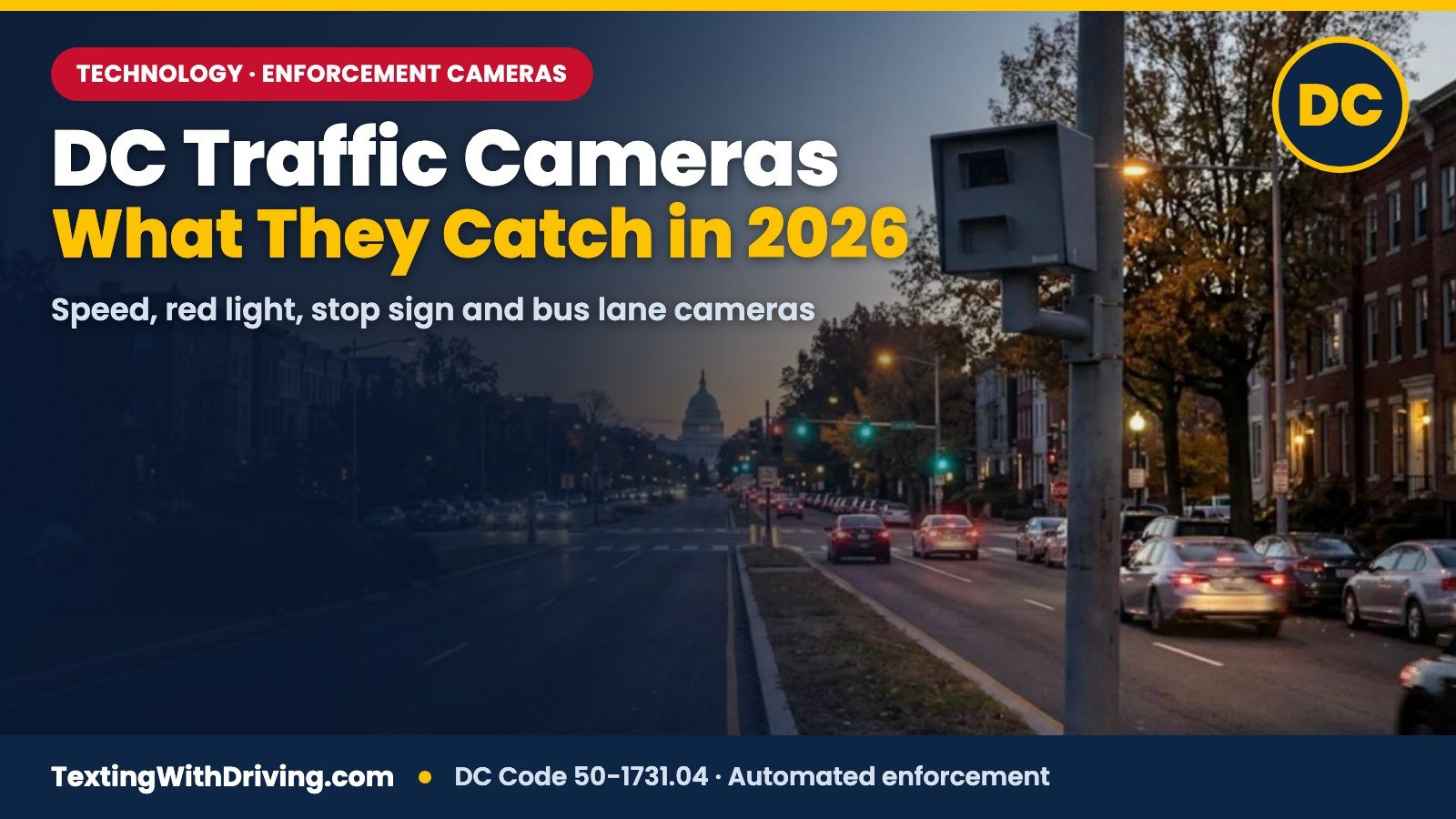
DC traffic cameras are hard to miss in the District, and drivers often ask whether one of them will ticket them for holding a phone. The short answer is no. DC’s automated cameras are built to catch speeding, red light running, stop sign running and a few other specific violations. Phone use is still enforced by police officers, not cameras.
Here is what each type of camera does, how many there are, what the program has achieved so far, and how DC’s phone law is enforced in practice.
Key facts about DC traffic cameras
DC has 215 speed cameras, 55 red light cameras, 31 stop sign cameras, 10 oversized and overweight truck cameras and 25 school bus stop arm cameras (WTOP, April 2026).
Another 210 cameras on WMATA buses ticket drivers parked in bus lanes (WTOP).
DDOT reports a 50% drop in speeds up to 25 mph over the limit and a 35% drop in speeds more than 25 mph over where cameras operate (WTOP).
No DC camera is used to ticket handheld phone use. That violation carries a $100 fine and is enforced by police (DC Code 50-1731.06).
DC traffic deaths fell 52% in 2025, the largest drop in the nation (National Safety Council via WTOP).
What DC traffic cameras catch
The District Department of Transportation (DDOT) runs a large automated enforcement program, and a major expansion came in 2024. As of April 2026, WTOP reported these camera counts:
Camera type
Number
What it tickets
Speed
215
Driving over the posted speed limit
Red light
55
Entering an intersection on red or not stopping behind the stop line
Stop sign
31
Rolling through a stop sign
School bus stop arm
25
Passing a stopped school bus with its stop arm out
Oversized and overweight truck
10
Trucks on restricted streets
WMATA bus mounted
210
Vehicles parked in bus lanes
DDOT places cameras on its High Injury Network, the streets where crash data shows the most serious problems, and in response to community requests. DDOT Director Sharon Kershbaum told WTOP that many stop sign cameras are near schools and parks. Once installed, a camera usually stays at least 12 to 18 months.
What tickets cost
When DDOT installs a new camera, it starts with a 30-day warning period, during which violators receive warning notices instead of fines. After that, fines apply. DDOT announced in 2024 that speed camera fines range from $100 to $500 depending on how far over the limit a driver is going, and its October 2024 release said red light fines begin at $150.
Camera tickets go to the registered owner of the vehicle, wherever it is registered. According to city data reported by WTOP, about 18% of tickets went to DC plates, 27% to Virginia plates and 41% to Maryland plates.
Do DC traffic cameras ticket phone use?
No. None of the camera types in DC’s program is used to detect a phone in a driver’s hand. The District’s cameras cover speed, red lights, stop signs, school buses, truck routes and bus lanes.
That does not make phone use safe or legal. DC Code 50-1731.04 bans using a mobile phone without a hands-free accessory while driving, and DC Code 50-1731.06 sets a $100 fine. Police officers enforce it during traffic stops.
DC phone rule
Details
Handheld phone use while driving
Banned (DC Code 50-1731.04)
Fine
$100 (DC Code 50-1731.06)
First offense handheld fine
Suspended with proof you bought a hands-free accessory (does not apply to texting)
Headphones or earbuds in both ears
Banned while driving, except to assist a hearing-impaired driver
Drivers under 18, learner’s permit holders, school bus drivers with passengers
No phone use at all except in an emergency (DC Code 50-1731.05)
Even though DC traffic cameras do not see phones, they address what distraction leads to. A driver looking at a screen is more likely to drift over the limit, miss a light change or roll through a stop sign. Cameras catch those outcomes.
DDOT says the program is changing behavior. Kershbaum told WTOP the city has measured a 50% reduction in speeds up to 25 mph over the limit and a 35% reduction in speeds more than 25 mph over, with similar improvements where red light and stop sign cameras operate. About 70% of drivers who get a speed camera ticket receive only one, she said.
The District’s overall results have been striking. DC had the largest decrease in traffic deaths in the nation in 2025, according to National Safety Council estimates reported by WTOP: 27 fewer deaths, a drop of 52%. DC’s Vision Zero program has credited part of its progress to the automated camera program. See Washington DC Vision Zero for more.
What the cameras do not catch
Automated enforcement has limits. DC traffic cameras cannot see:
Handheld phone use or texting. Officers must observe it.
Drivers who look away at the wrong moment but stay under the limit and stop at the line.
Failure to yield to pedestrians at most locations, unless it also involves a signal or stop sign violation.
Weaving, tailgating and aggressive lane changes.
That is why DDOT pairs cameras with street redesign and why the Metropolitan Police Department still runs traffic enforcement. Kershbaum acknowledged the limits herself: “Cameras are not going to fix it for everybody. It is one of many tools in our tool kit.”
Commuters from Maryland and Virginia
Most DC camera tickets go to drivers from outside the District. According to city data reported by WTOP, 41% of tickets in fiscal year 2025 went to Maryland plates and 27% to Virginia plates, compared with 18% to DC plates. For commuters, the lesson is that a familiar daily route can still be camera enforced, and that a speed limit can drop the moment you cross the District line.
The phone rules are close to the same on both sides of the river. Maryland and Virginia also ban holding a phone while driving, though the fines differ: Maryland’s is up to $75 for a first offense and Virginia’s is $125. DC also bans earbuds in both ears. A commuter who mounts the phone, sets navigation before leaving and uses voice commands only stays legal in all three.
The debate over DC traffic cameras
The program is popular with safety advocates and residents who ask for cameras on their blocks, but some drivers see it as a revenue tool. WTOP reported that the city collected more than $110 million in camera fines in the first half of 2025, and that Pennsylvania Rep. Scott Perry was leading a measure in Congress to ban the city’s use of cameras. Kershbaum said revenue is “a nonfactor in our decisions about where to put cameras.”
Driving safely in DC
Assume every block can be photo enforced. Speed limits on many DC streets are low.
Stop fully at stop signs. Stop sign tickets were the second most common camera violation in FY2025, WTOP reported.
Keep the phone mounted and hands-free. Cameras will not catch it, but police will.
Watch for school buses. Stop arm cameras now ride on buses.
Do DC traffic cameras catch you on your phone?
No. DC’s cameras ticket speeding, red light and stop sign violations, school bus passing, truck restrictions and bus lane parking. Phone use is enforced by police.
How many traffic cameras does DC have?
As of April 2026, WTOP reported 215 speed, 55 red light, 31 stop sign, 25 school bus and 10 truck cameras, plus 210 bus mounted cameras.
How much is a DC speed camera ticket?
DDOT has said speed camera fines range from $100 to $500 depending on how far over the limit the driver was going.
How much is a ticket for using a phone while driving in DC?
$100. A first handheld offense can be suspended if you show proof you bought a hands-free accessory.
Do Maryland and Virginia drivers have to pay DC camera tickets?
Camera tickets are mailed to the registered owner. City data shows most tickets go to Maryland and Virginia plates.
This article is general information, not legal advice. For a specific ticket, contact the DC Department of Motor Vehicles or a licensed DC attorney.
TextingWithDriving.com is professionally built and maintained to ensure accurate, accessible safety information reaches every driver who needs it. Website development and ongoing support is handled by Budgetic, a digital agency specializing in purpose-driven WordPress websites.
The TextingWithDriving.com Editorial Team researches and writes every article on this site. We cover distracted driving laws in all 50 states and Washington, DC, national crash data, teen driver safety, workplace policy, and practical ways to keep phones out of drivers' hands. Every statistic and legal reference links to its original source, such as NHTSA, FMCSA, IIHS, state statutes, and state transportation departments. If you spot an error or an outdated figure, contact us and we will check it and correct it.
Vermont distracted driving law bans handheld devices while driving. See the $100 to $1,000 fines, points, work and school zone penalties and teen rules.
New Hampshire distracted driving law bans handheld phones. Fines rise to $250 to $1,000 with suspensions on January 1, 2027. See the rules and teen limits.
Charlottesville distracted driving in 2026: Route 29 crash data, the city's plan to end traffic deaths, student driver risks, and Virginia's phone law.