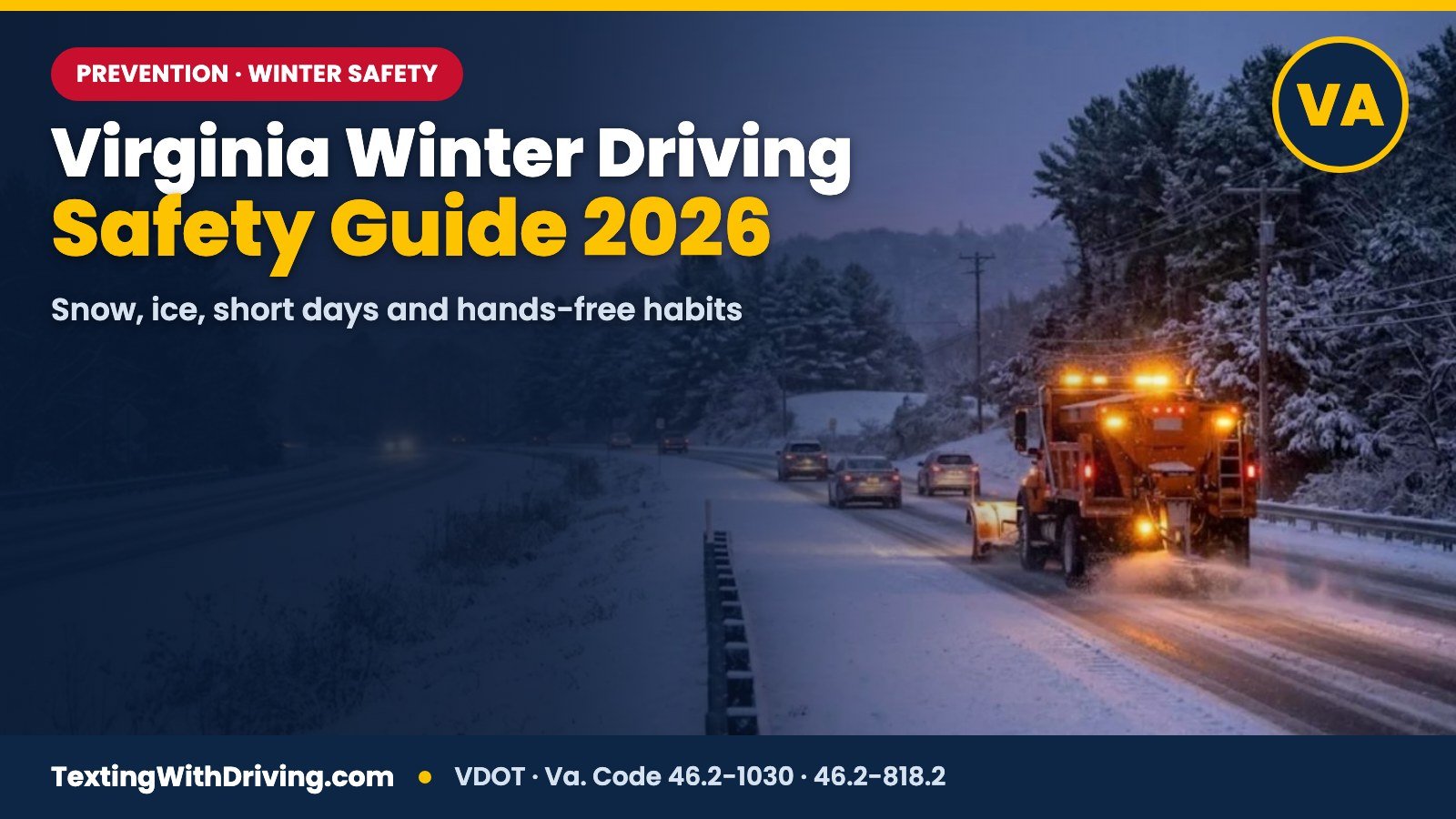
Virginia winter driving safety starts before the first flake falls. VDOT says it has more than 12,000 pieces of equipment, over 700,000 tons of salt, sand and treated abrasive, and more than 1.9 million gallons of brine ready for the 2026 to 2027 season. Last winter showed why: multiple statewide storms from December through February pushed VDOT’s emergency response spending to about $418.4 million, nearly double its $225 million budget.
Crews can treat the roads, but only drivers control speed, following distance and attention. Here is how Virginia gets ready for winter, how to get your car ready, and why a phone in your hand is even more dangerous on snow and ice.
Key facts on Virginia winter driving
VDOT maintains more than 128,000 lane miles and uses more than 12,000 pieces of equipment each winter (VDOT via WWBT, November 9, 2026).
VDOT has over 700,000 tons of salt, sand and treated abrasive and more than 1.9 million gallons of brine on hand (VDOT, 2026).
VDOT budgeted $225 million for emergency response in fiscal year 2026 but expected to spend about $418.4 million after multiple winter storms (VDOT, May 2026).
Virginia law requires headlights whenever your wipers are on because of rain, snow, sleet or fog (Va. Code 46.2-1030).
Holding a phone while driving costs $125 for a first offense and $250 after that (Va. Code 46.2-818.2).
How VDOT prepares for winter
VDOT plans all year for snow and ice. Mechanics inspect and repair plow blades, spreaders and trucks, and the agency works with contractors to plow and treat more than 128,000 lane miles. “Safety is at the forefront of everything we do at VDOT,” Acting Chief of Maintenance and Operations Anne Booker said in November 2026.
VDOT winter readiness, 2026
Figure
Lane miles maintained
More than 128,000
Pieces of winter equipment
More than 12,000
Salt, sand and treated abrasive
Over 700,000 tons
Brine
More than 1.9 million gallons
Fiscal year 2026 emergency response budget
$225 million
Expected fiscal year 2026 emergency response spending
About $418.4 million
Last winter’s cost overrun was large enough that VDOT had to find savings elsewhere, including $45.5 million from maintenance and operations and $15 million in administrative savings, with the rest covered by reductions to construction funds, according to a May 2026 VDOT presentation to the Commonwealth Transportation Board.
Why phones are more dangerous in winter
Every distraction risk gets bigger in winter. On dry pavement, a five second look at a phone at 55 mph covers about the length of a football field, according to NHTSA. On snow or ice, a car needs much more distance to stop, so the gap between seeing a hazard and avoiding it shrinks to almost nothing.
Winter also adds more to watch: brake lights coming on suddenly, plows moving slowly with amber lights, black ice on bridges and shaded curves, and cars sliding at intersections. Each of those needs your eyes and both hands. A driver holding a phone has one hand on the wheel at exactly the moment a skid calls for two.
Short days compound the problem. After the end of Daylight Saving Time on November 1, much of the evening commute happens in the dark, and NHTSA counted 20,971 traffic deaths at night (6 p.m. to 5:59 a.m.) in 2024, more than the 18,017 during the day. See our report on distracted driving at night.
Virginia winter driving safety comes down to a simple rule: if conditions are bad enough to slow down, they are bad enough to put the phone away completely.
Get your car ready
VDOT recommends these checks before winter weather arrives:
Tire pressure. It drops with the temperature. Fill tires to the manufacturer’s recommended pressure and replace worn tires.
Battery. Check it, especially if you have needed a jump-start recently.
Lights. Check brake lights, headlights, turn signals and emergency flashers.
Wipers and fluid. Make sure wipers work and the washer fluid is full.
Emergency kit. Pack a flashlight, ice scraper, jumper cables, blankets, a first aid kit, bottled water, nonperishable food, and sand or cat litter for traction.
Add one more item to that list: a phone mount and a driving focus mode set up before the first storm. Our hands-free setup guide walks through iPhone, Android and in-car systems.
Know the Virginia rules
Two Virginia laws matter most for winter driving:
Rule
What it requires
Headlights (Va. Code 46.2-1030)
Headlights on from sunset to sunrise, when visibility is low, and whenever wipers are in use because of rain, snow, sleet or fog
Hands-free (Va. Code 46.2-818.2)
No holding a phone while driving. $125 first offense, $250 after that, $250 mandatory in a highway work zone
Move Over (Va. Code 46.2-861.1)
Move over or slow down for stopped vehicles with flashing lights or hazards, including disabled cars
Winter breakdowns put more people on the shoulder. Read our guide to the Virginia Move Over law for details.
Driving in snow and ice
These habits make the biggest difference to Virginia winter driving safety:
Check 511 Virginia before you leave. The free app and 511.vdot.virginia.gov show road conditions, incidents and traffic cameras.
Stay home if you can. Fewer cars on the road lets crews work faster.
Slow down and leave space. Increase your following distance well beyond normal.
Give plows room. Stay well back from treatment trucks, and do not pass them on a snowy road.
Watch bridges and overpasses. They freeze before other road surfaces.
Brake and steer gently. Sudden inputs cause skids.
Keep both hands on the wheel. Set navigation before you start, and let calls go to voicemail.
New drivers and their first winter
For many teens, this will be their first winter behind the wheel. Snow, ice and early darkness are new, and so is the urge to check a phone while creeping through slow traffic. Before the first storm, parents can ride along on an empty parking lot to practice gentle braking, and agree on a family rule that the phone stays in the console or back seat on every trip. Our Virginia teen distracted driving guide includes a phone agreement families can copy.
Virginia winter driving safety for new drivers also means knowing when not to go. A teen who decides to wait out an ice storm has made a better decision than one who drives carefully through it.
Commuting in the dark
From November through February, many Virginians drive to work and home again in darkness. Pedestrians in dark clothing are harder to see, glare off wet pavement hides lane lines, and fatigue sets in sooner. Keep headlights and windshields clean inside and out, dim dashboard screens, and save calls for when you arrive. See our guide to Virginia pedestrian safety after dark.
If you get stuck or slide off
If your car slides off the road, stay inside if it is safe to do so, turn on your hazard lights, and call for help. Keep the exhaust pipe clear of snow if you run the engine for heat. Your emergency kit and a charged phone matter most here, which is another reason to keep the phone charging in a mount instead of in your hand while you drive.
Frequently asked questions
How does VDOT prepare for winter?
VDOT stocks salt, sand and brine, inspects more than 12,000 pieces of equipment, and works with contractors to treat more than 128,000 lane miles.
Do I have to turn on my headlights when it snows in Virginia?
Yes. Va. Code 46.2-1030 requires headlights whenever your windshield wipers are in use because of rain, snow, sleet or fog, and from sunset to sunrise.
What should be in a winter car kit?
VDOT suggests a flashlight, ice scraper, jumper cables, blankets, a first aid kit, bottled water, nonperishable food, and sand or cat litter for traction.
Is it legal to use GPS on my phone while driving in snow?
Yes, if the phone is mounted and not in your hand. Set the destination before you start driving.
What is the most important Virginia winter driving safety tip?
Slow down and give yourself space, with your full attention on the road. Snow and ice leave no margin for a glance at a phone.
TextingWithDriving.com is professionally built and maintained to ensure accurate, accessible safety information reaches every driver who needs it. Website development and ongoing support is handled by Budgetic, a digital agency specializing in purpose-driven WordPress websites.
The TextingWithDriving.com Editorial Team researches and writes every article on this site. We cover distracted driving laws in all 50 states and Washington, DC, national crash data, teen driver safety, workplace policy, and practical ways to keep phones out of drivers' hands. Every statistic and legal reference links to its original source, such as NHTSA, FMCSA, IIHS, state statutes, and state transportation departments. If you spot an error or an outdated figure, contact us and we will check it and correct it.
Vermont distracted driving law bans handheld devices while driving. See the $100 to $1,000 fines, points, work and school zone penalties and teen rules.
DC traffic cameras in 2026: what speed, red light, stop sign and bus cameras ticket, why they do not catch phone use, and how DC's phone law is enforced.
Virginia Thanksgiving traffic 2026: AAA expects 72.9 million road trips. See the worst times to drive, VDOT tools, and how to stay off your phone on I-95.
New Hampshire distracted driving law bans handheld phones. Fines rise to $250 to $1,000 with suspensions on January 1, 2027. See the rules and teen limits.
Charlottesville distracted driving in 2026: Route 29 crash data, the city's plan to end traffic deaths, student driver risks, and Virginia's phone law.
Idaho distracted driving law bans handheld device use while driving. See the $75 to $300 fines, hands-free exceptions, points rules and neighbor states.