
How Distracted Driving Affects Your Car Insurance 2026: Complete National Rate Guide

How Distracted Driving Affects Your Car Insurance 2026: Complete National Rate Guide
How distracted driving affects car insurance 2026 is a question that most drivers answer with the wrong number. The fine is $125 in Virginia. The fine is $100 in Washington DC. The fine is $83 in Maryland. Those are the numbers on the citation. The number that actually matters for the next three to five years of a driver’s financial life is the insurance rate increase — and that number is far larger.
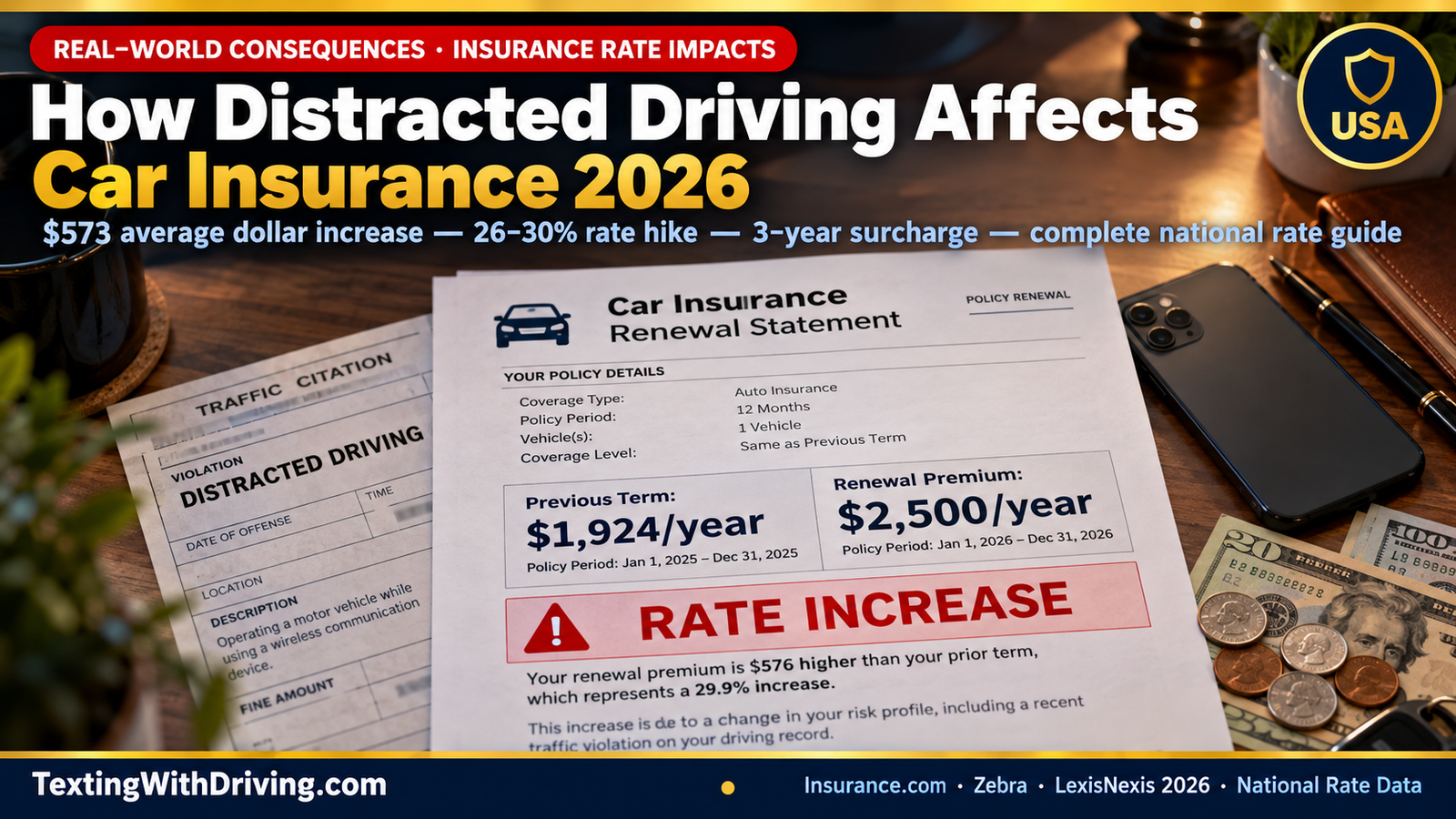
A distracted driving ticket produces an average 30 percent rate increase and an average $576 annual premium increase, according to Insurance.com’s rate analysis of distracted driving tickets. At the national average full coverage premium of $2,637 in 2026, a 30 percent increase adds approximately $791 per year. Sustained for three years — the standard surcharge period in most states — that is a $2,373 real cost from a single citation, sitting on top of whatever fine the court imposed.
The LexisNexis 2026 U.S. Auto Insurance Trends Report adds the macro context: distracted driving violations are up 57 percent since 2022 while miles driven increased only 2 percent, and bodily injury costs — driven by the severity of distracted driving crashes — rose from less than 20 percent of all auto insurance claim dollars in 2022 to more than 26 percent in 2025. The premium increases that the 2026 and 2027 rate environment will produce are the aggregate consequence of the behavioral shift that the LexisNexis violation data documents.
This guide covers the complete how distracted driving affects car insurance 2026 picture: the specific rate increase data, how long the surcharge lasts, how insurers access the violation record, the state-by-state variation, the DUI and reckless driving comparisons, the telematics dimension, and what every driver can do to protect their premium.
The Core Numbers: What a Distracted Driving Ticket Actually Costs
How distracted driving affects car insurance 2026 starts with the three data sources that provide the most consistent national picture:
Insurance.com rate analysis (2026 data, millions of quotes):
Average annual premium after a distracted driving ticket: $2,492
Average dollar increase: $576
Average percentage increase: 30%
Insurance.com traffic ticket calculator (current data):
Distracted driving ticket annual premium after violation: $2,788
Dollar increase: $573
Percentage increase: 26%
Zebra insurance comparison site study:
Average annual rate hike from distracted driving ticket: $226
This figure is lower than the Insurance.com data — reflecting either a different data set or an older baseline — but has been widely cited across the industry.
The Insurance.com 28% figure:
A separate Insurance.com analysis cited by AAA found a 28 percent average premium increase for a texting while driving ticket.
The data converges on a range of 26 to 30 percent annual rate increase with a $573 to $576 average dollar increase per year. At the 2026 national average full coverage premium of $2,637, a 26 percent increase adds $686 per year. A 30 percent increase adds $791 per year. The three-year total surcharge at these rates ranges from approximately $2,058 to $2,373 — before the fine itself is counted.
The real three-year cost of a distracted driving citation in 2026:
| Component | Low Estimate | High Estimate |
|---|---|---|
| Court fine | $50 (TN) | $200+ (NJ) |
| Annual rate increase | $576/yr | $791/yr |
| 3-year surcharge total | $1,728 | $2,373 |
| Real 3-year total | ~$1,778 | ~$2,573 |
The fine that appears on the citation is the smallest item in the real cost calculation.
How Long Does the Rate Increase Last?
How distracted driving affects car insurance 2026 produces a surcharge that most states sustain for three to five years after the citation date. The specific duration varies by state law and by insurer:
Three-year maximum (Virginia): As documented in our Virginia distracted driving insurance rate increase 2026 article, Virginia insurance law prohibits surcharges longer than 36 months from the date of conviction. Virginia’s maximum provides a hard ceiling that protects Virginia policyholders.
Three to five year standard (most states): The industry standard for distracted driving citation surcharges runs three to five years, with most major insurers maintaining the surcharge for three years at the point of maximum rate impact, then tapering. The Insurance.com data notes that most insurers view violations for three to five years of the driving record — and the difference between the surcharge ending and the violation leaving the record means some insurers weigh it in underwriting decisions even after the surcharge expires.
The renewal trigger: The rate increase does not always kick in immediately after the citation. Insurers typically access the MVR at each policy renewal — annually for most policies, every six months for others. A citation received in October 2026 may not appear in the premium until the January 2027 or October 2027 renewal depending on the policy cycle.
States that don’t report to home-state MVR: Some states do not report out-of-state citations to the driver’s home-state motor vehicle registry. A New York driver cited in Virginia who drives through Virginia may not see a Virginia citation appear on their New York MVR — meaning the insurance company’s annual MVR pull misses it. This enforcement gap is being closed by interstate compacts, but it remains a factor in some cross-state citation scenarios.
The Comparison: DUI, Reckless Driving and Distracted Driving
How distracted driving affects car insurance 2026 is best understood in comparison to other violations:
DUI/DWI: By far the most expensive rate increase — the Zebra study found an extra $1,095 per year. Insurance.com data shows a second DUI offense produces a 186 percent rate increase or an average $3,565 increase. DUI is the catastrophic insurance event.
Reckless driving: Average 87.5 percent rate increase nationally (InsuranceQuotes.com analysis). For the driver whose distracted driving produces a reckless driving charge — as documented in our Virginia reckless driving and distracted driving 2026 article — the reckless driving rate increase applies, not the milder distracted driving increase.
Distracted driving: 26 to 30 percent average rate increase. The Zebra analysis called this finding shocking — because distracted driving’s actual crash risk data, which shows phone use increases crash risk 23 times, is not fully reflected in the insurance penalty relative to less dangerous violations like driving too slowly or passing a school bus.
At-fault accident: An at-fault accident typically produces a 20 to 40 percent rate increase — comparable to distracted driving. The combination of a distracted driving citation and an at-fault accident from the same incident produces both surcharges simultaneously.
The distracted driving underpricing relative to actual risk is identified as a structural problem in the insurance industry: rate changes have to go through state regulatory agencies and can take years to adjust to emerging behavioral data. As LexisNexis’s 2026 data establishes that the 57 percent violation increase is producing higher bodily injury costs, actuarial pressure for higher distracted driving surcharges will increase.
How Insurers Find Out About the Citation
How distracted driving affects car insurance 2026 requires understanding the specific mechanisms by which insurance companies access violation records.
MVR pull at renewal: The most common mechanism. At each policy renewal — annually or semi-annually — the insurer purchases the policyholder’s Motor Vehicle Report from the state DMV. The MVR shows all moving violations, license actions, and conviction records within the insurer’s look-back period (typically 3-5 years). A distracted driving citation that was convicted and posted to the DMV record appears on the next MVR pull.
CLUE report: The Comprehensive Loss Underwriting Exchange tracks insurance claims history. A distracted driving citation that also produced an at-fault accident creates a CLUE entry when the claim is filed — creating both an MVR record and a CLUE claim record that underwriters see at renewal and when shopping new policies.
Telematics programs: Usage-based insurance programs — Progressive Snapshot, State Farm Drive Safe and Save, Allstate Drivewise, Root Insurance — collect driving behavior data directly from the vehicle or smartphone. These programs detect phone use events (phone motion, screen activity, handling while vehicle is in motion) and score them independently of MVR records. A driver enrolled in a telematics program who receives a distracted driving citation has also generated telematics data that preceded and follows the citation. The telematics behavioral record can affect premium independent of the MVR.
New telematics-MVR integration: As documented in our telematics distracted driving 2026 article, the integration of telematics behavioral data with MVR violation records is creating a more complete behavioral picture for underwriters. A driver whose telematics data shows high phone-handling frequency — even without a citation — may face higher premiums than a clean-record driver with low phone-handling telematics scores.
The LexisNexis 2026 Macro Picture
How distracted driving affects car insurance 2026 takes place in the context of the most significant behavioral insurance data shift in the industry’s recent history.
The 2026 LexisNexis U.S. Auto Insurance Trends Report, released May 19, 2026, established:
Distracted driving violations up 57 percent since 2022 — with only a 2 percent increase in miles driven. Driver behavior changed; driving frequency did not. The violation rate increase is pure behavioral change.
Drivers aged 66 and older: 73 percent violation increase — the highest of any age group. As documented in our distracted driving senior drivers 2026 article, the senior driver demographic has become the fastest-growing distracted driving violation group.
Bodily injury costs rose from less than 20 percent of all auto insurance claim dollars in 2022 to more than 26 percent in 2025. The severity increase — not just the frequency — is driving premium rate increases that affect every policyholder, not just those with citations.
The LexisNexis data explains why the 2026 insurance market is experiencing premium increases that go beyond individual policyholder citation records. When the overall population’s distracted driving behavior increases by 57 percent and bodily injury costs rise by 6 percentage points as a share of all claims, the actuarial math requires rate adjustments that affect the entire risk pool — including drivers who have never received a distracted driving citation.
The practical implication for every driver: the 2026 premium increases are happening partly because of your neighbors’ distracted driving behavior, not just your own. This is the classic insurance pool dynamic — the risk pool’s aggregate behavior determines the premium environment for all participants.
State-by-State Variation: Where the Surcharge Hits Hardest
How distracted driving affects car insurance 2026 produces significantly different dollar amounts by state because the base premium varies dramatically:
States with high baseline premiums — New York, Michigan, Florida, Louisiana — produce larger absolute dollar increases for the same 26-30 percent percentage increase. A 30 percent increase on a $3,000 New York baseline is $900/year. A 30 percent increase on a $1,500 Ohio baseline is $450/year. The percentage is the same; the real financial impact is doubled.
The highest-premium states for full coverage in 2026 include:
New York, New Jersey, and Michigan consistently top the national premium rankings — partly due to state insurance laws (Michigan’s unlimited PIP coverage historically), partly due to urban traffic density and crash frequency. A distracted driving citation in these states carries the highest absolute dollar surcharge.
Mid-range states — including Virginia ($2,003 average), Colorado, and Washington — produce mid-range dollar surcharges that still reach $500-$700/year at the 26-30 percent rate.
Lower-baseline states — including Ohio, Indiana, and the Great Plains states — produce lower absolute surcharges even at the same percentage increase.
New Jersey’s expected 10.46 percent overall rate increase in 2026 and Nevada’s 6.42 percent increase (cited in the LexisNexis analysis) are state-level expressions of the national trend — some states’ regulators are approving higher rate increases in response to the bodily injury cost pressure than others.
The Safe Driver Discount Double Loss
How distracted driving affects car insurance 2026 has a compound financial effect beyond the surcharge itself — the loss of safe driver discounts that the citation eliminates.
Most major insurers offer safe driver discounts for policyholders who maintain clean records — typically 5 to 22 percent of the base premium. A policyholder who was receiving a 15 percent safe driver discount on a $2,637 national average premium was saving approximately $396 per year. A distracted driving citation eliminates that discount at the next renewal while adding the 26-30 percent surcharge.
The combined financial swing:
Lost 15% safe driver discount: $396/year
Added 28% rate surcharge: $738/year
Total annual swing from one citation: $1,134/year
Three-year total: $3,402
This is the number that most drivers never calculate. The citation cost is not just the surcharge. It is the surcharge plus the lost discount — a combined impact that can exceed $3,000 over the surcharge period from a single first-offense citation.
Telematics: The Monitoring That Bypasses the MVR
How distracted driving affects car insurance 2026 increasingly operates through telematics programs that create a second behavioral data channel independent of the MVR citation record.
Approximately 30 million US drivers are currently enrolled in telematics insurance programs. These programs directly monitor driving behavior — including phone handling, hard braking, rapid acceleration, and nighttime driving — and adjust premiums based on behavioral scores.
For distracted driving specifically, telematics programs detect:
Phone pickup events while the vehicle is in motion.
Screen interaction events during driving periods.
Phone handling events at traffic signals.
A driver enrolled in a telematics program who regularly handles their phone while driving is generating a behavioral record that the insurer sees regardless of whether a citation has been issued. High phone-handling frequency scores in telematics data can increase premiums independent of the MVR — creating a double-track insurance consequence for habitual phone users.
The inverse is also true: a driver who received a single distracted driving citation but enrolls in a telematics program and demonstrates clean behavioral data may see their rate recover faster than the standard surcharge period, as some insurers use telematics behavioral improvement as a factor in rate setting.
What Every Driver Must Do After a Distracted Driving Citation
How distracted driving affects car insurance 2026 creates specific post-citation actions that can minimize the financial impact.
Shop rates immediately after the citation posts. Different insurers weight distracted driving violations differently. Some carriers — particularly those with telematics programs that reward current behavior — offer better post-citation rates than the incumbent carrier’s renewal. Shopping immediately after the violation posts to the MVR identifies the best available rate in the new risk category.
Enroll in a telematics program. Progressive Snapshot, State Farm Drive Safe and Save, and similar programs create a path to behavioral credit that can partially offset the surcharge. A driver who demonstrates zero phone-handling events in telematics data for six months is building the behavioral record that supports rate recovery.
Complete a driver improvement course. Some states and insurers offer premium discounts for completion of an approved driver improvement course following a distracted driving citation. The discount varies by carrier (typically 5-10 percent) but directly offsets a portion of the surcharge.
Request the insurer’s look-back period. Understanding exactly how far back the insurer reviews the MVR — three years, five years — establishes the timeline for when the citation fully exits the pricing calculation. Some drivers mistakenly believe the surcharge lasts longer than the insurer’s actual look-back window.
The most effective action: prevent the citation. Activating Driving Focus before every drive eliminates the behavioral risk that produces both the citation and the telematics behavioral score. The three-year $2,373 surcharge at 30 percent of the national average premium is the cost of a 30-second setup failure that could have been prevented before the car left the driveway.
For the Virginia-specific insurance rate impact with the state’s 36-month maximum surcharge, our Virginia distracted driving insurance rate increase 2026 article covers the Virginia-specific calculation. For the LexisNexis 2026 violation data showing who is driving the behavioral trend, our distracted driving senior drivers 2026 article covers the demographic breakdown. For the distracted driving statistics that insurance actuaries use to set risk rates, our distracted driving statistics 2026 covers the full national picture. And for the technology setup that protects both safety and the insurance premium on every drive, our hands-free while driving complete setup guide covers iPhone, Android, Bluetooth, and CarPlay.
Sources Used in This Article
All links verified working before publication.
Insurance.com: How Much Will Car Insurance Go Up After Accident or Ticket — Distracted driving ticket average $2,492 annual premium after citation, $576 dollar increase, 30% percentage increase, second DUI 186% $3,565 increase, at-fault accident comparison, insurer-by-insurer variation table
Insurance.com: Traffic Ticket Calculator — Distracted driving ticket $2,788 annual premium after, $573 dollar increase, 26% percentage increase, millions of data points multiple insurance providers
Insurance.com / AAA: Texting While Driving Ticket Increase Auto Insurance Premiums — 28% average premium increase texting violation consistent multiple data sources, rate increase not immediate renewal trigger, MVR pull mechanism, insurer variation some more forgiving single violations
NBC24 / Multiple: Zebra Study Distracted Driving Insurance — Zebra $226/year average rate hike, shocking finding analyst, DUI $1,095/year, driving too slowly $345 school bus $386, distracted penalty lower than risk deserves
Motor1 / InsuranceQuotes.com: How Much Tickets Raise Insurance — Reckless driving 87.5% average rate increase, DUI highest, distracted driving in comparison context
LexisNexis Risk Solutions: 2026 Auto Insurance Trends Report May 19 2026 — Violations up 57% since 2022, miles driven only 2% increase, 66+ up 73%, bodily injury costs less than 20% to more than 26% of all auto insurance claim dollars 2022-2025, Jeff Batiste SVP quote
RateChaser: LexisNexis 2026 Auto Insurance Trends — National average full coverage premium $2,637 in 2026, NJ 10.46% rate increase NV 6.42%, 57% violations up behavioral cause confirmed
NHTSA: Distracted Driving — 3,208 deaths 2024, 315,167 injuries, national context
TextingWithDriving.com is professionally built and maintained to ensure accurate, accessible safety information reaches every driver who needs it. Website development and ongoing support is handled by Budgetic, a digital agency specializing in purpose-driven WordPress websites.
