

Distracted Driving at Night: Why Evening Hours Are the Most Dangerous Time to Text

Distracted Driving at Night: Why Evening Hours Are the Most Dangerous Time to Text
Most people assume the morning rush hour is the most dangerous time to drive. Heavy traffic, stress, people running late. It feels like the obvious answer.
The data says otherwise.
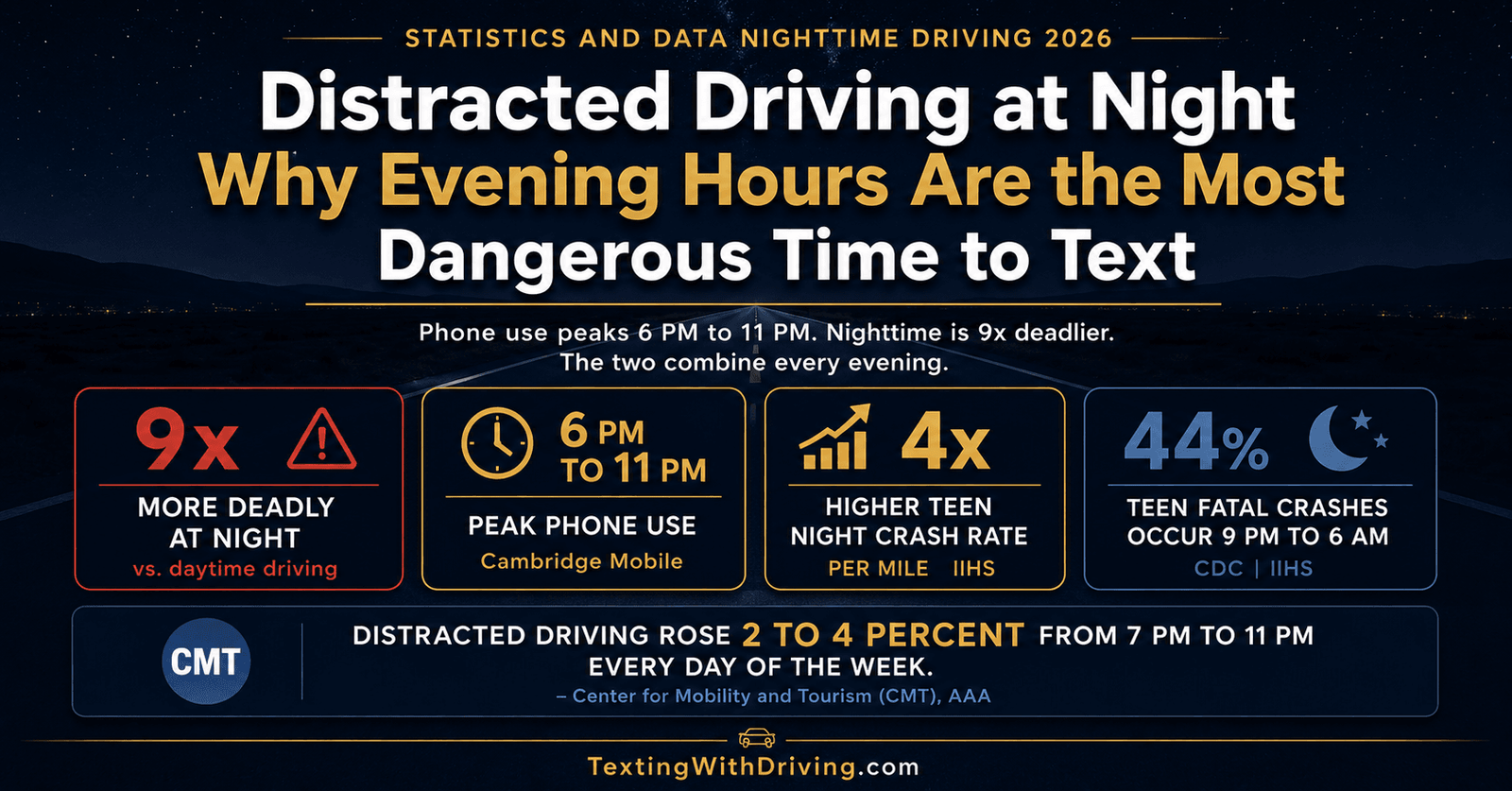
The most dangerous window for distracted driving in the United States is not the morning commute. It is the evening hours between 6 PM and 11 PM. And the reason comes down to a collision between two separate risk factors that happen to peak at exactly the same time: the inherent danger of driving in the dark, and the period when American drivers are most likely to be interacting with their phones.
Understanding why these two factors combine so powerfully is the most important road safety insight most drivers have never encountered.
The Nighttime Driving Baseline: How Much More Dangerous Is It?
Before looking at phone distraction specifically, it helps to understand how much more dangerous nighttime driving is compared to daytime driving, independently of any other factor.
MoneyGeek analyzed 93,554 driving fatalities from NHTSA’s Fatal Accident Reporting System and found that night driving is nine times more lethal than daytime driving when considering the number of fatal accidents relative to traffic volume. Night driving risk is highest for drivers in California and Hawaii, where nighttime driving is 12 times more dangerous than daytime driving. Federal Motor Carrier Safety Administration
Nine times more lethal. Not 20 percent more dangerous. Not twice as dangerous. Nine times the fatality rate per vehicle mile traveled compared to daylight driving.
The factors driving this baseline are well established. Reduced visibility shortens stopping distances relative to reaction time. Fatigue accumulates throughout the day, reducing alertness for evening drivers. Alcohol and drug impairment peaks in late evening hours. Pedestrians are harder to see. Wildlife and road debris are less visible. And headlight glare from oncoming vehicles temporarily impairs vision in ways that have no daytime equivalent.
The CDC confirms nighttime driving is riskier for drivers of all ages. Other road users are more likely to be driving impaired or drowsy after dark. 30 percent of fatal crashes at night involve alcohol impairment, compared to just 10 percent during daytime hours, according to NHTSA analysis. Zutobi
Any single one of these factors would make evening driving meaningfully more dangerous than morning driving. All of them together create a baseline crash risk environment that is categorically different from daytime conditions before a driver even considers looking at their phone.
When Phone Use Peaks: The 6 PM to 11 PM Window
Here is where the risk compounds dramatically.
Cambridge Mobile Telematics data shows distracted driving spikes at night between 6 PM and 11 PM. CMT’s analysis is drawn from over one billion car trips across millions of US drivers, making it the most comprehensive real-world dataset on driver phone behavior available. The Zebra
This is the core finding that changes how we should think about distracted driving risk. The period when drivers are most likely to be using their phones while driving is exactly the same period when the road environment is most dangerous.
A March 2026 analysis from CMT and AAA examining spring break driving patterns found that distracted driving increased 2 to 4 percent from 7 PM to 11 PM each day of the week. The analysis noted that nighttime driving is already more dangerous than daytime driving, so the danger of any additional distraction is compounded. Baderlaw
That word compounded is doing important work. When risks multiply rather than add, the combined effect is disproportionate. A driver who is already navigating the reduced visibility, increased fatigue, and higher ambient impairment of nighttime driving conditions, and then adds phone distraction on top of all of that, is not simply experiencing two risk factors. They are experiencing a risk environment where each factor amplifies the consequences of the other.
Why Phone Use Peaks in the Evening: The Social Media Connection
Understanding why phone use peaks between 6 PM and 11 PM helps explain why this pattern is so persistent and so difficult to legislate away.
Social media engagement peaks in the evening hours across every major platform. Instagram, TikTok, Facebook, Snapchat, and Twitter/X all record their highest daily active user numbers and posting activity between 6 PM and 10 PM. This is when people are decompressing after work and school, catching up on conversations, posting about their day, and responding to content that built up during daytime hours.
The psychology we covered in our article on the psychology of phone addiction applies with particular force in the evening. Dopamine responses to incoming notifications are stronger when content is novel and unexpected. Evening social media activity is inherently more social, more personal, and more emotionally resonant than morning news consumption, which creates stronger notification urgency.
CMT’s historical data shows that nighttime distraction, specifically trips from 11 PM to 6 AM, increased 40 percent from February 2020 to April 2020 at the start of the pandemic, reaching 1 minute and 20 seconds per hour of driving. In February 2022, nighttime distraction further increased to 1 minute and 29 seconds per hour. QuatriniRafferty
The pandemic amplified this pattern because social isolation increased the emotional urgency of every social media interaction. Post-pandemic, the habit of intense evening phone engagement has not disappeared. It has become the new normal for most American smartphone users. And it follows them into the car.
The Fatigue Factor: Why Evening Willpower Fails
There is a neurological dimension to the evening distraction problem that goes beyond social media behavior.
Research on decision fatigue and executive function consistently shows that the prefrontal cortex’s ability to override impulses degrades over the course of the day. By evening, after hours of work, social decisions, and the accumulated cognitive load of a full day, drivers have significantly less cognitive reserve for impulse control than they did in the morning.
As we explained in our article on the psychology of phone addiction, phone notifications trigger a dopamine response that the prefrontal cortex must actively override to prevent an immediate reach for the device. That override requires cognitive resources. Evening drivers, who are often tired, mentally depleted, and socially engaged with their phones in ways that feel more urgent than morning content, have the least available resources precisely when they need them most.
NHTSA confirms drowsy driving is a significant evening risk factor, with drowsy driving claiming 644 lives in 2024. Drowsy driving affects alertness, attention, reaction time, judgment, and decision-making capabilities, with higher risk occurring between midnight and 6 AM, but also during dips in circadian rhythm in the late afternoon and evening. SearchAtlas
The overlap between fatigue-impaired judgment and peak phone notification urgency in the evening creates a behavioral perfect storm that no amount of awareness alone is sufficient to fully overcome. This is why pre-drive habit formation, placing the phone in the back seat and activating driving mode before the engine starts, is more effective than relying on in-moment willpower during the evening hours when that willpower is most depleted.
Teen Drivers at Night: A Compounded Crisis
The intersection of nighttime risk and distracted driving risk falls most severely on the demographic that is already most vulnerable on the road.
Per mile driven, the fatal crash rate of 16 to 19 year-olds is about four times as high at night as it is during the day. Based on the National Household Travel Survey, teenagers’ rate of fatal nighttime crash involvements is nearly three times as high as the rate for adults aged 30 to 59. LuccaAM
44 percent of motor vehicle crash deaths among teens aged 13 to 19 occurred between 9 PM and 6 AM, and 50 percent occurred on Friday, Saturday, or Sunday, according to CDC and IIHS data updated August 2025. Zutobi
The most frequent time period for teen crash deaths was between 6 PM and 3 AM when it is often dark. Teenage car crashes were most common at night, peaking between the hours of 9 PM and midnight. Driving at night is more dangerous at any age, but night driving is particularly dangerous for teens since they have less driving experience and are more likely to be distracted by friends in the car. Governor’s Traffic Safety Committee
For teen drivers, the evening window is not just the most dangerous time to text. It is the most dangerous driving situation they encounter regularly. Reduced visibility combined with less experience reading road conditions, peer passengers who increase social distraction, Friday and Saturday social events that extend driving hours into late night, and evening phone engagement that peaks exactly when they are most likely to be driving home from those events.
The data from our detailed article on teen driver risk shows that distraction is a factor in 58 percent of teen crashes overall. During evening hours, when every risk factor is elevated, that proportion and its consequences become even more severe.
Graduated Driver Licensing provisions that restrict teen drivers from nighttime driving are specifically designed to address this compounded risk. Optimal GDL provisions limit newly licensed drivers from driving after 9 or 10 PM. This is because the majority of fatal nighttime crashes for teens occur between 9 PM and midnight. Once licensed, initially limit nighttime driving to hours before 9 PM, as this GDL restriction usually times out after six to 12 months of independent driving when hopefully teen drivers have had sufficient time to practice driving at night in lower-risk conditions. LuccaAM
The 1 Minute and 56 Seconds Problem
Cambridge Mobile Telematics provides the most granular real-world measurement of driver phone behavior available, drawn from over one billion actual car trips across millions of US drivers.
Drivers spent 1 minute and 56 seconds per driving hour tapping their phone screens in 2024, the lowest level since 2020. Phone motion distraction, when drivers are physically handling their phones, declined 11.3 percent in 2024 to 1 minute and 22 seconds per driving hour. Netradyne
One minute and 56 seconds per hour of screen tapping. That improvement, the result of hands-free laws, telematics insurance programs, and increased public awareness, is real and represents genuine progress. But nearly two minutes of screen interaction per hour of driving, even at the 2024 improved level, still means that for a 30-minute evening commute a driver is tapping their phone screen for approximately one full minute. At 55 mph, that one minute represents nearly a mile of road covered with divided or absent visual attention.
One in three crashes in 2024 occurred within one minute of drivers using their phones, according to CMT analysis. Drivers making handheld phone calls crashed at the highest speeds, and nearly 33 percent of all phone motion that CMT measured occurred at speeds higher than 50 mph. Penske Truck Leasing
That last data point is particularly striking. One-third of all phone handling while driving occurs at speeds above 50 mph, where stopping distances are longest, where crash outcomes are most severe, and where the football-field-of-blindness calculation we covered in our article on the real danger of texting while driving applies with full force.
What the Evening Window Means in Practice
The combination of factors that make evening driving the most dangerous period for distracted driving creates specific, actionable implications.
The phone setup matters more in the evening than the morning. Pre-drive habit formation, placing the phone in the back seat and activating driving mode before the car starts, is effective at any time of day. But during evening hours when social media urgency is highest, willpower is most depleted, and road conditions are most unforgiving, the importance of removing the decision from the moment of temptation is greatest. Our guide to setting up Do Not Disturb While Driving on iPhone and Android covers the two-minute setup that handles this automatically.
Teen drivers need explicit evening-specific conversations. A parent who has addressed phone use generally but has not specifically discussed Friday and Saturday night driving home from social events has left the highest-risk scenario unaddressed. The specific conversation should cover what happens when a notification arrives at 10 PM on the highway, not just the general principle of phone-free driving.
Employers with evening-shift or night-delivery workers face elevated liability. Workers driving home from evening shifts, making late deliveries, or operating company vehicles during evening hours are in the highest-risk window for distracted driving. A workplace policy that addresses phone use during company-related driving needs to specifically cover these higher-risk hours.
Evening road trips and weekend travel warrant extra vigilance. As CMT and AAA data from spring break 2026 confirmed, travel periods that extend into evening hours show elevated distraction rates compared to typical commuting patterns. If you are planning a long drive that extends into evening, the pre-drive phone setup is not optional. It is the most important safety decision of the trip.
For the full national picture of how distracted driving deaths and injuries break down across all conditions and demographics, see our distracted driving statistics 2026 overview. For everything on the legal framework across all 50 states, see our hands-free driving laws by state 2026 guide. And for the specific behavioral and technology solutions that make phone-free driving automatic rather than dependent on depleted evening willpower, the best apps to block texting while driving guide covers every option from free built-in features to fleet-grade solutions.
The road is nine times more dangerous at night. Your phone is most tempting at the same time. That combination does not resolve itself through awareness alone. It resolves through a decision made before the drive starts.
Sources Used in This Article
All links verified working before publication.
Cambridge Mobile Telematics: Distracted Driving Fell 8.6 Percent in 2024 — April 3, 2025
Repairer Driven News: CMT and AAA Reveal Increased Risky Driving During Spring Break — March 23, 2026
BusinessWire: Cambridge Mobile Telematics Reports Distracted Driving at Highest Point During Pandemic — Historical nighttime distraction data
The Zebra: Distracted Driving Statistics 2026 — January 15, 2026, CMT nighttime spike data
MoneyGeek: How Much More Dangerous Is Driving at Night — NHTSA FARS analysis, December 2025
CDC: Risk Factors for Teen Drivers — August 4, 2025, nighttime crash statistics
IIHS: Teenagers Research Page — Fatal nighttime crash rates per mile driven
Children’s Hospital of Philadelphia: Night Driving Statistics — Teen fatality rate at night
Autoinsurance.com: 2026 Teen Driver Crash Statistics — March 6, 2026, peak crash hours
Bankrate: Teen Driving Facts and Statistics — March 11, 2025, IIHS teen nighttime data
Insurify: Distracted Driving Statistics 2026 — February 10, 2026, CMT speed data
NHTSA: Teen Safe Driving — Drowsy driving 644 deaths 2024, NHTSA updated
Defensive Drivers Institute: Distracted Driving Statistics 2025 — CMT 2024 per-hour screen time data
TextingWithDriving.com is professionally built and maintained to ensure accurate, accessible safety information reaches every driver who needs it. Website development and ongoing support is handled by Budgetic, a digital agency specializing in purpose-driven WordPress websites.

About Texting With Driving
TextingWithDriving.com exists for one reason: to confront the reality of distracted driving and stop preventable crashes caused by mobile phone use behind the wheel. Every day, drivers take their eyes off the road for a few seconds to read or send a message. Those few seconds are enough to cause life-altering consequences. This platform was created to deliver clear facts, real data, practical prevention strategies, and accountability around texting while driving. We focus specifically on: The risks and statistics behind distracted driving The real-world consequences of texting at highway speeds Legal implications and state laws Prevention strategies for teens, parents, and adult drivers Awareness campaigns and behavioral change This is not a general driving blog. It is a focused awareness initiative built around one critical issue: phone distraction behind the wheel. Our content is direct, research-driven, and practical. We prioritize accuracy over opinion and education over sensationalism. The goal is simple — reduce distracted driving incidents by increasing awareness and responsibility. If one article causes one driver to put their phone down, the mission is working. For inquiries or partnerships, contact: privacy@textingwithdriving.com
View all posts by Texting With Driving