

Texting While Driving Fines by State 2026: How Much Could You Actually Owe?

Texting While Driving Fines by State 2026: How Much Could You Actually Owe?
Most drivers who think about the cost of a texting ticket think about the headline fine. They calculate the $25 or the $100 or the $200, decide it is manageable, and move on.
That calculation misses nearly everything.
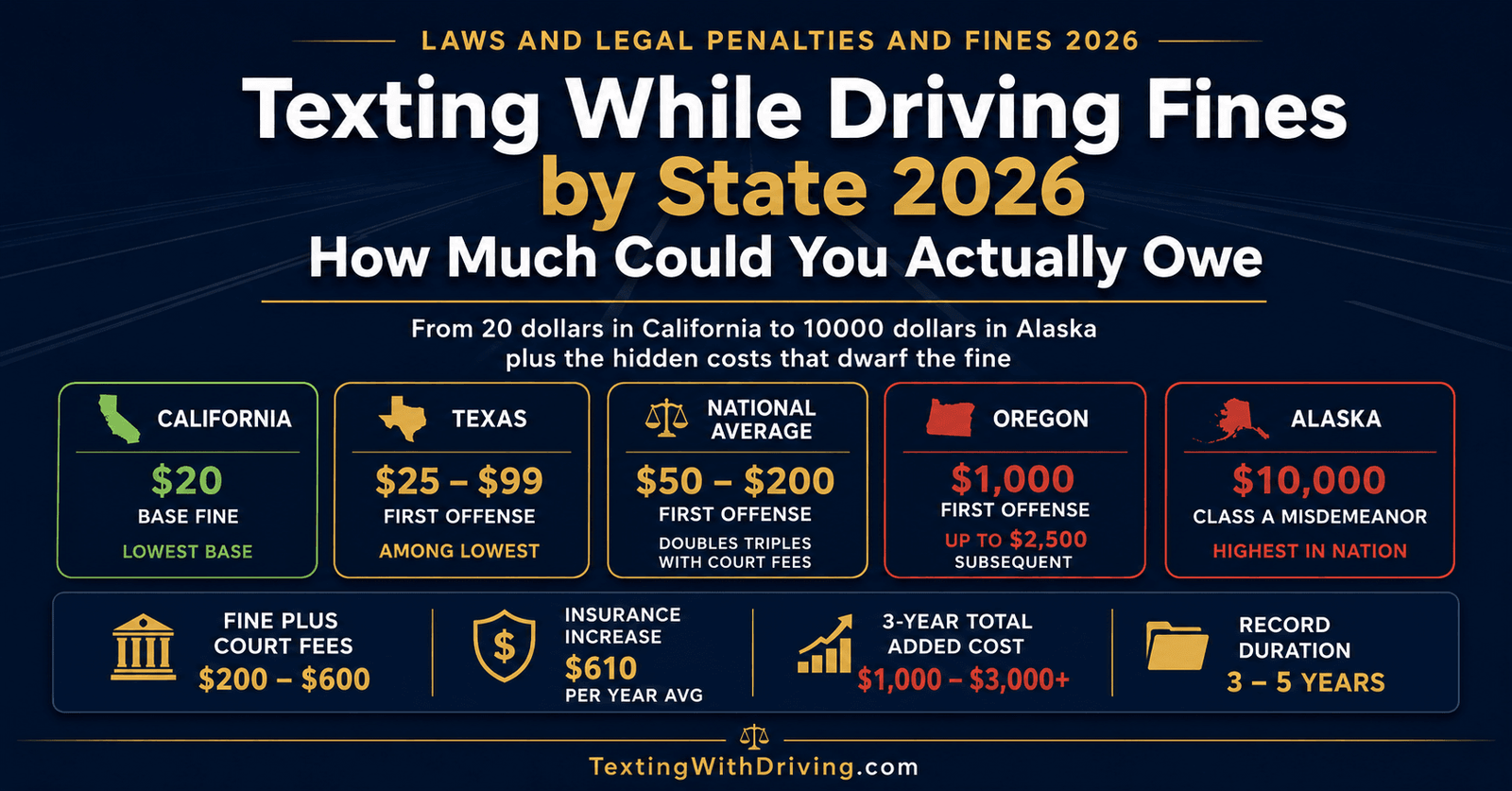
The ticket fine is the smallest part of what a texting while driving conviction actually costs. Add court fees that often double or triple the base fine, insurance rate increases that average $610 per year maintained for three to five years, and in some states license points that follow your record through every policy renewal and background check, and a single texting ticket becomes a $1,000 to $3,000 financial consequence spread across the next several years of your life.
This guide covers both the visible cost and the hidden cost, state by state, so you know exactly what you are risking.
The National Range in 2026: $20 to $10,000
A texting while driving fine in 2026 ranges from $20 in California to $1,000 in Oregon for a first offense. The national average is $50 to $200, but court fees and surcharges typically double or triple the base amount. Including insurance increases, the total texting ticket cost averages $1,000 to $3,000 over three years. Michigan Auto Law
Oregon’s $1,000 first offense makes it the highest standard first-offense fine in the continental US. But Alaska stands alone at the top of the national penalty scale.
In Alaska, texting and driving is a class A misdemeanor criminal offense where you can spend up to a year in jail and up to $10,000 in fines for a first offense. Penske Truck Leasing
Alaska does not treat phone use while driving as a traffic infraction. It treats it as a criminal act. That distinction puts a first-time texting offense in Alaska in the same legal category as certain assault charges, carrying the possibility of a criminal record, not just a traffic ticket.
The gap between a $25 fine in Texas and a $10,000 criminal charge in Alaska for the same behavior illustrates how dramatically the legislative approach to distracted driving varies across the country.
State-by-State First Offense Fine Reference
The following covers verified first-offense fines across all 50 states for 2026. Where base fines differ from actual total fees, both are noted.
Alabama’s first offense carries a $25 fine, the second offense is $50, and each subsequent offense is $75, with two points added to the license for each offense. Arizona drivers caught texting face fines between $75 and $149 for a first offense and between $150 and $250 for each subsequent offense. Baderlaw
Arkansas residents who text while driving can face a fine ranging from $25 to $250 for a first offense and from $50 to $500 for a second offense. California carries a minimum fine of $162 with the base fee of $20 and additional court fees and surcharges. Colorado treats texting while driving as a misdemeanor traffic offense punishable by a $300 fine and four points on the driving record. Connecticut’s first offense is $200, the second is $375, and each subsequent violation is $625. NAHB
Delaware’s first offense fine is $100 with subsequent offenses falling between $200 and $300. Florida’s first offense is $30 plus court costs making the effective fine approximately $100 to $130, but the second offense within five years becomes a moving violation carrying three license points. Georgia’s first offense is $50 and one demerit point, which can be dismissed by providing proof of purchasing a hands-free device. Illinois carries a $75 fine for a first offense but assigns 10 points for drivers under 19, and only 15 points in Illinois triggers a license suspension. Penske Truck Leasing
Kentucky’s first offense carries a $25 fine and three driving record points, with a $50 fine and three more points for subsequent violations. Louisiana’s first offense was previously $500 before HB 519 passed in 2025. Under the new hands-free law, Louisiana fines are now $100 for a first offense, $300 for a second offense, and $250 in school and work zones, representing a restructuring of the penalty framework. Maine prohibits handheld phone use and carries a fine of no less than $250 for a first offense and a minimum 30-day license suspension for repeat offenders. Maryland’s first offense carries a $70 fine and one point on the driving record. Massachusetts first offense is up to $100 in fines, with the second offense rising to $250 and the third and subsequent at $500. NAHB
New York’s first offense carries a fine of $50 to $200 and adds five points to the driver’s license, one of the stiffest point penalties in the country. North Carolina’s first offense is $100. Ohio’s first offense for distracted driving is $150. Baderlaw
Oregon’s first offense is $1,000, which is the highest standard first offense fine in the continental US. Pennsylvania’s first offense under Paul Miller’s Law is $50 plus court costs and fees, but the law carries an enhanced sentencing provision of up to five additional years in prison for violations causing a fatality. Texas first offense ranges from $25 to $99 and up to $200 for repeat offenses. Baderlaw
Utah comes in as the state with the most severe license point system, adding 50 points for a texting violation and fining up to $750 for a first offense. If 200 points accrue, the license is suspended, meaning four texting violations could cost a Utah driver their license entirely. Sentryroad
For the most current complete state-by-state list, the GHSA distracted driving state laws page is updated regularly by state highway safety offices and is the most authoritative public reference available. The Road Law Guide distracted driving laws page also maintains a comprehensive 2026 updated fine reference.
The States With the Highest Penalties Overall
When comparing total financial exposure from a first offense, including base fine, court fees, and the likely insurance impact, several states stand out as carrying disproportionately high consequences.
Alaska remains in a category of its own. A criminal misdemeanor classification means potential jail time, a criminal record, and fines up to $10,000. This is not a traffic enforcement approach. It is a criminal law approach.
Oregon at $1,000 for a first offense, rising to $2,500 for subsequent offenses, treats phone use while driving as a serious civil offense requiring a financial deterrent substantial enough to actually change behavior. Oregon was among the earlier states to pass a comprehensive handheld ban, and its fine structure reflects a deliberate policy choice to make the deterrent meaningful.
Utah fines can reach $750 for a first texting offense, and the 50-point addition to the driving record creates an accelerated path to license suspension for repeat offenders. Michigan Auto Law
Connecticut at $200 for a first offense, $375 for the second, and $625 for subsequent violations has one of the clearest escalating structures in the country, designed specifically to increase deterrent effect for drivers who do not change behavior after an initial citation.
New York’s five-point system deserves specific mention alongside its $50 to $200 fine range. The points are often more financially damaging than the base fine because of their insurance impact. Five points in New York is a significant license record mark that insurers access when renewing or quoting policies.
The States With the Lowest Penalties: What That Means
The states with the lowest base fines include Alabama ($25 first offense), Texas ($25 to $99), Florida ($30 first offense), Georgia ($50 first offense), Kentucky ($25 first offense), and Maryland ($70 first offense).
Several important context points about low-fine states:
Low base fines do not necessarily mean low total consequences. Court fees, surcharges, and administrative fees that fund courthouse operations, public safety programs, and road maintenance are added on top of base fines in virtually every state. In some states, these fees routinely double or triple the headline number.
Car insurance increases an average of 28 to 32 percent after a texting ticket, adding about $610 per year. California drivers face the highest impact at 45 to 51 percent, while New York has the lowest at approximately 9 percent. The increase typically lasts three to five years, making insurance the single largest component of the total texting ticket cost regardless of the base fine level. Michigan Auto Law
This is why the fine structure by itself is an incomplete picture of what a texting violation actually costs. A driver in Texas who pays a $75 first-offense fine and $100 in court fees has spent $175 in visible costs. But if their insurer raises their annual premium by 28 percent on a $1,500 policy, they are paying $420 more per year for the next three years. That is $1,260 in additional insurance costs, plus $175 in direct fines, for a total consequence of $1,435 from a ticket whose headline fine was $75.
We covered the insurance impact in detail in our dedicated article on what happens to your car insurance after a distracted driving ticket.
License Points: The Invisible Multiplier
Not all states add license points for texting violations, and the point systems that do exist vary dramatically in their structure and consequences.
About 26 states add license points for texting violations, ranging from one point in Georgia and Maryland to six points in North Dakota. Even states without points still record the violation, which insurers can see when reviewing driving history. A few states like Florida treat the first texting offense as a non-moving violation with no points, but the second offense within five years becomes a moving violation with three points. Michigan Auto Law
New York’s five-point system is particularly consequential. New York drivers who accumulate 11 points within 18 months face license suspension. A single texting violation does not reach that threshold, but combined with even one speeding ticket or other moving violation, it creates a meaningful path toward suspension.
Utah’s 50-point system creates the most accelerated path to suspension of any state. A driver who receives four texting violations in Utah could theoretically accumulate the 200 points required for license suspension from that violation alone.
The practical implication: when evaluating the cost of a texting violation, the point impact on your license and what that means for your insurance tier is often more financially significant than the base fine.
Enhanced Penalties: When Fines Multiply
Most states include enhanced fine provisions for specific circumstances that dramatically increase the base penalty.
School zones and construction zones carry enhanced penalties in virtually every state with a distracted driving law. Missouri’s $150 first offense becomes $500 in school zones. Louisiana’s $100 first offense becomes $250 in school and construction zones. Pennsylvania enhances penalties for school zone violations. The pattern is consistent nationally: distracted driving near children or road workers carries a disproportionately higher penalty.
Crashes and injuries: When a texting violation contributes to a crash, the fine structure changes entirely. Louisiana’s law requires the fine to double when a crash is involved. Other states elevate the charge category when a crash occurs.
If texting and driving results in the death or serious bodily injury of another person in Texas, the driver can be charged with a Class A misdemeanor punishable by a fine up to $4,000 and up to one year in jail, even in a state where the standard first offense fine is $25 to $99. NAHB
This escalation from traffic infraction to criminal charge when a crash results is consistent across most US states. The $25 base fine in Texas is not relevant when someone is seriously injured. The criminal charge is. And as we covered in our Pennsylvania distracted driving law 2026 guide, Pennsylvania’s Paul Miller’s Law adds up to five additional years in prison on top of a homicide by vehicle conviction when phone use was a contributing factor.
Repeat offenses: Every state with a texting ban increases penalties for subsequent violations. The escalation structure varies but the direction is always the same: the second offense costs more than the first, and the third costs more than the second. Some states like Utah and Maine add license suspension risk that does not exist for first offenses.
Primary vs. Secondary Enforcement: Who Can Actually Pull You Over
The enforcement type matters as much as the fine structure for determining the real-world risk of a texting violation.
Currently, 48 states enforce texting bans as a primary offense. In primary enforcement states, police can pull you over for texting alone, even if you are otherwise driving perfectly legally. In secondary enforcement states, an officer can only issue the texting citation if they stopped you for another violation first. Mattiacci Law
In a primary enforcement state, any officer who observes you with a phone in hand has the legal authority to initiate a traffic stop specifically because of that observation. In a secondary enforcement state, the same officer who watches you text through a red light cannot pull you over unless you also run the light, speed, or commit another infraction.
The practical implication for drivers: in the 48 primary enforcement states, there is no “safe” moment to text while driving where you are protected from a traffic stop by an absence of other violations. The observation of phone use alone is sufficient.
Missouri’s hands-free law, which we covered in full detail in our Missouri hands-free driving law 2026 guide, is an unusual case where the law is primary in school zones but operates as secondary in practice on open roads, despite technically being a primary offense.
What $25 vs. $10,000 Actually Tells Us About Deterrence
The enormous variation in fine structures across states is not random. It reflects fundamentally different policy philosophies about whether financial deterrence actually changes driver behavior.
States with very low base fines like Texas ($25 to $99) and Alabama ($25) have effectively decided that the primary function of the fine is legal acknowledgment of the violation rather than financial deterrence sufficient to change behavior. The research on fine deterrence consistently shows that drivers respond more strongly to perceived probability of being caught than to fine magnitude, so this approach has some research basis.
States with very high fines like Alaska (up to $10,000) and Oregon ($1,000) have concluded that only a fine substantial enough to create real financial pain will change behavior for drivers who are already aware of the danger and do it anyway.
The research on which approach produces better outcomes is mixed, because fine effectiveness depends heavily on enforcement visibility and the likelihood of being caught. A $10,000 fine with no enforcement produces less behavioral change than a $100 fine with aggressive, visible enforcement. The GHSA and Cambridge Mobile Telematics research we referenced in our distracted driving statistics 2026 overview consistently shows that high-visibility enforcement paired with clear laws produces the strongest behavioral outcomes, regardless of the specific fine level.
The Real Total Cost: Doing the Full Math
Here is the honest calculation that most drivers do not do when they get caught.
Take a hypothetical driver in a state with a $100 first-offense texting fine. Add court fees and surcharges that average $100 to $200 on top of the base fine. The immediate out-of-pocket cost is $200 to $300.
Now calculate the insurance impact. National average insurance increase of 28 to 32 percent. On a $1,400 annual premium, that is $392 to $448 per year in additional premium. Maintained for three years, that is $1,176 to $1,344 in cumulative additional insurance costs.
Total consequence of one texting ticket: $1,376 to $1,644 over three years. For a ticket whose headline fine was $100.
In states like Connecticut or Oregon where base fines are higher, or New York where insurance impact is compounded by the five-point license record mark, the total three-year cost rises well above $2,000 for a single first offense.
Including insurance increases, the total texting ticket cost averages $1,000 to $3,000 over three years, making the insurance cost the single largest component of the real financial consequence regardless of which state the violation occurred in. Michigan Auto Law
The ticket fine is the opening line. The three-year financial consequence is the chapter that follows.
For the full legal picture of what your state requires and where it sits in the national legislative landscape, see our hands-free driving laws by state 2026 guide covering all 50 states. For the specific legal details of recently enacted laws in Pennsylvania, Missouri, and Louisiana, we have dedicated guides for each. And for the complete picture of how texting while driving compares to other dangerous driving behaviors in its legal treatment and actual danger level, see our analysis of texting while driving vs drunk driving.
Sources Used in This Article
All links verified working before publication.
Road Law Guide: Distracted Driving Laws 2026 Complete State Guide — February 11, 2026
Road Law Guide: Texting While Driving Fine 2026 Ticket Cost by State — February 11, 2026
DriversEd.com: A State-by-State Guide to Texting and Driving Fines — Updated 2025
Aceable: Texting While Driving Penalties by State — State fine reference
For The People: Texting and Driving Laws Across the US — January 22, 2025
iDriveSafely: Texting and Driving Laws and Fines by State — Fine and point system reference
GHSA: Distracted Driving State Laws — Governors Highway Safety Association, 2025 update
NHTSA: Distracted Driving — National data and legislative context
TextingWithDriving.com is professionally built and maintained to ensure accurate, accessible safety information reaches every driver who needs it. Website development and ongoing support is handled by Budgetic, a digital agency specializing in purpose-driven WordPress websites.

About Texting With Driving
TextingWithDriving.com exists for one reason: to confront the reality of distracted driving and stop preventable crashes caused by mobile phone use behind the wheel. Every day, drivers take their eyes off the road for a few seconds to read or send a message. Those few seconds are enough to cause life-altering consequences. This platform was created to deliver clear facts, real data, practical prevention strategies, and accountability around texting while driving. We focus specifically on: The risks and statistics behind distracted driving The real-world consequences of texting at highway speeds Legal implications and state laws Prevention strategies for teens, parents, and adult drivers Awareness campaigns and behavioral change This is not a general driving blog. It is a focused awareness initiative built around one critical issue: phone distraction behind the wheel. Our content is direct, research-driven, and practical. We prioritize accuracy over opinion and education over sensationalism. The goal is simple — reduce distracted driving incidents by increasing awareness and responsibility. If one article causes one driver to put their phone down, the mission is working. For inquiries or partnerships, contact: privacy@textingwithdriving.com
View all posts by Texting With Driving