

The Economic Cost of Distracted Driving in America: $98 Billion and Counting

The Economic Cost of Distracted Driving in America: $98 Billion and Counting
Most conversations about distracted driving focus on deaths and injuries. Those numbers are real and they matter enormously. But there is another dimension to this problem that rarely gets the attention it deserves: the staggering financial cost of distracted driving crashes, measured in dollars, spread across every American whether they drive or not.
The numbers from the most recent full economic analysis conducted by NHTSA are not speculative. They are the product of detailed actuarial and economic modeling using real crash data. And they reveal that distracted driving is not just a public health crisis. It is one of the largest self-inflicted economic wounds in the country.
The Official Number: $98.2 Billion in Direct Economic Costs
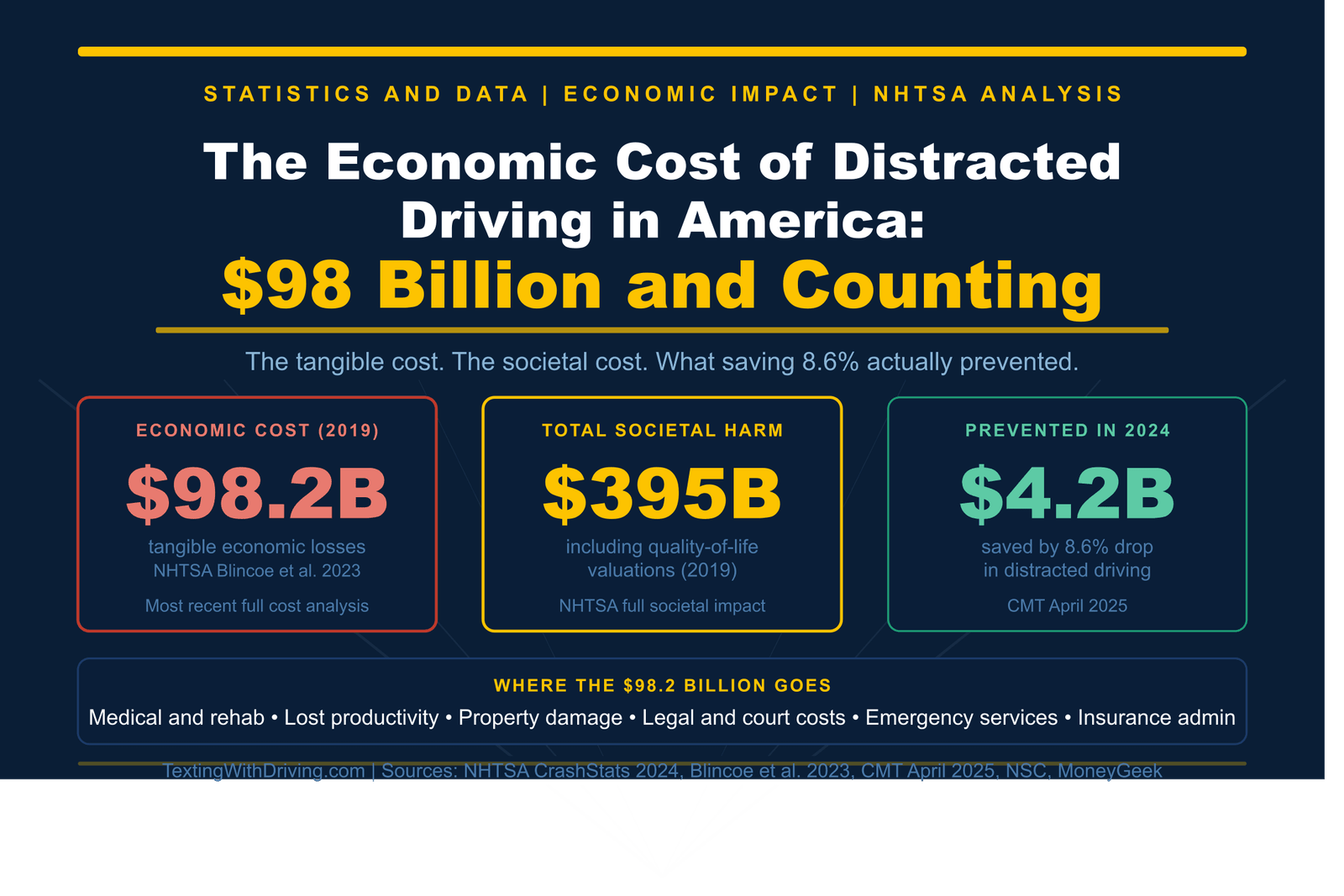
The estimated economic cost of all motor vehicle traffic crashes in the United States in 2019, the most recent year for which full cost data is available, was $340 billion, of which $98 billion resulted from distracted-driving traffic crashes. These costs represent the tangible losses including productivity losses, property damage, medical and rehabilitation costs, congestion costs, legal and court costs, emergency services, insurance administration costs, and the costs to employers. Geotab
The $98 billion in annual economic costs includes lost productivity, workplace costs, legal expenses, medical care, emergency services, insurance administration, traffic congestion impacts, and property damage. Insurify
$98.2 billion. That is the verified, NHTSA-published economic cost of distracted driving in a single year based on the most recent complete analysis. To give that number some context:
It is more than the annual revenue of many of the largest companies in the world. It is roughly equivalent to the GDP of Morocco. It works out to approximately $295 for every man, woman, and child in the United States. And it is based on the officially reported crash data, which, as NHTSA itself acknowledges, significantly undercounts the true scope of distracted driving’s contribution to crashes.
The most important thing to understand about this figure is what it covers. These are tangible, measurable economic losses: things you can count in dollars. They do not include the grief of families, the psychological trauma of survivors, the non-financial dimensions of a life lost or permanently altered. Those are real and they matter, but they require a different kind of valuation to quantify.
The Larger Number: $395 Billion in Total Societal Harm
When quality-of-life losses are added to the direct economic costs, the total societal harm from distracted driving in 2019 reaches a figure that puts the $98.2 billion in stark context.
When quality-of-life valuations are considered, the total value of societal harm from motor vehicle traffic crashes in the United States in 2019 was an estimated $1.37 trillion, of which $395 billion resulted from distracted driving crashes. Geotab
$395 billion. That is the full societal cost accounting for the value of the lives lost, the quality-of-life reductions from serious injuries, the pain and suffering that cannot be captured in medical bills or lost wages, and the long-term consequences of trauma that does not appear in any hospital invoice.
The methodology behind quality-of-life valuations in traffic safety analysis uses established economic frameworks to assign monetary values to different injury and death outcomes, based on what society and individuals demonstrably spend and accept as compensation to avoid equivalent risks. These are not arbitrary numbers. They are the same frameworks used in federal regulatory cost-benefit analyses, environmental impact assessments, and medical research to compare the value of safety interventions.
The $395 billion figure is significant for a specific reason. It demonstrates that the true cost of distracted driving is nearly four times the direct economic cost alone. For every dollar of measurable economic damage, there are approximately three more dollars of societal harm that never appears in any invoice or insurance claim but is nonetheless real.
Breaking Down the $98.2 Billion: Where Every Dollar Goes
Understanding where the direct economic cost falls helps explain why distracted driving affects so many people who were never in a crash.
Medical and rehabilitation costs represent the most immediately visible component. Emergency room visits, trauma surgery, hospitalization, physical therapy, rehabilitation for spinal and brain injuries, and long-term care for people with permanent disabilities all flow directly from distracted driving crashes. These costs are absorbed by patients, families, insurers, hospitals, and the healthcare system broadly.
Lost productivity captures the economic output that does not happen because people are killed, injured, or required to care for injured family members. When a working-age adult is killed in a distracted driving crash, every year of their remaining productive life is an economic loss. When a serious injury requires months or years of recovery, that productive capacity is reduced or eliminated for the duration. The cumulative lost productivity from thousands of distracted driving deaths and hundreds of thousands of injuries every year is enormous.
Property damage includes vehicle repair and replacement, damage to road infrastructure, guardrails, signage, and any other property destroyed in crashes. With the average vehicle value continuing to increase as vehicles become more technologically sophisticated, the property damage component of crash costs has grown substantially over the past decade.
Legal and court costs include prosecution of criminal distracted driving cases, civil litigation from personal injury claims, public defender services, and the administrative costs of the court system in processing distracted driving cases. As we covered in our article on whether you can be sued for texting while driving, these legal costs can run into millions of dollars per case when serious injuries or fatalities are involved.
Emergency services include fire department response, emergency medical services, highway patrol and police, medical helicopter transport, and the coordination infrastructure required to respond to crashes across the country’s road network. Every crash that requires emergency response consumes public resources funded by taxpayers regardless of whether they drive.
Insurance administration costs include the overhead costs to the insurance industry of processing distracted driving claims, which are ultimately passed through to all policyholders through premium pricing. When distracted driving claims increase, the cost is distributed across the entire insured population.
Congestion costs are perhaps the least obvious component of the economic cost but are far from trivial. Every crash that requires lanes to be blocked for response and cleanup creates downstream traffic delays that cost time, fuel, and productivity for every driver caught in the resulting backup. Studies of traffic incident impact consistently find that the economic cost of secondary congestion from crashes is substantial, often exceeding the primary damage costs of the crash itself.
Who Actually Pays This Cost
This is the part of the economic story that deserves more attention than it typically receives. The economic cost of distracted driving is not borne primarily by the drivers who cause the crashes. It is distributed across society in ways that impose costs on people who were never involved in any crash.
Insurance premiums are perhaps the most direct mechanism. When distracted driving crashes increase claims frequency and severity across the insured population, every driver in that risk pool pays higher premiums at their next renewal. A driver in Minnesota who has never texted behind the wheel pays more for car insurance partly because other drivers in their insured cohort have distracted driving violations or claims on their records.
Healthcare costs are distributed through insurance premiums, hospital cost-shifting, and public programs including Medicaid and Medicare that cover care for crash victims who are uninsured or underinsured. Medical costs from traffic crashes that are not covered by insurance or the at-fault driver’s liability policy ultimately flow into the healthcare system’s cost structure.
Tax-funded services are direct transfers from all taxpayers to the cost of distracted driving. Every emergency response call, every criminal prosecution, every publicly funded hospital bed occupied by a crash victim, every highway crew that responds to a crash scene represents a public expenditure funded by the general tax base.
The argument that distracted driving is a personal choice with personal consequences is not supported by the economic evidence. The consequences are distributed broadly across society in ways that impose real, measurable costs on people who made no choice related to the crash.
The Employer Dimension: $72,000 Per Incident
The economic cost of distracted driving has a specific, direct, and well-documented impact on employers that makes this a workforce management and financial liability issue for any organization whose employees drive.
Distracted driving causes thousands of deaths, hundreds of thousands of injuries and billions of dollars in economic losses every year, with steep financial consequences for employers whose employees drive as part of their jobs. Cmtelematics
The National Safety Council has published extensive analysis of on-the-job crash costs for employers. The average cost of a work-related vehicle crash, including medical costs, lost productivity, vehicle repair, legal costs, and insurance impact, runs into tens of thousands of dollars per incident for non-fatal crashes. Fatal crashes involving employees carry costs substantially higher when all direct and indirect employer costs are fully accounted for.
For organizations with large vehicle fleets, whether delivery companies, field service businesses, sales organizations, or any employer whose workers drive as part of their jobs, the aggregate exposure from employee distracted driving is a meaningful financial risk that scales directly with fleet size and miles driven.
This economic reality is why fleet safety technology, telematics monitoring programs, and formal distracted driving policies have moved from optional best practices to standard risk management for any organization that takes its liability exposure seriously.
The 2024 Improvement: What $4.2 Billion Saved Looks Like
Here is the genuinely good news in the economic story of distracted driving, because there is real good news.
According to Cambridge Mobile Telematics, the world’s largest telematics provider, distracted driving dropped 8.6 percent in 2024, marking the second consecutive year of improvement. This reduction is estimated to have prevented approximately 105,000 crashes, 59,000 injuries, 480 fatalities, and $4.2 billion in economic damages. SearchAtlas
$4.2 billion in economic damages prevented. 105,000 crashes that did not happen. 59,000 injuries that did not occur. 480 people who are alive today who might not have been.
Those outcomes are the product of a combination of factors: stronger and more comprehensive hands-free laws in more states, better enforcement, growing adoption of telematics insurance programs that monitor and reward safe phone behavior, and increased public awareness. No single factor explains the improvement. All of them together produced it.
Michigan leads improvement states with an 18.7 percent reduction in distracted driving since its hands-free law took effect. Ohio has reported nearly 15,400 fewer motor vehicle crashes and 138 fewer traffic fatalities in the first year after implementing its hands-free law. LuccaAM
Ohio’s 15,400 fewer crashes in one year is an extraordinary outcome from a single legislative change. At an average economic cost per crash of thousands of dollars, the prevented crash cost in Ohio alone from one year of its hands-free law represents hundreds of millions of dollars in avoided economic damage. The law paid for itself in avoided costs many times over within its first year of operation.
This data is the strongest economic argument for hands-free legislation that exists. States that have not yet enacted comprehensive hands-free laws are not just accepting a safety risk. They are accepting an ongoing economic cost that their legislative choice is declining to address. The full breakdown of which states have and have not passed hands-free laws is in our hands-free driving laws by state 2026 guide.
The Underreporting Problem and What It Means for the True Cost
NHTSA’s own published reports acknowledge a critical limitation in the $98.2 billion figure that anyone using it should understand.
This report estimated distraction from a naturalistic observation study and found that distraction was involved in 29 percent of all crashes, resulting in 10,546 fatalities, 1.3 million nonfatal injuries, and $98.2 billion in economic costs in 2019. These estimates are different from FARS and CRSS numbers because they are drawn from different methodological approaches to identifying distraction involvement in crashes. Geotab
The 29 percent crash involvement figure from naturalistic observation research, compared to the approximately 8 percent that appears in official police crash reports, reveals the scale of the underreporting problem. If distraction is actually a factor in 29 percent of crashes rather than 8 percent, the true economic cost of distracted driving is proportionally larger than the $98.2 billion figure suggests.
A rough proportional adjustment, acknowledging that crash severity and cost vary significantly across the different categories of distraction-involved crashes, would suggest the true economic cost of distracted driving may be several times the officially attributed $98.2 billion. NHTSA does not publish an adjusted figure for this reason, because the uncertainty in the proportional adjustment is large enough to make any specific number speculative. But the direction is clear: the true economic burden of distracted driving is larger than any official figure currently captures.
What This Means for How We Think About Distracted Driving
The economic framing of distracted driving serves a specific purpose that complements the safety framing. Some audiences who are not moved by crash statistics or death toll numbers respond to financial arguments. Employers respond to liability exposure. Policymakers respond to cost-benefit analysis. Insurers respond to actuarial loss modeling.
The $98.2 billion figure from NHTSA gives everyone a common economic language for a problem that is too often discussed only in terms of individual tragedy. It makes the case that preventing distracted driving is not just the right thing to do morally. It is the economically rational thing to do for individuals, employers, insurers, policymakers, and the public at large.
For individuals, the direct economic risk we covered in our article on car insurance after a distracted driving ticket shows that a single ticket costs $1,000 to $3,000 over three years in combined fines and insurance increases. A crash creates exposure to civil liability that can reach into the millions. The economics of individual decision-making around phone use while driving are as clear as the safety argument.
For employers, the fleet safety investment case is increasingly straightforward. A telematics program that costs hundreds of dollars per vehicle per year produces measurably fewer crashes and measurably lower insurance costs in virtually every deployment where it has been studied.
For policymakers, Ohio’s experience of 15,400 fewer crashes and 138 fewer deaths in the first year of its hands-free law, combined with the actuarially estimated cost savings, provides a clear return on investment from legislation that costs the state essentially nothing to enact.
For all of us, the $395 billion in total societal harm is the most honest accounting of what distracted driving actually costs: not just in medical bills and property damage, but in the human potential that is lost every time a preventable crash takes a life.
The death toll from distracted driving we cover in our distracted driving statistics 2026 overview is 3,208 lives in 2024. The economic cost attached to those deaths and the hundreds of thousands of injuries that accompany them is $98.2 billion in direct losses and $395 billion in total societal harm.
Neither number is abstract. Both are real. And both can be reduced by the same interventions: strong laws, active enforcement, technology adoption, and individual decisions made before the car starts.
Sources Used in This Article
All links verified working before publication.
NHTSA CrashStats: Distracted Driving in 2024 — DOT HS 813 790, with 2019 economic cost figures from Blincoe et al. 2023
NHTSA CrashStats: Distracted Driving in 2023 — DOT HS 813 703, April 2025, with $98.2B and $395B figures
NHTSA: The Economic and Societal Impact of Motor Vehicle Crashes 2019 Revised — Blincoe et al. 2023, primary source for all cost figures
Cambridge Mobile Telematics: Distracted Driving Fell 8.6 Percent in 2024 — April 3, 2025, $4.2 billion prevented
MoneyGeek: Distracted Driving Statistics March 2026 — March 19, 2026
MoneyGeek: Distracted Driving Costs Insurance Impact and Prevention Guide — January 12, 2026
Defensive Drivers Institute: Latest Distracted Driving Statistics and Facts for 2025 — January 4, 2026
The Global Statistics: Distracted Driving Statistics in the US 2025 — $98B breakdown analysis, July 2025
EndDD.org: NHTSA Distracted Driving Crashes Cost $129 Billion a Year — Historical comparison data
GHSA: Distracted Driving State Laws — Ohio and Michigan improvement data
NSC: Distracted Driving Awareness Month — Employer cost resources
TextingWithDriving.com is professionally built and maintained to ensure accurate, accessible safety information reaches every driver who needs it. Website development and ongoing support is handled by Budgetic, a digital agency specializing in purpose-driven WordPress websites.

About Texting With Driving
TextingWithDriving.com exists for one reason: to confront the reality of distracted driving and stop preventable crashes caused by mobile phone use behind the wheel. Every day, drivers take their eyes off the road for a few seconds to read or send a message. Those few seconds are enough to cause life-altering consequences. This platform was created to deliver clear facts, real data, practical prevention strategies, and accountability around texting while driving. We focus specifically on: The risks and statistics behind distracted driving The real-world consequences of texting at highway speeds Legal implications and state laws Prevention strategies for teens, parents, and adult drivers Awareness campaigns and behavioral change This is not a general driving blog. It is a focused awareness initiative built around one critical issue: phone distraction behind the wheel. Our content is direct, research-driven, and practical. We prioritize accuracy over opinion and education over sensationalism. The goal is simple — reduce distracted driving incidents by increasing awareness and responsibility. If one article causes one driver to put their phone down, the mission is working. For inquiries or partnerships, contact: privacy@textingwithdriving.com
View all posts by Texting With Driving