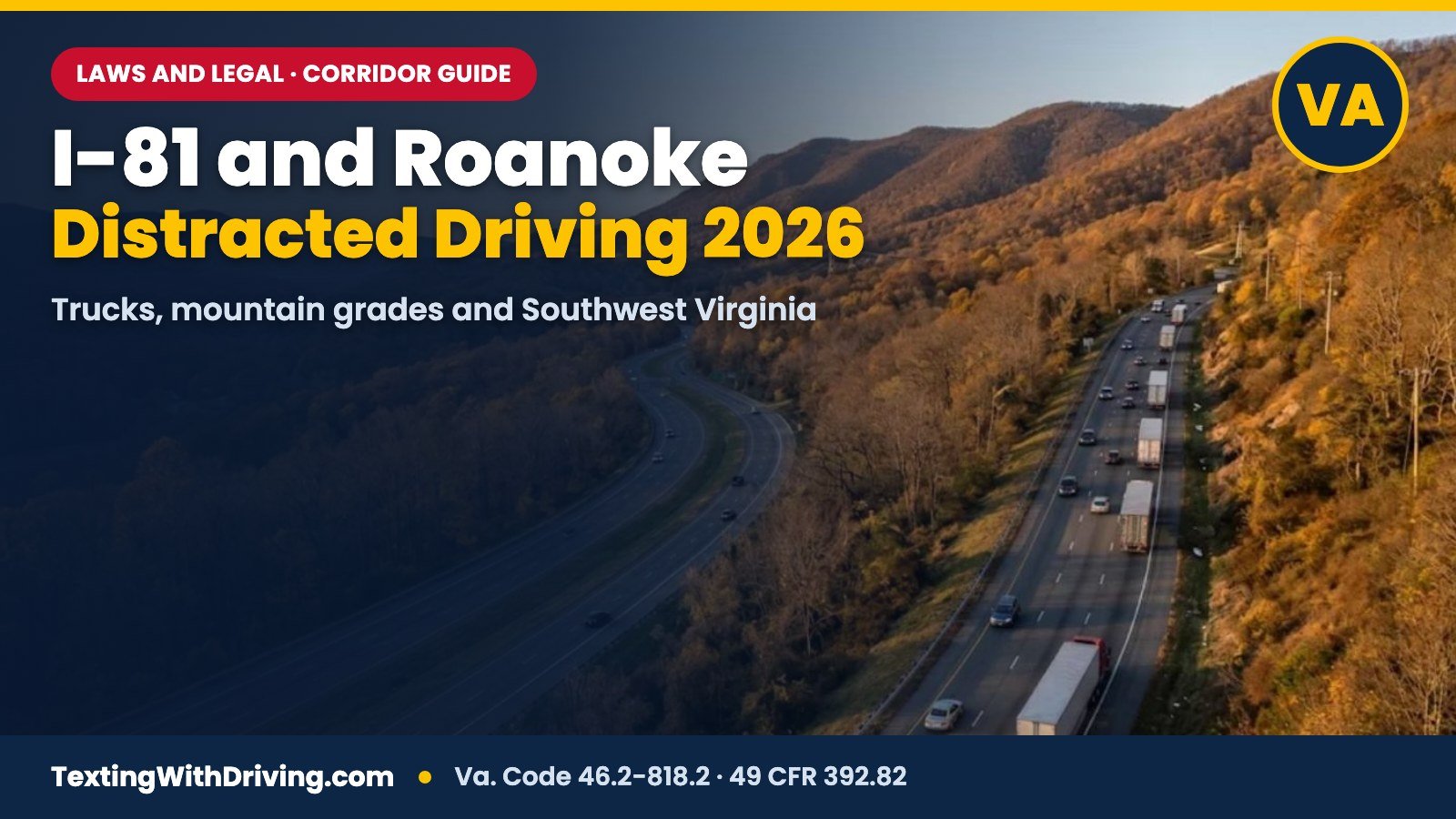
I-81 Virginia distracted driving is a different problem from city traffic. The interstate runs 325 miles through the Shenandoah Valley and Southwest Virginia, climbs long mountain grades, and carries some of the heaviest truck traffic in the state. On the stretch through Montgomery and Roanoke counties alone, VDOT counted more than 800 crashes from 2019 to 2023, on a road where 28 percent of the roughly 56,000 vehicles a day are trucks.
Few Virginia roads demand more attention than I-81. Below are the crash numbers, what State Police found during their 2026 enforcement operations, what VDOT plans to build, and the phone rules for both car and truck drivers.
Key facts on I-81 in Virginia
VDOT reported more than 800 crashes from 2019 to 2023 on I-81 between Exits 128 and 137 in Montgomery and Roanoke counties (WSLS, October 2025).
About 56,000 vehicles use that section each day, and 28% of them are trucks (WSLS).
State Police ran Operation DISS-rupt on all 325 miles of I-81 on October 21 and 22, 2026, focused on distracted, impaired and speeding drivers and seat belt use (WFXR).
Virginia recorded 553 traffic deaths in 2026 before that operation, compared with 590 over the same period of 2025 (Virginia State Police via WFXR).
VDOT’s 2026 I-81 Corridor Improvement Plan approves 22 projects worth up to $2.25 billion (VDOT, January 2026).
Why I-81 is different
Three things make I-81 unforgiving. First, trucks: the share of heavy vehicles is far higher than on most Virginia roads, and a loaded tractor-trailer needs much more room to stop than a car. Second, terrain: long climbs slow trucks while cars behind them speed up to pass, creating big speed differences between lanes. Third, the road itself: most of I-81 is two lanes in each direction, so a single crash can block the interstate for hours.
Distraction makes each of those risks worse. A driver who looks down while approaching a slow truck on a grade closes the gap quickly. A driver changing lanes to pass without a full mirror and shoulder check can cut off a truck that cannot stop in time. And when traffic suddenly stops behind a crash over a hill, a driver reading a text has no warning at all.
What State Police found in 2026
Virginia State Police runs Operation DISS-rupt on a rotating basis across the interstates. The name stands for its four focus areas: distracted driving, impaired driving, speed compliance and seat belt safety.
On I-81, troopers ran operations in April and again on October 21 and 22, 2026, covering all 325 miles in the Appomattox, Culpeper, Salem and Wytheville divisions. During the April operation, State Police cited 176 drivers for speeding and 51 for reckless driving and arrested one for driving while intoxicated, with no fatal crashes on I-81 during the operation.
“We want Virginians focused on the basics of traffic safety,” said Capt. Patrick L. Kirtner, commander of the State Police Wytheville Division. State Police set goals of zero fatal crashes during each enforcement period and a 10 percent cut in interstate crashes for the year.
I-81 enforcement and safety data
Figure
Source
April 2026 DISS-rupt speeding citations
176
Virginia State Police via WFXR
April 2026 reckless driving citations
51
Virginia State Police via WFXR
Virginia traffic deaths in 2026 before October 21
553
Virginia State Police via WFXR
Same period in 2025
590
Virginia State Police via WFXR
Speed-related deaths in Virginia, 2024
410
Virginia State Police via WFXR
What VDOT is building
VDOT updated its I-81 Corridor Improvement Plan in 2025, using crash, congestion and lane closure data from 2019 through 2024. The final plan, released in January 2026, identified 41 possible capital projects worth more than $7 billion and approved 22 of them, worth up to $2.25 billion, for funding beginning in 2035. The Salem District, which includes the Roanoke Valley, has three of those projects, estimated at $300 million to $462 million. The plan also set aside $3 million for faster operational fixes.
A separate widening of I-81 between Exits 128 and 137 is already moving forward. “These widening projects are really intended to improve safety, reduce congestion, and improve response times,” VDOT spokesperson Jason Bond told WSLS.
More construction is coming to the corridor, which brings its own rule: holding a phone in a highway work zone carries a mandatory $250 fine in Virginia.
Why a glance costs more on I-81
NHTSA says reading or sending a text takes a driver’s eyes off the road for about five seconds, which at 55 mph covers the length of a football field. On I-81, where speed limits reach 70 mph in places, the same five seconds covers even more ground. Virginia State Police notes that posted limits on Virginia interstates never exceed 70 mph.
That distance matters most where traffic changes suddenly: at the bottom of a grade, behind a slow truck, or approaching a crash scene beyond a curve. Most distraction crashes on I-81 are not dramatic moments of recklessness. They are ordinary glances at the wrong time, on a road with little room for error.
Phone rules for every I-81 driver
Car drivers. Virginia’s hands-free law, Va. Code 46.2-818.2, makes it illegal to hold a handheld personal communications device while driving a moving vehicle. The fine is $125 for a first offense, $250 for a second or later offense, and a mandatory $250 in a highway work zone. GPS and calls are legal as long as the phone is not in your hand, State Police reminds drivers.
Truck drivers. Commercial drivers face a stricter federal rule. Under 49 CFR 392.82, no driver of a commercial motor vehicle may use a hand-held mobile phone while driving, and no motor carrier may allow or require it. FMCSA’s fact sheet lists penalties of up to $2,750 for drivers and up to $11,000 for employers. See our FMCSA rules for commercial drivers guide.
Driver
Rule
Penalty
Passenger car, first offense
No holding a phone while moving
$125
Passenger car, repeat offense
Same
$250
Any driver in a highway work zone
Same
Mandatory $250
Commercial motor vehicle driver
No hand-held phone use (federal)
Up to $2,750 (FMCSA fact sheet)
Motor carrier allowing it
Federal rule
Up to $11,000 (FMCSA fact sheet)
Driving I-81 safely
These habits reduce the risk of I-81 Virginia distracted driving crashes, especially in the mountains.
Set the phone before the on-ramp. There is no good place to fiddle with a screen on a two-lane interstate full of trucks.
Stay out of truck blind spots. If you cannot see the driver’s mirrors, the driver cannot see you.
Pass with purpose. Finish passing a truck on a grade instead of lingering beside it.
Watch for sudden stops over hills. A crash can back traffic up just past a crest.
Leave extra room on downgrades. Trucks may need to brake hard or use runaway ramps.
Check 511 Virginia before long trips. Lane closures on I-81 can last hours.
Roanoke drivers use I-81 as a commuting route as much as a long-distance highway, which means local trips share lanes with interstate freight. The risks continue across the state line, too. If you drive into West Virginia, read our West Virginia distracted driving law guide, and for statewide rules see our Virginia distracted driving law overview.
Frequently asked questions
What are the I-81 Virginia distracted driving rules?
Holding a phone while driving is illegal anywhere in Virginia. Hands-free calls and GPS are allowed. The fine is $125 for a first offense and $250 after that.
What is Operation DISS-rupt?
A Virginia State Police enforcement and education campaign that rotates across interstates and focuses on distracted driving, impaired driving, speeding and seat belt use. It covered all 325 miles of I-81 on October 21 and 22, 2026.
Why is I-81 in Virginia so dangerous?
It combines heavy truck traffic, mountain grades and mostly two lanes in each direction. On one Roanoke-area stretch, 28 percent of traffic is trucks and VDOT counted more than 800 crashes from 2019 to 2023.
Can truck drivers use a phone on I-81?
Not handheld. Federal rule 49 CFR 392.82 bans hand-held mobile phone use by commercial motor vehicle drivers while driving.
Is I-81 being widened near Roanoke?
Yes. VDOT is advancing a widening between Exits 128 and 137, and its 2026 Corridor Improvement Plan approves 22 more projects across the corridor.
This article is general information, not legal advice. For a specific ticket, talk to a licensed Virginia attorney.
TextingWithDriving.com is professionally built and maintained to ensure accurate, accessible safety information reaches every driver who needs it. Website development and ongoing support is handled by Budgetic, a digital agency specializing in purpose-driven WordPress websites.
The TextingWithDriving.com Editorial Team researches and writes every article on this site. We cover distracted driving laws in all 50 states and Washington, DC, national crash data, teen driver safety, workplace policy, and practical ways to keep phones out of drivers' hands. Every statistic and legal reference links to its original source, such as NHTSA, FMCSA, IIHS, state statutes, and state transportation departments. If you spot an error or an outdated figure, contact us and we will check it and correct it.
Vermont distracted driving law bans handheld devices while driving. See the $100 to $1,000 fines, points, work and school zone penalties and teen rules.
DC traffic cameras in 2026: what speed, red light, stop sign and bus cameras ticket, why they do not catch phone use, and how DC's phone law is enforced.
Virginia Thanksgiving traffic 2026: AAA expects 72.9 million road trips. See the worst times to drive, VDOT tools, and how to stay off your phone on I-95.
New Hampshire distracted driving law bans handheld phones. Fines rise to $250 to $1,000 with suspensions on January 1, 2027. See the rules and teen limits.
Charlottesville distracted driving in 2026: Route 29 crash data, the city's plan to end traffic deaths, student driver risks, and Virginia's phone law.