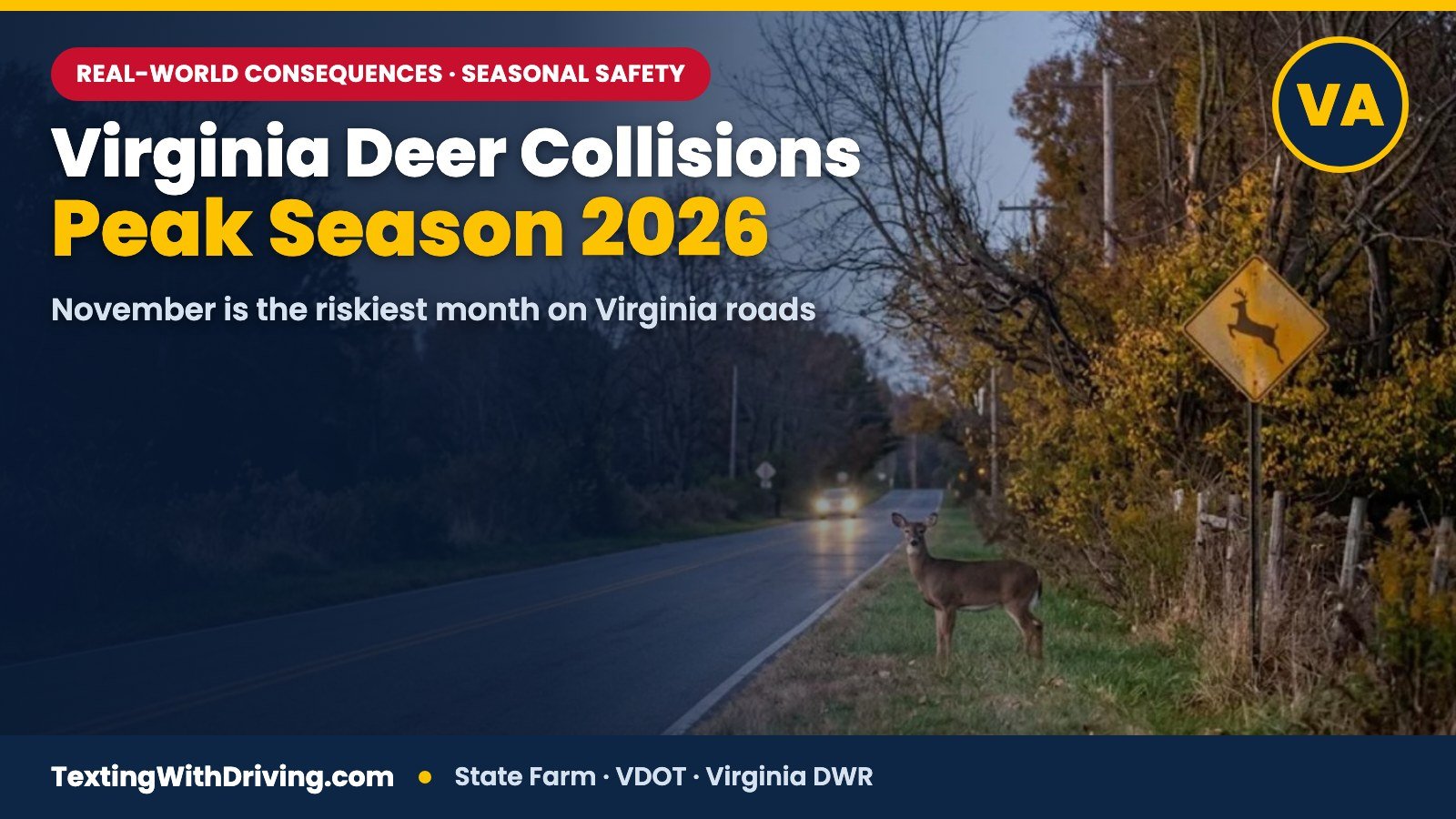
Virginia deer collisions peak in November, and 2026 is no exception. State Farm estimates that 1 in 81 Virginia drivers will file an animal collision claim in a year, which ranks Virginia eighth in the country, and the insurer lists November as the top month for these crashes nationwide. Add the end of Daylight Saving Time on November 1, which moved the evening commute into darkness, and this is the month when drivers most need their eyes on the road.
Deer are on the move right now, and Virginia’s numbers show it. We cover why November is so risky, how a quick look at a phone can turn a near miss into a crash, and what to do if you do hit a deer.
Key facts on Virginia deer collisions
Virginia drivers have a 1 in 81 chance of an animal collision claim, eighth highest in the US; the national figure is 1 in 145 (State Farm, July 2025 to June 2026 claims).
November, October and December are the top three months for animal collisions, in that order (State Farm, 2026).
Virginia police recorded 7,335 crashes involving deer in 2023, with 690 injuries, and 42% happened in October and November (Virginia DMV via VDOT).
Deer crashes in Virginia rose 20% from 2022 to 2023 (VDOT).
35 people died in animal collisions in Virginia from 2015 to 2024 (IIHS, 2026).
Why November is peak season
Deer are especially active from mid-October through November because it is their mating season, according to VDOT and the Virginia Department of Wildlife Resources (DWR). During the rut, deer travel farther and more unpredictably, and they forage along road edges as other fall food runs short.
Timing makes it worse. Deer cross roads at all hours but are most active at dawn and dusk. When clocks fell back on November 1, 2026, sunset moved into the heart of the evening commute, so many Virginians now drive home in exactly the hours when deer are moving.
State Farm’s 2026 analysis, based on more than 1.6 million animal collision claims from July 2025 through June 2026, ranks November first, October second and December third for animal strikes nationally.
What the Virginia numbers show
Virginia deer collision data
Figure
Source
Odds of an animal collision claim
1 in 81 (8th highest)
State Farm, 2025 to 2026
National odds
1 in 145
State Farm, 2025 to 2026
Police-reported crashes involving deer, 2023
7,335
Virginia DMV via VDOT
Injuries in those crashes, 2023
690
Virginia DMV via VDOT
Share in October and November, 2023
42%
Virginia DMV via VDOT
Change from 2022 to 2023
Up 20%
VDOT
Animal collision deaths in Virginia, 2015 to 2024
35
IIHS
Most Virginia deer collisions damage cars rather than people, but not all of them. Nationally, the Insurance Institute for Highway Safety counted 210 deaths in crashes with animals in 2024, down from 234 in 2023. The most serious injuries often come from what happens next: a driver swerves into a tree, a ditch or oncoming traffic.
How distraction makes deer crashes worse
A deer gives you very little warning. It often stands on the shoulder, then steps into the road with no hesitation. The only defense is seeing it early enough to brake.
That is why phone use is so dangerous in deer season. NHTSA says sending or reading a text takes your eyes off the road for about five seconds, which at 55 mph is like driving the length of a football field blind. A deer that appears at the edge of your headlights is well inside that distance. If your eyes are on a screen, the first thing you see may be the impact.
Distraction also costs you the other cues. VDOT and DWR advise drivers to watch road shoulders, use high beams when no one is ahead, and slow down when they see one deer because others usually follow. None of that is possible while reading a message. And because Virginia deer collisions are concentrated at dawn and dusk, drivers are already working with less light.
Virginia’s hands-free law, Va. Code 46.2-818.2, bans holding a phone while driving, with a $125 fine for a first offense. In deer season, the bigger cost is the crash itself.
Where deer crashes are most likely
VDOT and DWR say to be extra careful near forested areas, along streams and rivers, and wherever deer crossing signs have been posted, because those signs mark known high-traffic crossings. Rural two-lane roads in the Shenandoah Valley, the Piedmont and Southwest Virginia combine all three, but suburban drivers are not exempt. Deer use creek corridors and wooded edges in Northern Virginia, Richmond and Hampton Roads too.
The state is working on the problem. VDOT, DWR, the Department of Conservation and Recreation and the Department of Forestry created a Wildlife Corridor Action Plan to protect habitat corridors and reduce wildlife-vehicle collisions. Tools include directional fencing that steers animals to culverts or bridges, deer crossing signs and changeable message signs during the rut.
Planning a November drive in Virginia
A little planning goes a long way during the rut. If you can, shift long rural drives to full daylight hours instead of starting at dawn or finishing after dusk. Thanksgiving week puts extra cars on the same two-lane roads where Virginia deer collisions are most common, so build in time to drive slower at the start and end of the day.
Before you leave, check road conditions on VDOT’s 511 Virginia app or 511.vdot.virginia.gov, and make sure your headlights are clean and aimed correctly. Virginia law requires headlights from sunset to sunrise and whenever your wipers are on because of rain, sleet, snow or fog (Va. Code 46.2-1030), and good lighting gives you more time to spot eyes reflecting at the roadside.
Passengers can help, too. Ask whoever is riding with you to handle navigation and messages, and to call out movement on the shoulder. Two sets of eyes are better than one, and an extra set of eyes is the simplest defense against Virginia deer collisions after dark. Teen drivers in particular should hear this before their first fall of driving, because they have less experience reading the edges of a dark road.
How to avoid hitting a deer
Most Virginia deer collisions can be avoided or made less severe with a few habits.
Scan the shoulders. Deer often stand beside the road before darting across.
Use high beams when there is no traffic ahead.
Slow down at dawn and dusk, especially near woods, streams and crossing signs.
Expect more than one. If one deer crosses, slow down and wait for the others.
Brake, do not swerve. VDOT’s advice is “do not veer for deer.” Gradual braking keeps you in control.
Use your horn. A blast can scare deer off the road.
What to do if you hit a deer in Virginia
Pull onto the shoulder and turn on your hazard lights.
Stay in the car. Do not approach the deer. An injured animal can hurt you.
Call for help if anyone is hurt or the car cannot be driven safely.
Report a dead deer creating a hazard on a state-maintained road by calling 800-367-7623 (800-FOR-ROAD) or using my.vdot.virginia.gov.
Call your insurer. Animal strikes are usually handled under comprehensive coverage.
Other drivers have a role too. Under Virginia’s Move Over law, Va. Code 46.2-861.1, drivers approaching a stopped vehicle with its hazard lights on must move over a lane when it is safe, or slow down. Read more in our guide to Virginia fall driving safety.
Frequently asked questions
When are Virginia deer collisions most common?
From mid-October through November, during deer mating season, and especially at dawn and dusk. In 2023, 42 percent of Virginia’s deer crashes happened in October and November.
What are the odds of hitting a deer in Virginia?
State Farm estimates 1 in 81 Virginia drivers will file an animal collision claim in a year, the eighth highest rate in the US.
Should I swerve to avoid a deer?
No. VDOT and DWR advise braking firmly but gradually and staying in your lane. Swerving can send you into a tree, a ditch or oncoming traffic.
What should I do after hitting a deer in Virginia?
Pull over, turn on your hazard lights, stay in your vehicle, call for help if needed, and report a dead deer on a state road to 800-FOR-ROAD.
Does phone use really matter in deer crashes?
Yes. Looking at a phone for five seconds at 55 mph means traveling about the length of a football field without seeing the road, which is far longer than a deer gives you to react.
TextingWithDriving.com is professionally built and maintained to ensure accurate, accessible safety information reaches every driver who needs it. Website development and ongoing support is handled by Budgetic, a digital agency specializing in purpose-driven WordPress websites.
The TextingWithDriving.com Editorial Team researches and writes every article on this site. We cover distracted driving laws in all 50 states and Washington, DC, national crash data, teen driver safety, workplace policy, and practical ways to keep phones out of drivers' hands. Every statistic and legal reference links to its original source, such as NHTSA, FMCSA, IIHS, state statutes, and state transportation departments. If you spot an error or an outdated figure, contact us and we will check it and correct it.
Virginia Thanksgiving traffic 2026: AAA expects 72.9 million road trips. See the worst times to drive, VDOT tools, and how to stay off your phone on I-95.
Charlottesville distracted driving in 2026: Route 29 crash data, the city's plan to end traffic deaths, student driver risks, and Virginia's phone law.
Chesterfield County distracted driving in 2026: how school bus and school zone cameras work, what Hull Street enforcement found, and what tickets cost.
Henrico County distracted driving in 2026: where crashes cluster on West Broad Street, what Arrive Alive Henrico changes, and what a phone ticket costs.