

School Zone Distracted Driving Laws: What Every Parent and Driver Must Know

School Zone Distracted Driving Laws: What Every Parent and Driver Must Know
There is no place in the United States where distracted driving is more dangerous and more legally consequential than a school zone at arrival and dismissal time.
Children crossing streets. Parents double-parked with doors opening unexpectedly. Buses stopping and starting. Crossing guards stepping into traffic. Bikes. Scooters. Groups of children walking in clusters with unpredictable paths. The density of vulnerable pedestrians in a school zone at peak hours creates an environment where five seconds of phone distraction can have catastrophic and irreversible outcomes.
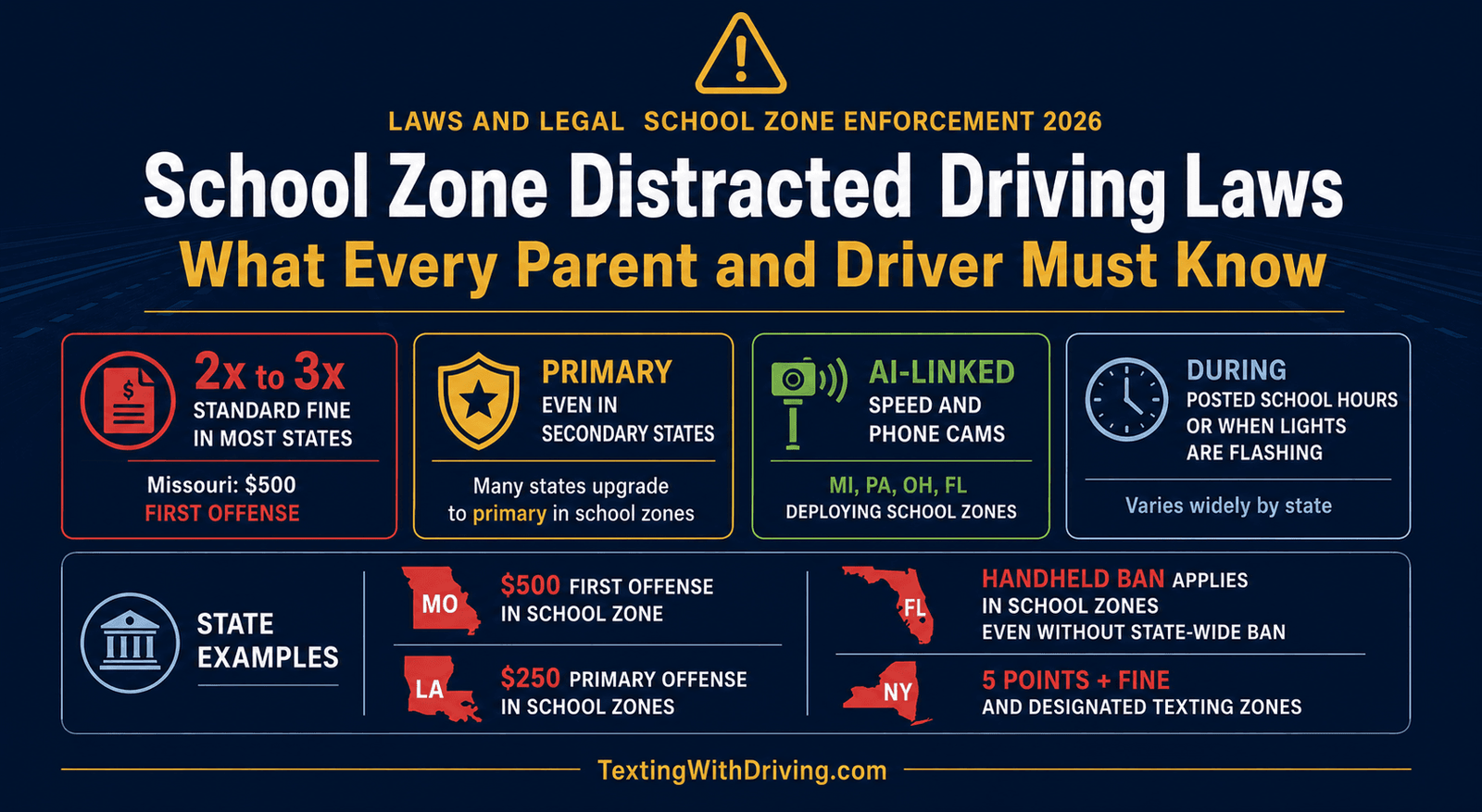
The law reflects this. Almost every state in the country treats distracted driving in school zones differently from distracted driving on open roads, with enhanced fines that are often double or triple the standard rate, upgraded enforcement that allows stops specifically for phone use even in states where that would normally require another violation, and in 2026, a growing network of automated camera enforcement that can issue citations without a police officer present.
If you are a parent who drives past a school. If you are a driver on any road that passes a school. This article covers exactly what you need to know.
What Makes School Zones Legally Different
The enhanced legal treatment of school zones in traffic law is not new. School zones have carried special legal status for decades for speed enforcement, with reduced speed limits and double-fine provisions that have been standard in most states since the 1980s. The application of this enhanced treatment to phone use and distracted driving is newer, reflecting the legislative response to phone distraction specifically.
While state distracted driving rules vary widely, they commonly restrict handheld calls, limit device use for learner’s permit or intermediate license holders, or apply enhanced enforcement in school zones and work areas. MoneyGeek
The school zone enhanced enforcement framework typically operates through two mechanisms simultaneously. First, higher fines: a violation that carries a $150 fine on an open road may carry $300 or $500 in a school zone. Second, upgraded enforcement type: some states that maintain secondary enforcement for distracted driving on open roads, meaning officers must observe another violation before initiating a stop, upgrade to primary enforcement in school zones, allowing officers to stop a driver specifically for phone use near a school.
This combination makes school zones the most legally high-risk environment for phone use while driving in any state, regardless of what the broader state law says about distracted driving.
The Fine Structure: How Much More Expensive a School Zone Violation Is
The enhanced fine framework for school zone distracted driving violations varies significantly by state, but the pattern is consistent: expect to pay substantially more than the standard violation rate.
Missouri provides one of the clearest examples of this escalation. Under Missouri’s Siddens Bening Hands-Free Law, which we covered in detail in our Missouri hands-free driving law 2026 guide, the standard first offense fine on an open road is $150. In a school zone or active construction zone, the first offense fine rises to $500. The school zone multiplier in Missouri is more than three times the standard rate.
Louisiana’s HB 519 hands-free law, covered in our Louisiana hands-free law 2025 guide, carries a standard first offense of $100. In school zones, the violation rises to $250 and becomes a primary offense even though the standard law operates as secondary enforcement. The school zone provision both increases the fine and upgrades the enforcement type simultaneously.
Distracted driving laws commonly apply enhanced enforcement in school zones. Several states apply enhanced penalties for cell phone violations in designated safety zones, and a distracted driving penalty in a school or active work zone may be doubled or tripled compared to regular roadway violations. IIHS-HLDI
Pennsylvania’s Paul Miller’s Law, which entered full citation enforcement on June 6, 2026 as we covered in our Pennsylvania Paul Miller’s Law Day 1 article, also includes enhanced penalties for school zone violations. The base fine of $50 plus court costs escalates in school and work zones, and the law’s primary offense status means officers can and do focus enforcement in zones where children are present.
For states that do not have comprehensive hands-free laws but do have school zone provisions, Florida is the clearest example. Florida does not have a statewide handheld ban for all driving conditions, but it does restrict handheld phone use specifically in school zones and active construction zones. A driver who can legally hold their phone while driving on a Florida state road faces a violation the moment they enter a designated school zone.
This Florida situation illustrates one of the most practically important points for drivers who have studied their state’s general distracted driving law but not its school zone provisions: the school zone rules may be stricter than what you know about the general law.
Primary vs. Secondary Enforcement in School Zones: The Critical Distinction
One of the most significant features of school zone distracted driving enforcement in 2026 is the enforcement type upgrade that many states apply specifically in these areas.
As we covered in our hands-free driving laws by state 2026 guide, the distinction between primary and secondary enforcement is fundamental to how distracted driving laws actually deter behavior. Primary enforcement means an officer can stop you solely for phone use, without any other violation. Secondary enforcement means the officer needs another reason to stop you first.
Missouri’s law operates as secondary enforcement on open roads in practice, but as primary enforcement in school zones. Louisiana’s law is secondary on open roads but primary in school zones. Several other states have implemented similar zone-specific upgrades.
In 2026, most states have shifted to primary enforcement for handheld and hands-free laws. In these states, officers can pull you over just for holding or using your phone while driving, even if you are stopped at a red light or have not otherwise violated traffic laws. This change is already active in states like Florida, Ohio, and Pennsylvania. CDC
The school zone primary enforcement upgrade is particularly important because of the specific driving environment. In a school zone at dismissal time, drivers are often moving slowly, stopping frequently, and focused on finding parking or their child’s position at the curb. These low-speed conditions create a sense of reduced risk that makes phone use feel more acceptable than at highway speeds. The primary enforcement provision specifically addresses this rationalization: an officer who observes a driver on their phone in a school zone can initiate a stop immediately regardless of vehicle speed or any other factor.
The Hours of Operation Question: When School Zone Laws Apply
One of the most practically confusing aspects of school zone laws is the time dimension. A school zone sign is a permanent installation. But the enhanced laws that come with it do not necessarily apply 24 hours a day, seven days a week.
The hours during which school zone provisions are active vary by state and often by the specific type of school zone designation. In most states, school zone restrictions apply during posted school hours or when flashing warning lights are active. The flashing yellow lights on school zone signs are designed specifically to indicate when the zone is legally active and the reduced speed limit and enhanced enforcement provisions apply.
Some states apply school zone provisions during all hours when children might be present, including before and after school when activities occur. Others apply them only during the standard school day window, typically 7 AM to 5 PM on school days. Still others use a year-round 24/7 approach.
The practical advice: do not assume a school zone is legally inactive because it is early morning, because school has already dismissed, or because it is summer. If you cannot see the flashing lights on the sign, the safest assumption is that the zone provisions apply until you have confirmed otherwise for your specific state.
Camera Enforcement: The 2026 Development That Changes Everything
One of the most significant developments in school zone enforcement in 2026 is the expansion of automated camera enforcement to specifically detect phone use near schools, not just speeding.
Michigan, Pennsylvania, Maryland, Ohio, Florida, and other states are actively deploying AI-linked cameras that monitor speeds in construction and school zones and issue civil violations without a police officer on site. Team Justice
AI-linked cameras in school zones represent a qualitative shift in enforcement capacity that manual policing cannot replicate. A police officer can observe phone use when they are physically present at a school zone at the right time. A fixed or mobile camera can observe and document phone use at that location continuously, around the clock, on every school day.
Automated traffic enforcement continues to expand in 2026. More states and municipalities are adopting speed cameras and red light cameras to supplement traditional policing. These systems are often placed in high-risk areas such as busy intersections, school zones, and construction corridors. While fines issued through cameras are typically lower than those issued by officers during traffic stops, they are still legally enforceable and can accumulate quickly if a driver is unaware of enforcement zones. Some jurisdictions limit the maximum fine amount, while others use repeat violations as a trigger for additional penalties. AAA Foundation for Traffic Safety
The key behavioral implication of camera enforcement is that it changes the deterrent equation for every driver passing through a school zone, not just those who happen to be observed by a present officer. When drivers know that camera enforcement is operating in a school zone, the perceived probability of being caught rises substantially. And as the research we covered in our articles on distracted driving awareness campaigns that actually worked consistently shows, perceived probability of being caught is a stronger behavioral motivator than awareness of danger.
New York has approached school zone enforcement through a different but related model. New York created designated Texting Zones along state highways, providing pull-off areas where drivers can safely stop to use their phones. The Texting Zone program operates alongside New York’s strict enforcement framework with 5 points per violation and $50 to $200 fines, offering a practical alternative for drivers who genuinely need to respond to a message while traveling.
What Florida’s Partial Law Means for School Zones
Florida’s approach to distracted driving deserves specific attention because it creates confusion for drivers who may know that Florida does not have a comprehensive statewide hands-free law but do not know about the school zone exception.
Florida bans handheld device use in school zones and active work zones as a primary offense, even though the broader state law does not impose a full handheld ban for all driving conditions. This means that a Florida driver who is legally operating their phone while driving on a state highway faces an immediate primary offense the moment they enter a school zone without disconnecting from the device.
Florida’s law applies enhanced enforcement in school zones specifically, making it one of the states where drivers face stricter rules in school zones than in the general driving environment. MoneyGeek
For Floridians who have been operating under the assumption that their state’s limited texting ban means they can hold their phone for calls, GPS management, or other purposes while driving, the school zone reality is different. In a Florida school zone, the full hands-free standard applies. Understanding this distinction is important because the Florida school zone provision is often not highlighted in general descriptions of Florida’s distracted driving law.
School Bus Considerations: A Related but Distinct Issue
While this article focuses on school zone laws, the issue of distracted driving around school buses is related and also carries specific legal provisions in most states.
36 states and DC ban all cell phone use by novice drivers, and 25 states and DC prohibit cell phone use by school bus drivers specifically. DOT
For school bus drivers, 25 states plus DC impose a complete cell phone prohibition that is stricter than what applies to standard drivers. A school bus driver in these states cannot make or receive phone calls of any kind while operating the vehicle, including hands-free calls. This restriction reflects the unique responsibility of operating a vehicle carrying children and the heightened duty of care that comes with that role.
For drivers around school buses, the legal requirements around stopping for school bus warning lights and extended stop arms are separate from but related to the distracted driving issue. A driver who misses a school bus stop arm because they were looking at their phone faces both a distracted driving violation and a school bus stop arm violation, the latter of which carries significant penalties in every state.
The Parental Dimension: Modeling in the School Zone
There is a specific and underappreciated irony in the school zone phone use data. The drivers most likely to be on their phones in school zones at dismissal time include parents driving to pick up their own children from school. The school zone violation that carries the harshest financial consequences in the state is often committed by the people who care most about the children in that zone.
The modeling research we covered in our parent’s guide to talking to your teen about phone use while driving found that teens are 14 percent more likely to text while driving when they have observed their parents doing the same. A parent who uses their phone while navigating a school zone dismissal pickup is engaging in the most legally risky driving behavior in their state while simultaneously modeling exactly the behavior they want their teen to avoid.
The school zone is the place where all of these considerations converge: the legal risk is highest, the physical danger to children is highest, and the modeling impact on teen drivers who may be watching from the sidewalk or the car window is most direct.
What Practically Changes Your School Zone Behavior
The consistent theme across all of the school zone legal provisions reviewed above is that phone-free driving standards apply most strictly in exactly the environment where children are most present and most vulnerable.
Before arriving at a school zone: set your GPS destination, activate Driving Focus or Android driving mode, and place the phone out of reach. Our Do Not Disturb while driving setup guide covers the two-minute configuration for both platforms that makes this automatic every time your car moves.
During dismissal pickup: your vehicle may be stationary while you wait in a pickup line. In many states, stationary vehicles in a school zone that are on a public road are still subject to the school zone provisions because operating a vehicle includes being in control of it on a public road regardless of whether it is moving. Check your specific state’s definition of operating to understand your school zone obligations while in a stationary pickup line.
For employers whose employees drive through school zones: include school zone compliance as a specific element of your workplace distracted driving policy. The enhanced fines and primary enforcement in school zones create elevated liability exposure that a general phone-free driving policy should specifically address. Our employee distracted driving policy guide covers the complete framework.
Sources Used in This Article
All links verified working before publication.
Road Law Guide: Distracted Driving Laws by State 2026 — School zone enhanced fine provisions across states, February 2026
Road Law Guide: Hands-Free Law by State 2026 — Colorado, Pennsylvania, Iowa, Louisiana, South Carolina legislation details, February 2026
Pacific Driver Education: New Driving Laws for 2026 — AI camera enforcement in school zones, primary enforcement expansion, February 2026
CarZing: What Drivers Need to Know About New US Traffic Laws in 2026 — Automated enforcement camera expansion in school zones, January 2026
ABC17News: Big Changes in 2026 Traffic Laws — Northeast school zone fine increases, January 2026
World Population Review: Texting and Driving Legality by State 2026 — Enhanced school zone provisions by state
DK Law: Distracted Driving Laws California 2026 — New York Texting Zones program details, February 2026
GHSA: Distracted Driving State Laws — National state law reference including school bus provisions, October 2025
NSC Injury Facts: Distracted Driving — School bus driver cell phone ban statistics
NHTSA: Distracted Driving — National data and enforcement context
TextingWithDriving.com is professionally built and maintained to ensure accurate, accessible safety information reaches every driver who needs it. Website development and ongoing support is handled by Budgetic, a digital agency specializing in purpose-driven WordPress websites.

About Texting With Driving
TextingWithDriving.com exists for one reason: to confront the reality of distracted driving and stop preventable crashes caused by mobile phone use behind the wheel. Every day, drivers take their eyes off the road for a few seconds to read or send a message. Those few seconds are enough to cause life-altering consequences. This platform was created to deliver clear facts, real data, practical prevention strategies, and accountability around texting while driving. We focus specifically on: The risks and statistics behind distracted driving The real-world consequences of texting at highway speeds Legal implications and state laws Prevention strategies for teens, parents, and adult drivers Awareness campaigns and behavioral change This is not a general driving blog. It is a focused awareness initiative built around one critical issue: phone distraction behind the wheel. Our content is direct, research-driven, and practical. We prioritize accuracy over opinion and education over sensationalism. The goal is simple — reduce distracted driving incidents by increasing awareness and responsibility. If one article causes one driver to put their phone down, the mission is working. For inquiries or partnerships, contact: privacy@textingwithdriving.com
View all posts by Texting With Driving