

Distracted Driving Accident Statistics: Crashes, Injuries and Costs by the Numbers

Distracted Driving Accident Statistics: Crashes, Injuries and Costs by the Numbers
Every year, millions of Americans drive past the aftermath of a crash on the side of the road and wonder what happened. Some of those crashes involved weather, mechanical failure, or unavoidable hazards. But the data tells a different story about a large and measurable proportion of them.
Distraction is a factor in roughly one in eight injury crashes and one in eight police-reported crashes in the United States in the most recent complete data. Not occasionally. Not in rare circumstances. In approximately 12 to 13 percent of every police-reported crash on American roads.
This article presents the complete statistical picture of what distracted driving produces in crashes, injuries, deaths, and financial costs, drawn from NHTSA’s most current CrashStats publications, the National Safety Council’s Injury Facts database, and Cambridge Mobile Telematics. Every figure is sourced, every source is linked, and every claim is grounded in verified data rather than estimates or advocacy organization projections.
The 2024 Death Toll: The Headline Figure
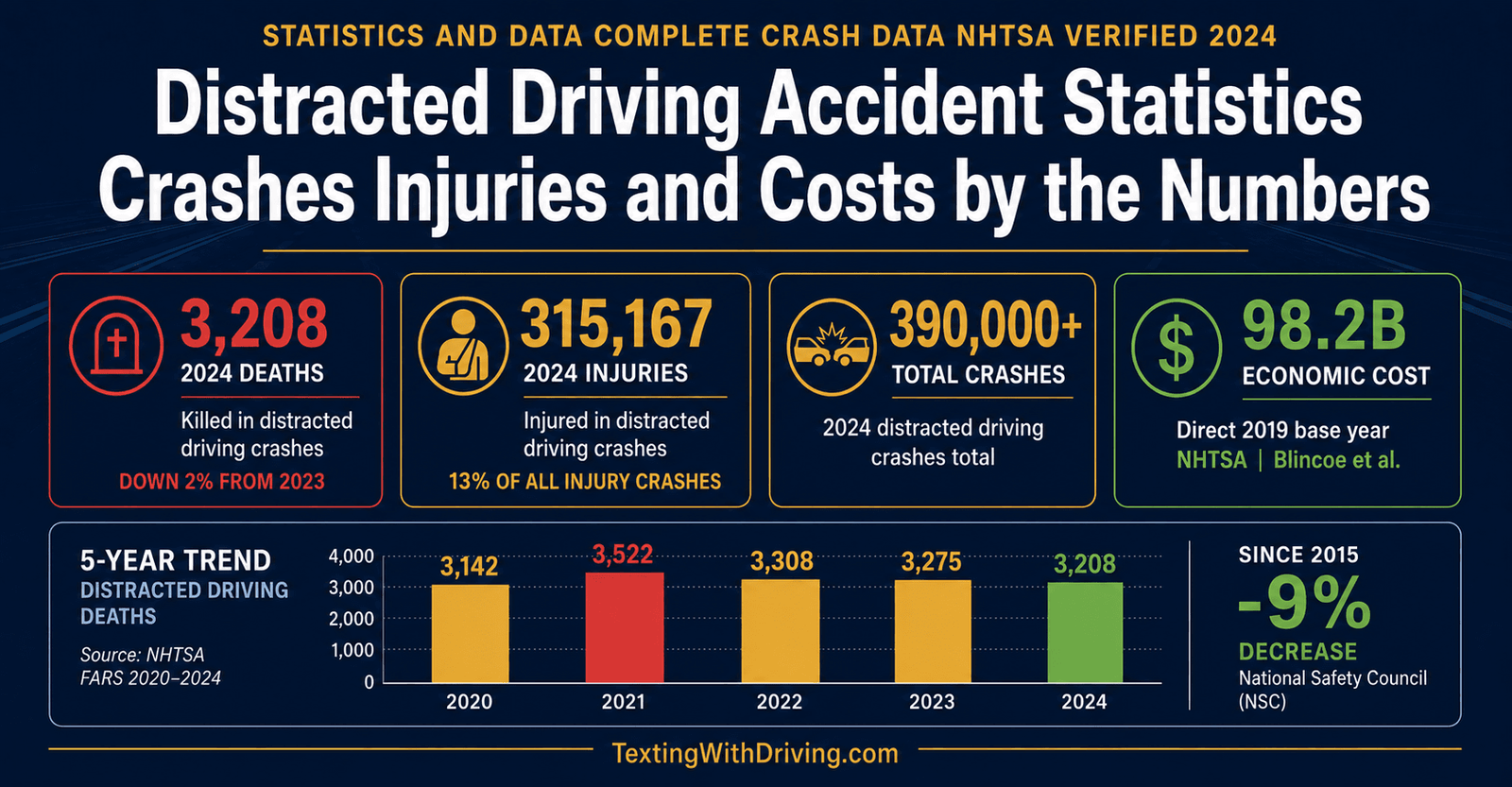
In 2024, 3,208 people were killed in motor vehicle crashes involving distracted drivers, according to NHTSA, which leads the national effort to save lives by preventing this dangerous behavior. CDC
3,208 deaths. That works out to approximately 267 per month, 62 per week, and just under 9 per day every day of the year including holidays, weekends, and the quiet Tuesday afternoons that never make the news.
The total number of fatal distraction-affected crashes decreased 2 percent in 2024 compared to 2023. Distraction-affected fatal crashes have also decreased nearly 9 percent since 2015, according to NSC citing NHTSA Driver Electronic Device Use data. DOT
A 2 percent year-over-year decline and a 9 percent decline since 2015 are genuine improvements that deserve acknowledgment. But they also require context. The 2024 figure of 3,208 represents a very slow decline from the peak year of 3,522 in 2021, a post-pandemic spike driven by reduced traffic volume producing higher-speed roads and more emboldened phone use among the drivers who remained. The pace of improvement from that 2021 peak works out to roughly 100 deaths per year of reduction, or about 30 seconds per day of improvement. At that rate, meaningfully eliminating distracted driving deaths would take generations.
The Injury Data: The Number That Never Makes Headlines
Deaths receive the most media attention. Injuries are where the true scale of the problem lives.
Eight percent of fatal crashes, an estimated 13 percent of injury crashes, and an estimated 12 percent of all police-reported motor vehicle traffic crashes in 2024 were reported as distraction-affected, according to NHTSA’s 2024 CrashStats publication DOT HS 813 790. Insurify
In 2024, there were an estimated 315,167 injuries in distraction-affected crashes. That figure represents 13 percent of all injury crashes. For every person killed in a distracted driving crash in 2024, approximately 98 people were injured. The death count gets the attention. The injury count is nearly 100 times larger.
What those injuries represent in human terms varies enormously. Some are minor: soft tissue injuries, cuts from broken glass, bruising from airbag deployment. Others are catastrophic: spinal cord injuries producing permanent paralysis, traumatic brain injuries with lifelong cognitive consequences, amputations, burns, and disfigurement from severe crashes. The 315,167 figure does not distinguish between these outcomes. Every one of them is a person whose life was disrupted or permanently altered by a preventable event.
In 2023, the most recent year with fully published breakdown data, there were 324,819 people injured in distracted driving crashes. The 2024 figure of 315,167 represents a modest improvement, consistent with the overall trend of slow but real progress.
The Total Crash Count: Beyond Deaths and Injuries
The deaths and injuries represent the most severe outcomes of distracted driving crashes. But the total number of distracted driving crashes is substantially larger than the count of those producing deaths or injuries.
In 2024, distracted driving caused over 390,000 crashes, with a significant percentage of those resulting in injuries. These crashes often involve rear-end collisions, sideswipes, or accidents where drivers leave their lanes. Universal Law Group
390,000 total distracted driving crashes in 2024. That means roughly 71 percent of distracted driving crashes in 2024, approximately 275,000 events, were property-damage-only crashes that produced no recorded injuries. These are the fender benders, the parking lot collisions, the rear-end nudges at low speed that produce insurance claims and vehicle damage but no hospital admissions.
They are not without consequence. Property-damage-only crashes produce repair costs, insurance rate increases, vehicle downtime, and the secondary congestion effects of blocked lanes during response and cleanup. They also represent the near-miss events from which serious crashes are only separated by a few miles per hour, a different angle of impact, or the presence of a pedestrian who happened not to be there.
The ratio of property-damage crashes to injury crashes to fatal crashes in distracted driving data is broadly consistent with the overall crash population pattern: for every fatal crash, there are roughly five to six injury crashes and many more property-damage-only crashes. The 390,000 total distracted driving crashes in 2024 against the 3,208 deaths suggests a fatality rate per distracted crash of approximately 0.8 percent, meaning roughly 99 percent of distracted driving crashes do not kill anyone. The statistical survivability of most distracted driving events is partly why drivers underestimate the cumulative risk of the behavior.
The Crash Type Breakdown: What Kind of Crashes Distraction Produces
Understanding what types of crashes distracted driving specifically produces helps explain both the danger and the injury pattern.
Distracted driving crashes often involve rear-end collisions, sideswipes, or accidents where drivers leave their lanes. Universal Law Group
These three crash types are precisely what you would predict from the physics of distracted driving. A driver who looks away from the road for five seconds at highway speed, covering a full football field blind, has no ability to respond to the vehicle ahead slowing or stopping. Rear-end collision is the mechanical outcome. A driver whose attention has drifted cognitively while eyes remain forward may fail to maintain lane position consistently, producing lane departure crashes and sideswipes. These are not random crash patterns. They are the predictable physical outcomes of specific attention failures.
Rear-end crashes are the most common crash type in the United States overall, and distracted driving is one of the leading behavioral factors in them. When researchers analyze the pre-crash behavior data from naturalistic driving studies, phone use appears in a disproportionate share of the rear-end and lane departure crash categories.
Year-by-Year: The Five-Year Fatality Trend
The five-year fatal crash trend from 2020 through 2024 tells the story of where the problem has been and where it is heading.
2020: 3,142 deaths. The first pandemic year produced a paradox: reduced traffic volume led to a lower absolute death count from distracted driving even as the driving that did occur was riskier on average, with higher speeds on emptier roads and documented increases in phone use per mile driven according to CMT data.
2021: 3,522 deaths. The post-pandemic traffic surge combined with entrenched pandemic phone habits produced the highest distracted driving death toll in several years. Traffic volume recovered faster than safety behavior.
2022: 3,308 deaths. A 6 percent decline from the 2021 peak as traffic patterns normalized and the first wave of hands-free legislation in states like Ohio began producing behavioral effects.
2023: 3,275 deaths. A further modest decline, consistent with the slow but real improvement trend. States that enacted hands-free laws in 2022 and 2023 showed measurable phone distraction reductions in CMT telematics data.
2024: 3,208 deaths. A 2 percent further decline according to NSC citing NHTSA data. The ninth consecutive year of a distracted driving death toll above 3,000. Progress is real. The pace is inadequate.
The 9 percent total decline since 2015 noted by NSC is the long-run trend line. Nine percent over nine years represents less than 1 percent per year of improvement on average. Against a death toll of over 3,000 per year, that pace means approximately 27,000 people have died from distracted driving during those nine years of improvement.
The Underreporting Gap: What the Official Numbers Do Not Capture
Experts caution that distracted driving fatalities are likely significantly underreported. A 2023 NHTSA study found that when accounting for unreported incidents, distraction may have been involved in as many as 29 percent of all crashes in 2019, resulting in over 10,500 fatalities, more than three times the officially reported numbers. AAA Foundation for Traffic Safety
Three times the officially recorded number. The gap between 3,208 officially attributed deaths and a research-estimated 10,500 distraction-involved deaths in a comparable year reflects the fundamental challenge of crash scene distraction documentation.
Alcohol impairment can be measured with a breathalyzer at the scene in seconds. Phone distraction cannot. Unless a driver admits to using their phone, a witness observed it, or investigators subsequently subpoena phone records, the crash report attributes the crash to another cause. Ran a red light. Failed to maintain lane. Rear-ended a stopped vehicle. The driver was distracted when all of these happened, but the distraction is not recorded.
NHTSA is actively working to improve crash data collection methodology to address this gap. The Textalyzer technology we covered in our dedicated article on the device that could prove you were texting when you crashed exists specifically to close this evidence gap at the crash scene, though no US state has yet enacted legislation authorizing its use.
The Cell Phone Crash Numbers: The Most Specific Subset
Within the broader distracted driving crash data, cell phone-specific crashes are separately tracked where police reports document that specific cause.
In 2024, cellphones were involved in 437 fatal crashes representing 14 percent of all distraction-affected fatal crashes, with police reports noting that at least one driver was engaged in some form of cell phone activity at the time. This includes talking, listening, and other cellphone activity beyond texting specifically.
437 cell phone-specific deaths. 3,208 total distracted driving deaths. The cell phone figure is the best-documented subset of the total, but it is also the most severely undercounted for the same reason the total figure is undercounted. It represents only the crashes where cell phone use was specifically documented in the police report, which requires direct evidence that most crash investigations never produce.
The Economic Cost: What the Crashes Actually Cost
Every crash has a cost that extends far beyond the hospital bill of the most seriously injured person.
The estimated economic cost of all motor vehicle traffic crashes in the United States in 2019 was $340 billion, of which $98 billion resulted from distracted-driving traffic crashes. When quality-of-life valuations are considered, the total value of societal harm from motor vehicle traffic crashes in the United States in 2019 was an estimated $1.37 trillion, of which $395 billion resulted from distracted-driving crashes. Trafficsafetymarketing
$98.2 billion in direct economic costs. $395 billion in total societal harm including quality-of-life valuations. These figures from NHTSA’s Blincoe et al. 2023 report use 2019 as the base year because that is the most recent year for which the full cost analysis has been completed.
The $98.2 billion encompasses medical costs, rehabilitation, lost productivity, property damage, legal and court costs, emergency services, insurance administration, and traffic congestion costs from crash-related lane closures. Every category is fully documented in the underlying Blincoe analysis. The $395 billion adds the economic valuation of the quality-of-life losses from death and serious injury, using the same methodology applied in federal regulatory cost-benefit analyses.
For the driver who caused the crash personally, the economic exposure is more immediate: medical liability, potential criminal charges, civil lawsuit exposure that can reach into the millions as we covered in our article on whether you can be sued for texting while driving, and the insurance impact that averages a 43 percent rate increase for three to five years following a distracted driving citation as we covered in our article on car insurance after a distracted driving ticket.
The Progress That $4.2 Billion Represents
The consistent improvement trend in distracted driving statistics over recent years is real and worth quantifying specifically.
According to Cambridge Mobile Telematics, distracted driving dropped 8.6 percent in 2024, marking the second consecutive year of improvement. This reduction is estimated to have prevented approximately 105,000 crashes, 59,000 injuries, 480 fatalities, and $4.2 billion in economic damages. AAA Foundation for Traffic Safety
105,000 crashes that did not happen. 59,000 injuries that were not sustained. 480 people who are alive today. $4.2 billion in economic damage that was not incurred. That is what the 8.6 percent behavioral improvement documented by CMT’s telematics data produced in 2024 relative to the behavioral baseline.
The improvement was not evenly distributed. States that enacted hands-free laws in 2023 and 2024, including Ohio, Michigan, Missouri, and Alabama, showed the strongest behavioral improvement in CMT data. Ohio documented 15,400 fewer crashes in the first year of its hands-free law. Michigan showed an 18.7 percent reduction in distracted driving post-legislation. The legislative improvements we have covered throughout this series are the primary driver of the national improvement trend.
The Crash Pattern During the Day and Week
The timing of distracted driving crashes is not random. It follows the patterns of human behavior and road use that create specific high-risk windows.
As we covered in our dedicated article on distracted driving at night, phone use while driving peaks between 6 PM and 11 PM according to CMT data, aligning with the window when social media engagement is highest and evening commute traffic is combined with reduced visibility. Fatal crashes involving teen drivers peak between 9 PM and midnight. Weekend evenings produce the highest concentration of all risk factors simultaneously: fatigue, social activity, peer pressure, phone engagement, and reduced daylight.
The geographical distribution of crashes is also non-uniform. Rural highways produce higher-severity crashes due to higher speeds, while urban and suburban roads produce higher crash frequency due to traffic density and intersection complexity. Distracted driving intersects differently with each environment: rural highway crashes are more likely to be fatal when they occur because crash speeds are higher, while urban distracted driving crashes are more frequent but often lower-severity due to slower traffic speeds.
What These Numbers Mean for Individual Drivers
The aggregate statistics in this article describe a national pattern. But every statistic represents a specific event involving specific people.
The 3,208 deaths in 2024 are 3,208 individual tragedies with specific names, specific families, and specific moments when a driver looked at their phone and a life ended. The 315,167 injuries are 315,167 people who went to emergency rooms, rehabilitation centers, and long-term care facilities. The 390,000 crashes are 390,000 insurance claims, repair bills, and disrupted journeys.
For any individual driver, the statistic that matters most is not the national total. It is the probability that their own driving behavior will eventually produce one of these outcomes. That probability is not zero. Every time a driver reaches for their phone while operating a vehicle on a public road, they are increasing the probability of becoming one of these numbers.
The prevention strategies that reduce that probability for individual drivers are covered throughout this site. For the specific behavioral changes supported by research, our article on 10 proven ways to stop texting while driving for good covers the full framework. For the technology tools that make prevention automatic, our guide to the best apps to block texting while driving covers every option from free built-in features to enterprise solutions.
Sources Used in This Article
All links verified working before publication.
NHTSA: Distracted Driving Dangers and Statistics — 3,208 deaths in 2024, official NHTSA page
NHTSA CrashStats: Distracted Driving in 2024 — DOT HS 813 790, complete 2024 crash breakdown
NHTSA CrashStats: Distracted Driving in 2023 — DOT HS 813 703, 2023 data with economic cost references
NHTSA CrashStats: Distracted Driving in 2022 — DOT HS 813 559, five-year trend context
NSC Injury Facts: Distracted Driving — 2 percent year-over-year decline, 9 percent since 2015, updated 2025
Defensive Drivers Institute: Distracted Driving Statistics and Facts for 2025 — 390,000 crash count, 29 percent underreported estimate, January 2026
Defensive Drivers Institute: Distracted Driving Statistics and Facts for 2024 — Crash type breakdown, rear-end and sideswipe patterns, January 2025
Cambridge Mobile Telematics: Distracted Driving Fell 8.6 Percent in 2024 — 105,000 prevented crashes, $4.2 billion economic damage prevented, April 2025
The Zebra: Distracted Driving Statistics 2026 — Survey data and NHTSA cross-reference, January 2026
EndDD.org: Research and Statistics — 400,000 crash estimate and research library
TextingWithDriving.com is professionally built and maintained to ensure accurate, accessible safety information reaches every driver who needs it. Website development and ongoing support is handled by Budgetic, a digital agency specializing in purpose-driven WordPress websites.

About Texting With Driving
TextingWithDriving.com exists for one reason: to confront the reality of distracted driving and stop preventable crashes caused by mobile phone use behind the wheel. Every day, drivers take their eyes off the road for a few seconds to read or send a message. Those few seconds are enough to cause life-altering consequences. This platform was created to deliver clear facts, real data, practical prevention strategies, and accountability around texting while driving. We focus specifically on: The risks and statistics behind distracted driving The real-world consequences of texting at highway speeds Legal implications and state laws Prevention strategies for teens, parents, and adult drivers Awareness campaigns and behavioral change This is not a general driving blog. It is a focused awareness initiative built around one critical issue: phone distraction behind the wheel. Our content is direct, research-driven, and practical. We prioritize accuracy over opinion and education over sensationalism. The goal is simple — reduce distracted driving incidents by increasing awareness and responsibility. If one article causes one driver to put their phone down, the mission is working. For inquiries or partnerships, contact: privacy@textingwithdriving.com
View all posts by Texting With Driving