

Distracted Driving and Senior Drivers 2026: LexisNexis 73% Spike, Brain Science and What Families Must Know

Distracted Driving and Senior Drivers 2026: LexisNexis 73% Spike, Brain Science and What Families Must Know
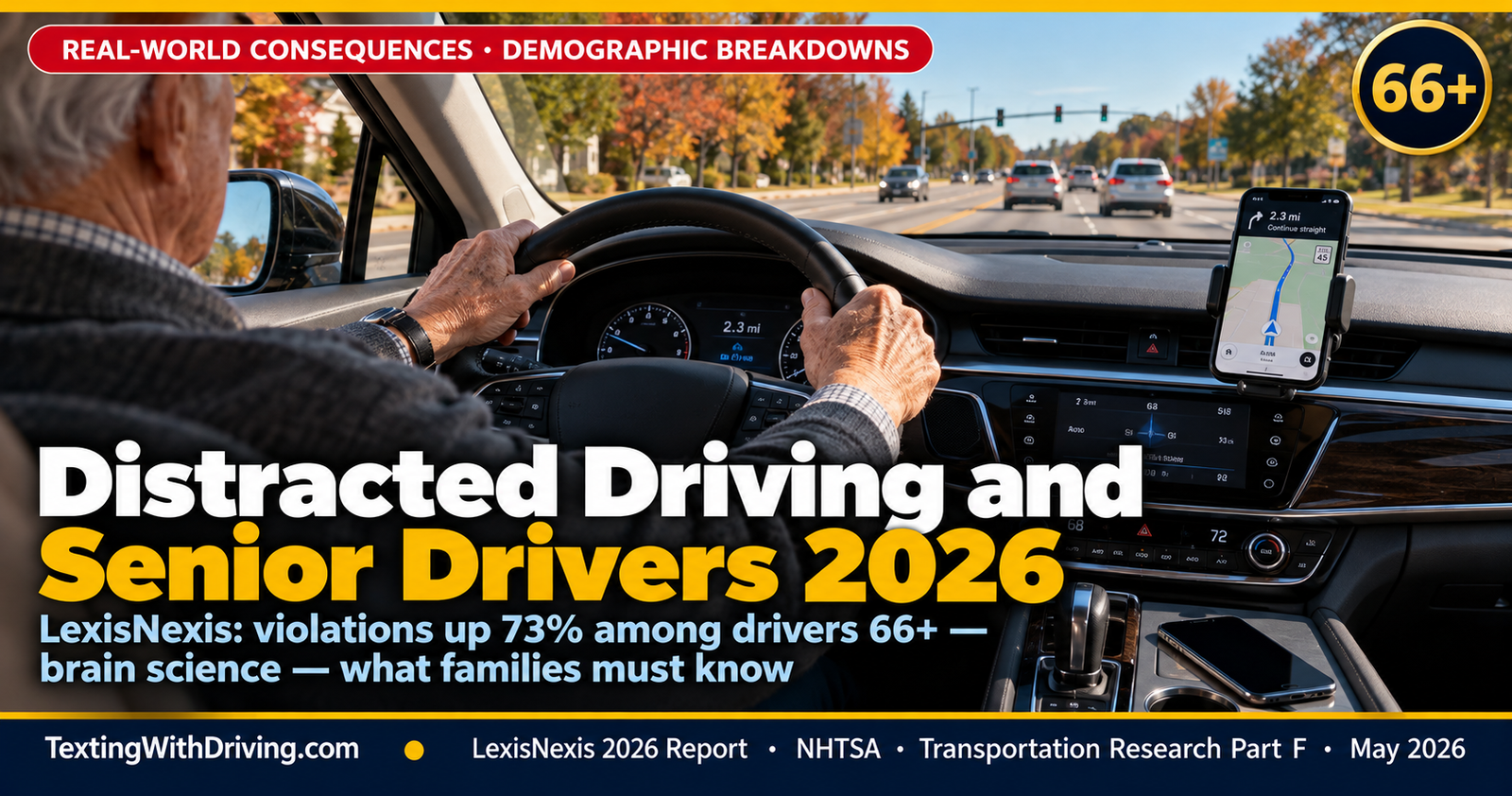
Distracted driving senior drivers 2026 is defined by a data finding that overturns one of the most persistent assumptions in traffic safety: that distracted driving is primarily a young driver problem. The 2026 LexisNexis U.S. Auto Insurance Trends Report — released May 19, 2026 — found that distracted driving violations among drivers aged 66 and older increased 73 percent since 2022, the steepest increase of any age group and a figure that substantially outpaces the 48 percent increase seen among drivers aged 16 to 25 during the same period.
73 percent. Among the age group that insurance actuaries and traffic safety researchers have historically treated as lower-risk and more safety-conscious than younger drivers — the drivers who grew up before smartphones existed, who are retired or semi-retired and therefore not under the work-schedule pressure associated with distracted driving — violations have increased at the fastest rate in the country.
The LexisNexis finding is not an outlier. The same company’s 2025 data showed drivers aged 66 to 90 with an 80.3 percent year-over-year increase in distracted driving violations — already the highest of any age group before the 2026 data extended the trend. The causes, the mechanisms, and the family response to this data are what this guide addresses.
This guide covers the complete distracted driving senior drivers 2026 picture: what the LexisNexis data shows and why it matters, the specific brain science of aging and distraction that explains older drivers’ vulnerability, the real-world crash consequences, the family conversation framework, and what every senior driver and their family must know.
The LexisNexis Data: What 73% Actually Means
Distracted driving senior drivers 2026 begins with the source: the 2026 LexisNexis U.S. Auto Insurance Trends Report, released May 19, 2026, drawing on insurance violation records and claims data across the US driver population.
The report’s headline finding: distracted driving violations are up 57 percent since 2022 across all age groups. The critical age-specific breakdown:
Drivers 66 and older: 73 percent increase — the highest of any age group.
Drivers 36-45: 70 percent or more increase.
Drivers 16-25: 48 percent increase — still significant, but notably lower than the senior driver surge.
The data’s most important interpretive fact: the number of miles driven increased by only 2 percent over the same period. More driving does not explain the violation increase. Driver behavior changed — not driving frequency. Distracted driving violations are increasing because drivers at every age, including drivers 66 and older, are more likely to use their phones while driving than they were four years ago.
LexisNexis Risk Solutions SVP Jeff Batiste’s assessment was direct: age bands that have historically carried more favorable factors may no longer be as benign if mid-life and senior drivers are increasingly engaging in distracted behavior. The actuarial reassessment that the data demands — that 66-plus drivers can no longer be assumed to be lower-risk — has significant implications for insurance pricing, enforcement targeting, and family safety conversations.
The financial consequence is already visible. The share of total auto insurance claim dollars attributable to bodily injury rose from less than 20 percent in 2022 to more than 26 percent in 2025. As distracted driving increases and the severity of the crashes it produces drives bodily injury costs, the premium increases that LexisNexis data drives are not abstract — they arrive as rate increases for every driver in states where distracted driving’s bodily injury cost is accelerating.
The 2025 LexisNexis data adds the year-over-year context: drivers aged 66 to 90 saw the largest single-year increase of distracted driving violations at 80.3 percent year-over-year in 2024. This was not a sudden 2025 spike — it was the continuation of a multi-year trend already visible in LexisNexis’s 2025 report. The 2026 data’s 73 percent since-2022 figure represents a sustained structural shift in senior driver behavior, not a temporary anomaly.
Why Senior Drivers Are Increasingly Distracted: The Technology Explanation
Distracted driving senior drivers 2026 has a specific behavioral cause that the LexisNexis researchers identify: technology adoption among older Americans has accelerated dramatically since 2020, and the same smartphone engagement patterns that younger drivers developed earlier are now being adopted by older drivers without the same institutional reinforcement of distracted driving awareness.
Texting remains a distraction but drivers are also using social media and other apps while driving. In-vehicle interfaces can also pull drivers’ attention away from the road. The LexisNexis analysis identifies three distinct distraction channels that are driving the violation increase: traditional texting, expanded social media and app use, and the complexity of in-vehicle infotainment systems.
For the 66-plus demographic specifically:
Smartphone adoption acceleration. Pew Research data shows that smartphone ownership among adults 65 and older increased from 46 percent in 2017 to 61 percent in 2021 and has continued rising. The COVID-19 pandemic’s social isolation accelerated senior smartphone adoption for video calls, social media connections, and delivery app use — creating a cohort that is now smartphone-dependent and brings those habits into the vehicle.
WhatsApp and family group communication. The specific communication pattern that many older Americans have adopted — constant family group message threads on WhatsApp, iMessage, or Facebook Messenger — creates the always-on message-checking impulse that produces distracted driving. Checking whether a grandchild’s school play went well, responding to a family group vacation planning thread, or sharing a photo from a lunch outing are the specific interactions that produce the same phone-in-hand violation that a 22-year-old generates while texting a friend.
Navigation app dependency. Older drivers who use smartphone GPS navigation — which has largely replaced standalone GPS devices that mounted to the windshield — are more likely to pick up the phone to zoom in on the map, search for a destination address, or re-route after a missed turn. These navigation-related interactions produce the handheld device use that the texting ban and hands-free laws target.
In-vehicle technology complexity. The Frontiers in Psychology research on older drivers and in-vehicle interface systems found that older drivers took longer to complete tasks, were slower to react to stimuli, and reported higher task demand when interacting with in-vehicle systems. Counterintuitively, the voice-based commands that hands-free systems require can produce higher cognitive demand for older drivers than for younger ones — age-related differences in distraction from voice commands more than doubled compared to baseline reaction time differences when participants used voice-based systems to select music or dial a phone number.
The Brain Science: Why Aging Amplifies Distraction’s Risk
Distracted driving senior drivers 2026 has a specific neurological explanation that makes the 73 percent violation increase more dangerous than a comparable percentage increase in younger age groups.
The 2026 Transportation Research Part F study — published April 2026, covering 51 older adults (mean age 69.5 years) compared to 50 younger adults (mean age 33.4 years) — found that older adults exhibited significantly longer braking times than younger adults (p=0.046). The study also found that cognitive distraction reduced speed in older adults, suggesting a compensatory driving strategy.
This compensatory strategy finding is significant: older drivers instinctively reduce speed when cognitively loaded — a self-protective behavioral response that partially mitigates the reaction time impact of distraction. But the compensatory strategy has limits. A driver who has slowed to 20 mph in response to sensing cognitive overload but is simultaneously holding their phone for a navigation query is still creating the manual and visual distraction that speed reduction cannot address.
The age-related cognitive changes that underpin older drivers’ greater vulnerability to distraction:
Generalized slowing. Cognitive neuroscience has long established that processing speed declines with age — a phenomenon researchers call generalized slowing. The time required to perceive a hazard, identify it as requiring a response, and execute the appropriate motor action increases throughout the adult lifespan. A 70-year-old driver’s baseline reaction time to a braking event is measurably longer than a 35-year-old’s — independent of any distraction.
Reduced divided attention capacity. Older adults have greater difficulty in dividing attention between simultaneous tasks than younger adults. Driving already requires divided attention — monitoring traffic, managing speed, scanning for hazards, and interpreting road geometry simultaneously. Adding a phone interaction to this existing attention demand creates a more severe division than the same interaction produces for a younger driver with greater divided attention capacity.
Vulnerability to compounding impairment. The research on brain pathologies and distracted driving found that mobile phone use had a statistically significant negative effect on both reaction time and accident probability, especially in Alzheimer’s participants — and that AD and PD drivers had the longest reaction times among the study participants. For older drivers with early or mild cognitive impairment — a condition that many drivers in the 66-plus age group may have without formal diagnosis — the distraction of phone use is applied to a cognitive substrate that is already reduced from baseline.
Visual field narrowing. Age-related changes in vision — reduced contrast sensitivity, narrowed useful field of view, slower dark adaptation — reduce the detection distance and accuracy that aging drivers can achieve even with full attention. Adding the visual distraction of looking at a phone reduces already-reduced visual attention to a combined level that makes hazard detection at distance essentially impossible.
The compound effect: a 70-year-old driver with age-normal processing speed reduction, age-normal divided attention reduction, and age-normal visual field changes who is simultaneously looking at their phone for 2 seconds has a failure-to-detect probability for a sudden hazard that is substantially higher than a 30-year-old distracted driver in the same scenario — because the baseline cognitive capacity that phone distraction further reduces is already operating at a lower level.
Real-World Consequences: Crashes, Insurance, and the Family Impact
Distracted driving senior drivers 2026 produces real-world consequences that extend beyond the violation record.
The bodily injury cost increase — from less than 20 percent of all auto insurance claims in 2022 to more than 26 percent in 2025 — is the aggregate financial expression of the crash severity that increased distracted driving across all age groups is producing. Distracted driving kills an average of 9 people per day nationally, according to the National Safety Council.
For the senior driver specifically, a crash caused by distracted driving carries consequences beyond the physical injury:
License implications. A crash or citation record that raises concerns about driving fitness can trigger a driving evaluation requirement in many states — the DMV medical review process that can result in license restriction or revocation. For many older Americans, losing driving privileges means losing independence — the ability to reach medical appointments, maintain social connections, and participate in community activities independently.
Insurance rate consequences. As documented in our how distracted driving affects car insurance 2026 article, a distracted driving citation increases annual insurance premiums by an average of $226 per year (Zebra study) for a three-year surcharge period. For a senior driver on a fixed income, a $678 three-year surcharge from a single citation is a significant financial burden — and the irony is that the LexisNexis data showing 66-plus drivers as the fastest-growing violation category will ultimately translate into premium rate increases for this demographic.
Family relationship stress. A senior driver’s distracted driving citation or crash — especially if it causes injury to another person — creates the difficult family conversation that most adult children have been avoiding. The moment a citation arrives is often the trigger for the larger conversation about driving safety, driving limitations, and eventually driving cessation that many families navigate with significant emotional difficulty.
Virginia’s own data documented the 92 percent increase in pedestrian deaths among drivers aged 51 and older between 2018 and 2019 — a state-specific expression of the national trend that the LexisNexis data confirms.
What Families Must Know: Starting the Conversation
Distracted driving senior drivers 2026 requires adult children and family members to approach the conversation about senior distracted driving with the same directness and care that the data demands.
The conversation challenge is specific: raising concerns about an older parent’s phone use while driving without triggering the defensive response that any implication of diminished driving ability produces. The LexisNexis data provides a factual, non-accusatory entry point: this is happening at a 73 percent rate increase across the entire 66-plus demographic — it is not a personal failing but a behavioral trend that the data shows is affecting drivers of this generation specifically.
Start with the technology, not the driving. Framing the conversation around smartphone habits rather than driving ability reduces the defensive response. A conversation that begins with “the LexisNexis report shows that drivers your age are the fastest-growing group for distracted driving violations” is received differently than one that begins with “I’m worried about your driving.” The data provides the external anchor.
Offer the hands-free setup, not just the advice. As documented in our how to talk to an older parent about distracted driving article, the most effective family intervention is a practical one. Sit with the older parent, set up Driving Focus or Android Do Not Disturb on their phone, pair their Bluetooth in their car, and configure their navigation app to mount and speak through the car speakers. Removing the technical barrier removes the most common reason for picking up the phone.
Use the insurance framing for financially conscious seniors. For an older driver who is on a fixed income and price-sensitive about insurance — which the LexisNexis data shows is the majority of the senior driver demographic — the financial consequence of a citation is a concrete deterrent. A $100-$125 fine plus a $226/year insurance increase for three years is a $775-$800 real cost from a single phone interaction. That is real money for a senior on Social Security.
Recognize the compensatory strategy as a positive sign. The Transportation Research Part F study’s finding that older drivers reduce speed when cognitively loaded suggests that many senior drivers are already self-regulating their distraction risk. A senior driver who instinctively slows down when they feel overloaded is demonstrating the driving awareness that hands-free technology reinforces — the setup that removes the phone from the distraction equation allows the older driver’s natural compensatory strategy to work without the device interaction that creates the violation.
What Senior Drivers Must Do
Distracted driving senior drivers 2026 requires specific behavioral and technology changes from drivers in the 66-plus age group — not as an admission of diminished capacity but as the adoption of the same hands-free standard that is becoming the legal and behavioral norm for drivers of every age.
Set up Driving Focus or Android DND once, correctly, permanently. The most effective single intervention for senior distracted driving is a properly configured automatic Driving Focus mode — one that activates when the vehicle is moving and silences all notifications, texts, and calls without requiring the driver to actively manage the phone. A grandchild who sends a message during the drive will receive an automatic reply that the grandparent is driving. This removes the social obligation to respond that often drives senior phone checking.
Mount the phone at eye level before driving, navigation on. The navigation-related phone pickup — reaching for the phone to check the map — is eliminated by a mounted phone with navigation visible at eye level. A $25 dashboard mount and a properly configured Google Maps or Waze session started before the car moves is the complete solution to navigation-related phone handling.
Tell family members about the hands-free setup. The family group message thread that generates the phone-checking impulse is managed by telling family members: “I use Driving Focus when I drive now — I will see your message when I arrive.” The social context for checking messages during a drive is removed when the people sending those messages know that the driver will not see them until parked.
Schedule the driving evaluation conversation proactively. Senior drivers who proactively engage with driving safety — taking a refresher course, scheduling a voluntary driving evaluation, or using an AAA senior driver self-assessment tool — are managing their own driving fitness in the way that maintains independence longer. Waiting until a citation or crash forces the conversation means having that conversation in the worst possible context.
For the complete national distracted driving statistics that contextualize the senior driver data, our distracted driving statistics 2026 covers the full picture. For the family conversation framework on talking to an older parent about distracted driving, our how to talk to an older parent about distracted driving article covers the complete approach. For the insurance rate increase consequences that the LexisNexis data predicts for the senior driver demographic, our how distracted driving affects car insurance 2026 article covers the complete rate impact picture. And for the technology setup that makes hands-free automatic for every senior driver on every drive, our hands-free while driving complete setup guide covers iPhone, Android, Bluetooth, and CarPlay.
Sources Used in This Article
All links verified working before publication.
LexisNexis Risk Solutions Press Room: 2026 U.S. Auto Insurance Trends Report May 19 2026 — Distracted driving violations up 57% since 2022, drivers 66+ up 73%, drivers 36-45 up 70%+, miles driven only 2% increase, behavior not mileage cause, May 19 2026
Insurance Business Magazine: LexisNexis Flags Surge Distracted Driving BI Costs — Jeff Batiste SVP age bands historically favorable no longer benign quote, steepest growth older cohorts 73% for 66+, bodily injury from less than 20% to more than 26% of claims dollars 2022-2025
RateChaser: LexisNexis 2026 Auto Insurance Trends Distracted Driving Bodily Injury — 57% violations up since 2022, 2% miles driven increase, behavior cause confirmed, 73% for 66+, national full coverage premium $2,637 in 2026
Property Casualty 360: Distracted Driving Up 68.8% April 2026 — Drivers over 66 up 79% increase comparing first three quarters 2025 to 2022, 36-45 up 70%, 16-25 up 48%, NSC distracted driving kills average 9 people per day
PIA West / LexisNexis 2025 Report: DUIs Speeding Distracted Driving Up — Drivers 66-90 largest increase distracted driving 80.3% year-over-year, Millennials 77.3%, Gen X 68.1%, DUIs older drivers up 19%, Prasanth Kambhatla VP quote violations rising scary rate all demographics, August 2025
Transportation Research Part F: Impact Cognitive Distraction Driving Performance Older Adults 2026 — 51 older adults mean age 69.5 vs 50 younger adults mean age 33.4, older adults significantly longer braking times p=0.046, conversation reduced speed older adults p=0.01 compensatory strategy, drivers older less educated reduced mobility increased vulnerability, April 2026
Frontiers in Psychology: Older Drivers In-Vehicle Technology Cognitive Demand — Older drivers longer to complete tasks slower to react higher task demand IVIS, age differences more than doubled voice commands vs baseline, Strayer et al 2015 greater cognitive demand older drivers voice systems
Repairers Driven News: LexisNexis Distracted Driving Up 68.8% 2025 — Silent Generation 66-90 largest increase 80.3%, texting most dangerous 23x crash risk, drivers 16-24 most likely text social media video, year-over-year LexisNexis 2025 data
NHTSA: Distracted Driving — 3,208 deaths 2024, 315,167 injuries, national context
TextingWithDriving.com is professionally built and maintained to ensure accurate, accessible safety information reaches every driver who needs it. Website development and ongoing support is handled by Budgetic, a digital agency specializing in purpose-driven WordPress websites.
