

Maryland Distracted Driving and Work Zones 2026: AI Cameras, SB613 and What Every Driver Must Know

Maryland Distracted Driving and Work Zones 2026: AI Cameras, SB613 and What Every Driver Must Know
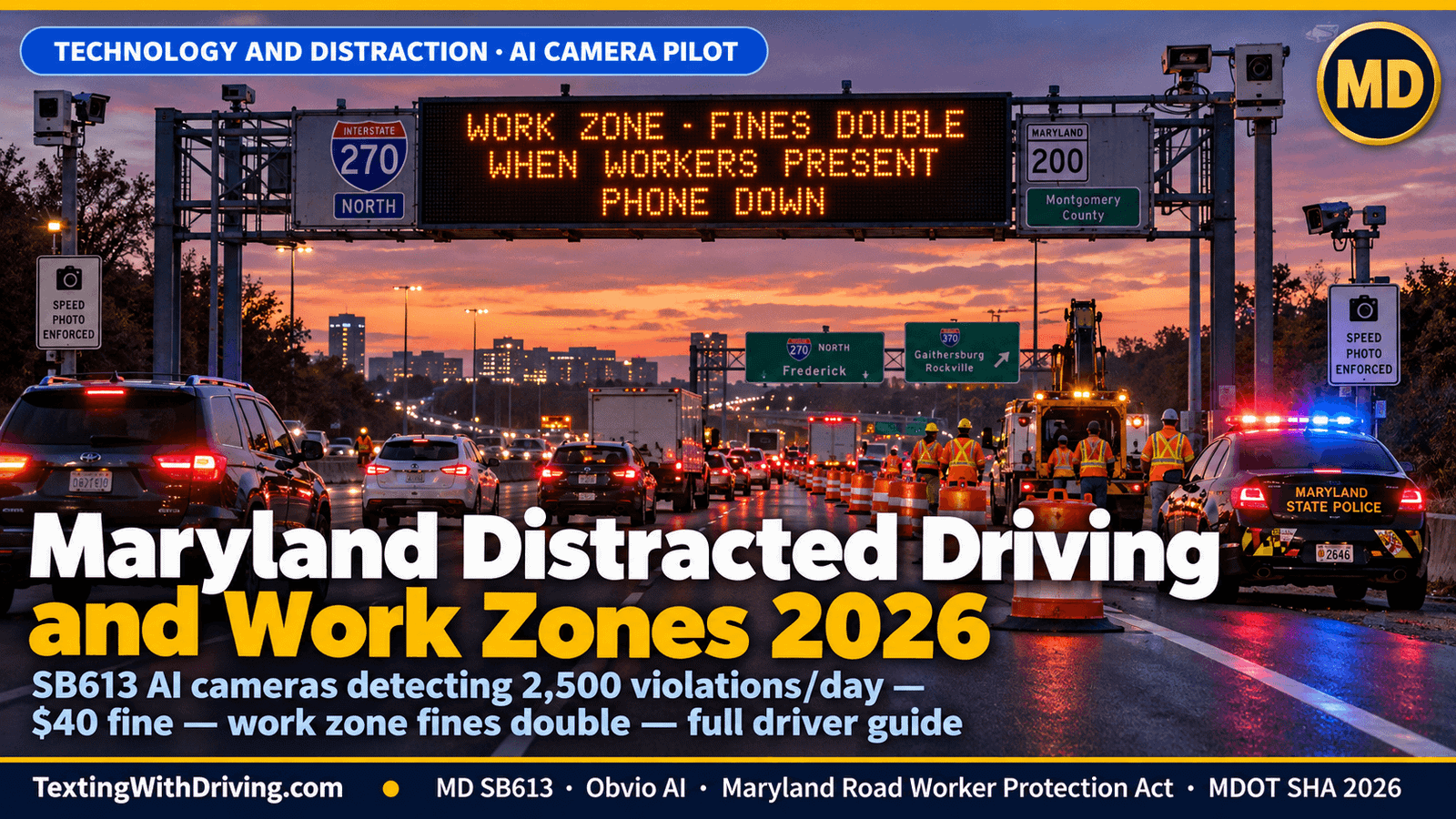
Maryland distracted driving work zones 2026 represents the intersection of two of the state’s most aggressive traffic safety initiatives: a proposed AI camera enforcement pilot that is already detecting 2,500 distracted driving violations per day in Montgomery County before a single fine has been issued, and a work zone safety law that has already reduced work zone deaths from 12 in 2024 to 9 in 2025 by doubling fines when workers are present.
Maryland’s distracted driving problem is quantified with specific severity: distracted driving is responsible for 34 percent of roadway deaths in the state. Not 8 percent as NHTSA’s federal coding produces nationally. Not the official undercount that we documented in our Distracted Driving Awareness Month 2026 article as potentially representing only 25-30 percent of actual distracted driving deaths. Maryland’s own state data places distracted driving at more than a third of all roadway deaths — a finding that reflects more thorough crash investigation and coding than the federal baseline.
Against this backdrop, Maryland has been more aggressive than almost any other state in the DMV region in deploying automated enforcement technology. Nine Obvio AI cameras in Montgomery County are identifying 2,500 distracted driving violations daily while operating in a data-collection mode — without issuing citations. That is 2,500 per day from just nine camera locations. If the SB613 pilot program achieves full legislative authorization and the $40 civil fine begins being issued, the citation volume from nine camera locations in a single Maryland county would dwarf the manual enforcement totals of entire state police forces.
This guide covers the complete Maryland distracted driving work zones 2026 picture: the SB613 AI camera pilot and its current status, what 2,500 daily violations means for the scale of Maryland’s distracted driving problem, the Maryland Road Worker Protection Act’s work zone fine structure, the specific construction corridors where both distracted driving law and work zone law apply simultaneously, and what every Maryland driver must know about navigating the state’s expanding automated enforcement landscape.
The SB613 AI Camera Pilot: What It Is and Where It Stands
Maryland distracted driving work zones 2026 technology story begins with Senate Bill 613 — the Montgomery County and Prince George’s County Distracted Driving Monitoring System Pilot Program that was introduced January 28, 2025 by Senators Jackson and Waldstreicher.
SB613 would establish a pilot program to authorize the use of distracted driving monitoring systems in Montgomery County and Prince George’s County to enforce certain prohibitions regarding the use of certain devices while operating a vehicle.
The key provisions of SB613:
Camera technology. The monitoring systems use AI to detect drivers using phones or mobile devices without capturing facial recognition data. The Obvio AI platform — already deployed in nine Montgomery County locations as the basis for SB613’s evidence base — uses computer vision to identify handheld device use from a roadside camera position, detecting the specific visual signature of a driver holding and interacting with a phone without identifying the driver’s face.
$40 civil fine. Violators would receive a $40 civil fine, similar to a parking ticket, without points on their driving record. The $40 fine — one of the lowest of any distracted driving camera program nationally — reflects the Maryland legislature’s pilot approach: the goal is behavioral change data and program evaluation, not maximum financial deterrence.
No DMV points, no moving violation record. The citation does not contribute points to the driver’s record, nor is it recorded as a moving violation. Vehicle owners who receive citations can contest them in District Court.
Vehicle owner liability. Citations are issued to the vehicle’s registered owner, using the same owner-liability structure as Maryland’s speed camera and red light camera programs.
Pilot duration: October 1, 2025 through September 2028. The pilot runs for approximately three years, with participating counties required to report on the effectiveness of the systems on or before December 1, 2027 — allowing one year of full evaluation data before the pilot ends.
The legislative status of SB613 as of October 2026: the bill was heard in the Senate Judicial Proceedings Committee in February 2025. As of the available reporting, the bill was in committee hearing status. The companion House Bill HB908 was cross-filed. Whether SB613 passed through the 2025 Maryland General Assembly session and achieved full enactment is a status update that drivers should verify with the Maryland MVA or the Maryland General Assembly’s legislative database.
What is confirmed regardless of SB613’s final legislative status: the nine Obvio cameras are deployed in Montgomery County. They are detecting 2,500 violations per day. The data they are collecting is available. And the legal framework for converting that data into civil citations — if SB613 achieved enactment — is the specific question that Maryland drivers should verify.
What 2,500 Daily Violations Means
Maryland distracted driving work zones 2026 technology pilot’s most significant data point is the 2,500 violations per day that nine Obvio cameras detected in Montgomery County. Understanding what this number means requires the context of the camera deployment.
Nine cameras deployed across Montgomery County for one month in July 2024, identifying 2,500 violations per day. Montgomery County has a population of approximately 1.1 million — the most populous county in Maryland — and its road network carries the I-270 corridor, the Beltway (I-495) northern and western sections, and the dense suburban arterial network of Rockville, Gaithersburg, Bethesda, and Silver Spring.
2,500 violations per day from nine cameras. If the nine cameras are distributed across the county’s highest-traffic corridors — I-270, Route 355 (Rockville Pike), Georgia Avenue, and the Beltway — the 2,500 daily violations represent a sampling of the full distracted driving violation rate on the roads those nine cameras happen to cover. The actual daily violation count across the county’s full road network is substantially larger.
Montgomery County Police Assistant Chief David McBain testified in support of SB613 in February 2025, saying it would be helpful in assisting the department’s enforcement of distracted driving laws as the department faces staffing challenges. The staffing challenge framing is significant: officer-based primary enforcement of Maryland’s handheld ban requires dedicated officer observation time. Nine AI cameras can cover nine road locations 24 hours per day, 365 days per year, with no staffing cost beyond the camera lease and the human-review time required before citations are issued. The 2,500 daily violations that nine cameras detect in a month could not be produced by any realistic deployment of patrol officers.
The Washington DC comparison context is directly relevant: Currently, the technology is being used as part of a pilot program in Washington, D.C. — the Maheshwari testimony at SB613’s hearing noted DC’s Obvio deployment. Montgomery County’s 2,500 daily violations from nine cameras represents a scale of detection that makes the manual enforcement-only approach to Maryland’s 34-percent-distracted-driving death share appear fundamentally inadequate for the scale of the problem.
Maryland’s Distracted Driving Law: The Baseline for Camera Enforcement
Maryland distracted driving work zones 2026 camera enforcement operates within Maryland’s existing distracted driving law framework, which is the baseline that the AI cameras are enforcing.
Maryland law prohibits using a handheld phone or mobile device while driving — primary enforcement, active since October 2013. The current Maryland fine structure: $83 first offense (base fine), $140 second offense, $160 third and subsequent offense. Unlike Virginia’s point-assessed civil infraction structure, Maryland’s distracted driving citations under the standard officer-issued citation process are minor traffic violations.
The SB613 AI camera citation — $40 with no points and no moving violation record — is actually lower than the officer-issued first offense fine of $83. The camera program’s lower fine reflects its civil penalty structure, parallel to how Maryland’s speed and red light camera programs work: lower financial penalty than officer-issued citations, but covering a vastly larger detection volume through automated enforcement.
Jake’s Law — Maryland’s criminal injury crash provision — remains available for the most serious distracted driving outcomes regardless of SB613’s camera program. As documented in our Maryland distracted driving and insurance 2026 article, Jake’s Law creates criminal liability when distracted driving causes a serious injury crash — independent of the civil fine structure that camera programs address.
The Maryland Road Worker Protection Act: Work Zone Fines in 2026
Maryland distracted driving work zones 2026 has a specific work zone dimension that represents Maryland’s most aggressive automated enforcement expansion: the Maryland Road Worker Protection Act of 2024.
The catalyst for the Road Worker Protection Act was a March 2023 crash on Interstate 695 near the Interstate 70 interchange that killed six road crew workers when two cars driving at more than 100 mph collided and crashed into the work zone. The March 2023 I-695 crash — the deadliest Maryland work zone crash in recent history — drove the legislative response that created the Road Worker Protection Act.
The Road Worker Protection Act’s provisions — effective in stages through 2025:
June 1, 2024: First doubling. The maximum work zone speed camera fine doubled from $40 to $80.
January 2025: Tiered sliding scale. Work zone speed camera fines shifted to a sliding scale from $60 to $500, corresponding to how far over the speed limit the driver was traveling. The highest fine is $1,000, which requires a driver to be more than 40 mph over the posted limit.
Fines double when workers are present. The most significant provision: when highway workers are actively present at the work zone site, all fines double. A driver ticketed for a speed camera violation with workers present faces double the standard fine tier.
The 2026 results: The number of work zone deaths dropped from 12 in 2024 to 9 in 2025 — a 25 percent reduction. On a typical day in Maryland, there are 300 active construction zones with more than 1,000 workers posted at sites statewide. Maryland has already seen two highway workers killed within recent months as of the summer 2026 reporting — establishing that the protection mandate remains urgent despite the fatality reduction.
The distracted driving connection to work zones is structural. A driver entering a Maryland highway work zone who is holding their phone is committing both a distracted driving offense and a work zone violation simultaneously. Maryland’s work zone cameras detect speed violations specifically — not handheld phone use. But the behavioral reality is that the drivers most likely to fail to reduce speed in work zones, most likely to drift into reduced-width work zone lanes, and most likely to miss the amber electronic message board warnings are drivers whose attention is divided by phone use.
Maryland highway officials maintain that everyone needs to fully focus through work zones — road workers or not. Work zones are challenging regardless of worker presence. The June 2024 and January 2025 fine increases apply to any camera-detected speed violation in a designated work zone, whether workers are present or not — the doubling applies when workers are present, but the base fine applies whenever the work zone designation is active.
The DMV Work Zone Overlap: Maryland and Virginia
Maryland distracted driving work zones 2026 has a specific DMV region dimension: the major construction corridors that create work zones near the Maryland-Virginia border are traveled daily by hundreds of thousands of commuters who must navigate both Maryland’s and Virginia’s work zone enforcement frameworks.
The I-495 Capital Beltway — which crosses the Maryland-Virginia state line at the American Legion Bridge (northwest) and Woodrow Wilson Bridge (southeast) — carries multiple active construction and improvement projects in its Maryland sections. A commuter who enters a Maryland work zone on I-495 in Montgomery County and then crosses into Virginia on the same trip faces both jurisdictions’ work zone enforcement simultaneously in either direction.
The I-270 corridor in Montgomery County — one of the locations where Obvio’s nine AI cameras were deployed — runs northwestward from the I-495 junction toward Frederick and the Appalachian corridors. The I-270 corridor hosts multiple MDOT SHA construction projects and is one of Maryland’s most heavily camera-monitored highway segments. A driver on I-270 in an active work zone who is holding their phone is potentially subject to both the work zone speed camera (for speed) and the future SB613 AI camera citation (for phone use) in the same work zone stretch.
What the Numbers Show About Maryland’s Work Zone-Distraction Intersection
Maryland distracted driving work zones 2026 statistics establish the specific scale of the problem:
1,200 work zone crashes in 2023 in Maryland. On a typical day, 300 active work zones with 1,000 workers are present statewide. The 1,200 annual work zone crashes — across 300 daily zones — suggest approximately one crash per 91 zone-days, or roughly one crash per zone every three months of continuous operation. At those volumes, every Maryland work zone that is active for a full construction season will statistically experience a crash.
956 people died in work zone crashes nationally in 2021 — the most recent available National Work Zone Safety Information Clearing House data. Maryland’s 12 work zone deaths in 2024, falling to 9 in 2025, represents a meaningful share of this national toll from a state with 6.2 million people.
34 percent of Maryland roadway deaths involve distracted driving. Not all work zone crashes involve distracted driving specifically. But the driver behavioral profile most associated with work zone speed violations — the driver who fails to reduce speed in a posted work zone, fails to detect the reduced-speed conditions ahead, and fails to move over from narrowed lanes — is the same behavioral profile that distraction produces. The overlap between Maryland’s 34 percent distracted driving death share and its 1,200 annual work zone crashes is not precisely quantified but is real and significant.
The specific 2025 enforcement data: twenty-three drivers received the maximum $1,000 fine in 2025 for exceeding the work zone speed limit by 40-plus mph. Two drivers were ticketed for speeds of 132 mph and 134 mph respectively in active work zones. The extreme speeding cases — 134 mph in a work zone where workers were present — represent the behavioral extreme of the inattentive driver spectrum. The driver traveling 134 mph in a work zone was not gradually approaching a speed threshold they misjudged. They were either completely unaware of the work zone conditions or entirely indifferent to them.
What Every Maryland Driver Must Know
Maryland distracted driving work zones 2026 creates specific compliance imperatives for every driver on Maryland’s roads.
Assume the SB613 AI cameras may be active in Montgomery County. Nine Obvio cameras identified 2,500 violations per day in July 2024. The cameras’ current operational status and citation-issuing authority as of October 2026 depends on SB613’s legislative outcome — which drivers should verify directly with the Maryland MVA. If SB613 achieved enactment, any of those nine camera locations may be issuing $40 civil citations to registered vehicle owners.
Maryland work zone fines double when workers are present. The Maryland Road Worker Protection Act’s most important provision for daily commuters is the worker-presence doubling. An MDOT SHA worker in a high-visibility vest standing in a work zone activates the doubling provision. Before you pass through an active Maryland work zone — on I-270, I-495, I-95 in Maryland, or any other state-maintained corridor — the question is not whether the work zone speed limit applies. It does. The question is whether workers are present, because if they are, every speed camera fine doubles.
Maryland’s distracted driving citation is $83 first offense from an officer, $40 from a camera. The camera citation is lower in financial terms than an officer-issued citation — but the camera’s detection volume is thousands of times higher than manual enforcement. The driver who avoids officer-based citations by avoiding obvious phone use near patrol vehicles cannot apply the same visible-officer awareness strategy to AI cameras that operate from fixed roadside positions 24 hours per day.
Jake’s Law creates criminal liability for injury crashes. As documented in our Maryland distracted driving and insurance 2026 article, Jake’s Law applies when distracted driving causes a serious injury crash — creating criminal exposure that the $83 base fine and the $40 camera citation both dramatically understate as a consequence measure.
Work zone camera tickets in Maryland are issued regardless of worker presence. Workers do not need to be present for a work zone speed camera ticket to be issued. A driver who exceeds the work zone speed limit on I-270 at 2 AM when no workers are visible is still subject to the work zone speed camera fine. The doubling applies only when workers are present — the base fine applies at all times in a designated work zone.
For the complete Maryland distracted driving law that applies on every Maryland road, our Maryland distracted driving law 2026 covers the full handheld ban and fine structure. For the AI camera technology behind the SB613 pilot, our distracted driving AI technology 2026 article covers Obvio, the 2,500-violations-per-day detection rate, and the national AI camera expansion. For the Jake’s Law criminal liability that applies when Maryland distracted driving causes injury crashes, our Maryland distracted driving and insurance 2026 article covers the complete consequence framework. And for the technology setup that makes Maryland compliance automatic on I-270, I-495, and every Maryland work zone, our hands-free while driving complete setup guide covers iPhone, Android, Bluetooth, and CarPlay.
Sources Used in This Article
All links verified working before publication.
Kurrant / Kurrantly News: Maryland Proposes AI Cameras Distracted Driving SB613 — SB613 deploys Obvio cameras no facial recognition data, nine cameras Montgomery County 2,500 violations daily no fines yet, $40 civil fine no points similar parking ticket, pilot September 2028 counties report December 2027, 34% Maryland roadway deaths distracted driving, March 2025
Bethesda Magazine: Distracted Driving Camera Bill SB613 Montgomery County — Montgomery County police Asst Chief McBain testified support staffing challenges, July 2024 nine Obvio cameras one month, pilot aligns Vision Zero, DC pilot comparison Maheshwari testimony, Senate hearing February 13, Senators Jackson Waldstreicher sponsors, February 2025
Maryland General Assembly SB613 2025RS — Pilot authorized Montgomery and Prince George’s Counties, $40 civil no points no moving violation, effective October 1 2025, report December 1 2027, county agencies issue civil citations based on recorded images, 2025
WUSA9: Maryland Work Zone Speed Fines Double June 1 — Maryland Road Worker Protection Act HB513/SB479, June 1 2024 fines doubled $40 to $80, January 2025 tiered $60 to $500 sliding scale, fines double workers present, Moore signed April 2024, Governor Moore Work Zone Safety Work Group November 2023, June 2024
Construction Dive: Maryland Doubles Work Zone Fines — 300 active work zones 1,000 workers daily Maryland, 1,200+ work zone crashes 2023, 250 crashes so far 2024, 956 national work zone deaths 2021, April 2024
CBS Baltimore: Maryland Leaders Urge Work Zone Safety 2025 — January 2025 tiered fines, 23 drivers maximum $1,000 fine 2025, two drivers 132 mph 134 mph active work zone, work zone deaths 12 in 2024 to 9 in 2025, April 2025
NBC Washington: Maryland Work Zone Speed Cameras When Workers Away — Work zone camera tickets even when workers not present, viewer $120 ticket no workers visible, MDOT SHA Cedric Ward work zones challenging regardless, doubling law when workers present, work zone deaths 12 to 9, two workers killed recent months 2026
WYPR: Higher Fines Work Zone Speeding Maryland June 1 — HB513 doubles fines to $80, passed response March 2023 I-695 six workers killed, June 2024
NHTSA: Distracted Driving — 3,208 deaths 2024, national context
TextingWithDriving.com is professionally built and maintained to ensure accurate, accessible safety information reaches every driver who needs it. Website development and ongoing support is handled by Budgetic, a digital agency specializing in purpose-driven WordPress websites.
