

Distracted Driving and AI Technology 2026: How Artificial Intelligence Is Changing Enforcement

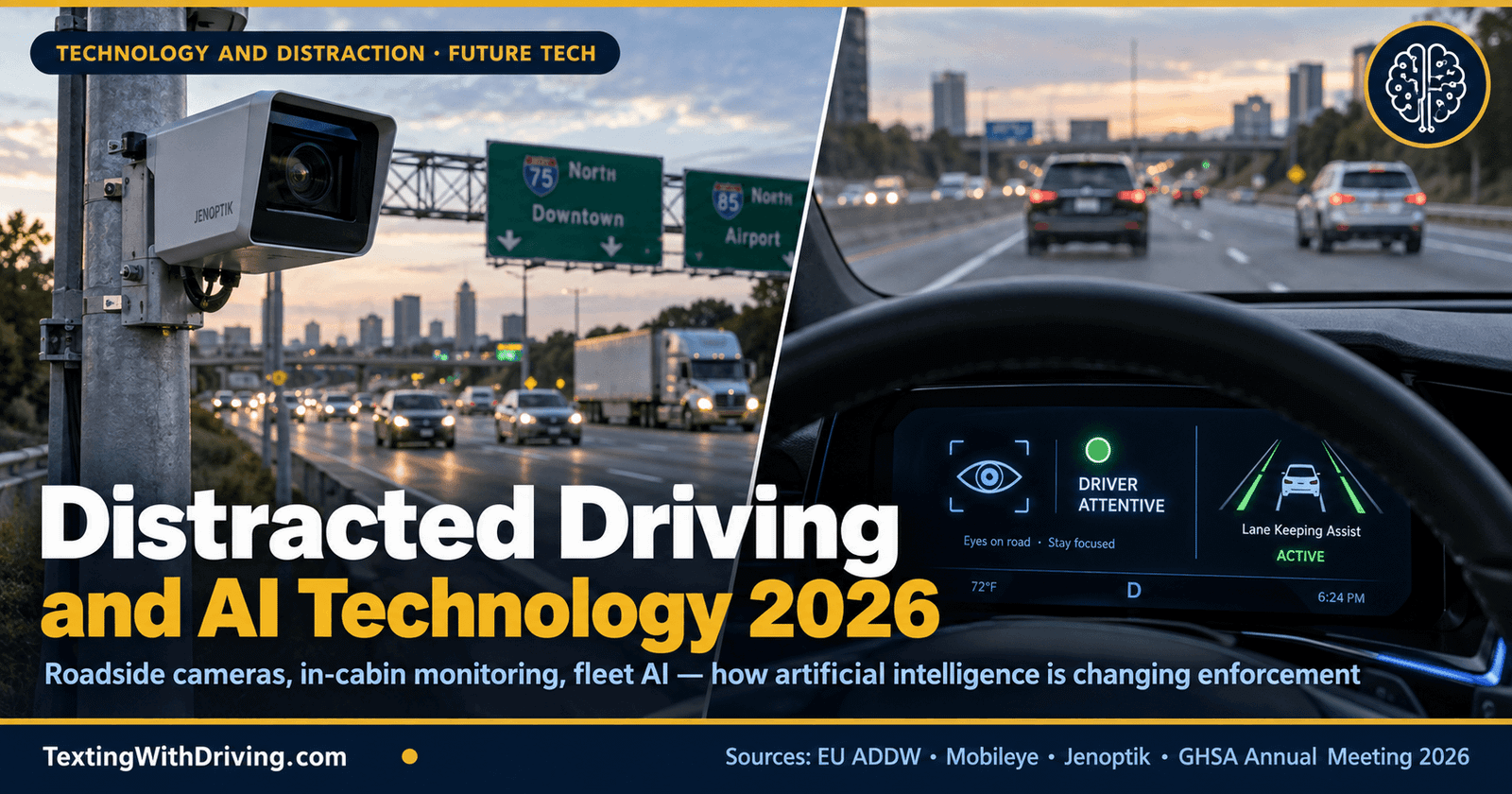
Distracted Driving and AI Technology 2026: How Artificial Intelligence Is Changing Enforcement
Distracted driving AI technology 2026 is no longer a future-tense story. The artificial intelligence systems that detect, alert, and build evidence against distracted drivers are deployed right now — in Maryland school zones where Obvio cameras catch 2,500 violations daily, inside the fleet trucks crossing Virginia’s I-95 where Mobileye and Lytx cameras flag phone-holding events within two seconds, and built into every new vehicle sold in the European Union since July 2024 as a mandated safety feature.
The GHSA’s 2026 Annual Meeting spotlighted the technology reshaping roadway safety from AI to Intelligent Speed Assistance in conversations that will move the needle. That GHSA focus reflects the recognition that has taken hold across the traffic safety policy community in 2026: the behavioral approach to distracted driving — awareness campaigns, fine structures, enforcement campaigns — has produced measurable but insufficient improvement. The technology approach — AI that detects distraction and either alerts the driver before a crash, generates the evidentiary record that supports enforcement, or removes the phone from the hands by making it impossible to use while moving — represents the next phase of the distracted driving safety response.
This guide covers the complete distracted driving AI technology 2026 landscape across three distinct application categories: roadside enforcement cameras that detect phone use from outside the vehicle, in-cabin driver monitoring systems that detect distraction from inside the vehicle, and fleet management AI cameras that create behavioral accountability for commercial drivers. Each category has different technical mechanisms, different legal frameworks, different deployment stages, and different implications for the Virginia, Maryland, and DC drivers who will encounter them on the roads they drive daily.
Category 1: Roadside AI Enforcement Cameras
The most policy-relevant application of distracted driving AI technology 2026 for American drivers is the roadside AI camera that detects phone use from outside the vehicle as the vehicle passes the camera’s field of view.
Handheld phones are no longer invisible. Modern AI cameras capture clear images through windshields, even in low light, and flag hand-to-ear phone use. Unlike traditional spot checks, these systems can monitor entire highways continuously.
The technology works through a specific detection pipeline. The camera unit — typically solar-powered, pole-mounted, and positioned at intersections or along highway corridors — captures continuous image or video data of passing vehicles. The AI model processes each frame in real time, performing object detection across the scene to identify vehicles, and within each vehicle’s windshield area to identify human figures, hands, and phone-shaped objects. When a hand-to-face or hand-to-phone pattern is detected that meets the confidence threshold of the model, the event is flagged for human review.
AI-assisted enforcement includes human oversight: almost all programs require human review of flagged images before fines are issued. However, initial data capture is entirely machine-driven, increasing the volume of detected offences.
The human review requirement serves two functions: it provides the legal foundation for the citation by ensuring that a qualified officer has assessed the AI’s flagged event before a fine is issued, and it addresses the privacy concerns that AI-only citation systems generate. The AI determines which events are worth reviewing. A human determines whether a citation is appropriate. This hybrid model — AI-powered detection, human-reviewed enforcement — is the dominant design in current roadside distracted driving camera deployments.
The Maryland SB613 Pilot: The most direct current example of roadside AI distracted driving camera enforcement in the US context covered by this platform is Maryland’s SB613 pilot in Montgomery and Prince George’s Counties, documented in detail in our Maryland work zone distracted driving 2026 article.
The Maryland SB613 pilot uses Obvio’s technology — cameras that process images locally and blur faces for privacy before uploading flagged events to the cloud for human review. The testing-phase data was specific and alarming: nine Obvio cameras caught 2,500 distracted driving violations per day before any fines were issued.
2,500 violations per day from nine cameras. 278 detected violations per camera per day. The scale of detected violation behavior — in a state with a primary enforcement handheld ban already in effect — establishes how dramatically AI cameras expand the enforcement detection capability beyond officer-observed citations.
The violations dropped nearly 70 percent in four months after the technology was installed in Prince George’s County — demonstrating the behavioral change that detection systems produce even before citations begin.
The Virginia SB84 Connection: As we documented in our Virginia distracted driving cameras 2026 article, Virginia’s SB84 cameras authorized by Governor Spanberger effective July 1, 2026 deploy the same Obvio technology — but currently authorized only for stop sign and crosswalk violations, not distracted driving. The cameras can detect phone use. Virginia law does not yet permit them to cite for it. The legislative extension needed to convert Virginia’s SB84 infrastructure into a distracted driving enforcement system is the specific next step for Virginia’s AI camera deployment.
International Precedent: In September 2022, the University of Alberta launched a three-week pilot in Edmonton, testing AI cameras to detect distracted drivers. Australia has deployed roadside distracted driving cameras across New South Wales with the most mature national rollout of any country — hundreds of thousands of citations annually from cameras that operate on every major highway, 24 hours per day. New South Wales’s AI camera program has been operational since 2020 and represents the most direct available evidence base for what US states will experience when they authorize comparable deployments.
Jenoptik’s Expanding Capabilities: Beyond Obvio, the competitive field of AI traffic enforcement camera providers is expanding rapidly. Jenoptik Smart Mobility, whose vice president for R&D Gavin Eaton stated: We can take our AI models and run them in all our devices, to take enforcement beyond speed, into more advanced scenarios. So that could be wrong-way detection, making an illegal turn or distracted driving — phone use — or not wearing a seatbelt. The multi-violation detection capability of current-generation AI cameras means that the same hardware installed for speed enforcement can be software-updated to detect distracted driving, enabling jurisdictions to expand enforcement scope through software deployment rather than new hardware installation.
Category 2: In-Vehicle Driver Monitoring Systems
The most rapidly growing application of distracted driving AI technology 2026 in terms of deployment scale is the driver monitoring system — the in-cabin camera and AI that watches the driver rather than the road, detecting distraction, drowsiness, and inattention from inside the vehicle.
Regulation (EU) 2019/2144 mandates that all new passenger and goods vehicles sold in the European Union must be equipped with driver drowsiness and attention warning (DDAW) systems. These systems have been required for new vehicle types since July 2022, and for all new vehicles since July 2024. Further, the fitment of Advanced Driver Distraction Warning (ADDW) systems became mandatory for all new vehicle types in July 2024, and will extend to all new vehicles by July 2026.
Every new vehicle sold in the EU from July 2026 onward must have an AI-powered in-cabin camera that detects driver distraction and alerts the driver. This mandate affects every major vehicle manufacturer’s global platform — because automakers who build vehicles for the EU market build the DMS into the vehicle architecture globally, not just for EU-market units.
The technical mechanism of driver monitoring systems operates through a camera positioned to view the driver’s face — typically mounted in the dashboard or steering column. The AI model analyzes:
Gaze direction. Where the driver’s eyes are pointed relative to the expected forward-gaze zone. A driver who is looking down at their lap (where a phone typically sits) or sideways at a passenger shows a gaze vector outside the forward zone that the DMS detects as a distraction event.
Eye closure patterns. The frequency and duration of blinks and eye closures. Extended closure or heavy blinking patterns indicate drowsiness that the DMS flags separately from phone-related distraction.
Head position. The three-dimensional orientation of the driver’s head relative to the forward-facing expected position. Head-down, head-tilted, or extended lateral head movement all indicate distraction.
Phone detection. Advanced systems including Mobileye’s Driver Monitoring System specifically identify phone-holding behavior — the hand-to-face or hand-in-lap phone interaction — as a separate detection category from the gaze and head position analysis.
Mobileye has developed its own driver monitoring system, applying its deep expertise in AI-powered computer vision and ADAS. Euro NCAP 2026 scoring includes both driver engagement monitoring and occupant monitoring requirements, while other regulations require DMS for compliance.
The Euro NCAP safety rating dimension is significant for American car buyers: most major vehicles sold globally receive Euro NCAP safety ratings, and the 2026 scoring requirement for DMS means that vehicles without credible driver monitoring receive lower safety ratings — creating market incentive for DMS deployment beyond the regulatory mandate.
North American automakers and regulators are studying similar frameworks for future rollout. The US DMS mandate is not yet in effect — NHTSA has been studying the regulatory pathway for several years without finalizing a rule. But the EU mandate’s effect on global vehicle platforms means that most new vehicles sold in the US in 2026 and beyond will include DMS as standard equipment regardless of US regulatory requirement, because the global platform approach makes it more cost-effective to install DMS universally than to build market-specific variants without it.
The behavioral implication is significant: a driver in a 2026 model-year vehicle who looks down at their phone is being observed by an AI camera that can alert them with a warning tone or haptic feedback within seconds. The driver who ignores the alert is creating a documented event record that the vehicle’s telemetry system logs — a record that in an insurance or legal context establishes that the driver was warned of the distraction before the crash occurred.
Category 3: Fleet AI Cameras
The most mature and commercially established application of distracted driving AI technology 2026 is the fleet management AI camera — the commercial product deployed by trucking companies, delivery fleets, rideshare operators, and any business with vehicles that employs drivers.
70 percent of fleet managers have experienced the effects of distracted driving incidents, with mobile phone use cited as the primary cause. AI-powered dashcams transform fleet safety by proactively identifying distracted driving behaviors, providing real-time alerts that equip fleet managers with actionable insights.
Fleet AI cameras operate through the same computer vision mechanisms as in-cabin DMS but with a commercial accountability layer: the detected events are flagged, stored, reviewed by fleet managers, and used for driver coaching and performance management rather than regulatory enforcement.
The leading fleet AI camera platforms in 2026 include Mobileye (originally road-facing collision avoidance, now including driver-facing DMS), Lytx DriveCam (the market leader in event-triggered recording with AI analysis), Samsara AI Dash Cam (integrated with fleet management software), and Netradyne (AI-exclusive approach to continuous event analysis rather than event-triggered recording).
AI models trained on 200 million-plus real-world distraction event images classify phone use, inattention, drowsiness, eating, smoking, and infotainment interactions with 92-plus percent production accuracy.
92 percent production accuracy from models trained on 200 million real-world events. The scale of training data that leading fleet AI camera providers have accumulated — from years of deployment across hundreds of thousands of commercial vehicles — produces models that reliably distinguish phone use from other hand-near-face behaviors (scratching, adjusting glasses, eating) that lower-quality models confuse with phone interaction.
The detection-to-behavior-change pipeline that fleet AI cameras implement:
Real-time detection and in-cab alert. The camera detects a distraction event — phone use, eye closure, gaze away from road — and issues an in-cab alert within two seconds. The alert is typically a tone or a spoken phrase (“Eyes on road,” “Please put down your phone”) that addresses the distraction in the moment before it becomes a crash.
Event clip generation. The camera saves a short clip of the event — typically 15 to 30 seconds — for manager review. The clip shows the driver’s face and behavior, the forward road scene, and telemetry data (speed, location, time) in a single package that enables manager review without watching hours of continuous footage.
Driver safety scoring. The AI aggregates events over time into per-driver and per-shift safety scores that fleet managers use for performance conversations, coaching, and incentive programs. The driver who has no phone-detection events over a month receives a perfect distraction score. The driver with 15 events receives a score that triggers a coaching conversation.
Behavior change documentation. Over 8-month periods, documented fleet AI camera deployments have produced 73 percent phone-event reductions as we noted in our employer distracted driving policy 2026 article — the largest documented behavioral change of any fleet safety intervention.
It is a detection and consequence problem: when drivers know that distraction events are not monitored, they are not deterred. Fleet AI cameras solve the detection problem — making every distraction event a documented event — and the consequence follows from documentation.
The Privacy Dimension: The Most Contested Question in AI Enforcement
Distracted driving AI technology 2026 faces its most significant non-technical challenge in the privacy concerns that roadside AI enforcement cameras generate. As the technology advances rapidly, privacy advocates remain watchful: Duke University law professor Jolynn Dellinger argues that while the safety case for AI cameras is compelling, the data collection, retention, and secondary use questions require careful regulatory attention.
The specific privacy concerns are:
Facial recognition and identity. Most current roadside distracted driving camera systems specifically blur or do not capture faces — citations are issued to vehicle owners based on license plate identification rather than to identified drivers based on facial recognition. The Obvio system’s face-blurring privacy protection, referenced in our Virginia distracted driving cameras 2026 article, is the design choice that most directly addresses the facial recognition concern.
Data retention. How long are flagged events stored? Who has access to the stored data? Can law enforcement access stored footage for investigations unrelated to the traffic safety purpose the cameras were installed for? These questions are not resolved by technology — they require legislative and regulatory frameworks that most US states have not yet developed in the context of AI traffic enforcement cameras.
Racial equity concerns. The Washington Area Bicyclist Association’s opposition to armed traffic enforcement in DC — cited in our DC distracted driving and pedestrians 2026 article — reflects a broader concern about enforcement systems that disproportionately target certain communities. AI camera enforcement systems that cite based on license plate rather than officer observation have different equity implications than officer-based enforcement, but the distribution of camera placement and the vehicle-type biases in training data both require analysis.
False positive management. A 92 percent accuracy rate that fleet AI camera providers cite means approximately 8 percent of events are flagged incorrectly — a rate that is acceptable for coaching purposes but that requires robust human review processes before citations are issued. The human review requirement in Maryland’s SB613 framework directly addresses this concern.
The balance between safety benefit and privacy protection is the design challenge that AI traffic enforcement camera policy must navigate. Maryland’s SB613 framework — civil penalty (not a moving violation), vehicle owner citation (not driver identification), face blurring, human officer review before citation — represents one approach to this balance. Virginia’s SB84 framework extends comparable protections to the stop-sign and crosswalk cameras currently deployed. Any extension of the AI camera framework to distracted driving in Virginia will need to address the same privacy balance that Maryland has navigated in its SB613 design.
The EU Mandate: What American Drivers Will See in Their New Cars
Distracted driving AI technology 2026 has a specific near-term implication for every American driver who purchases a new vehicle in 2026 or beyond: most new vehicles will include driver monitoring systems that were mandated for EU-market versions and deployed globally through the manufacturer’s platform architecture.
Driver drowsiness and attention warning (DDAW) and Advanced Driver Distraction Warning (ADDW) systems became mandatory for all new vehicle types in the EU in July 2024, extending to all new vehicles by July 2026. The systems that implement these mandates operate through the in-cabin camera infrastructure that the DMS category uses — detecting gaze, head position, eye closure, and phone interaction and alerting the driver through the vehicle’s audio, haptic, or display systems.
For American car buyers, the practical manifestation of the EU mandate in 2026 new vehicles is:
A driver-facing camera is now standard equipment in many vehicles, often mounted in the driver information cluster or rearview mirror assembly. The camera feeds an AI model that monitors gaze and attention during driving. An alert system — typically a chime, a display warning, or a steering wheel haptic feedback pulse — activates when the model detects sustained attention away from the road.
The system does not prevent phone use. It does not lock the phone or enforce the hands-free law. It alerts the driver that they are looking away from the road — the same warning that an attentive passenger might provide — and creates the documented event record that establishes the pre-crash warning in any subsequent legal proceeding.
Mandatory in-cabin alerts are coming: EU-mandated DDAW and ADDW systems will be standard on new vehicles, alerting you to distraction or drowsiness before a critical moment. North American automakers and regulators are studying similar frameworks for future rollout.
How AI Technology Connects to Virginia, Maryland and DC
Distracted driving AI technology 2026 has specific current and near-future applications in the DMV region:
Virginia’s SB84 AI cameras are deployed in school zone crosswalks and at stop signs, using Obvio technology that can detect distracted driving but is not yet authorized to cite for it. The legislative extension of SB84 to distracted driving citations is the most proximate AI enforcement expansion available in Virginia.
Maryland’s SB613 AI camera pilot in Montgomery and Prince George’s Counties is the most advanced roadside distracted driving AI enforcement pilot in the US. The $100,000 GHSA-IIHS grant to Maryland’s Highway Safety Office for distracted driving quantification — as we documented in our distracted driving news August 2026 article — will produce the behavioral change data that Maryland’s pilot generates, available to every other state considering comparable deployments.
DC’s laser scanner feedback technology — deployed in 2024 as documented in our Washington DC distracted driving law 2026 article — is an earlier-generation AI-adjacent technology that detects phone handling behavior and triggers a roadside advisory sign. The DC laser scanner represents the roadside advisory approach rather than the enforcement approach — influencing driver behavior through real-time feedback rather than through citation.
Fleet AI cameras are already operating on Virginia’s I-95, I-66, and I-81 corridors in the commercial trucks that dominate Virginia’s interstate freight network. Every major commercial carrier operating in Virginia in 2026 — UPS, FedEx, Amazon Logistics, the large LTL carriers — uses AI dash cameras as standard fleet management practice. The 92 percent accuracy detection, the real-time in-cab alerts, and the 73 percent event reduction documented in fleet deployments are already operating on Virginia’s interstates today, producing behavioral change in the commercial driver category even without any Virginia regulatory requirement.
What the AI Technology Trajectory Means for Drivers
Distracted driving AI technology 2026 is moving on a trajectory that will, within three to five years, make AI-detected distracted driving as common and documented as AI-detected speeding is today.
The progression is visible: Maryland’s roadside AI cameras detecting 2,500 violations daily (2026) will generate behavioral data that justifies expansion. Virginia’s SB84 cameras detecting distracted driving without citation authority (2026) will accumulate documented violation data that supports the legislative extension of citation authority. The EU DMS mandate (2024-2026) will produce billions of miles of driver monitoring data that establishes the behavioral impact of in-cabin detection systems. Fleet AI cameras with 92 percent accuracy (2026) will continue producing the 73 percent event reduction evidence that accelerates fleet adoption.
The driver who puts their phone in the back seat today is doing what technology will make unavoidable within the next commercial vehicle replacement cycle. The question is not whether AI will detect distracted driving. The question is how quickly the legislative authority to cite for camera-detected distracted driving follows the deployment of cameras that can already see the behavior.
For the Virginia-specific AI camera deployment and the SB84 framework, our Virginia distracted driving cameras 2026 article covers the complete current picture. For Maryland’s active AI camera pilot and its 2,500-daily-violation detection data, our Maryland work zone distracted driving 2026 covers the SB613 framework. For the fleet AI camera context within employer distracted driving policy, our employer distracted driving policy 2026 covers the complete employer framework. And for the technology setup that makes voluntary compliance automatic before any AI camera can detect non-compliance, our hands-free while driving complete setup guide covers iPhone, Android, Bluetooth, and CarPlay.
Sources Used in This Article
All links verified working before publication.
SureCam: How AI Dash Cameras Stop Distracted Driving for Fleets in 2026 — Phone usage texting advanced image recognition detection even partially obscured, facial mapping drowsiness eye closure yawning, seatbelt compliance, excessive in-cab movement, alerts happen instantly without cloud connectivity, June 2026
Traffic Technology Today: How AI Cameras Are Changing Traffic Enforcement — Jenoptik Gavin Eaton VP R&D quote distracted driving phone use seatbelt beyond speed, Kapsch TrafficCom HoTCap system March 2026 Intertraffic Amsterdam, Duke University privacy advocacy Jolynn Dellinger, May 2026
Elovate: Distracted Driving in the Age of AI What Every Driver Should Know — EU Regulation 2019/2144 DDAW mandatory July 2022 new types July 2024 all vehicles, ADDW mandatory July 2024 all new vehicle types July 2026 all new vehicles, Edmonton University Alberta pilot September 2022, handheld phones no longer invisible through windshields low light, human review before fines, North American regulators studying DMS framework, July 2025
Mobileye: Driver Monitoring System — Euro NCAP 2026 driver engagement occupant monitoring requirements DMS compliance, AI-powered computer vision ADAS expertise, fatigue distraction impaired driving millions of accidents annually, April 2026
OxMaint: Distracted Driving Detection Fleet AI Cameras — AI models trained 200M+ real-world distraction events 92%+ production accuracy, Samsara Lytx DriveCam Netradyne Mobileye integrations, detection and consequence problem unmonitored drivers not deterred, 2-second in-cab alert 4-hour coaching clip delivery, April 2026
Teletrac Navman: How Advances in AI Camera Technology Prevent Distracted Driving — 70% fleet managers experienced distracted driving incidents mobile phone primary cause, machine learning computer vision detect phone use drowsiness hands off wheel, driver safety scores coaching programs
GHSA: Distracted Driving State Laws — 2026 Annual Meeting AI and ISA technology spotlight, $100,000 IIHS grant Maryland Highway Safety Office distracted driving quantification pilot, June 2026
NHTSA: Distracted Driving — 3,208 deaths 2024, 537,000 distracted drivers at any daylight moment, national context
TextingWithDriving.com is professionally built and maintained to ensure accurate, accessible safety information reaches every driver who needs it. Website development and ongoing support is handled by Budgetic, a digital agency specializing in purpose-driven WordPress websites.

About Texting With Driving
TextingWithDriving.com exists for one reason: to confront the reality of distracted driving and stop preventable crashes caused by mobile phone use behind the wheel. Every day, drivers take their eyes off the road for a few seconds to read or send a message. Those few seconds are enough to cause life-altering consequences. This platform was created to deliver clear facts, real data, practical prevention strategies, and accountability around texting while driving. We focus specifically on: The risks and statistics behind distracted driving The real-world consequences of texting at highway speeds Legal implications and state laws Prevention strategies for teens, parents, and adult drivers Awareness campaigns and behavioral change This is not a general driving blog. It is a focused awareness initiative built around one critical issue: phone distraction behind the wheel. Our content is direct, research-driven, and practical. We prioritize accuracy over opinion and education over sensationalism. The goal is simple — reduce distracted driving incidents by increasing awareness and responsibility. If one article causes one driver to put their phone down, the mission is working. For inquiries or partnerships, contact: privacy@textingwithdriving.com
View all posts by Texting With Driving