

Fairfax County Distracted Driving 2026: Virginia’s Highest-Crash County and What Every Driver Must Know

Fairfax County Distracted Driving 2026: Virginia’s Highest-Crash County and What Every Driver Must Know
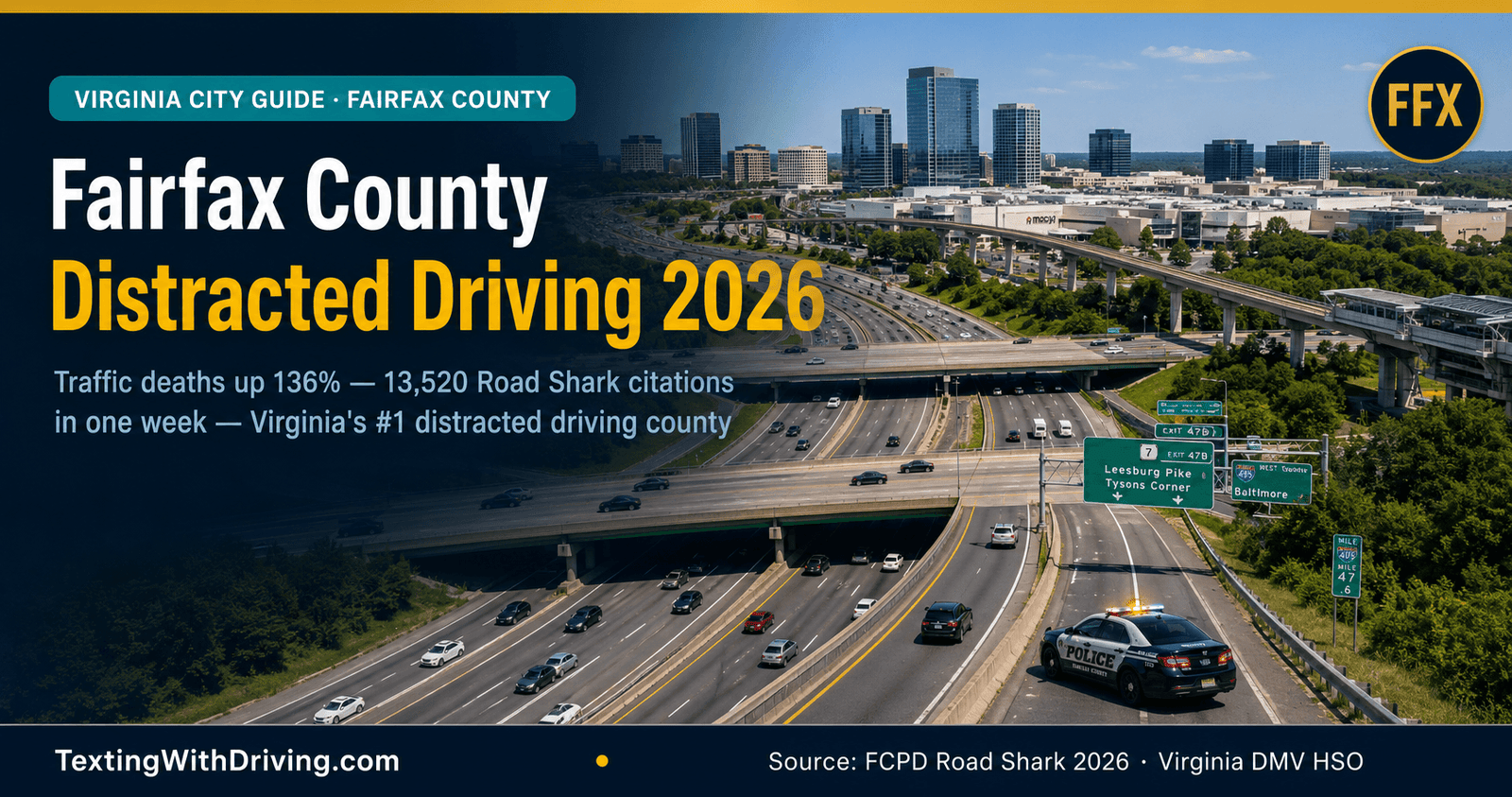
Fairfax County distracted driving 2026 is in the middle of its most alarming road safety year in recent memory. Traffic deaths in Fairfax County have increased from 11 at this point in 2025 to 26 so far in 2026 — a 136 percent year-to-date increase that prompted the Fairfax County Police Department to issue an urgent call for safer driver behavior and launch one of the most intensive traffic enforcement campaigns in the county’s history.
Virginia’s own DMV Highway Safety Office data places Fairfax County at the top of every distracted driving crash metric in the Commonwealth. Fairfax County leads Virginia in total distracted driving crash concentration — ahead of Loudoun County, Henrico County, Richmond City, Prince William County, Norfolk City, and Virginia Beach City. It is not just a big county with a proportionally large share of crashes. It is disproportionately dangerous relative to its population — and the 2026 traffic death surge is making the disproportionality worse.
This guide covers the complete Fairfax County distracted driving 2026 picture: the alarming death count data, the Road Shark enforcement campaign that responded with 13,520 citations in a single week, the specific high-crash corridors and intersections that data consistently identifies, the specific Fairfax enforcement tools including data-driven patrol deployment, and what every driver on Fairfax County roads must do in 2026 to navigate safely and legally.
The 136 Percent Traffic Death Increase: What Is Happening in Fairfax County in 2026
The most alarming statistic in Fairfax County distracted driving 2026 coverage is the year-to-date traffic death trajectory.
Traffic deaths in Fairfax County have increased from 11 last year at this time to 26 so far in 2026, leading officers to step up enforcement efforts and encourage safer driving.
At this point in 2025, the county had eight vehicle fatalities and three pedestrian deaths — a total of 11. So far in 2026, there have been 11 pedestrian fatalities alone in addition to 15 vehicle deaths — a total of 26. The same period, 136 percent more deaths.
This is not a national trend problem. Virginia’s overall road safety trajectory is positive — 825 total Virginia road deaths in 2025 represented an 11 percent improvement from the prior year. Fairfax County’s 2026 death surge is occurring against a background of statewide improvement, making the county’s specific trajectory even more alarming as an outlier.
Fairfax County police is stepping up traffic enforcement in reaction to a concerning spike in traffic fatalities, including pedestrian deaths. You have so many more distractions now than we had growing up. You have the cellphones, the traffic, the amount of traffic. Everybody’s in a hurry in Northern Virginia, said Master Police Officer Earl Culbertson.
The specific causes of the 2026 surge have not been publicly isolated to a single factor. But distracted driving, speeding, and aggressive driving are the three behaviors that Fairfax County Police identify in every enforcement initiative as the primary contributors to serious and fatal crashes on county roads. All three are compounding in the specific road environment of Northern Virginia’s most complex county.
Why Fairfax County Leads Virginia in Distracted Driving Crashes
Fairfax County’s position as Virginia’s highest distracted driving crash jurisdiction is not accidental. It is the product of specific structural factors that interact to produce more crash opportunities per driver per mile than any other county in the Commonwealth.
Scale of the road network. Fairfax County contains approximately 4,000 lane miles of roads, from the major interstate corridors of I-95, I-66, I-395, and I-495 to the dense surface street network of Tysons Corner, Reston, Herndon, Springfield, and the Route 1 corridor. The county covers 395 square miles with 1.2 million residents — making it the most populous jurisdiction in Virginia — and produces a vehicle miles traveled figure that dwarfs every other Virginia county.
The interchange complexity. Fairfax County contains more complex highway interchanges than any other Virginia county. The Springfield Mixing Bowl (I-95/I-395/I-495), the Tysons Corner interchange (I-495/Route 7/Route 123), the I-66/I-495 interchange at Merrifield, the Route 7/Route 267 connection at Tysons, and the multiple I-95 access points in the Springfield-Lorton-Woodbridge corridor all create navigation complexity that drives smartphone interaction while driving.
The employment center concentration. Fairfax County contains Tysons Corner — the second-largest urban employment center on the East Coast outside Manhattan — and major federal and defense contractor employment clusters in Reston, Chantilly, Springfield, and McLean. The 21-35 age group that Virginia DMV data identifies as the most frequently involved in distracted driving crashes is heavily concentrated in Fairfax County’s technology and defense contractor workforce.
The commuter pressure. Distracted driving was a significant factor in crashes statewide with 21,528 incidents in Virginia linked to distracted drivers, marking a 4.1% increase from the previous year. Fairfax County likely reflected this trend, given its high traffic density.
The most common distractions include mobile phone use, diverting attention from the road, and looking at roadside incidents. In Fairfax County’s specific road environment, all three of these distraction categories are amplified: mobile phone use by the high-notification-load professional workforce, attention diversion by the visual complexity of the Tysons and Springfield interchange environments, and roadside incident distraction by the county’s high density of accidents creating secondary crash risk from rubbernecking.
Road Shark 2026: The County’s Most Intensive Enforcement Response
The Fairfax County Police Department’s Road Shark campaign is the primary enforcement vehicle for Fairfax County distracted driving 2026 compliance. The 2026 campaign scale is unprecedented.
The Fairfax County Police Department launched its 2026 Road Shark Campaign in partnership with Virginia State Police to make roads safer for everyone. As part of the initiative, officers and troopers increase their visibility in areas identified through traffic data and crash trends, helping pinpoint locations and times where extra enforcement can benefit safety.
The citation volumes from Road Shark 2026 are extraordinary by any enforcement standard:
Wave 1 (Spring 2026): 13,520 citations and warnings in one week alone.
Wave 2 (June 8-14, 2026): 11,791 citations and warnings — 5,740 citations and 6,051 warnings. By comparison, Wave 2 of the 2025 campaign resulted in just over 8,250 citations and warnings — meaning 2026 Wave 2 citations were up 43 percent over 2025 Wave 2.
Full 2025 campaign total: 49,304 citations and warnings across multiple enforcement waves, an increase of nearly 15,000 from 2024. 2026 is tracking significantly above this already elevated 2025 total.
The program returns after a widely successful 2025 campaign that saw officers issue nearly 50,000 citations and warnings overall, including more than 9,000 in the first week alone. During the first wave, nearly three dozen arrests were made for intoxicated driving, and more than 100 felony charges were ultimately levied against drivers.
Road Shark focuses on coordinated, strategic enforcement to deter dangerous driving. With heightened patrols and visibility, Fairfax County officers and state troopers aim to change driver behavior, improve public safety, and reduce serious crashes on county roads. Officers target speeding, aggressive driving, distracted driving, driving under the influence, and school zone violations — with distracted driving specifically named as one of the primary violation categories.
The strategic deployment methodology is data-driven. Officers increase their visibility in areas identified through traffic data and crash trends, helping pinpoint locations and times where extra enforcement can benefit safety. This means Road Shark enforcement is not uniformly distributed across all 4,000 lane miles of Fairfax County road. It concentrates on the specific corridors and time windows that crash data identifies as highest risk — which, based on Virginia DMV crash pattern data, means the I-495 corridor through Tysons, the I-95/I-395 Springfield corridor, the Route 7 and Route 50 surface corridors, and the Dulles Toll Road approach.
The High-Crash Corridors and Intersections
Fairfax County distracted driving 2026 crash concentration follows specific geographic patterns that every driver using Fairfax County roads needs to understand.
I-495 Capital Beltway Through Fairfax County
The Virginia segment of I-495 runs approximately 35 miles through Fairfax County, carrying more daily traffic than any comparable highway segment in Virginia. The Beltway’s specific high-crash concentration points within Fairfax include the Springfield Mixing Bowl where I-95, I-395, and I-495 converge — the most complex interchange in Northern Virginia — and the Tysons Corner corridor between Route 7 and Route 123 where weave conflicts are constant.
Fairfax County sits at the heart of Northern Virginia’s network — Beltway (I-495), I-66, I-95/I-395, Route 7, Route 50, and the Dulles Toll Road all cut through it. That mix of high-speed traffic, constant merges, and dense commuting routinely puts Fairfax at or near the top in total crashes statewide. In 2022 alone, over 3,000 accidents were recorded on I-95, with Fairfax County registering the highest number at 1,055 incidents.
Route 7 (Leesburg Pike) Through Tysons and Falls Church
Route 7 is one of Fairfax County’s most crash-intensive surface roads. From the I-495 interchange at Tysons through Falls Church to the Arlington County line, Route 7 carries the intersection of heavy commuter traffic, Tysons Corner mall access traffic, transit connections to the Silver Line Metro, and the navigation confusion of drivers unfamiliar with the Tysons urban core. The combination produces the conditions for distraction-related crashes at nearly every major intersection along its length.
With I-495, VA-7 (Leesburg Pike), and VA-123 (Chain Bridge Road) converging amid dense retail, Tysons creates constant weave conflicts. Many collisions happen when drivers try to cross multiple lanes quickly.
Route 50 (Arlington Boulevard / John Marshall Highway)
Route 50 is a cross-county arterial connecting Arlington County through Falls Church, Fairfax City, and Chantilly to Loudoun County. Its mixed-use character — transitioning from urban density near the Arlington line to suburban commercial and residential through the county’s interior — creates the unpredictable speed variance and access conflict patterns that produce rear-end and intersection crashes when drivers are distracted.
The Dulles Toll Road (VA-267) and the Tech Corridor
The Dulles Toll Road corridor connecting Tysons Corner through Reston, Herndon, and Sterling to Dulles International Airport carries one of the highest professional-workforce commuter loads in the country. The Route 28 interchange, the Reston/Wiehle-Reston East Metro station approaches, and the Dulles International Airport access road all create navigation decision points that drive phone use among the technology, federal contracting, and aviation-sector workforce using this corridor daily.
The 2026 Pedestrian Crisis in Fairfax County
The Fairfax County distracted driving 2026 story has a specific pedestrian dimension that mirrors the pattern we documented for Richmond in our Richmond Virginia distracted driving 2026 article.
So far in 2026, there have been 11 pedestrian fatalities in Fairfax County — compared to three pedestrian deaths at the same point in 2025. An 11 to 3 comparison in pedestrian deaths at the same calendar point represents a 267 percent increase in pedestrian fatalities in a single year-over-year comparison.
The pedestrian fatality surge in Fairfax County in 2026 is occurring in a county with some of the most active pedestrian safety infrastructure investments of any Virginia county — crosswalk improvements, leading pedestrian intervals, and pedestrian-friendly redesigns around the Tysons Metro stations. The infrastructure is improving. The driver behavior — particularly distracted driving at and near pedestrian crossings — is producing the pedestrian deaths that infrastructure alone cannot prevent.
The June Road Shark campaign specifically noted that summer school, camps, recreation programs, and other youth activities continue throughout the season, with school buses remaining active on county roads during summer. Always stop for school buses displaying flashing red lights and a stop arm. The specific attention to school bus compliance during summer reflects the county’s awareness that back-to-school safety extends year-round with summer programs.
The Data-Driven Enforcement Approach: How Road Shark Uses Crash Data
The tactical sophistication of Fairfax County distracted driving 2026 enforcement is the Road Shark campaign’s data-driven deployment methodology. This is not standard saturation patrol. It is targeted patrol based on crash frequency, location, and time-of-day analysis.
Officers increase their visibility in areas identified through traffic data and crash trends, helping pinpoint locations and times where extra enforcement can benefit safety.
The data-driven approach means Road Shark enforcement concentrates at the specific intersections and highway segments where crash data shows the highest frequency of the violation types being targeted. For distracted driving specifically, the highest-crash intersections in Fairfax County — identified through the Virginia DMV crash database — receive disproportionate patrol attention during the enforcement windows when distraction-related crashes are most frequent.
The specific deployment timing follows the crash data as well. Distracted driving crashes peak in the afternoon between 3 PM and 6 PM nationally, per NHTSA data. For Fairfax County’s commuter-dominated road environment, the 6-9 AM and 3-6 PM peak commute windows are the highest-risk enforcement targets. Road Shark enforcement during these windows catches the specific driver behavior patterns — commuter phone checking, navigation uncertainty at interchanges, social coordination messaging — that produce the crash concentration Fairfax County’s data documents.
The DRIVE SMART Virginia partnership that brought ThinkFast Interactive driver education assemblies to Fairfax and Prince William Counties in partnership with the I-66 Express Mobility Partners specifically targets the road safety culture change that enforcement alone cannot achieve. Young drivers in Fairfax County high schools experience the distracted driving simulator and educational programming that supplements the citation-based deterrence of Road Shark with the behavioral science-based approaches that research consistently shows are necessary for lasting attitude change.
The Law That Applies on Every Fairfax County Road
Virginia Code § 46.2-818.2 applies on every road in Fairfax County — on I-495 at 65 mph, on Route 7 through Tysons, at a red light on Route 50 in Fairfax City, and in every school zone during active hours. The full Virginia law provisions are covered in our Virginia distracted driving law article and the complete fine structure is in our Virginia distracted driving fines 2026 article.
The specific Fairfax County enforcement context adds several layers to the standard Virginia law analysis:
Road Shark’s unmarked vehicle deployment. Fairfax County Police and Virginia State Police both deploy unmarked vehicles during Road Shark. A vehicle traveling at highway speed on I-66 or I-495 that appears to be a civilian sedan may be an unmarked patrol unit with an officer who can observe phone-holding behavior through the vehicle’s windows. The 136 percent traffic death increase that prompted the 2026 campaign escalation has increased the urgency and the resources allocated to unmarked vehicle enforcement.
Primary enforcement authority means no other violation needed. Every Road Shark citation for distracted driving is issued under Virginia’s primary enforcement law. The 5,740 citations in one week during Wave 2 were issued to drivers who were observed violating the hands-free law — without any requirement that they were also speeding, running a red light, or committing any other violation simultaneously.
The reckless driving upgrade applies in Fairfax County as everywhere in Virginia. As we documented in our Virginia reckless driving and distracted driving criminal guide, a driver who is holding a phone while simultaneously driving in a manner that endangers life, limb, or property under Va. Code § 46.2-852 can face reckless driving charges in addition to the hands-free infraction. In Fairfax County’s high-speed interchange environment, phone use at 85 mph or while weaving across multiple lanes carries this specific escalation risk.
What Every Driver in Fairfax County Must Do Right Now
The Fairfax County distracted driving 2026 enforcement environment is the most intensive in Virginia at any point in the county’s recent history. The 26 traffic deaths year-to-date through mid-2026, the 43 percent increase in Road Shark Wave 2 citations over 2025, and the 136 percent year-over-year traffic fatality increase all describe a county where the consequence of non-compliance — both legal and physical — is higher than at any prior period.
The pre-drive standard that eliminates both the legal and safety risks simultaneously:
Phone mounted on the dashboard or windshield before the engine starts. Not in the cupholder where it requires reach. On the mount where it requires no contact to display navigation.
Navigation destination entered before moving. Every I-495 interchange decision, every Tysons interchange split, every Route 7 and Route 50 turn — handled by a navigation route that was set before the car moved, requiring no phone contact while moving.
Bluetooth connected for all calls. The Fairfax County commuter who receives professional communications during their commute manages all of them through the vehicle’s Bluetooth system or a hands-free earpiece. No phone held to ear at any speed on any road at any time.
Driving Focus or Android DND active. The professional notification pressure that Fairfax County’s technology and government contractor workforce experiences is among the highest in the United States. Driving Focus eliminates it before it can generate the check impulse that produces phone-in-hand violations.
Assume Road Shark enforcement is active throughout the county at all times. The 13,520 Wave 1 citations and 11,791 Wave 2 citations in one week each during the 2026 campaign are not anomalies. They are the intended operating level of a campaign designed to address a 136 percent traffic death increase. Road Shark is active, intensified, and specifically targeting distracted driving as a primary violation category.
For the complete Virginia law that applies on all Fairfax County roads, our Virginia distracted driving law covers Va. Code § 46.2-818.2 in full. For the complete technology setup that makes compliance automatic, our hands-free while driving complete setup guide covers iPhone, Android, Bluetooth, and CarPlay. For the commuter-specific guide to I-95, I-66, and the Beltway, our Northern Virginia distracted driving guide covers every major corridor.
Sources Used in This Article
All links verified working before publication.
NBC Washington: Police Increase Traffic Enforcement in Fairfax Co. Amid Spike in Fatalities — 26 traffic deaths in 2026 vs 11 at same point 2025, 11 pedestrian fatalities 2026 vs 3 in 2025, Master Police Officer Culbertson quote, July 2026
WJLA: Fairfax County Road Sharks Issue 13,520 Citations in a Week — 13,520 Wave 1 citations one week, Road Shark 2026 campaign purpose, May 2026
Fairfax Times: Public Safety Notes Week of June 26 2026 — Wave 2 11,791 citations 5,740 citations 6,051 warnings, up from 8,250 in 2025 Wave 2, June 2026
DC News Now: Road Shark 2026 Campaign Launch — 49,304 citations 2025 full campaign, 15,000 increase from 2024, data-driven deployment, April 2026
FFXNow: Fairfax County Police to Increase Traffic Enforcement 2026 — Nearly 50,000 citations 2025, 9,000 first week 2025, 35 DUI arrests first wave 2025, 100+ felony charges, April 2026
FCPD News: More Travel More Activity More Enforcement June 2026 — Road Shark definition, summer school buses remain active, June 2026 initiatives Move Over Road Shark loud exhaust
MacDowellLaw: Fairfax County Among Most Dangerous Virginia for Car Accidents — 21,528 statewide distracted driving incidents 4.1% increase, Fairfax high traffic density reflects trend, mobile phone use primary distraction
Virginia DMV Distracted Driving Toolkit — Fairfax County named #1 highest distracted driving crash jurisdiction in Virginia, ages 21-35 demographic
DRIVE SMART Virginia: 2025 Annual Report — I-66 Express Mobility Partners ThinkFast program Fairfax and Prince William Counties, 6,000 teens reached 28 high schools
VDOT: Heads Up End Distracted Driving in Virginia — 18,688 crashes 73 fatalities 10,222 injuries statewide 2024, cell phone distraction rose 3%
NHTSA: Distracted Driving — 3,208 deaths 2024, national context
TextingWithDriving.com is professionally built and maintained to ensure accurate, accessible safety information reaches every driver who needs it. Website development and ongoing support is handled by Budgetic, a digital agency specializing in purpose-driven WordPress websites.

About Texting With Driving
TextingWithDriving.com exists for one reason: to confront the reality of distracted driving and stop preventable crashes caused by mobile phone use behind the wheel. Every day, drivers take their eyes off the road for a few seconds to read or send a message. Those few seconds are enough to cause life-altering consequences. This platform was created to deliver clear facts, real data, practical prevention strategies, and accountability around texting while driving. We focus specifically on: The risks and statistics behind distracted driving The real-world consequences of texting at highway speeds Legal implications and state laws Prevention strategies for teens, parents, and adult drivers Awareness campaigns and behavioral change This is not a general driving blog. It is a focused awareness initiative built around one critical issue: phone distraction behind the wheel. Our content is direct, research-driven, and practical. We prioritize accuracy over opinion and education over sensationalism. The goal is simple — reduce distracted driving incidents by increasing awareness and responsibility. If one article causes one driver to put their phone down, the mission is working. For inquiries or partnerships, contact: privacy@textingwithdriving.com
View all posts by Texting With Driving