

Northern Virginia Distracted Driving 2026: The I-95, I-66 and Beltway Commuter Risk Guide

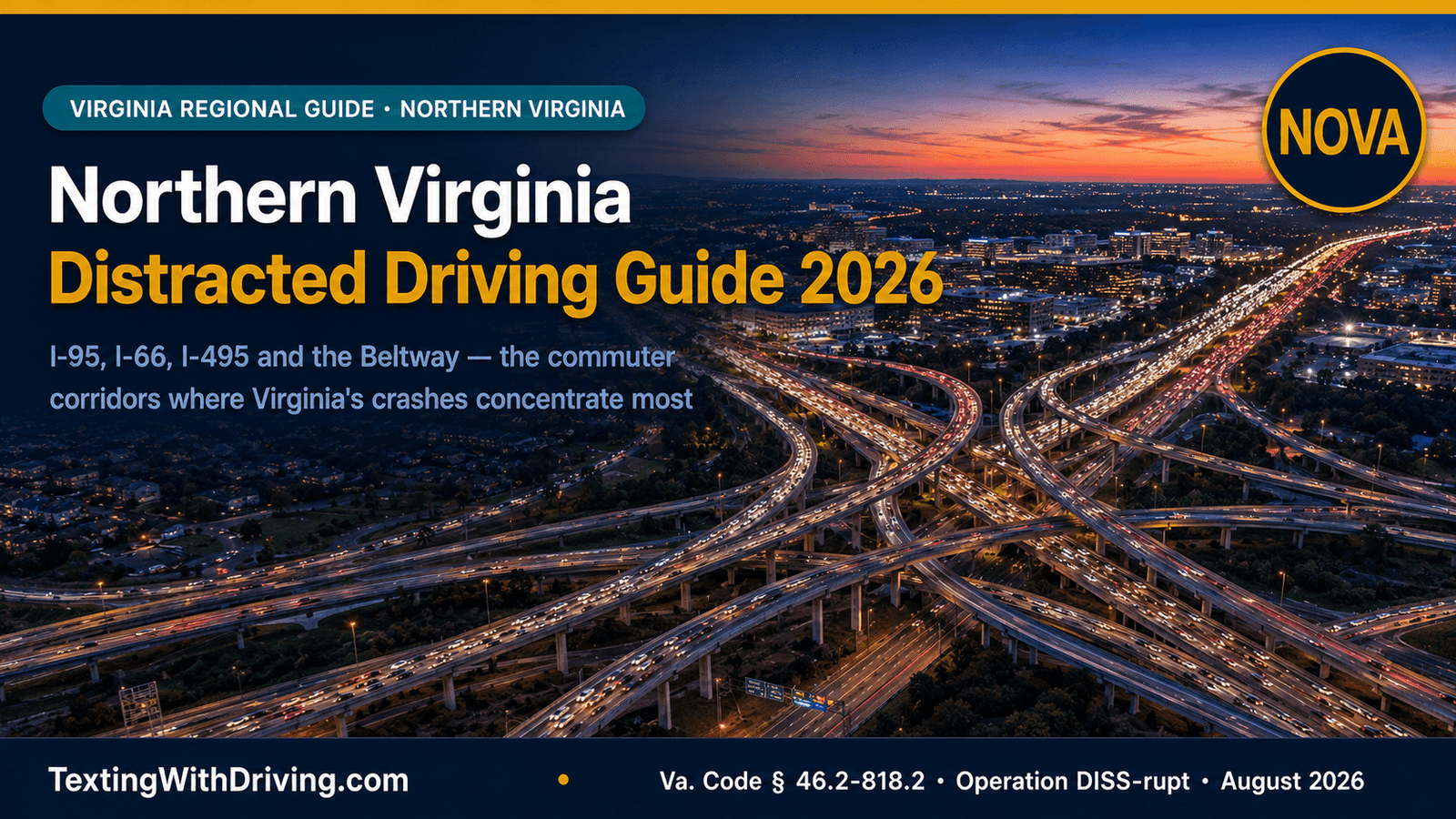
Northern Virginia Distracted Driving 2026: The I-95, I-66 and Beltway Commuter Risk Guide
Northern Virginia distracted driving crashes are not distributed evenly across the Commonwealth. They concentrate — heavily, measurably, and with specific geographic precision — in the corridor of counties and highway segments that every Northern Virginia commuter navigates daily. Fairfax County, Loudoun County, and Prince William County together represent three of the seven highest distracted driving crash jurisdictions in all of Virginia per Virginia DMV data. And the highway network that connects them — I-95, I-66, I-495, and the matrix of high-speed arterials threading between — is the specific road environment where the vast majority of that crash concentration occurs.
In 2024, there were 18,688 crashes, 73 fatalities, and 10,222 injuries attributed to a distracted driver statewide in Virginia. A disproportionate share of those crashes occurred in Northern Virginia, in exactly the counties and on exactly the highway corridors covered in this guide. Cell phone distraction rose 3 percent from 2023 to 2024 even with Virginia’s hands-free law in primary enforcement — and that rise is most visible in the dense commuter traffic of the Northern Virginia metro corridor where notification pressure, navigation demands, and the social coordination demands of a complex suburban professional life create maximum phone-use temptation at exactly the moments when driving demands maximum attention.
This guide covers the specific Northern Virginia distracted driving risk landscape corridor by corridor, the enforcement operations targeting each major highway, the specific high-crash locations that Virginia crash data identifies, and the practical compliance strategy for every NOVA commuter navigating this environment in 2026.
Why Northern Virginia Produces Virginia’s Highest Distracted Driving Crash Concentration
Virginia’s official crash data confirms what we experience on the road: the Northern Virginia region bears an outsized share of collisions due to its sheer volume, complex interchanges, and aggressive driving behaviors under congestion.
The structural reasons for Northern Virginia’s crash concentration are specific and well-documented:
Vehicle miles traveled. Northern Virginia’s three primary counties — Fairfax, Loudoun, and Prince William — collectively produce more daily vehicle miles traveled than any other region of comparable size in Virginia. The combination of bedroom community density, long-distance commuting to the DC metro employment centers, and through-traffic on the East Coast’s primary north-south artery (I-95) creates a daily driving volume that multiplies every risk factor.
Interchange complexity. The Springfield Mixing Bowl where I-95, I-395, I-495, and the Franconia-Springfield Parkway converge is one of the most complex highway interchanges in the eastern United States. The I-66/I-495 interchange at Tysons Corner, the I-95/Dulles Toll Road approach, and the Route 7/I-495/I-66 corridor near Falls Church all create navigation demands that drive phone use. When a driver is unsure which of six lanes to be in for the next interchange decision in 400 meters, they reach for the phone. That reach is a primary offense under Virginia Code § 46.2-818.2 regardless of the navigation justification.
Professional notification load. Northern Virginia has one of the highest concentrations of federal government employees, defense contractors, technology company workers, and professional services firms of any region in the United States. The notification pressure on NOVA commuters — from federal agency communications, contractor project management systems, LinkedIn, professional email — is among the highest of any commuter population in the country. Every one of those notifications creates a check impulse during the morning and evening commute.
Unfamiliar driver presence. Northern Virginia’s rapid population growth means a large share of drivers are relatively new to the specific road network. New residents from other states, particularly from states without comprehensive hands-free laws, bring different driving phone-use habits and different familiarity with NOVA’s specific interchange patterns.
The I-95 Corridor: Virginia’s Highest-Volume Distracted Driving Risk Zone
I-95 in Virginia carries more daily traffic than any other highway in the Commonwealth. From the Occoquan River in Prince William County north through Fairfax County to the DC line, this corridor produces the highest absolute crash counts of any Virginia highway segment.
In 2022 alone, over 3,000 accidents were recorded on I-95, with Fairfax County registering the highest number at 1,055 incidents. Drivers are advised to exercise extra caution when traveling along this route due to frequent and severe accidents.
I-95 in Northern Virginia creates specific Northern Virginia distracted driving risk conditions that differ from most other highway environments:
Stop-and-go speed variance. I-95 through Northern Virginia during peak hours experiences dramatic speed variance — speeds dropping from 65 mph to complete stops in moments, then accelerating again. The stop periods create exactly the conditions where drivers pick up their phones, and the subsequent acceleration creates the scenario where the phone is still in hand or the driver’s attention is still divided when speed returns to highway levels.
The HOV and Express Lane complexity. The I-95 Express Lanes (95 Express) and the HOV designations create navigation decisions that require active attention to signs, toll systems, and lane assignment throughout the Northern Virginia segment. A driver unfamiliar with whether their vehicle qualifies for HOV-2 or HOV-3 on a given segment may reach for their phone to look up the current HOV requirements while traveling at highway speed.
The Occoquan, Woodbridge, and Dale City segments. Prince William County’s I-95 corridor is the primary commuter route connecting the Prince William County bedroom communities to the DC metro employment centers. Prince William County is one of the seven highest distracted driving crash counties in Virginia per Virginia DMV data, and the I-95 corridor is the primary crash concentration zone within the county.
Operation Disrupt launching in February 2026 then expanding to Interstate 95 specifically targeted distracted driving, impaired driving, speeding, and seatbelt safety as the four primary causes of fatal crashes. The I-95 expansion of Operation Disrupt in 2026 represents one of the most sustained enforcement presence on any Virginia highway corridor.
The I-66 Corridor: Operation DISS-rupt’s Primary Target
Interstate 66 carries Northern Virginia’s east-west commuter traffic from the Shenandoah Valley through Gainesville, Manassas, Centreville, Fairfax, Falls Church, and Arlington to the Theodore Roosevelt Bridge entering Washington DC. Its 76-mile Virginia length makes it one of the most heavily enforced corridors in the Commonwealth.
Virginia State Police said they will increase enforcement on all 76 miles of Interstate 66. The Operation DISS-rupt initiative will focus on distracted driving, impaired driving, speeding, and seat belt safety.
DRIVE SMART Virginia partnered with the I-66 Express Mobility Partners to bring four engaging driver’s education assemblies to Fairfax and Prince William Counties with the ThinkFast Interactive program.
Operation DISS-rupt deploys the Virginia State Police Culpeper Division and Fairfax Division simultaneously across the entire 76-mile I-66 corridor. This coordinated multi-division deployment creates an enforcement presence density that is unusual even by Virginia State Police standards — every segment of I-66 from the Shenandoah Valley foothills to the DC border is simultaneously patrolled during Operation DISS-rupt windows.
The August timing of Operation DISS-rupt is not coincidental. The middle of August is a perfect time to focus on promoting highway safety with schools starting back up, and people getting in their last-minute vacations. The back-to-school period in Northern Virginia produces a specific traffic pattern change: dramatically increased school bus frequency on feeder roads, new school zone speeds and hours in effect, and a large volume of families making end-of-summer trips. All of these factors combine with the established commuter traffic to create August’s specific Northern Virginia distracted driving risk environment.
For NOVA commuters on I-66, the practical implication of Operation DISS-rupt is clear: August is the month when the probability of being observed and cited for a hands-free violation on I-66 is highest. The 76-mile corridor is saturated with enforcement specifically targeting phone use during exactly the back-to-school window when this guide is published.
The I-495 Capital Beltway: Fairfax County’s Crash-Dense Ring Road
Interstate 495 — the Capital Beltway — forms the ring road around Washington DC, with approximately 35 miles of its Virginia segment running through Fairfax County. The Beltway is simultaneously one of the most critical commuter routes in the region and one of the most complex driving environments in the country.
Fairfax County sits at the heart of Northern Virginia’s network — Beltway (I-495), I-66, I-95/I-395, Route 7, Route 50, and the Dulles Toll Road all cut through it. That mix of high-speed traffic, constant merges, and dense commuting routinely puts Fairfax at or near the top in total crashes statewide.
The Beltway’s specific crash concentration points in Fairfax County are well-documented in Virginia crash data and in the Northern Virginia legal community’s firsthand experience:
The Springfield Mixing Bowl (I-95/I-395/I-495 interchange). The most complex interchange in Northern Virginia, where drivers must make rapid lane decisions across multiple simultaneous merge conflicts. A sudden brake check at the Beltway, a risky merge near Tysons, and a tractor-trailer drifting across lanes on I-95 are the most common crash scenarios documented at this interchange.
The Tysons Corner corridor (I-495 between Route 7 and Route 123). With I-495, VA-7 (Leesburg Pike), and VA-123 (Chain Bridge Road) converging amid dense retail development, Tysons creates constant weave conflicts. Many collisions happen when drivers try to cross multiple lanes quickly for exits at the Tysons cluster. A driver reaching for their phone to confirm which exit serves their Tysons destination is creating exactly the conditions that produce lane-change collisions in this environment.
The I-66/I-495 interchange at Merrifield. The connection between I-66 and the Beltway at the Merrifield area is another high-concentration crash location where the navigation complexity of choosing between I-66 east into DC, I-66 west toward Prince William County, or continuing on I-495 north or south creates the phone-reach behavior that primary enforcement targets.
Drivers can be pulled over for hands-free violations, and police in Loudoun County may begin more actively stopping drivers solely for violating the hands-free law. The same pattern applies in Fairfax County and throughout the Beltway corridor — primary enforcement authority means any trooper who observes a driver holding a phone on any segment of I-495 can initiate a stop without any other violation.
The Dulles Corridor: Route 7, Route 28, and the Dulles Toll Road
The Dulles corridor — connecting Tysons Corner through Reston, Herndon, Sterling, and Ashburn to Dulles International Airport and the Loudoun County tech cluster — creates a specific Northern Virginia distracted driving risk environment that differs from the I-95 and I-66 situations.
The Dulles Toll Road (VA-267) and its parallel surface routes carry some of the highest-income professional commuter populations in the country — technology workers from the Loudoun County data center corridor, Amazon’s HQ2 employees, federal contractors, and Dulles airport staff. This professional population faces the same notification load we described for the broader Northern Virginia commuter base, amplified by the specific demands of tech-sector work culture where constant connectivity is both a professional expectation and a personal habit.
Loudoun County is one of Virginia’s fastest-growing counties and one of the seven highest distracted driving crash jurisdictions per Virginia DMV data. The distracted driving crash concentration in Loudoun reflects the combination of rapid population growth (producing a driver population with many newer residents unfamiliar with the specific road network), high professional notification load, and the specific navigation demands of the Route 7, Route 28, and VA-267 corridors.
Enforcement of Virginia’s hands-free driving law is ramping up specifically in Loudoun County in 2026. Drivers in Ashburn and throughout Loudoun County may be experiencing more active enforcement as Virginia State Police and Loudoun County Sheriff’s deputies increase focused distracted driving enforcement in response to the continuing rise in distracted driving crashes and the 3 percent year-over-year cell phone distraction increase documented in 2024.
What Operation DISS-rupt Means for Commuters Right Now
Operation DISS-rupt is the Virginia State Police enforcement initiative most directly relevant to Northern Virginia distracted driving in August 2026. The operation deploys both the Culpeper Division (covering western I-66 from the Shenandoah Valley to Gainesville and Manassas) and the Fairfax Division (covering eastern I-66 from Centreville through Falls Church to the DC line) simultaneously.
The operation’s goal is to reduce fatal crashes on Virginia interstates for the year by 10 percent. Ditch distractions: Virginia has a hands-free law that prohibits a driver from holding a handheld personal communications device while driving.
The practical enforcement mechanics of Operation DISS-rupt for NOVA commuters are:
Unmarked vehicle deployment. In 2025, Virginia law enforcement ramped up efforts to catch distracted drivers using unmarked vehicles, cameras, and roadside patrols to spot violations. Officers are trained to spot even subtle signs of phone use. The unmarked vehicle component specifically addresses the detection-avoidance behavior where drivers put their phone down when they see a marked patrol car. An unmarked vehicle traveling at traffic speed provides no visual cue that triggers the put-down behavior.
Elevated position observation. Officers observing traffic from elevated positions — overpasses, on-ramps, the higher vantage points of NOVA’s complex interchange structures — can observe phone-holding behavior through vehicle windows that would be invisible to a road-level patrol car. This is the same elevated-position technique that Minnesota deployed on buses for its April 2026 campaign, as we covered in our Minnesota distracted driving law article.
Multi-violation stops. Operation DISS-rupt targets distracted driving, impaired driving, speeding, and seatbelt compliance simultaneously. A driver who is exceeding the speed limit while holding a phone may face both a speeding citation and a hands-free violation from a single traffic stop. Virginia State Police issued reckless driving citations to 28 drivers and speeding citations to 69 drivers during one Operation DISS-rupt deployment on I-66.
The Navigation Trap: When GPS Use Becomes a Violation
One of the most practically important Northern Virginia distracted driving compliance issues for commuters is the navigation trap — the scenario where a driver believes they are using GPS legally but is actually violating the hands-free law.
GPS navigation is legal in Virginia when the device is mounted and the destination is pre-set before the vehicle moves. The violation occurs when a driver who is not sure which exit to take reaches for their phone while moving to adjust the route, zoom in on the map, search for a destination, or read the navigation instructions in detail.
This is particularly relevant on NOVA’s complex interchange corridors. A driver approaching the Springfield Mixing Bowl who is uncertain about which lane leads to I-95 north versus I-395 into DC, who picks up their phone to look at the navigation map at 60 mph, has made a handheld device contact that is a primary offense under Virginia Code § 46.2-818.2. The navigation destination and the navigation purpose do not create an exception. The exception is the device being mounted — not being held.
The practical solution is the one that Virginia’s DISS-rupt campaign messaging specifies: GPS and making phone calls are still legal as long as the device is mounted and not in your hands. A mounted phone with the correct destination entered before leaving home or the office handles every navigation demand on every I-66 interchange, every Beltway split decision, and every Springfield Mixing Bowl lane choice without any violation risk.
The Enforcement Reality for NOVA Commuters in August 2026
The Northern Virginia distracted driving enforcement environment in August 2026 is more intensive than at any prior point in recent years, for three converging reasons:
Operation Disrupt expanding to I-95 and I-66 in 2026. The February 2026 launch on I-64 with planned expansion to I-95, I-81, and I-66 means NOVA’s primary corridors are within the 2026 expansion targets.
Increased Loudoun County enforcement. Specific enforcement escalation in Loudoun County cited in January 2026 attorney guidance targeting Ashburn and Loudoun generally.
August back-to-school enforcement tradition. Operation DISS-rupt has historically deployed in August for the back-to-school period, deploying all 76 miles of I-66 simultaneously with Culpeper and Fairfax VSP divisions.
Virginia law enforcement is using unmarked vehicles, cameras, and roadside patrols to spot violations. The combination of unmarked vehicles, elevated observation positions, and primary enforcement authority means that the NOVA commuter who relies on being able to spot a marked patrol car before putting their phone down is operating on an assumption that no longer accurately describes the enforcement environment.
The Compliance Standard Every NOVA Commuter Needs Before Every Drive
The Northern Virginia distracted driving compliance standard under Virginia Code § 46.2-818.2 is the same for every Virginia road and every Virginia commuter. But the specific NOVA commuter context — complex interchanges, high notification load, professional social coordination pressure — makes the pre-drive setup more important than anywhere else in the Commonwealth.
The pre-drive setup that eliminates all compliance risk on any NOVA corridor:
Phone mounted before leaving the parking space. Not in the cupholder — mounted on the dashboard or windshield where it displays navigation without requiring reach or touch while moving.
Navigation destination entered before moving. Every exit on the Springfield Mixing Bowl, every Tysons interchange decision, every I-66/I-495 split — all handled by a pre-set navigation route with no touching required while the vehicle is in motion.
Bluetooth connected for all calls. The vehicle’s Bluetooth system or a Bluetooth earpiece handles all incoming and outgoing calls without any phone interaction.
Driving Focus or Android driving mode active. Every notification silenced automatically. Every sender receives an auto-reply. The professional notification pressure that makes NOVA commuters reach for their phones is neutralized by technology before the temptation can compete with driving attention.
Phone in back seat if not using navigation. For commuters who know their route without navigation assistance, the back seat eliminates the reach impulse entirely.
For the complete technology setup that makes this pre-drive standard automatic, our hands-free while driving complete setup guide covers iPhone, Android, Bluetooth, and CarPlay from scratch in under 10 minutes. For the specific Virginia law provisions that apply across all of these corridors, our Virginia distracted driving law covers Va. Code § 46.2-818.2 in full including the reckless driving criminal upgrade pathway. And for the complete Virginia distracted driving statistics showing where Northern Virginia sits in the statewide picture, our Virginia distracted driving statistics 2026 covers the full data picture.
Sources Used in This Article
All links verified working before publication.
Nova Injury Lawyers: Enforcement of Virginia’s Hands-Free Driving Law in 2026 — 18,688 crashes 2024, Loudoun County enforcement escalation 2026, primary offense authority, unmarked vehicle enforcement, January 2026
Shin Law Office: Where Northern Virginia Crashes Happen Most — Fairfax County at or near top statewide, Springfield Mixing Bowl, Tysons weave conflicts, I-95 tractor-trailer lane drift, March 2026
Jennifer Porter Law: Where Do Most Crashes Happen in Virginia — 3,000 I-95 accidents 2022, Fairfax County 1,055 I-95 incidents, December 2025
Augusta Free Press: Virginia State Police to Step Up Enforcement on I-66 — Operation DISS-rupt 76 miles I-66, Culpeper and Fairfax divisions, 10% fatality reduction goal, August 2025
Patch: More Police Traffic Enforcement Planned on I-66 in Northern Virginia — Operation DISS-rupt August 16-17, 28 reckless driving and 69 speeding citations issued, Captain Jones quote, August 2024
WTVR: Virginia State Police Launch Operation Disrupt February 2026 — February 2026 I-64 launch, I-95 I-81 I-66 planned expansion, 46 deaths January 2026, February 2026
Fauquier Now: Virginia State Police to Increase Patrols on I-66 — GPS and calls legal if mounted, ditch distractions messaging, August 2024
VTrans: Virginia’s Hands Free Law 2025 — Unmarked vehicles cameras roadside patrols, officers trained for subtle signs, August 2025
DRIVE SMART Virginia: Annual Report 2025 — I-66 Express Mobility Partners, ThinkFast Interactive Fairfax and Prince William Counties, 33 teen deaths 2025
VDOT: Heads Up End Distracted Driving — 18,688 crashes 73 fatalities 10,222 injuries 2024, cell phone distraction rose 3%
Virginia DMV Distracted Driving Toolkit — Ages 21-35 most frequent, top 7 counties including Fairfax Loudoun Prince William
TextingWithDriving.com is professionally built and maintained to ensure accurate, accessible safety information reaches every driver who needs it. Website development and ongoing support is handled by Budgetic, a digital agency specializing in purpose-driven WordPress websites.

About Texting With Driving
TextingWithDriving.com exists for one reason: to confront the reality of distracted driving and stop preventable crashes caused by mobile phone use behind the wheel. Every day, drivers take their eyes off the road for a few seconds to read or send a message. Those few seconds are enough to cause life-altering consequences. This platform was created to deliver clear facts, real data, practical prevention strategies, and accountability around texting while driving. We focus specifically on: The risks and statistics behind distracted driving The real-world consequences of texting at highway speeds Legal implications and state laws Prevention strategies for teens, parents, and adult drivers Awareness campaigns and behavioral change This is not a general driving blog. It is a focused awareness initiative built around one critical issue: phone distraction behind the wheel. Our content is direct, research-driven, and practical. We prioritize accuracy over opinion and education over sensationalism. The goal is simple — reduce distracted driving incidents by increasing awareness and responsibility. If one article causes one driver to put their phone down, the mission is working. For inquiries or partnerships, contact: privacy@textingwithdriving.com
View all posts by Texting With Driving
