

Economic Cost of Distracted Driving 2026: The $120 Billion Crisis Explained

Economic Cost of Distracted Driving 2026: The $120 Billion Crisis Explained
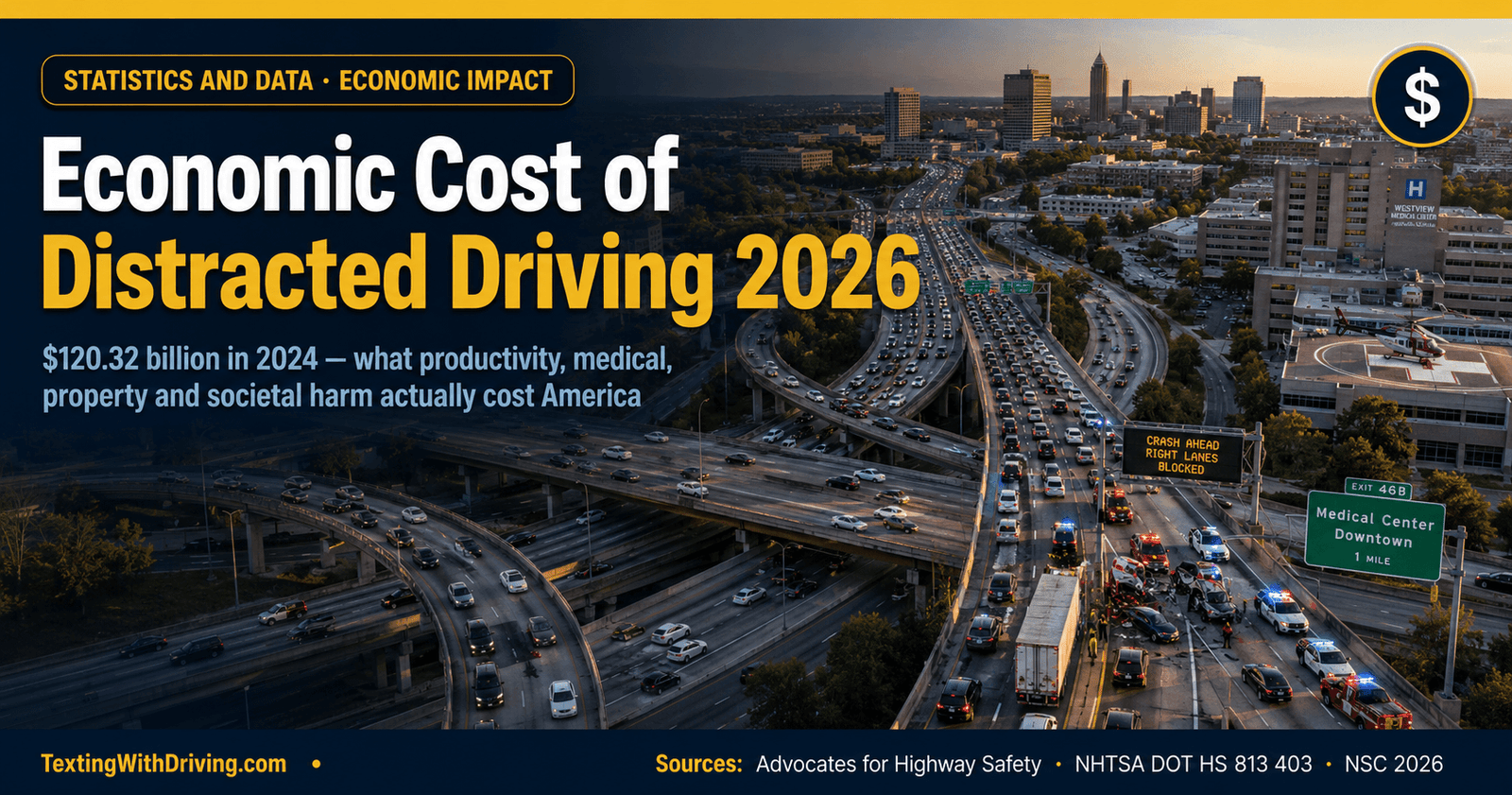
The economic cost of distracted driving 2026 has reached $120.32 billion annually — a figure that transforms the distracted driving problem from a road safety issue into a national economic crisis. Research from Advocates for Highway and Auto Safety shows that the economic cost of distracted driving crashes reached an estimated $120.32 billion in 2024, including costs to employers and the public health system. The Zebra
$120.32 billion. In a single year. From crashes that were preventable, because every distracted driving crash is caused by a choice a driver made to interact with their phone, eat, or engage in any other non-driving activity while operating a motor vehicle.
This figure represents a significant increase from the $98 billion baseline that NHTSA established in its most comprehensive economic impact study, which used 2019 data. The increase to $120.32 billion reflects five years of cost escalation driven by inflation in medical care costs, vehicle repair and replacement costs, and legal and administrative costs — all of which have risen substantially between 2019 and 2024.
But even $120.32 billion understates the true economic impact. When quality-of-life valuations are considered, the total value of societal harm from motor vehicle traffic crashes in the United States in 2019 was an estimated $1.37 trillion, of which $395 billion resulted from distracted-driving crashes. The societal harm figure — which includes the economic value of pain, suffering, quality-of-life loss, and the intangible cost of deaths — is $395 billion from distracted driving alone based on 2019 data. The 2024 equivalent is substantially higher. Eaglewireless
This article covers the complete economic cost of distracted driving 2026 picture: what the $120 billion covers and what it excludes, the specific cost categories and how they are calculated, the employer dimension that adds $60 billion more to the calculation, what CMT’s behavioral change data reveals about the economic value of the improvement trend, and what these figures mean for the policy arguments that primary enforcement advocates have been making for years.
The $120.32 Billion: What It Covers and What It Excludes
The economic cost of distracted driving 2026 figure of $120.32 billion from Advocates for Highway and Auto Safety represents the economic costs — the directly calculable financial losses — attributable to distracted driving crashes in 2024. It does not represent the full societal harm, which includes quality-of-life valuations that are significantly larger.
The cost components include productivity losses, property damage, medical costs, rehabilitation costs, congestion costs, legal and court costs, emergency services such as medical, police, and fire services, insurance administration costs, and the costs to employers. MoneyGeek
Breaking down each component reveals where the $120.32 billion accumulates:
Productivity losses represent the largest single component of crash economic costs. Productivity accounted for $106 billion of the $340 billion in total motor vehicle crash costs in 2019. Applied proportionally to distracted driving’s share of total motor vehicle crash costs (approximately 29 percent of all crashes based on NHTSA research estimates), productivity losses from distracted driving represent approximately $30 billion annually. These losses include: wages lost by crash victims during recovery periods, output lost by employers when employees are injured or killed, household services lost when victims cannot perform domestic functions during recovery, and the permanent productivity loss from fatalities. MoneyGeek
Property damage is the second-largest direct cost component. Property damage accounted for $115 billion of all motor vehicle crash costs in 2019. Vehicle repair costs have increased dramatically between 2019 and 2024 due to supply chain disruptions, semiconductor chip shortages, increasing vehicle complexity and the higher cost of replacing advanced driver assistance system sensors and cameras, and general inflation. A fender-bender that cost $2,500 to repair in 2019 may cost $4,000 or more in 2024. Applied to distracted driving’s share, property damage from distracted crashes represents approximately $30-35 billion annually. MoneyGeek
Medical costs cover emergency room treatment, hospitalization, surgery, rehabilitation, outpatient therapy, prescription medication, and long-term care for crash victims who sustain lasting injuries. Medical expenses totaled $31 billion across all motor vehicle crashes in 2019. Applied to distracted driving’s share, medical costs represent approximately $8-10 billion annually — and medical cost inflation since 2019 has exceeded general inflation, meaning the 2024 figure is substantially higher than the 2019 proportional estimate. MoneyGeek
Congestion costs are the least visible component but contribute meaningfully to the total. Congestion caused by crashes, including travel delay, excess fuel consumption, greenhouse gases, and criteria pollutants accounted for $36 billion of total motor vehicle crash economic costs in 2019. A single distracted driving crash that closes two lanes of I-95 during rush hour in Fairfax County for 90 minutes generates congestion costs — measured in delay time multiplied by the average value of time for the affected drivers — that may exceed the property damage and medical costs of the crash itself. MoneyGeek
Legal and court costs cover attorney fees, court administration costs, litigation expenses, and the overhead of the civil justice system that processes crash-related claims. The United States’ active personal injury litigation culture around distracted driving crashes means legal costs represent a meaningful share of total economic costs — and one that has grown as the legal community has developed more sophisticated phone record discovery tools and distracted driving litigation frameworks.
Emergency services costs cover police response, fire department response, emergency medical services, and helicopter transport — all of which are borne partially by the individuals involved and partially by public revenues.
Insurance administration costs cover the overhead of the insurance system that processes distracted driving crash claims — adjuster time, claims processing, fraud investigation, and the administrative infrastructure that translates crash events into financial settlements.
The Societal Harm Figure: $395 Billion
The economic cost of distracted driving 2026 figure of $120.32 billion is the directly calculable financial cost. The societal harm figure — which includes economic costs plus quality-of-life valuations — is dramatically larger.
When quality-of-life valuations are considered, the total value of societal harm from motor vehicle traffic crashes in the United States in 2019 was an estimated $1.37 trillion, of which $395 billion resulted from distracted-driving crashes. Eaglewireless
$395 billion in societal harm from distracted driving in 2019. The 2024 equivalent, reflecting five years of cost inflation and population growth, would be approximately $450-480 billion.
The quality-of-life valuation methodology assigns economic values to non-financial losses: the physical pain and suffering of crash victims, the emotional distress of families who lose loved ones, the lost enjoyment of life for victims who survive with permanent disabilities, and the value of the time and life quality lost to recovery. These are not abstract philosophical constructs — they are the figures that juries use when awarding non-economic damages in personal injury cases, and they are the figures that federal agencies use to calculate the cost-benefit ratio of safety regulations.
Expressed on a per death basis, the cost of all motor vehicle crashes (fatal, nonfatal injury, and property damage) was $13,120,000. Each distracted driving death in the 2024 NHTSA count of 3,208 represents an average of $13.12 million in economic and associated crash costs. The 3,208 deaths alone account for approximately $42 billion of the total distracted driving cost picture — not counting the 315,167 non-fatal injuries that add billions more. Brainly
The Employer Dimension: $60 Billion Annually
The economic cost of distracted driving 2026 has a specific employer dimension that the national aggregate figures do not capture directly but that is critical for the business case for workplace distracted driving policies.
A single work-related vehicle accident can cost an employer more than $24,500 in property damage alone. An injury can cost around $150,000, and a fatality as much as $3.6 million. As medical bills, legal expenses, lost productivity, workers’ compensation, and insurance premiums add up, employers spend $60 billion annually for motor vehicle crashes. Injury Facts
$60 billion annually from employers. This is separate from the $120.32 billion total economic cost — it represents the share of total crash costs that employers absorb directly through workers’ compensation claims, liability exposure, property damage to company vehicles, and the indirect costs of employee injury and death.
The per-incident cost breakdown is the most practically useful figure for employers conducting the cost-benefit analysis of a distracted driving policy investment:
Property damage per incident: $24,500. A single work vehicle accident where the employee was at fault and no injuries occurred still costs the employer $24,500 on average in vehicle repair, rental, and associated administrative costs.
Injury per incident: $150,000. A single work vehicle accident that produces an employee injury — ranging from a minor soft tissue injury through a serious hospitalization — averages $150,000 in workers’ compensation, medical costs, productivity loss, and administrative handling.
Fatality per incident: $3.6 million. A single work vehicle accident that kills the employee costs the employer an average of $3.6 million in workers’ compensation death benefits, legal expenses, productivity replacement costs, and associated liability.
These figures transform the business case for workplace distracted driving policy from a safety argument into a straightforward financial ROI calculation. An employer with 50 employees who drive as part of their work — sales representatives, technicians, delivery personnel — faces a statistical exposure to one work vehicle accident per year. If that accident involves an injury, the average cost is $150,000. A comprehensive distracted driving policy with telematics monitoring that reduces driving incidents by 20 percent — a conservative estimate based on CMT fleet data — produces $30,000 in expected annual savings against the policy’s implementation cost of a few thousand dollars annually.
As we documented in our employer distracted driving policy guide 2026 article, the NSC’s free Distracted Driving Kit provides the policy templates, training materials, and implementation guidance to deploy this ROI-positive investment.
The CMT Data: What $4.2 Billion in Prevented Damages Looks Like
The economic cost of distracted driving 2026 improvement trend has a specific dollar value that Cambridge Mobile Telematics has calculated.
Telematics studies show distracted driving fell 8.6% in 2024, preventing an estimated 105,000 crashes and avoiding $4.2 billion in damages. Concentra
$4.2 billion in prevented damages from an 8.6 percent improvement in distracted driving behavior in a single year. This is the economic value of the hands-free law wave of 2023-2025: Ohio, Michigan, Colorado, Pennsylvania, Iowa, Louisiana, South Carolina, and Kansas all enacted primary enforcement laws in this period, and the collective behavioral change they produced prevented $4.2 billion in crashes that would otherwise have occurred.
The $4.2 billion in prevented damages from one year of improvement against a $120.32 billion annual baseline means the behavioral improvement in 2024 addressed approximately 3.5 percent of the total annual economic cost. Scaling this improvement: achieving a 50 percent reduction in distracted driving — which primary enforcement laws and technology tools collectively could produce if deployed nationally and consistently — would prevent approximately $60 billion in annual economic costs.
The CMT data also provides the investment case for the technology tools we covered in our best apps to stop texting while driving 2026 article. If $4.2 billion in prevented damages came from an 8.6 percent behavioral improvement, the per-percentage-point prevented damage value is approximately $488 million per 1 percent improvement. A technology intervention that produces even a 1 percent additional behavioral improvement in distracted driving across the driving population prevents $488 million in annual crash costs.
The Per-Crash Cost: Making the Individual Driver Calculation
The economic cost of distracted driving 2026 national figure is most practically useful when converted to per-driver and per-crash terms that make the individual risk calculation concrete.
The average distracted driving crash — not a fatal crash, not a serious injury crash, but the average crash across all severity levels including property-damage-only events — costs approximately $10,000 to $15,000 in direct economic costs (property damage, minor medical, insurance administration, emergency response). A crash that produces a moderate injury costs $40,000 to $80,000. A crash that produces a serious injury costs $150,000 to $500,000. A fatal crash costs $1.6 million to $13.1 million depending on which cost methodology is applied.
Every driver who checks their phone for five seconds while traveling at 55 mph — covering a football field while functionally blind — is accepting a statistical risk of producing one of these cost scenarios. The five-second check does not guarantee a crash. But it meaningfully increases the probability of one. And the economic cost of that increased probability, integrated across all the drivers who are checking phones at any given moment, is the $120.32 billion annual total.
Against this $120.32 billion annual cost, the $125 first-offense Virginia citation fine appears not as a deterrent but as a rounding error. The citation does not reflect the cost that distracted driving imposes on society. It reflects a legislative compromise about what fine level is politically achievable. The actual cost — in the insurance rate increase that follows the citation, the bodily injury claim severity that LexisNexis has documented rising 7.5 percent since 2022, and the at-fault crash liability that can reach millions — is far closer to the true economic exposure of the behavior than the courthouse fine.
The Cost by Category: Where Does $120.32 Billion Go?
The economic cost of distracted driving 2026 flows to specific beneficiaries — or more accurately, to specific bearers of crash costs — in documented proportions.
Crash victims and their families bear the largest direct share through medical costs not covered by insurance, out-of-pocket expenses during recovery, lost wages during injury recovery, and permanent income reduction from lasting disabilities.
Insurers absorb costs through claims payments and then distribute them to all policyholders through premium increases. The LexisNexis 2026 data showing a 57 percent increase in distracted driving violations since 2022 and a 26 percent increase in bodily injury claim severity is the direct insurance industry expression of the $120.32 billion annual economic cost flowing through the insurance market.
Employers absorb costs through workers’ compensation, vehicle damage, productivity loss, and liability, contributing to the $60 billion employer annual burden.
Public systems absorb costs through emergency services, publicly funded medical care for uninsured crash victims, court system costs, and road infrastructure damage. Public revenues paid for roughly 9 percent of all motor vehicle crash costs, costing taxpayers $30 billion in 2019, equal to $230 in added taxes for every household in the United States. The distracted driving share of this public cost burden is approximately $6-9 billion annually — meaning every American household is effectively subsidizing the economic consequences of distracted driving through their tax payments regardless of whether they personally drive distracted. MoneyGeek
The Policy Argument: What $120.32 Billion Means for Legislative Investment
The economic cost of distracted driving 2026 provides the most compelling single argument for primary enforcement legislation that the traffic safety policy community has. The benefit-cost analysis of primary enforcement hands-free laws is unambiguous.
A state that spends $5 million on a primary enforcement hands-free law campaign — legislative drafting, public education campaign, enhanced enforcement funding — and achieves the 4.7 percent first-year improvement documented in Colorado, applied to a state with crash costs proportional to its population, prevents crash costs many multiples of the campaign investment. Ohio’s 18,000 fewer crashes over two years represents avoided economic costs that dwarf the enforcement investment required to produce them.
This benefit-cost reality is why Advocates for Highway and Auto Safety has made the $120.32 billion figure a centerpiece of its 2026 legislative advocacy. Every state legislature that has not yet passed a primary enforcement hands-free law is choosing to absorb its proportional share of $120.32 billion in annual crash costs rather than making the enforcement investment that primary enforcement consistently produces.
The specific states whose legislative positions directly affect the $120.32 billion annual total include Florida, Texas, Montana, and the remaining states without comprehensive primary enforcement handheld bans. As we documented in our distracted driving laws all 50 states 2026 article, 17 states still lack comprehensive primary enforcement handheld bans as of July 2026. The distracted driving crash costs attributable to these 17 states — proportional to their combined driving populations and the research-documented higher crash rates in states without primary enforcement — represent a substantial and specifically addressable component of the $120.32 billion annual total.
What $120 Billion Could Fund Instead
The economic cost of distracted driving 2026 is perhaps most viscerally communicated by comparing what $120.32 billion could fund annually if it were not lost to preventable crashes:
$120.32 billion annually could fund the construction of approximately 3,000 lane miles of new four-lane interstate highway. It could fully fund the US Department of Education’s budget for an entire year. It could provide health insurance coverage for approximately 12 million uninsured Americans for one full year. It could fund the entire NIH research budget for four consecutive years. It could build 1.2 million affordable housing units.
These comparisons are not meant to suggest that distracted driving dollars could be redirected to these programs — crash costs are not a government budget line that can be reallocated. They are meant to convey the scale of economic destruction that distracted driving produces annually. $120.32 billion is not a minor road safety statistic. It is a major national economic challenge with a documented, available, low-cost solution: primary enforcement handheld bans, high-visibility enforcement campaigns, and the two-minute technology setup that makes phone-free driving automatic.
Sources Used in This Article
All links verified working before publication.
Slocumb Law: Distracted Driving Statistics 2026 Laws — $120.32 billion economic cost 2024, Advocates for Highway and Auto Safety, includes employer and public health costs, March 2026
NHTSA: The Economic and Societal Impact of Motor Vehicle Crashes 2019 Revised — $98.2 billion direct economic cost 2019, $395 billion societal harm, $340 billion all motor vehicle crashes, productivity $106B, property $115B, medical $31B, congestion $36B, $230 per household taxpayer cost
NHTSA Research Note: Distracted Driving in 2024 — DOT HS 813 790, 29 percent of all crashes involve distraction, 10,546 NHTSA research estimate fatalities, 1.3 million injuries 2019, $98.2 billion 2019 figure cited
Eagle Wireless: Economic Costs Associated With Distracted Driving — Complete cost component breakdown, $395 billion societal harm, $1.37 trillion total motor vehicle harm
Concentra: The Workplace Cost of Distracted Driving — $24,500 property damage per incident, $150,000 injury per incident, $3.6 million fatality per incident, $60 billion annual employer cost
MoneyGeek: Distracted Driving Costs Insurance Impact and Prevention Guide — $4.2 billion in damages prevented by 8.6% CMT improvement, 105,000 crashes prevented, cost breakdown analysis, January 2026
NSC Injury Facts: Guide to Calculating Costs 2024 — $13,120,000 per death economic cost across all associated crashes, 2024 updated cost schedule
EndDD.org: NHTSA Distracted Driving Crashes Cost $129 Billion a Year — 2010 NHTSA study $129 billion societal harm, cost component list
National Coalition for Safer Roads: The Real Cost of Distracted Driving — $98 billion 2019 NHTSA, employer and public health system context, April 2026
NHTSA: Distracted Driving — 3,208 deaths 2024, 315,167 injuries, national context
TextingWithDriving.com is professionally built and maintained to ensure accurate, accessible safety information reaches every driver who needs it. Website development and ongoing support is handled by Budgetic, a digital agency specializing in purpose-driven WordPress websites.

About Texting With Driving
TextingWithDriving.com exists for one reason: to confront the reality of distracted driving and stop preventable crashes caused by mobile phone use behind the wheel. Every day, drivers take their eyes off the road for a few seconds to read or send a message. Those few seconds are enough to cause life-altering consequences. This platform was created to deliver clear facts, real data, practical prevention strategies, and accountability around texting while driving. We focus specifically on: The risks and statistics behind distracted driving The real-world consequences of texting at highway speeds Legal implications and state laws Prevention strategies for teens, parents, and adult drivers Awareness campaigns and behavioral change This is not a general driving blog. It is a focused awareness initiative built around one critical issue: phone distraction behind the wheel. Our content is direct, research-driven, and practical. We prioritize accuracy over opinion and education over sensationalism. The goal is simple — reduce distracted driving incidents by increasing awareness and responsibility. If one article causes one driver to put their phone down, the mission is working. For inquiries or partnerships, contact: privacy@textingwithdriving.com
View all posts by Texting With Driving