

Richmond Virginia Distracted Driving 2026: City Statistics, Laws and What Every Driver Must Know

Richmond Virginia Distracted Driving 2026: City Statistics, Laws and What Every Driver Must Know
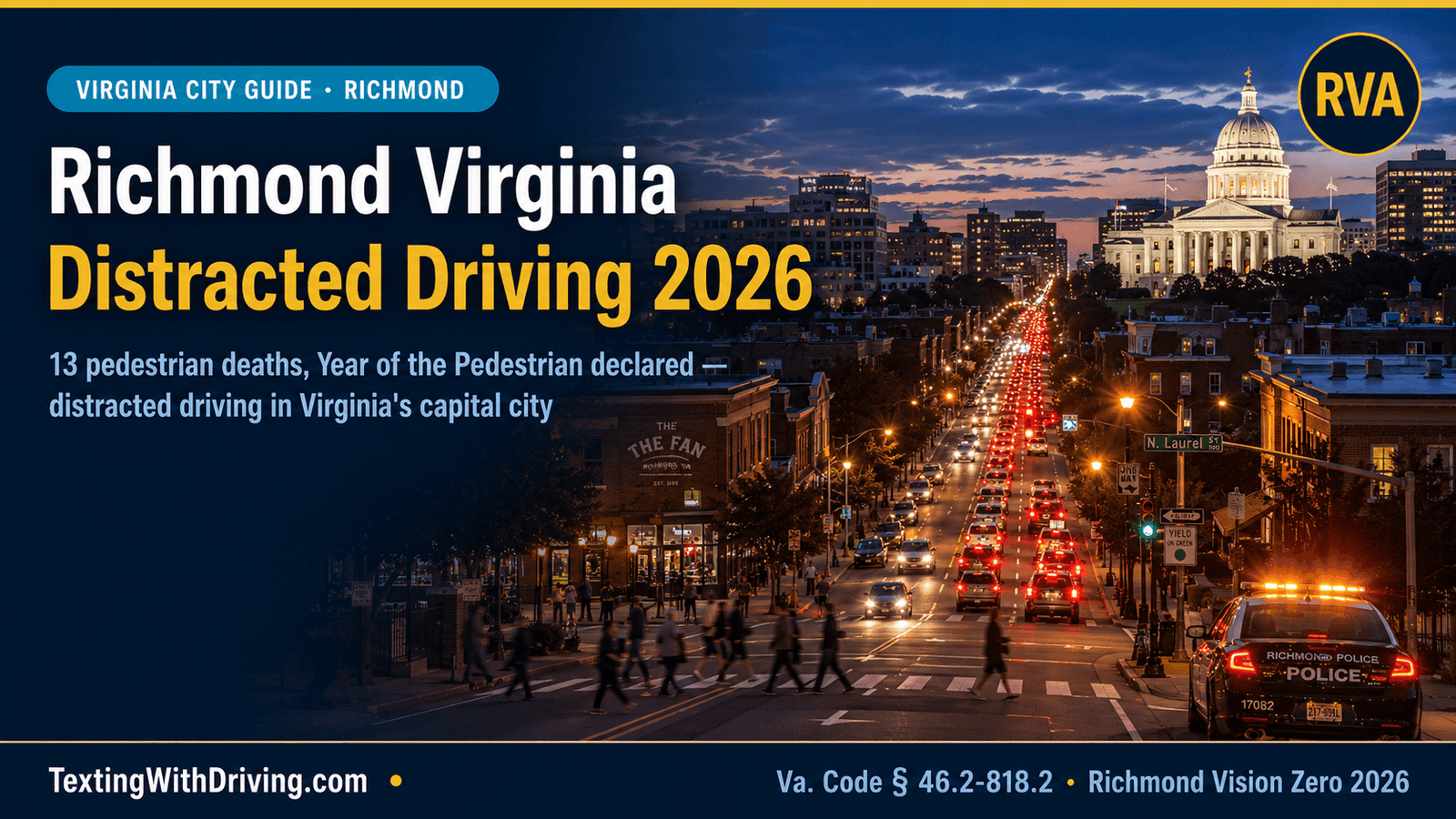
Richmond Virginia distracted driving 2026 is at the center of a citywide road safety crisis that Virginia’s capital city has responded to by declaring 2026 the Year of the Pedestrian. The declaration followed a devastating 2025 in which 13 pedestrians died on Richmond roads — the most of any Virginia locality, more than Fairfax County despite having one-fifth the population. Distracted driving, alongside speeding and impaired driving, is explicitly identified by Richmond law enforcement and traffic engineers as one of the leading causes of the pedestrian deaths and overall crash toll that make Richmond City one of the seven highest distracted driving crash jurisdictions in all of Virginia per the Virginia DMV’s own data.
This guide covers the complete Richmond Virginia distracted driving 2026 picture: the crash and fatality data, the specific corridors and intersections where distraction-involved crashes concentrate, what Richmond’s Vision Zero initiative is doing in 2026, the Virginia hands-free law provisions that apply on every Richmond road, and what every driver — resident, commuter, and visitor — needs to know before driving in Virginia’s capital city.
Richmond in Virginia’s Distracted Driving Data
The Virginia DMV’s Highway Safety Office explicitly identifies Richmond City as one of the seven highest distracted driving crash jurisdictions in the Commonwealth. Distracted driving crashes are most prevalent in Fairfax County, Loudoun County, Henrico County, Richmond City, Prince William County, Norfolk City, and Virginia Beach City.
Richmond City and Henrico County together form the Richmond metropolitan crash concentration that the Virginia DMV data captures. Henrico County — which surrounds Richmond City on three sides — shares the same commuter traffic patterns, the same I-95/I-64 corridor, and many of the same arterial roads that define the Richmond area’s crash profile.
In 2024, there were 18,688 crashes, 73 fatalities, and 10,222 injuries attributed to a distracted driver statewide in Virginia. Cell phone distraction rose 3 percent from 2023 to 2024. Richmond City and Henrico County together represent a significant concentration of those statewide crashes, concentrated on specific corridors and intersections that crash data has consistently identified over multiple years.
Richmond Police achieved a 32 percent reduction in traffic-related fatalities in 2024 — a significant improvement documented in the Virginia Association of Chiefs of Police spotlight on Richmond’s Vision Zero program. But 2025 saw 22 traffic deaths in Richmond, and the pedestrian death count of 13 represents the highest of any Virginia locality in 2025 — a data point that drove Mayor Danny Avula’s public response and the Year of the Pedestrian declaration.
The Pedestrian Crisis: 2025’s Most Alarming Richmond Data Point
The Richmond Virginia distracted driving 2026 story cannot be separated from Richmond’s pedestrian safety crisis that emerged with devastating clarity in late 2025 and early 2026.
Richmond saw a spike in fatalities early in 2026. In 2025, there were 13 pedestrian deaths in Richmond, and four have already occurred in early 2026.
The 13 pedestrian deaths in 2025 made Richmond the highest-pedestrian-death locality in Virginia — more than Fairfax County with a population five times that of Richmond. This disproportionate pedestrian death rate is directly connected to distracted driving because pedestrian crashes are among the crash types where distraction is most consequential. A driver who is looking at their phone at 20 mph on a downtown Richmond street may not have time to brake for a pedestrian entering a crosswalk, even at a low speed where a fully attentive driver would have stopped easily.
Most of the time, when we look at behavior and pedestrian injury, usually it’s the driver that’s causing problems. A lot of times it’s impaired driving; a lot of times it’s distracted driving.
Heavy traffic on I-95, Hull Street, and Semmes Avenue creates conditions where distracted drivers cause devastating crashes. Downtown intersections add pedestrians and complex traffic patterns into the mix.
The specific incidents that defined Richmond’s pedestrian crisis illustrate the intersection of distracted behavior and vulnerable road users. On January 3, 2026, Kristin Tolbert, 26, was struck by a hit-and-run driver on Semmes Avenue while walking her dog. On February 16, 2026, Hope Cartwright, 23, died from injuries when a pickup truck struck her in a crosswalk at the intersection of Second and East Cary streets in downtown Richmond. Both locations — Semmes Avenue and Second and Cary — are in the dense urban core where pedestrian activity is highest and where the gap between driver attention and pedestrian vulnerability is most consequential.
Richmond’s Vision Zero Response: What’s Happening in 2026
Richmond has committed to Vision Zero since 2017. Mayor Danny Avula reaffirmed the Vision Zero commitment in October 2025 and declared 2026 the Year of the Pedestrian following the 13 pedestrian deaths in 2025.
The city has dubbed 2026 the Year of the Pedestrian. According to the mayor, new initiatives include fast-tracking a dedicated Department of Transportation within the Department of Public Works charged with creating a street network that serves people of all ages and abilities.
Richmond’s Vision Zero approach to Richmond Virginia distracted driving and pedestrian safety operates through specific documented components:
The High Injury Network. Data analysis reflects that approximately 76 percent of fatalities and serious injuries occurs in only 9 percent of the network. Richmond’s Vision Zero program specifically identifies and maps this high injury network — the specific road segments where crashes concentrate disproportionately — to target engineering and enforcement investments precisely rather than diffusely across the full road network.
Roadway Safety Assessments. Richmond’s Roadway Safety Assessment Team conducts formal safety performance examinations at specific high-crash intersections. The Broad and Belvidere Street intersection is specifically identified as a high injury network intersection undergoing assessment. VCU implemented modular curbs at four on-campus intersections in 2025 to reduce left-turn speeds and prevent driver corner-cutting.
$1.2 billion in infrastructure investment. Richmond has secured over $1.2 billion in federal, state, and regional grants over a six-year period to change the built environment within the high injury network. This infrastructure investment represents one of the largest municipal road safety investments of any Virginia city and reflects the recognition that enforcement alone cannot address the underlying road design factors that concentrate crashes in specific locations.
Legislative support. Several bills are churning through the Virginia General Assembly including Senate Bill 84, House Bill 819, HB 1220, and HB 1330, which use automated speed and stop sign monitoring technology plus public engagement to persuade drivers to slow down, pay attention to roads and intersections, and give pedestrians a brake.
The enforcement gap. The most common and effective countermeasure to address distracted and impaired driving behaviors is enforcement — which has remained fairly lax across the city since its staggering reductions during COVID-19. Richmond’s enforcement capacity has been reduced since the pandemic period, creating a gap between the enforcement density required to produce behavioral change and the current operational reality.
The High-Crash Corridors in Richmond
Richmond Virginia distracted driving 2026 crash concentration follows specific corridors that every Richmond driver and every visitor navigating the Richmond metro area needs to know.
I-95 Through Richmond
Interstate 95 through Richmond is one of the highest-crash-density interstate segments in Virginia. The I-95/I-64 interchange (known locally as the High Rise Bridge area and the Downtown Expressway connection) is the most complex highway junction in the Richmond metro area, where through-traffic from the Northeast Corridor mixes with local commuter traffic and where the transition from high-speed interstate driving to urban street networks creates the speed variance that produces rear-end crashes when drivers are distracted.
Distracted driving has become one of Virginia’s deadliest road hazards. Heavy traffic on I-95, Hull Street, and Semmes Avenue creates conditions where distracted drivers cause devastating crashes.
The I-95 corridor through Richmond carries some of the highest truck traffic volumes in Virginia as the primary East Coast freight artery. The combination of high-speed interstate trucks, commuter vehicles, and the specific attention demands of the Richmond I-95 junction creates an environment where a two-second phone glance at highway speed has among the most severe potential consequences of any road segment in the Commonwealth.
Broad Street and the Downtown Core
Broad Street is Richmond’s primary east-west arterial, running from the western suburbs through the Carytown commercial district, through the VCU campus area, through downtown, and eastward toward the Henrico County line. Its role as both a commuter arterial and a mixed-use commercial street with heavy pedestrian activity creates the specific conditions that produce high distraction-crash density.
The Broad and Belvidere Street intersection has been specifically identified as a high injury network intersection requiring Roadway Safety Assessment. The VCU campus area along Broad Street — with its concentration of students crossing mid-block, the constant movement of new and unfamiliar drivers navigating the campus environs, and the high pedestrian density of an urban university neighborhood — represents the location where driver distraction and pedestrian vulnerability intersect most acutely within the city.
Witnesses at Richmond intersections observe distracted driving regularly: drivers staring at laps, holding phones, missing green lights.
Hull Street and Semmes Avenue
Hull Street on the south side of the James River and Semmes Avenue in Manchester are identified as high-crash corridors specifically associated with distracted driving crashes in Richmond attorney crash analysis data. These corridors serve the rapidly developing Manchester and South Richmond neighborhoods, where population growth has increased traffic volume faster than the road network has been upgraded to accommodate it.
The January 2026 death of Kristin Tolbert on Semmes Avenue — struck by a hit-and-run driver while walking her dog — is documented evidence of the specific pedestrian vulnerability on this corridor. Infrastructure changes are being accelerated in these corridors as part of the 2026 Year of the Pedestrian initiative.
Downtown Intersections: Second and Cary, West Cary and Harrison
The downtown Richmond intersection of Second Street and East Cary Street — where Hope Cartwright was killed in February 2026 — and the West Cary Street and South Harrison Street intersection are both documented high-crash downtown locations where pedestrian activity, commuter traffic, restaurant district pedestrian spillover, and nighttime activity combine to create peak crash risk windows.
The downtown core’s combination of one-way streets, complex intersection geometry, and high pedestrian activity at night creates conditions where a distracted driver who misses a red light or fails to yield at a crosswalk produces a pedestrian contact that a fully attentive driver would have avoided.
The Law That Applies on Every Richmond Road
Virginia Code § 46.2-818.2 applies to every driver on every Richmond public road — on I-95, on Broad Street, on Hull Street, on every downtown intersection, at every red light on Cary Street. The full provisions are covered in detail in our Virginia distracted driving law article.
The core compliance standard for every Richmond driver in 2026:
No phone in hand while moving. The prohibition covers every moment the vehicle is on a public road and moving — at highway speed on I-95, in stop-and-go Broad Street traffic, at a red light waiting for the signal on West Cary Street. The red light is not a legal phone window in Virginia.
The first offense fine is $125. The second offense is $250. The mandatory $250 fine applies in school zones and work zones. The reckless driving criminal upgrade pathway under § 46.2-868(C) creates potential Class 1 misdemeanor consequences when the violation accompanies driving that endangers others.
The pedestrian contact scenario. In Richmond’s specific context, the most severe legal consequence scenario is a distracted driver who strikes a pedestrian at a crosswalk while holding a phone. The Virginia Code § 46.2-818.2 violation is simultaneously with potential reckless driving, vehicular assault, or felony charges depending on the severity of the pedestrian’s injuries. Richmond’s pedestrian fatality data makes this not a theoretical scenario but a documented real-world occurrence pattern.
What Richmond’s Vision Zero Dashboard Tells Drivers
Richmond provides Richmonders with public access to a dashboard tracking fatality and serious injury data, prepared by the Richmond Police Department.
The Vision Zero dashboard is a publicly accessible resource that every Richmond driver can consult to see which specific road segments and intersections have the highest crash and serious injury rates. For drivers who navigate specific corridors regularly, the dashboard provides data-driven guidance about which intersections warrant maximum attentiveness — and by implication, which locations are exactly where phone-free compliance is most critical.
The dashboard’s high injury network data confirms what crash attorneys and traffic engineers have documented from case and assessment work: the Broad and Belvidere area, the Hull Street corridor, specific downtown intersections, and the I-95 ramps are the locations where distraction-related crashes concentrate most severely within Richmond’s 9 percent of roads that produce 76 percent of fatalities and serious injuries.
The built environment is safer than ever, but no infrastructure can fully overcome driver inattention, vehicle speed, or impaired brains.
The Commuter Picture: Henrico County and the Richmond Metro
Richmond City’s distracted driving crash data cannot be fully understood without the Henrico County context. Henrico County surrounds Richmond on three sides and is also explicitly identified in the Virginia DMV’s top 7 distracted driving crash jurisdictions. The two jurisdictions share the I-64 corridor, the I-295 beltway, Broad Street, and numerous arterials that carry commuter traffic between the suburban Henrico neighborhoods and the downtown Richmond employment centers.
The 21-35 age group is the most frequently involved in distracted driving crashes in Virginia per the Virginia DMV’s crash data analysis. The Richmond metro area’s large VCU student population, young professional population in the Fan, Carytown, and Scott’s Addition neighborhoods, and the commuter population in Henrico County’s suburban corridors collectively represent a concentration of the highest-crash-risk age demographic in one of Virginia’s highest-crash jurisdictions.
Recent updates in early 2026 show city officials accelerating street safety plans to address pedestrian fatalities and dangerous driver behaviors, including distractions. Officials encourage drivers to put your phone away and embrace slower, more attentive driving habits.
What Every Driver Must Do Before Driving in Richmond in 2026
The Richmond Virginia distracted driving 2026 enforcement and safety environment is more intensive than it has been at any point in recent years. The Year of the Pedestrian declaration, the accelerated Vision Zero infrastructure investments, the legislative push for automated speed and stop sign cameras, and the public momentum generated by Richmond’s pedestrian fatality crisis all point toward increased enforcement attention in 2026.
Every driver in Richmond — whether commuting through the city on I-95, navigating downtown for dinner in the Fan, driving to VCU, or passing through on the I-64/I-95 corridor — should apply the same pre-drive standard:
Phone mounted before leaving the parking space. Not in the lap for Broad Street navigation. On the dashboard mount where it requires no reach or touch.
Navigation destination entered before moving. In Richmond’s complex one-way street network, downtown navigation demands are high. Enter the destination before departure, not while moving through the Broad and Belvidere intersection.
Driving Focus or Android DND active. Richmond’s dense urban notification environment — notifications from bars, restaurants, events, friends navigating the same areas — creates constant phone-check pressure. Driving Focus eliminates that pressure before it can compete with driving attention.
Extra pedestrian vigilance at night. Richmond’s pedestrian deaths in 2025 and early 2026 clustered in evening and nighttime hours on corridors like Semmes Avenue, Cary Street, and the downtown core. The combination of nighttime reduced visibility, post-restaurant-district pedestrian spillover, and the specific timing when phone-checking behavior peaks makes Richmond’s evening driving environment the highest-risk window for distracted driver-pedestrian contacts.
For the complete Virginia law that applies on all Richmond roads, our Virginia distracted driving law covers Va. Code § 46.2-818.2 in full. For the complete Virginia statewide crash data that places Richmond in context, our Virginia distracted driving statistics 2026 covers the full picture. And for the hands-free technology setup that makes compliance automatic, our hands-free while driving complete setup guide covers both iPhone and Android from scratch.
Sources Used in This Article
All links verified working before publication.
WTVR: Data Shows Richmond Not Progressing on Goal to Eliminate Traffic Deaths — 22 traffic deaths Richmond 2025, 26 in 2022 highest recent, Vision Zero 2030 goal, Mayor Avula reaffirmation October 2025, January 2026
Richmond Magazine: The Year of the Pedestrian — Year of the Pedestrian declared, new Department of Transportation, 13 pedestrian deaths 2025 most any VA locality, Hope Cartwright death Feb 16 2026 Second and Cary, Mayor Avula press conference, March 2026
Richmond Family Magazine: Safer Streets — 13 pedestrian deaths 2025 four in early 2026, VCU modular curbs four intersections 2025, “put your phone down” messaging, Vision Zero 2016 implementation, May 2026
Gray Broughton: Distracted Driving Accident Attorneys in Richmond VA — 13 pedestrian deaths Richmond 2025, I-95 Hull Street Semmes Avenue high-crash corridors, downtown intersections, witnesses observe distracted driving regularly, June 2026
Virginia Association of Chiefs of Police: Richmond Police Achieve 32% Reduction in Traffic Fatalities 2024 — 32% fatality reduction 2024, 76% fatalities in 9% of network, Vision Zero multidisciplinary team, Broad and Belvidere high injury network, $1.2 billion grants
City of Richmond: Vision Zero — Vision Zero program details, public dashboard, Department of Public Works leadership, roundabout conversions
WRIC: Driving Factors Behind Richmond’s Pedestrian Safety Crisis — West Cary and Harrison intersection, enforcement lax since COVID, distracted driving impaired driving identified as primary causes, May 2026
Virginia Mercury: Pedestrian Deaths in Virginia’s Capital Cry Out for Real Solution — Kristin Tolbert January 3 2026 Semmes Avenue, Hope Cartwright February 16 Second and Cary, SB84 HB819 HB1220 HB1330 automated cameras, February 2026
ReidGoodwin: Are Distracted Driving Accidents Increasing in Richmond 2026 — City officials accelerating street safety plans 2026, Vision Zero dashboard, put your phone away messaging, February 2026
Virginia DMV Distracted Driving Toolkit — Richmond City in top 7 Virginia distracted driving crash jurisdictions, ages 21-35 demographic, Henrico County also named
NHTSA: Distracted Driving — 3,208 deaths 2024, national context
TextingWithDriving.com is professionally built and maintained to ensure accurate, accessible safety information reaches every driver who needs it. Website development and ongoing support is handled by Budgetic, a digital agency specializing in purpose-driven WordPress websites.

About Texting With Driving
TextingWithDriving.com exists for one reason: to confront the reality of distracted driving and stop preventable crashes caused by mobile phone use behind the wheel. Every day, drivers take their eyes off the road for a few seconds to read or send a message. Those few seconds are enough to cause life-altering consequences. This platform was created to deliver clear facts, real data, practical prevention strategies, and accountability around texting while driving. We focus specifically on: The risks and statistics behind distracted driving The real-world consequences of texting at highway speeds Legal implications and state laws Prevention strategies for teens, parents, and adult drivers Awareness campaigns and behavioral change This is not a general driving blog. It is a focused awareness initiative built around one critical issue: phone distraction behind the wheel. Our content is direct, research-driven, and practical. We prioritize accuracy over opinion and education over sensationalism. The goal is simple — reduce distracted driving incidents by increasing awareness and responsibility. If one article causes one driver to put their phone down, the mission is working. For inquiries or partnerships, contact: privacy@textingwithdriving.com
View all posts by Texting With Driving