

New Mexico Distracted Driving Law 2026: Worst State for the 5th Consecutive Year

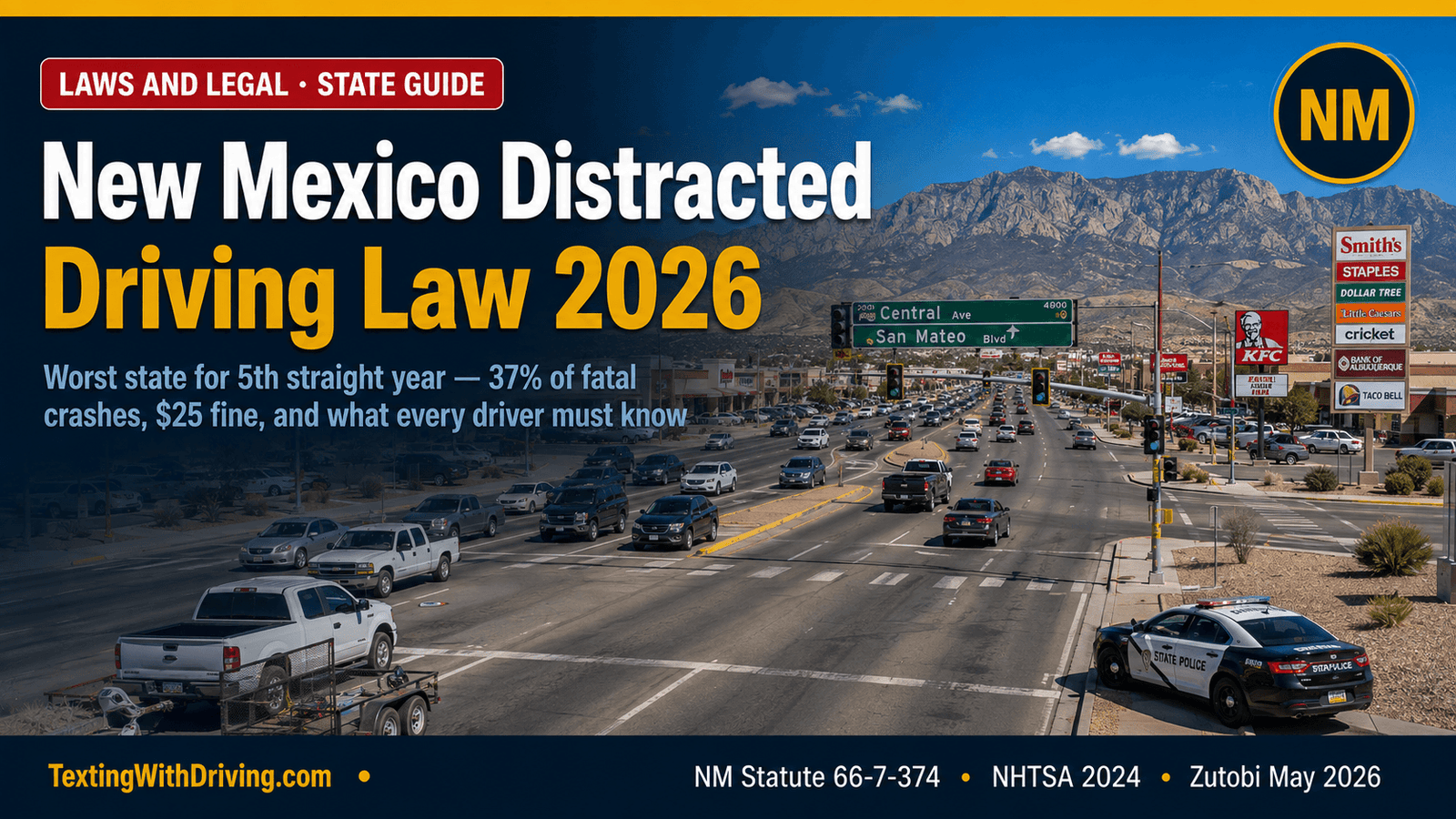
New Mexico Distracted Driving Law 2026: Worst State for the 5th Consecutive Year
The New Mexico distracted driving law has a $25 first-offense fine — the lowest of any state in the country that has a distracted driving law at all. And New Mexico is the worst state in the country for distracted driving, for the fifth consecutive year.
These two facts are not a coincidence.
For the fifth year in a row, New Mexico has the most distracted driving in the country. According to statistics by NHTSA, New Mexico reported 159 distracted driving deaths in 2024. The state reported 10.09 distracted driving deaths for every 100,000 drivers, and 37.04 percent of all fatal crashes in the state were due to distracted driving. EURweb
37.04 percent. More than one in three fatal crashes in New Mexico in 2024 involved a distracted driver. The national average is approximately 8 percent. New Mexico’s distracted driving fatality rate is more than four times the national average — and for the fifth straight year, no state has come close to matching it.
Distracted driving contributed to 18,344 crashes and 181 fatalities across New Mexico in 2024. Szantho Law Firm
An August 2026 report from Crowson Law Group examined fatal crash data from 2020 through 2024. New Mexico recorded 788 fatal crashes involving distracted drivers during the five-year period. Those crashes represented 259 out of every 1,000 fatal collisions, giving the state the highest rate in the study. The report also points to the state’s relatively low penalty for distracted driving. A first offense carries a $25 fine, the lowest among the states included in the analysis. Automotive Fleet
788 distracted-driving fatal crashes over five years. 259 per 1,000 fatal collisions. $25 first offense fine. This is the complete New Mexico distracted driving law picture in 2026 — a state with both the worst distracted driving outcomes in the country and one of the weakest financial deterrents of any state with a law.
This guide covers exactly what the New Mexico distracted driving law requires under NM Statute § 66-7-374, the complete fine structure, what the law prohibits and permits, the Albuquerque death rate that is the highest of any major US city, the specific corridors and intersections where New Mexico’s crashes concentrate, what the five-year worst-state position means for policy, and what every New Mexico driver and visitor must know in 2026.
What the New Mexico Distracted Driving Law Prohibits
The New Mexico distracted driving law is codified primarily under New Mexico Statute § 66-7-374, which establishes the state’s texting and electronic device restrictions.
Many of these rules and regulations can be found in New Mexico Statute 66-7-374 (2024) and include: Reading, sending, or typing a text message while driving is illegal. Youngers Law, PA
The specific prohibitions under the New Mexico distracted driving law cover:
Texting while driving. Reading, sending, or typing any text message, email, or written communication on a handheld device while operating a motor vehicle is prohibited under § 66-7-374.
Handheld phone use broadly. New Mexico law prohibits drivers from using a cell phone for calls or texting at stoplights, stop signs, and traffic signals as it still falls under the law’s definition of “driving.” This red light provision is significant — it places New Mexico in the category of states that explicitly prohibit phone use at red lights rather than creating a window of legal phone interaction during stops.
Commercial driver prohibition. Commercial drivers are not allowed to use a cell phone while driving. The commercial driver prohibition aligns with the FMCSA federal framework we covered in our FMCSA commercial driver distracted driving rules article, creating dual state and federal prohibition for CDL holders operating in New Mexico.
Police seizure authority. Police may seize cell phones to check if text messages were sent or received. This seizure authority — which requires examination within the constitutional protections of the Fourth Amendment — gives New Mexico law enforcement a specific investigative tool for establishing distracted driving in crash cases.
What Remains Legal: The Critical Gap
The New Mexico distracted driving law‘s most significant limitation is what it does not prohibit for adult drivers: holding a phone for a voice call.
New Mexico does not have a comprehensive statewide hands-free ban. An adult New Mexico driver can legally hold a phone to their ear for a voice call while driving on any New Mexico road. The prohibition covers text-based communication and the broader device use categories under § 66-7-374, but the handheld call — the behavior that most other states’ hands-free laws specifically target — remains legal for adult drivers under statewide law.
This gap directly mirrors the pattern we documented for other worst-state performers. In our distracted driving laws all 50 states 2026 article, New Mexico sits in the Tier 2 category — texting ban only, no comprehensive handheld ban — alongside states like Kentucky, Mississippi, and Wisconsin. The correlation between Tier 2 status and worst-state distracted driving outcomes is not coincidental. It is the documented consequence of laws that address only the most obvious distraction behavior while leaving the most prevalent one legally unaddressed.
What remains permitted under current NM law:
Holding a phone for a voice call while driving on New Mexico state highways is legal for adult drivers. Voice calls through a handheld device are not covered by § 66-7-374’s texting prohibition.
GPS navigation on a mounted or handheld device is permitted. Drivers who pull over to the side of the road and park the car are allowed to text or take calls — the shoulder/parking exception is explicit.
Emergency calls to law enforcement and emergency services are always permitted.
Primary Enforcement: Officers Can Stop You for Texting
Despite the law’s limited scope, the New Mexico distracted driving law is primary enforcement for the violations it does cover. New Mexico uses primary enforcement for its texting ban, meaning an officer who observes a driver texting can initiate a stop based solely on that observation without needing any other concurrent violation.
The primary enforcement authority applies to the texting prohibition but not to the legal handheld call. A New Mexico State Police officer who observes a driver holding a phone to their ear cannot stop that driver for the phone use under statewide law — because holding a phone for a call is not prohibited. The same officer who observes a driver looking at their phone screen while typing can initiate a stop for the texting violation.
This enforcement bifurcation — primary authority for texting, no authority for handheld calls — creates a practical compliance distortion. Drivers who know the law may migrate to holding the phone for calls (legal) rather than texting (illegal), substituting one high-risk behavior for another that is simply categorized differently.
The Fine Structure: $25 — The Lowest in the Country
The most discussed element of the New Mexico distracted driving law in the post-2024 worst-state data is the fine structure — specifically the $25 first offense fine.
A first offense carries a $25 fine, the lowest among the states included in the analysis. Automotive Fleet
The statute calls for a fine of $25 for the first offense of texting while driving and increases to $50 for all subsequent offenses. Szantho Law Firm
$25 first offense. $50 for all subsequent offenses. No points. No mandatory court appearance. No escalation beyond the $50 subsequent offense level.
For comparison with other states we have covered in this series:
- New Jersey: $200 to $400 first offense, mandatory court appearance
- New York: $50 to $200 plus $93 surcharge, 5 license points
- Virginia: $125 first offense, 3 DMV points
- Nevada: $50 first offense, 4 license points on second offense
- Oregon: $1,000 first offense
New Mexico’s $25 first offense fine is less than the court fees alone in most states that have distracted driving laws. It is less than a typical parking violation in most New Mexico municipalities. The financial deterrent that $25 represents for a behavior that kills more than one in three New Mexico crash victims annually is, by any behavioral economics standard, inadequate.
The five-year worst-state persistence and the $25 fine are the most direct available case study for the proposition that fine level matters to behavioral change. Alabama’s secondary enforcement law and $50 fine produces documented inadequate behavioral change. New Mexico’s $25 fine — with primary enforcement but no handheld ban — has produced five consecutive years at the top of the worst-state rankings.
The Albuquerque Dimension: Worst Major City in America
Within New Mexico’s worst-state position, Albuquerque creates a specific geographic concentration of the crisis that makes the city the most compelling case study in the entire New Mexico distracted driving law picture.
Albuquerque has the highest distracted driving death rate of any major US city at 5.42 per 100,000 residents, as documented in our distracted driving deaths by state 2026 article.
Central Ave. from San Mateo Blvd. SE to Dorado Pl. SE in Albuquerque is the deadliest stretch of road in New Mexico. From 2017 to 2019, 15 fatal crashes occurred there. Speeding contributed to 35% of accidents; drunk driving was involved in 28%. Distracted driving was involved in 36% of accidents. Parnall Law
Central Avenue — the historic Route 66 corridor through Albuquerque — is the deadliest specific road stretch in the state. The combination of the Route 66 commercial strip’s access complexity, the University of New Mexico pedestrian activity in the near-campus area, and Albuquerque’s specific traffic patterns produces the crash concentration that makes this corridor the most dangerous single road stretch in New Mexico.
In January 2025, New Mexico was ranked as the state with the worst drivers in the US in a study by Forbes Advisor, with the third highest overall rate of fatal car accidents. The top issues were: Distracted driving. New Mexico has the highest rate of traffic fatalities involving distracted driving. Traffic in Albuquerque and the surrounding county went up 3.5% to 118 deaths, about a third of the overall traffic deaths in the state. Egolflaw
118 deaths in Albuquerque and the surrounding Bernalillo County in 2024 — approximately a third of all New Mexico’s traffic deaths in the entire state, concentrated in the single metro area. In a state of 2.1 million people spread across 121,590 square miles, the Albuquerque metro’s concentration of one-third of all traffic deaths reflects both population concentration and the specific driving culture and road infrastructure factors that the worst-in-nation distracted driving data reflects.
Leading causes of fatal accidents were cited as distracted driving and intoxication by drugs or alcohol. Ron Bell Law
Distracted driving is explicitly the leading cause of fatal accidents in New Mexico — not a contributing factor, not one of several factors, but the leading cause. This is the most direct official state-level acknowledgment of the scale of the problem that the New Mexico distracted driving law is failing to adequately address.
The Five-Year Worst-State Story: Why Nothing Has Changed
Five consecutive years as the worst state. The question that every distracted driving researcher, advocate, and policy maker asks about New Mexico is: why has nothing changed?
The answer involves several compounding factors:
The fine level. $25 first offense. $50 subsequent. These amounts do not create meaningful financial deterrence for the behavior. The cost-benefit calculation for a driver who might receive a $25 citation is different from the calculation for a driver who might receive a $125 citation in Virginia or a $200 citation in New Jersey.
The incomplete legal coverage. The handheld call remains legal. A driver who migrates from texting to calling is no longer violating the law but is still creating comparable crash risk. The partial prohibition creates a legal safe harbor for high-risk behavior.
New Mexico’s specific road environment. New Mexico has long straight rural highways where drivers experience the under-stimulation that research consistently associates with maximum phone-checking behavior. Long drives between cities on I-25 and I-40 with limited traffic create exactly the conditions where drivers reach for their phones. Urban concentration in Albuquerque creates the intersection complexity that compounds distraction risk in the metro area.
Enforcement capacity. New Mexico has significant rural geography with limited law enforcement coverage per road mile. The New Mexico State Police highway patrol covers a vast network of state and federal highways with limited officer density per mile. Primary enforcement authority without adequate enforcement presence to exercise it produces limited behavioral change.
Cultural and demographic factors. New Mexico has specific demographic characteristics — a large young adult population as a percentage of total drivers, specific geographic patterns of social coordination driving — that compound the distraction risk the law is insufficient to address.
The five-year persistence reflects the combination of all these factors operating simultaneously against an inadequate legal framework.
The August 2026 Five-Year Analysis: 788 Fatal Crashes
The most comprehensive recent analysis of New Mexico’s distracted driving crisis is the August 2026 Crowson Law Group five-year study.
New Mexico recorded 788 fatal crashes involving distracted drivers during the five-year period from 2020 through 2024. Those crashes represented 259 out of every 1,000 fatal collisions, giving the state the highest rate in the study. Hawaii ranked second, with 193 distracted-driving fatalities per 1,000 fatal crashes. Kansas followed at 176, while New Jersey recorded 171 and Louisiana ranked fifth at 158. Automotive Fleet
788 fatal crashes in five years. 259 per 1,000. The second-place Hawaii figure of 193 per 1,000 is 25 percent lower than New Mexico’s 259. The gap between New Mexico and every other state in the five-year cumulative data is not marginal — it is categorical. New Mexico is not slightly worse than the rest. It is in a separate category of distracted driving crisis severity.
The five-year cumulative study is particularly relevant because it controls for the year-over-year variation that can affect single-year rankings. New Mexico’s worst-state position is not a statistical artifact of a single bad year. It is a persistent, documented, multi-year pattern that reflects structural rather than episodic factors.
What the Law Says About Seizure and Evidence
The New Mexico distracted driving law‘s seizure authority provision creates a specific evidence pathway that civil litigants and criminal prosecutors use in New Mexico crash cases.
Police may seize cell phones to check if text messages were sent or received.
This authority — subject to Fourth Amendment warrant requirements in most circumstances — means that in a serious crash case in New Mexico, law enforcement can seek judicial authorization to examine the device for evidence of active texting at the time of the crash. Combined with carrier subpoenas that can establish call and text timestamps from network records, New Mexico’s evidence framework for establishing distracted driving in post-crash investigation is functional despite the law’s limited pre-crash deterrent effect.
In civil litigation, New Mexico’s contributory/comparative negligence framework allows plaintiffs who are not at fault to pursue full recovery from a distracted driver. The phone record evidence that establishes active device use at the time of the crash is the foundation of distracted driving civil claims in New Mexico — and it is available regardless of whether the driver was violating § 66-7-374 at the time (texting) or engaging in legally permitted phone use (calling).
Albuquerque-Specific Hazards: The Route 66 Corridor
The New Mexico distracted driving law‘s inadequacy is most visible on the ground in Albuquerque’s specific high-crash corridors. Every driver navigating Albuquerque’s streets — resident or visitor — needs to know the specific locations where the worst-in-nation distracted driving crisis concentrates within the worst-in-nation state.
Central Avenue (Historic Route 66) from the Westside through Downtown to the University District and East Side is the primary crash corridor. The corridor’s characteristics that produce its worst-road status: mixed commercial and residential access with frequent turning movements, University of New Mexico campus pedestrian density, the Nob Hill entertainment district pedestrian activity at night, and the transition from lower-speed downtown arterial to higher-speed East Side Boulevard.
Interstate 25 through Albuquerque is the state’s primary north-south highway and the convergence point for traffic from Santa Fe, Las Cruces, and the entire Rio Grande Valley. The I-25/I-40 interchange — the “Big I” — is the most complex highway junction in the state and the highest-crash-density interchange in New Mexico.
The Paseo del Norte and Coors Boulevard intersection in the Northwest Albuquerque area, the Gibson Boulevard and Louisiana Boulevard intersection near the airport, and the Montgomery Boulevard and Louisiana Boulevard area in Northeast Albuquerque all appear consistently in Albuquerque crash data as high-concentration locations.
What Every New Mexico Driver Must Know
The New Mexico distracted driving law in 2026 establishes a $25 fine for texting while the state records 37 percent of fatal crashes involving distracted drivers. The law that exists is primary enforcement — meaning officers can stop you for texting. But the behavior the law leaves legal — the handheld voice call — creates equivalent crash risk.
For New Mexico residents: the legal permission to hold a phone for a call does not make the behavior safe. Every crash risk data point that applies to texting applies comparably to handheld calling. The reaction time reduction, the visual and cognitive distraction, and the crash probability increase documented in the research literature we covered in our distracted driving vs drunk driving 2026 article apply to both behaviors.
For visitors from other states: New Mexico’s law is significantly less restrictive than Virginia ($125 fine, complete handheld ban), DC (complete handheld ban since 2004), Maryland (complete handheld ban, Jake’s Law), and most other states we cover in this series. A visitor who drives through New Mexico holding their phone for a call is doing something legally permitted in New Mexico that would generate a citation in their home state.
The Albuquerque visitor navigating Central Avenue and the Route 66 tourist corridor is in the highest-death-rate major city in the United States for distracted driving. The legality of holding a phone in New Mexico does not reduce the crash risk on Albuquerque’s most dangerous roads.
The complete technology setup that makes phone-free driving automatic regardless of what any state’s law permits is in our hands-free while driving complete setup guide. For the national worst-state and best-state comparison that places New Mexico’s five-year position in full context, our distracted driving statistics by state 2026 covers the complete picture. For the distracted driving deaths data showing New Mexico’s 159 deaths in the 2024 NHTSA dataset, our distracted driving deaths by state 2026 covers every state.
Sources Used in This Article
All links verified working before publication.
Zutobi: States With the Least and Most Distracted Driving Accidents — Fifth consecutive year worst state, 159 deaths 2024, 10.09 per 100,000 drivers, 37.04% of fatal crashes, May 2026
EURweb: States with Most Distracted Driving Deaths August 2026 — Crowson Law Group five-year study 2020-2024, 788 fatal crashes, 259 per 1,000, $25 first offense lowest in study, August 2026
Parnall Law: What Is Distracted Driving New Mexico — 18,344 crashes 181 fatalities 2024 New Mexico, NM Statute 66-7-374, August 2026
Ron Bell Injury Lawyers: New Mexico Distracted Driving Laws and Statistics — $25 first offense $50 subsequent, police seizure authority, red light application, Survivors Against Distracted Driving 41% statistic, March 2026
Szantho Law: Distracted Drivers 240% More Likely to Crash — 2023 data 163 deaths 37%, 10.58 per 100,000 2023, NM Statute 66-7-374 provisions, November 2025
Szantho Law: New Mexico Struggles With High Rate of Distracted Driving Deaths — 41% of all NM fatal crashes, 5 times national average, Albuquerque concentration, April 2024
MoneyGeek: New Mexico’s Deadliest Roads and Fatal Accident Statistics — Central Ave San Mateo to Dorado Pl deadliest road, 36% distracted driving 15 fatal crashes 2017-2019, December 2025
E-Golf Law: New Mexico Car Accident Statistics 2026 Updated — Leading causes fatal accidents distracted driving and alcohol, 160 unbelted fatalities 2024, June 2026
Younger’s Law: New Mexico Car Accident Statistics — Forbes Advisor worst drivers January 2025, 118 Albuquerque area deaths one-third statewide, March 2025
Automotive Fleet: New Mexico Ranked as Worst State for Distracted Driving — Historical worst-state context 40% prior year data, May 2024
NHTSA: Distracted Driving — 3,208 deaths 2024, national context
TextingWithDriving.com is professionally built and maintained to ensure accurate, accessible safety information reaches every driver who needs it. Website development and ongoing support is handled by Budgetic, a digital agency specializing in purpose-driven WordPress websites.

About Texting With Driving
TextingWithDriving.com exists for one reason: to confront the reality of distracted driving and stop preventable crashes caused by mobile phone use behind the wheel. Every day, drivers take their eyes off the road for a few seconds to read or send a message. Those few seconds are enough to cause life-altering consequences. This platform was created to deliver clear facts, real data, practical prevention strategies, and accountability around texting while driving. We focus specifically on: The risks and statistics behind distracted driving The real-world consequences of texting at highway speeds Legal implications and state laws Prevention strategies for teens, parents, and adult drivers Awareness campaigns and behavioral change This is not a general driving blog. It is a focused awareness initiative built around one critical issue: phone distraction behind the wheel. Our content is direct, research-driven, and practical. We prioritize accuracy over opinion and education over sensationalism. The goal is simple — reduce distracted driving incidents by increasing awareness and responsibility. If one article causes one driver to put their phone down, the mission is working. For inquiries or partnerships, contact: privacy@textingwithdriving.com
View all posts by Texting With Driving