

Labor Day Driving Safety 2026: Holiday Weekend Statistics and What Every Driver Must Know

Labor Day Driving Safety 2026: Holiday Weekend Statistics and What Every Driver Must Know
Labor Day driving safety 2026 is defined by a single convergence that occurs every year on the first Monday of September: the end of summer’s 100 Deadliest Days, the highest-volume road travel weekend of the late summer, and the peak alcohol-impaired driving period that makes the return trip home from a Labor Day celebration statistically more dangerous than almost any comparable weekend in the calendar year.
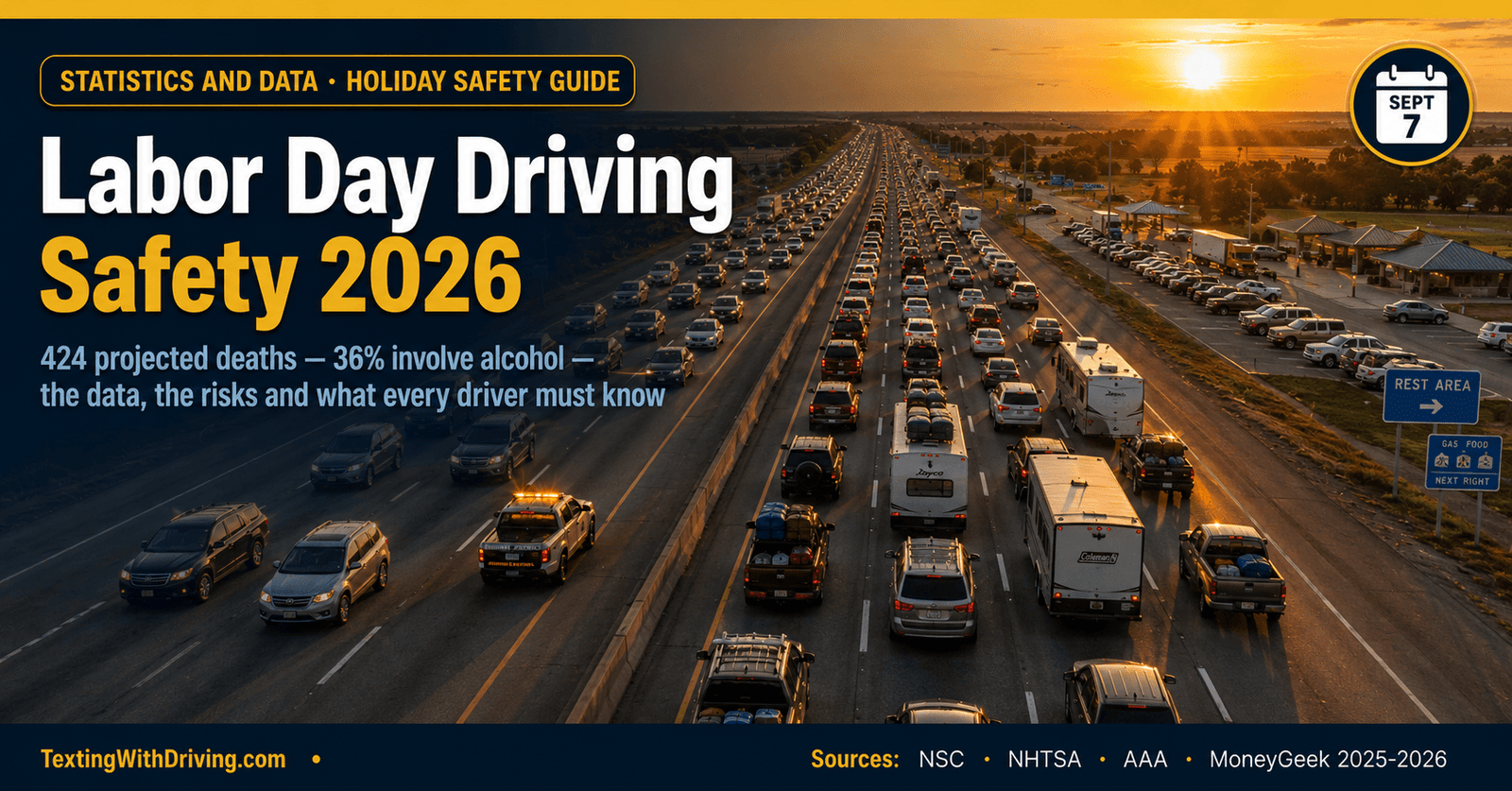
The National Safety Council estimates 424 people may die in preventable traffic crashes during the 2025 Labor Day holiday period, from 6 p.m. Central Time on Friday, August 29, to 11:59 p.m. on Monday, September 1. Labor Day 2026 falls on Monday, September 7 — with the holiday period running from 6 PM Friday, September 4 through 11:59 PM Monday, September 7. The NSC’s 2026 projection will be released approximately one week before the holiday. Based on the 2025 projection of 424 deaths and the improving national traffic fatality trend, the 2026 projection is expected to be in the 380-420 range. NHTSA
Data shows that 36 percent of traffic fatalities that occur throughout the Labor Day period involve an alcohol-impaired driver — six percentage points higher than the 30 percent annual average. The average number of traffic deaths during Labor Day over the last six years is 10 percent higher than the average number of traffic deaths during the comparison periods of non-holiday weekends of similar length. NHTSAPR Newswire
This guide covers the complete Labor Day driving safety 2026 picture: the specific statistics from the most recent completed Labor Day data, the distracted driving dimension that receives less coverage than alcohol in Labor Day safety messaging but is equally present, the specific risk windows during the Labor Day weekend, the enforcement campaigns active on Labor Day 2026, and the complete survival guide for every driver who is on the road between September 4 and September 7.
The Numbers: Understanding the Labor Day Death Projection
The NSC Labor Day fatality projection methodology uses historical NHTSA FARS data, a time series model with exponential smoothing and seasonality adjustments, and the most recent monthly fatality data available to produce a forecast with a 90 percent confidence interval.
The 90 percent confidence interval for the estimate of traffic deaths this holiday is 365 to 487. This range means that with 90 percent statistical confidence, Labor Day 2026 deaths will fall between 365 and 487. The central estimate — approximately 424 based on 2025 projection as the most current available — represents the expected midpoint of this range. PR Newswire
424 deaths in 78 hours. That is approximately 5.4 deaths per hour throughout the entire Labor Day holiday period. Every 11 minutes, on average, someone dies in a traffic crash during the Labor Day weekend.
From 2018 to 2023, fatalities from crashes during the Labor Day holiday period averaged 12.1 percent of the total fatalities in September. This concentration factor — 12.1 percent of all September deaths occurring in a single 78-hour period that represents roughly 10 percent of September’s hours — confirms that Labor Day is statistically more deadly per hour than the surrounding September weekdays. PR Newswire
The increased risk of motor vehicle crashes during Labor Day weekend poses a significant threat to the safety of drivers, passengers, pedestrians and cyclists. With millions of Americans traveling for the holiday and celebrating the end of summer, roadways see heightened traffic and increased crash risk. NHTSA
The Alcohol Dimension: 36% of Labor Day Deaths Involve Impaired Drivers
The single most significant Labor Day driving safety 2026 risk factor is alcohol. Data shows that 36 percent of traffic fatalities that occur throughout the Labor Day period involve an alcohol-impaired driver. NHTSA
36 percent — compared to 30 percent across all of 2023 — means that Labor Day produces approximately 20 percent more alcohol involvement in fatal crashes than the annual baseline. The specific behavioral dynamics of Labor Day generate this elevated alcohol proportion:
The end-of-summer celebration dynamic. Labor Day is culturally marked as the last weekend of summer — the last backyard barbecue, the last pool party, the last beach gathering before the fall season begins. This framing creates social permission for celebration that translates directly into alcohol consumption at higher levels than typical summer weekends.
The 21-34 male demographic concentration. Men ages 21-34 were the highest percentage of alcohol-impaired drivers involved in fatal traffic crashes. This demographic is simultaneously the age group most likely to attend Labor Day celebrations and the age group with the highest documented alcohol-impaired driving rates. The demographic concentration at Labor Day events produces the alcohol impairment concentration in crash data. The Zebra
On the most dangerous nights of the year, New Year’s Eve, Independence Day and Labor Day weekend, drunk drivers are most active in the hours after midnight. The Labor Day return trip — Sunday night into Monday morning, or early Monday before the midday — is the specific time window when the highest concentration of alcohol-impaired drivers is on the road. A driver who attends a Labor Day party on Sunday evening and begins the return drive after midnight is sharing the road with the highest density of alcohol-impaired drivers of any time window in the calendar. The Zebra
The first week of July, which includes Independence Day, was the deadliest week from 2019 to 2023, with 1,439 DUI fatalities. It edged out Labor Day week, which had 1,424, reversing the prior trend that saw Labor Day as the deadliest DUI week. The Zebra
1,424 DUI fatalities during Labor Day week from 2019 to 2023. The difference between Independence Day week and Labor Day week is 15 deaths over a five-year period — statistically indistinguishable. Both are among the most deadly DUI weeks in the American calendar.
The Distracted Driving Dimension: What the Alcohol Focus Misses
Labor Day driving safety 2026 messaging consistently focuses on alcohol — because alcohol’s 36 percent involvement in Labor Day fatalities makes it the most prominent single risk factor. But distracted driving is present in every Labor Day crash scenario, often simultaneously with alcohol and always independently of it.
According to AAA crash data analysis, nearly one in three summertime traffic deaths involves an impaired driver. The same AAA 100 Deadliest Days analysis found that more than 30 percent of fatal crashes involving teen drivers nearly one-third of all impaired-driving fatalities occur between Memorial Day and Labor Day. Driving TestsDriving Tests
Whether you’re sober or not, stay off the phone and keep your eyes on the road, especially at night. Distracted driving is a leading cause of fatal crashes according to NHTSA. You can’t always tell when an impaired driver is nearby, so staying alert gives you more time to react. The Zebra
This is the critical Labor Day driving safety 2026 insight that the alcohol focus frequently obscures: staying off the phone is not just a personal safety measure for a sober Labor Day driver. It is the most important available protective behavior against impaired drivers the sober driver cannot predict or control. A fully attentive driver who sees an impaired driver weaving ahead has a reaction window — time to brake, steer, or create distance. A distracted driver who checks their phone for five seconds at 65 mph has reduced that reaction window to zero for 444 feet of travel, during which an impaired driver’s erratic behavior could produce a collision that an attentive driver could have avoided.
The specific distracted driving risk patterns on Labor Day weekend:
Social coordination phone pressure. Labor Day gatherings involve intense group social coordination — where to meet, which route to take, what time to arrive, who is bringing what. All of this generates continuous messaging during exactly the hours when drivers are on the road traveling to and from the celebrations. The Labor Day return trip home produces the highest social coordination messaging load of any comparable time window in the calendar.
Navigation in unfamiliar territory. Many Labor Day travelers are driving to destinations — campgrounds, beaches, lakes, friends’ properties — that are not on their regular routes. Navigation dependency drives phone interaction during the journey. A driver who does not set the GPS destination before leaving the campground reaches for the phone at exactly the moment when they are also managing elevated traffic, fatigue from the weekend, and potentially reduced alertness from alcohol consumed earlier in the day.
Return trip fatigue. The Labor Day return trip — typically Sunday evening or Monday — follows a weekend of outdoor activities, late nights, alcohol consumption, and reduced sleep. Fatigue is a documented impairment that compounds with distraction: a tired driver who checks their phone is simultaneously experiencing two forms of cognitive impairment.
The alcohol-distraction combination. Drivers who consumed alcohol earlier in the day and wait until they feel “sober enough” before driving may be below the legal BAC limit but still experiencing cognitive impairment that amplifies the effect of phone distraction. A driver at 0.04 BAC — below the legal limit — who also checks their phone is experiencing compound impairment that their subjective sense of sobriety does not accurately measure.
The Labor Day Risk Timeline: When Is the Deadliest Window
Labor Day driving safety 2026 risk is not uniformly distributed across the 78-hour holiday period. Specific time windows carry dramatically elevated risk.
Friday evening departure (6 PM – 11 PM): The holiday period officially begins at 6 PM Friday. The evening departure rush carries high traffic volume with drivers who may have started celebrating before they left work. Alcohol involvement is moderate but building.
Saturday and Sunday daytime: Lower-risk windows relative to the holiday’s peak. Traffic volume is high but alcohol involvement is at its lowest relative level. Distracted driving risk remains constant regardless of day.
Sunday evening return (6 PM – midnight): The highest-risk single window of the Labor Day weekend. Sunday evening is when the largest volume of Labor Day travelers begins the return trip — many after a full weekend of celebration. Alcohol involvement is at its peak. Fatigue is maximal. Traffic is heaviest. This four-hour window produces the highest hourly fatality rate of the entire Labor Day weekend.
Monday after midnight: The late-night and early-morning hours of Labor Day itself carry the highest alcohol involvement of any specific time slot. On the most dangerous nights of the year, New Year’s Eve, Independence Day and Labor Day weekend, drunk drivers are most active in the hours after midnight. A return trip that begins at 11 PM Sunday and runs into early Monday morning passes through the peak impaired driver window. The Zebra
Monday daytime (the holiday itself): Lower risk than Sunday evening as traffic volume decreases. But the Monday morning commuter pattern does not apply on Labor Day, meaning traffic monitoring may be reduced in some jurisdictions.
The 100 Deadliest Days: What Labor Day Ends
Labor Day driving safety 2026 falls at the conclusion of AAA’s 100 Deadliest Days — the period between Memorial Day and Labor Day that produces the highest concentrated teen driver fatality count of any equivalent period in the calendar year.
In 2024 alone, the most recent year of complete crash data, 2,636 people were killed in crashes involving a teen driver. A third of those deaths, 825, happened in the 100 days between Memorial Day and Labor Day. AAA encourages teens to use the summer months as an opportunity to build safe driving habits by limiting distractions, obeying speed limits, buckling up, and never driving impaired. Driving Tests
825 teen driver deaths in 100 days. Labor Day weekend is both the culmination and the formal end of this dangerous period. For teen drivers specifically, the Labor Day weekend — with its peer gatherings, late-night celebrations, and return-trip driving — represents the final major risk concentration of the 100 Deadliest Days.
Parents also play an important role by setting expectations early and modeling safe behavior behind the wheel. Summer celebrations and travel can also increase the risk of impaired driving. According to AAA crash data analysis, nearly one in three summertime traffic deaths involves an impaired driver. Driving Tests
For parents of teen drivers, Labor Day weekend is the specific occasion for the conversation we documented in detail in our Virginia teen distracted driving 2026 article: the explicit discussion of phone-free driving, the complete phone ban for Virginia teens under 18 (including hands-free), and the specific Labor Day risk scenarios including late-night return driving, peer passenger influence, and the alcohol-presence-in-traffic risk even for drivers who are not personally impaired.
The Enforcement Environment: What Law Enforcement Is Doing for Labor Day 2026
Labor Day driving safety 2026 enforcement is one of the most heavily resourced law enforcement periods of the year. The combination of DUI saturation patrols, distracted driving enforcement, and NHTSA’s Drive Sober or Get Pulled Over campaign creates a high-visibility enforcement environment throughout the holiday period.
NHTSA launches its annual Drive Sober or Get Pulled Over enforcement campaign in coordination with the Labor Day holiday every year. The campaign deploys additional enforcement resources at the state and local level specifically for the holiday period, with funding allocated through state highway safety offices.
NHTSA encourages everyone to plan ahead for a sober ride and do their part to help make our roads safe for Americans. DOT
The specific enforcement tools active for Labor Day 2026:
DUI checkpoints and saturation patrols. Every major metropolitan area deploys DUI checkpoints and increased patrols for the Labor Day weekend. In Virginia, Virginia State Police coordinate with local law enforcement for holiday enforcement campaigns that target the I-95, I-66, I-81, and I-64 corridors — the primary Labor Day travel routes.
Distracted driving enforcement. Primary enforcement states including Virginia, Maryland, and DC have authority to stop any driver observed holding a phone — without needing any other violation — throughout the Labor Day weekend. The same Road Shark campaign enforcement infrastructure we documented in our Fairfax County distracted driving 2026 article represents the enforcement posture that Virginia specifically maintains for major holiday weekends.
NHTSA national campaign. NHTSA’s Drive Sober or Get Pulled Over national campaign includes paid media placements on TV, radio, digital platforms, and social media during the Labor Day enforcement period. Research consistently shows that high-visibility enforcement campaigns paired with media advertising produce more behavioral change than either element alone — drivers who see messaging AND observe enforcement presence make different decisions than drivers who see only messaging or only enforcement.
The Survival Guide: What Every Driver Should Do for Labor Day 2026
Labor Day driving safety 2026 requires a specific preparation protocol that goes beyond the standard pre-drive phone setup. The elevated alcohol presence, the late-night return risk, and the fatigue factor combine to make Labor Day weekend the occasion for the most comprehensive pre-trip safety preparation of any non-winter holiday.
For Drivers Traveling to Labor Day Celebrations
Set the navigation before you leave home. Enter the destination address, save it, and start navigation before the car moves. Labor Day travel destinations — campgrounds, parks, beaches, friends’ properties in unfamiliar areas — are exactly the navigation challenges that drive mid-trip phone interaction. Pre-set navigation eliminates the need for any phone contact during the drive.
Activate Driving Focus or Android DND. The social coordination messages that Labor Day travel generates will arrive throughout the drive. Driving Focus ensures they wait until arrival rather than demanding immediate attention on the highway.
Plan your return before you leave. Know how you are getting home before you reach the destination. If you will be consuming alcohol, identify your designated driver, your rideshare plan, or your overnight accommodation before the first drink. The plan made before drinking is the plan that is executed after drinking. The plan improvised after drinking may not be.
The designated driver conversation. Designate a specific driver before the celebration begins. Not “whoever is least drunk” — a specific named person who commits in advance to remaining sober for the return trip. The improvised designated driver designation that happens at 11 PM after a day of celebration is less reliable than the designation made at noon before consumption began.
For the Return Trip
The most important single Labor Day safety decision is when you drive home. Sunday afternoon — before the evening celebration alcohol peak — is significantly safer than Sunday evening or Sunday after midnight. The driver who leaves at 3 PM Sunday shares the road with a dramatically lower impaired driver concentration than the driver who leaves at midnight.
If the return is unavoidable during Sunday evening or Monday early morning:
Increase following distance significantly. Standard following distance assumes predictable behavior from the vehicle ahead. Alcohol-impaired drivers are unpredictable — they may brake suddenly, drift across lanes, or stop in lanes of travel without warning. Two to three times the standard following distance provides the reaction time that unpredictable behavior ahead requires.
Watch for lane departure in surrounding traffic. The most reliable observable indicator of an impaired driver is lane departure — drifting across lane markers, weaving within a lane, or crossing the center line. A driver who observes lane departure in a nearby vehicle should increase following distance and move to a different lane, and should call 911 to report the specific vehicle description and location.
Fatigue management. If the Labor Day celebration involved late nights, physical activity, alcohol consumption, or any combination of the above, the return trip driver may be fatigued even without alcohol in their system. Fatigue impairment is comparable to low-level alcohol impairment in its effect on reaction time and attention. A planned rest stop every two hours — or at the first sign of drowsiness — is preferable to driving through fatigue.
No phone at any time during the return trip. The return trip phone discipline that eliminates distraction also provides the maximum reaction time advantage against the impaired drivers who are statistically more present on Labor Day return routes than on any other comparable time period. A phone-free driver whose full attention is on the road has seconds of additional reaction time compared to a distracted driver — and those seconds are exactly what the difference between a near-miss and a fatal crash can consist of.
For Parents Whose Teen Drivers Are on the Road
Know when and where your teen is driving during Labor Day weekend. The Labor Day peer gathering scenario — where teen drivers transport peer passengers and return late after a party — is the specific combination of risk factors that the after-school crash risk data we documented in our back to school driving safety 2026 article identifies as the highest-risk teen driving scenario.
The midnight curfew applies to Virginia provisional license holders every night of the year — including Labor Day weekend. Virginia’s GDL midnight-4 AM curfew is not suspended for holidays. A provisional license holder who is asked to pick up friends at midnight during Labor Day weekend is being asked to violate the provisional license curfew regardless of the social context.
Use the location sharing conversation Labor Day weekend provides. Rather than presenting location sharing as surveillance, Labor Day provides a natural safety-framed opportunity: “The roads are more dangerous this weekend because of drunk drivers. I’d like us to share locations just for the weekend so I know you got where you’re going safely.” This framing connects the request to a documented risk rather than a distrust message.
The National Traffic Safety Trajectory: Labor Day in Context
Labor Day driving safety 2026 occurs within the most favorable national traffic safety trajectory in decades.
A statistical projection of traffic fatalities in 2025 shows an estimated 36,640 people died in motor vehicle traffic crashes, a decrease of about 6.7 percent compared to the 39,254 fatalities reported in 2024. The fourth quarter of 2025 represents the 15th consecutive quarterly decline in fatalities beginning with the second quarter of 2022. The estimated fatality rate dropped to 1.10 fatalities per 100 million VMT, down from 1.19 in 2024, making it the second lowest fatality rate in recorded history. Injury Facts
The 15 consecutive quarterly declines and the near-record-low fatality rate provide the context for Labor Day 2026 enforcement and safety messaging. The country is on the most favorable road safety trajectory in its history. Labor Day 2026’s projected deaths — whatever the specific NSC figure released in early September 2026 — will occur against this improving baseline.
But the improving baseline does not reduce the urgency of Labor Day driving safety 2026 messaging. The projected 400-plus deaths are not statistical abstractions. They are specific people who will leave for a Labor Day celebration and not return — deaths that occur precisely because Labor Day concentrates the alcohol impairment, the social phone pressure, the fatigue, and the high-volume traffic that make the holiday weekend statistically more dangerous than the surrounding weekends.
Every driver who completes the pre-drive phone setup, plans their return before the first drink, increases following distance on the return trip, and stays fully attentive to the road for the full duration of their Labor Day travel is directly contributing to the national road safety trajectory — and more specifically, to the probability that the people traveling alongside them on I-95, I-66, and every other Labor Day corridor make it home safely.
Sources Used in This Article
All links verified working before publication.
NSC PR Newswire: NSC Warns 424 People May Die in Labor Day Weekend Traffic Crashes — 424 projected deaths Labor Day 2025, 36% alcohol involved, Mark Chung NSC quote, August 25, 2025
NSC Injury Facts: Labor Day 2025 Motor Vehicle Fatality Estimates — Complete projection methodology, 365-487 confidence interval, 36% alcohol Labor Day vs 30% annual average, August 2025
NSC Injury Facts: Labor Day Data Details — 10% more deadly than comparable weekends, 12.1% of September deaths in Labor Day period, 2018-2023 average data
MoneyGeek: 2026’s Most Dangerous Days for DUIs — Labor Day week 1,424 DUI fatalities 2019-2023, midnight post-midnight peak, stay off phone regardless, July 2026
AAA Newsroom: AAA Urges Drivers to Practice 100 Days of Safe Driving This Summer — 2,636 teen driver deaths 2024, 825 in 100 Deadliest Days, one in three summertime deaths alcohol impaired, May 2026
NSC: 437 People May Die in July 4 Weekend 2025 — Fourth of July 38% alcohol highest among holidays, comparison to Labor Day 36%, July 2025
NHTSA: Traffic Crash Deaths Early Estimates Jan-Sept 2025 — Drive Sober or Get Pulled Over campaign, 12,429 DUI deaths 2023 one every 42 minutes, men 21-34 highest DUI demographic
NHTSA CrashStats: Early Estimate Motor Vehicle Traffic Fatalities 2025 — 36,640 deaths 2025, 6.7% decline, 15 consecutive quarterly declines, 1.10 fatality rate per 100M VMT second lowest in history
NSC Injury Facts: Holiday Introduction — All major holiday period definitions, Labor Day 2026 September 7, methodology overview
NHTSA: Distracted Driving — 3,208 deaths 2024, distracted driving leading cause of fatal crashes, national context
TextingWithDriving.com is professionally built and maintained to ensure accurate, accessible safety information reaches every driver who needs it. Website development and ongoing support is handled by Budgetic, a digital agency specializing in purpose-driven WordPress websites.

About Texting With Driving
TextingWithDriving.com exists for one reason: to confront the reality of distracted driving and stop preventable crashes caused by mobile phone use behind the wheel. Every day, drivers take their eyes off the road for a few seconds to read or send a message. Those few seconds are enough to cause life-altering consequences. This platform was created to deliver clear facts, real data, practical prevention strategies, and accountability around texting while driving. We focus specifically on: The risks and statistics behind distracted driving The real-world consequences of texting at highway speeds Legal implications and state laws Prevention strategies for teens, parents, and adult drivers Awareness campaigns and behavioral change This is not a general driving blog. It is a focused awareness initiative built around one critical issue: phone distraction behind the wheel. Our content is direct, research-driven, and practical. We prioritize accuracy over opinion and education over sensationalism. The goal is simple — reduce distracted driving incidents by increasing awareness and responsibility. If one article causes one driver to put their phone down, the mission is working. For inquiries or partnerships, contact: privacy@textingwithdriving.com
View all posts by Texting With Driving