

Distracted Driving vs Inattentive Driving: What Is the Legal Difference?

Distracted Driving vs. Inattentive Driving: What Is the Legal Difference?
If a police officer stops you after a crash and writes “inattentive driving” on the report instead of “distracted driving,” does that matter? If a citation reads “failure to maintain attention” rather than “texting while driving,” is it the same thing legally?
The answer is that these two terms are frequently confused, often used interchangeably in casual conversation, and are genuinely distinct in legal definition, enforcement approach, and practical consequences depending on your state. Understanding the difference matters both for drivers who have received a citation and for anyone trying to understand why distracted driving statistics may undercount the true scope of the problem.
The Core Distinction: Source of the Inattention
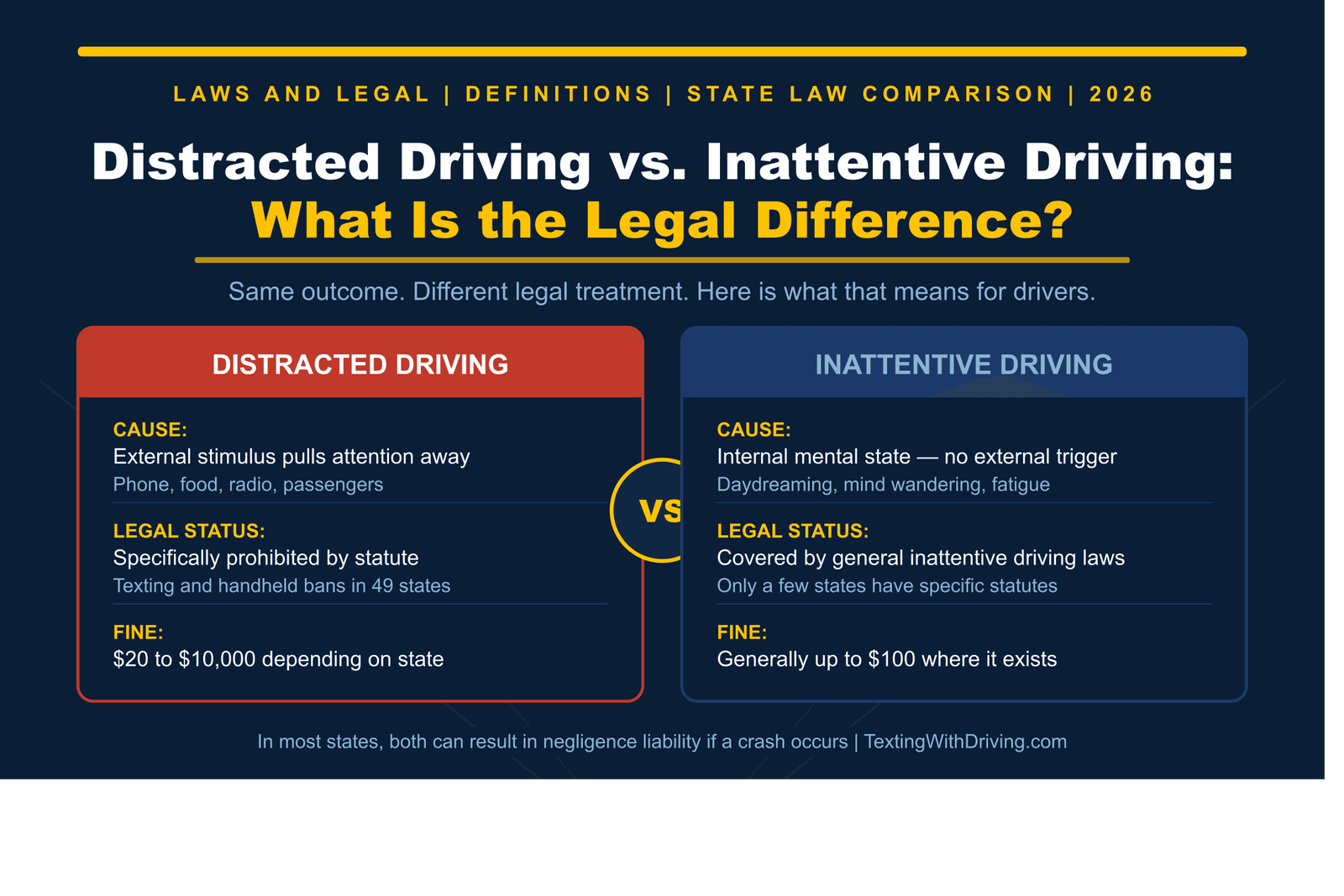
The most fundamental difference between distracted driving and inattentive driving comes down to what caused the lapse of attention.
Distracted driving refers to any activity that diverts the driver’s attention away from the primary task of operating the vehicle. This can include activities such as texting, talking on the phone, eating, putting on makeup, or even adjusting the radio. These distractions take the driver’s focus away from the road, impairing their ability to react quickly to potential hazards and increasing the risk of an accident. Michigan Auto Law
Inattentive driving, on the other hand, refers to a lack of focus or engagement in the driving task as a whole. It is a broader term that encompasses not only distractions but also instances where the driver’s mind wanders, they daydream, or they become lost in thought. Inattentive driving can occur even when no external distractions are present, making it a more subtle yet equally dangerous behavior on the road. Michigan Auto Law
The key distinction is the word external. Distracted driving has an external cause: the phone that buzzed, the food that needed unwrapping, the passenger who asked a question. Something in the world pulled the driver’s attention away from driving. Inattentive driving has an internal cause: the driver’s mind drifted to a problem at work, they began daydreaming about the weekend, they became emotionally overwhelmed by a thought. No external stimulus was involved. The attention simply was not there.
Both states produce the same outcome in terms of driving performance: the driver is not fully engaged with the task of operating the vehicle safely. But the distinction in origin is what creates the different legal treatment.
How the Legal Definitions Work in Practice
Distracted driving occurs when something takes a motorist’s attention away from driving. The most common form of distracted driving is related to cell phone use or texting while driving, however it can encompass a wide range of activities. The legal definition of distracted driving varies by state, but most laws recognize three main types of distractions: visual, manual, and cognitive. The Zebra
Because distracted driving has an identifiable, observable external cause, it is far easier to address through specific legislation. A state can pass a law saying “you may not hold a phone while driving” and officers can observe compliance or violation with their eyes. The behavior is visible. The cause is external and specific. Enforcement is straightforward, at least for device-related distractions.
Inattentive driving is significantly harder to legislate because it has no observable external correlate. A driver who is daydreaming looks identical to a fully attentive driver from outside the vehicle. Eyes forward. Hands on wheel. No visible device. The impairment is entirely internal and only becomes apparent when the driver fails to respond to something they should have noticed.
Inattentive driving is a form of distracted driving. It is a cognitive distraction that takes your mind off of driving. Daydreaming is a form of inattentive driving. While you may not take your hands off of the wheel or your eyes off the road, your mind is somewhere else entirely. Penske Truck Leasing
This relationship between the two terms is important to understand. Inattentive driving is technically a subset of distracted driving in the scientific sense because it involves a form of cognitive distraction. But in legal terms, states treat them separately because of the enforcement challenges that inattentive driving creates.
The NHTSA Framework: Inattention as the Broader Category
NHTSA’s official position adds a layer of technical precision that is worth understanding, especially for researchers and anyone using official crash data.
NHTSA defines driver distraction as inattention that occurs when drivers divert their attention away from the driving task to focus on another activity. NHTSA describes distraction as a subset of inattention, which also includes fatigue and physical and emotional conditions of the driver. However, while NHTSA may define the terms in this manner, inattention and distraction are often used interchangeably or simultaneously in other material including police crash reports. Baderlaw
Under NHTSA’s technical framework, inattention is the broader category and distraction is a specific type of inattention. Inattention encompasses distraction, fatigue, and emotional or physical states that impair attention without any external trigger. Distraction specifically refers to inattention caused by an external activity or stimulus.
This is exactly the reverse of how many people use the terms in everyday conversation, where “inattentive driving” is often used as the milder, more general term and “distracted driving” as the more specific and serious one. In NHTSA’s scientific framework, distraction is the subset and inattention is the parent category.
The practical impact of this definitional hierarchy appears most clearly in crash data. Inattention and distraction are often used interchangeably or simultaneously in other material including police crash reports. It is important that users of NHTSA data be aware of these differences in definitions. Baderlaw
When a police officer writes an accident report and codes the contributing factor as “inattentive driving” rather than “distracted driving,” that report may or may not end up in NHTSA’s distracted driving statistics depending on how the data is categorized. This inconsistency in reporting is one of several reasons why official distracted driving statistics are believed to undercount the true scope of the problem, which we discussed in our distracted driving statistics 2026 overview.
State Laws: How Each Term Is Handled
The legal treatment of distracted driving versus inattentive driving varies considerably across the 50 states, and understanding your state’s specific framework matters for knowing what you can be cited for.
States with specific distracted driving statutes are the majority. These states have passed laws that specifically address phone use, texting, or handheld device use while driving, with defined fines and enforcement types. We covered these in detail in our texting while driving laws by state 2026 and hands-free driving laws by state 2026 guides.
Distracted driving laws in every state target some form of device use behind the wheel, and a growing majority now ban holding a phone entirely while driving. Penalties start with fines as low as $20 but can escalate to felony charges carrying years in prison when someone is seriously hurt or killed. Sentryroad
States with inattentive driving statutes are fewer and their laws operate differently. These states have statutes that address the broader failure to maintain attention while driving, regardless of cause. Arkansas is a notable example.
Arkansas Section 27-51-104 prohibits operating a vehicle in any manner when the driver is inattentive, and this inattention is not reasonable and prudent in maintaining vehicular control. A violation results in a fine up to $100. QuatriniRafferty
The Arkansas inattentive driving statute covers a much wider range of behavior than a texting ban does, because it applies to any failure to maintain reasonable vehicular control due to inattention. But the fine structure, up to $100, reflects the lower enforcement profile of a general inattention standard compared to a specific device prohibition.
Iowa’s approach offers another instructive model. Iowa’s law addresses distracted driving more broadly than just phones.
Iowa Section 321.276 prohibits operating a vehicle while distracted. Distracted driving under Iowa’s statute is defined as inattentive driving while operating a vehicle that results in the unsafe operation of the vehicle when the inattention is caused by reading, writing, performing personal grooming or hygiene, interacting with persons or animals in or on the vehicle, or using an electronic communication device. The key element is that the inattention must result in unsafe operation to constitute a violation. QuatriniRafferty
Iowa’s requirement that the distraction result in unsafe operation is an important element. In states with this requirement, being distracted is not itself a violation. The distraction must produce an observable unsafe driving behavior. In contrast, states with primary enforcement handheld bans can cite you for holding a phone regardless of whether your driving appeared unsafe in that moment.
Minnesota’s approach historically used inattentive driving as a catch-all category in crash reports. Minnesota requires officers to document the contributing distraction type in crash reports, which helps create more detailed data for analysis but also means that two officers may code the same crash differently based on their individual interpretation of the driving behavior they observed.
Why the Distinction Matters for Civil Litigation
Beyond traffic fines, the distinction between distracted and inattentive driving matters significantly in civil lawsuits following crashes.
Distracted driving involves inattention. Reckless driving involves conscious disregard for safety. Fines for distracted driving are lower than reckless driving. Reckless driving can include jail time and license suspension. Reckless driving charges carry longer-term consequences for your record and insurance. NAHB
In a personal injury lawsuit following a crash, an attorney arguing that the at-fault driver was negligent will characterize their behavior in the way most favorable to their client. A driver who was texting is described as distracted. A driver who simply failed to pay attention without any identifiable external cause is described as inattentive or failing to maintain proper attention. Both support a negligence argument. But the texting case is generally easier to prove because phone records can establish exactly what the driver was doing at the moment of the crash.
In legal terms, distracted driving happens when drivers engage in any activity that diverts their attention from their primary task of operating their vehicle. When this causes a crash, the external cause of the distraction, whether it is a phone, food, or any other activity, becomes evidence of negligence. Inattentive driving without a specific external cause is harder to prove in court but can still establish negligence if the driver’s failure to respond to an obvious hazard demonstrates that their attention was not on the road. The Zebra
The evidentiary challenge of proving inattentive driving compared to distracted driving is one reason why plaintiff’s attorneys in crash cases work hard to establish that the defendant was doing something specific, not just generally not paying attention. Phone records are the most powerful evidence in this context because they create a timestamp-level record of what the driver was doing with their device in the seconds before a crash. We covered this evidence framework in detail in our article on whether you can be sued for texting while driving.
The Daydreaming Problem: The Most Dangerous Gap in the Law
Here is the aspect of this legal distinction that most people find genuinely surprising.
Discussions regarding distracted driving often center around cellphones and texting, but distracted driving also includes eating, talking to passengers, adjusting the radio or climate controls, or adjusting other vehicle controls. Mattiacci Law
And beyond all of those behaviors, the single most common cause of driver inattention in fatal crashes, according to research by Erie Insurance, is mind wandering. Daydreaming. Simply not thinking about driving. Not because of a phone or food or a passenger, but because the driver’s mind drifted somewhere else entirely.
This is the behavior that existing distracted driving laws almost universally fail to address because it is almost impossible to observe from outside the vehicle and nearly impossible to enforce through citation. A law cannot say “do not daydream while driving” in any practically enforceable way.
The gap between what the law addresses and what actually causes a large share of serious crashes is significant. It is why driving safely is not simply a matter of putting your phone away and complying with the law. It is why the definition of attentive driving, which means actively thinking about driving, scanning for hazards, maintaining situational awareness, represents a standard that is both higher than what the law requires and more accurately aligned with what the research shows produces safe outcomes.
What a Citation for Either Offense Actually Produces
Regardless of whether a citation reads “distracted driving” or “inattentive driving,” the practical consequences for the cited driver tend to be similar.
Both violations are typically traffic infractions rather than criminal charges in their basic form. Both carry fines that vary by state and circumstance. Both may add points to a driving record depending on the state’s point system. Both can be used as evidence of negligence in civil litigation. And both result in the violation appearing in the driver’s history, which insurers access when quoting or renewing policies.
The insurance impact of either violation is typically a rate increase, as we covered in our article on what happens to your car insurance after a distracted driving ticket. Most insurers do not distinguish between a texting citation and an inattentive driving citation in their rate calculations. Both represent a documented instance of unsafe driving behavior that the insurer treats as a predictor of elevated future claim risk.
The escalation path, from traffic infraction to misdemeanor to felony, applies to both distracted and inattentive driving when a crash causes serious injury or death. The specific charges available to prosecutors depend on the state, but virtually every state allows driving-related negligence to escalate to criminal charges when the outcome is severe enough regardless of whether the original behavior was categorized as distracted or inattentive.
How to Protect Yourself Practically
Understanding the legal distinction between distracted and inattentive driving has two practical applications.
First, if you receive a citation that characterizes your behavior as inattentive driving, understanding whether your state has a specific inattentive driving statute versus a broader negligent operation standard matters for how you respond. The fines, points, and enforcement type may differ from a standard distracted driving citation, and in some states an inattentive driving citation carries less weight on a driving record than a device-specific violation.
Second, understanding that legal compliance does not equal full attentiveness is important for your actual safety. Putting your phone away and driving hands-free means you are complying with the law in most states. It does not mean you are immune to the cognitive distraction of whatever you were just thinking about, the emotional state you brought into the car, or the mind-wandering that can occur on any long monotonous stretch of highway.
The legal standard is a floor. Safe driving requires going above it.
For the legal requirements in your specific state, our texting while driving laws by state 2026 guide covers all 50 states. For the science of why cognitive distraction is so dangerous even when no external device is involved, our article on the three types of distraction covers the full framework. And for what all of this looks like in practice when a distracted or inattentive crash produces a lawsuit, our article on whether you can be sued for texting while driving covers the civil liability picture in full.
Sources Used in This Article
All links verified working before publication.
NHTSA CrashStats: Distracted Driving in 2024 — NHTSA definition of distraction as subset of inattention
NHTSA: Distracted Driving — Official NHTSA definition and statistics
GHSA: Distracted Driving State Laws — State law definitions and enforcement
Justia: Distracted Driving Laws 50-State Survey — Arkansas and Iowa specific statute language
LegalClarity: Distracted Driving Laws Penalties Fines and Liability — Legal treatment and enforcement types, May 2026
Folkman Law: What Is the Legal Definition of Distracted Driving — Three-type legal framework, February 2025
Genthe Law Firm: Inattentive Driving vs Distracted Driving — Core distinction between internal and external causes, August 2025
Fibich Leebron Copeland Briggs: What Is the Difference Between Distracted and Inattentive Driving — Legal liability comparison, May 2025
Oleen Law Firm: Distracted Driving vs Reckless Driving Legal Differences — Comparative legal treatment, August 2025
Federal Register: Advanced Impaired Driving Prevention Technology — NHTSA formal definition in regulatory context
TextingWithDriving.com is professionally built and maintained to ensure accurate, accessible safety information reaches every driver who needs it. Website development and ongoing support is handled by Budgetic, a digital agency specializing in purpose-driven WordPress websites.

About Texting With Driving
TextingWithDriving.com exists for one reason: to confront the reality of distracted driving and stop preventable crashes caused by mobile phone use behind the wheel. Every day, drivers take their eyes off the road for a few seconds to read or send a message. Those few seconds are enough to cause life-altering consequences. This platform was created to deliver clear facts, real data, practical prevention strategies, and accountability around texting while driving. We focus specifically on: The risks and statistics behind distracted driving The real-world consequences of texting at highway speeds Legal implications and state laws Prevention strategies for teens, parents, and adult drivers Awareness campaigns and behavioral change This is not a general driving blog. It is a focused awareness initiative built around one critical issue: phone distraction behind the wheel. Our content is direct, research-driven, and practical. We prioritize accuracy over opinion and education over sensationalism. The goal is simple — reduce distracted driving incidents by increasing awareness and responsibility. If one article causes one driver to put their phone down, the mission is working. For inquiries or partnerships, contact: privacy@textingwithdriving.com
View all posts by Texting With Driving