

How Distracted Driving Affects Your Brain: The Neuroscience Behind the Danger

How Distracted Driving Affects Your Brain: The Neuroscience Behind the Danger
Here is the finding that changes how every driver should think about using their phone behind the wheel.
Your eyes can be open. They can be pointed directly at the road ahead. Traffic signals, pedestrians, stopped vehicles, and road hazards can all be visible in your field of view. And your brain can still fail to register any of it.
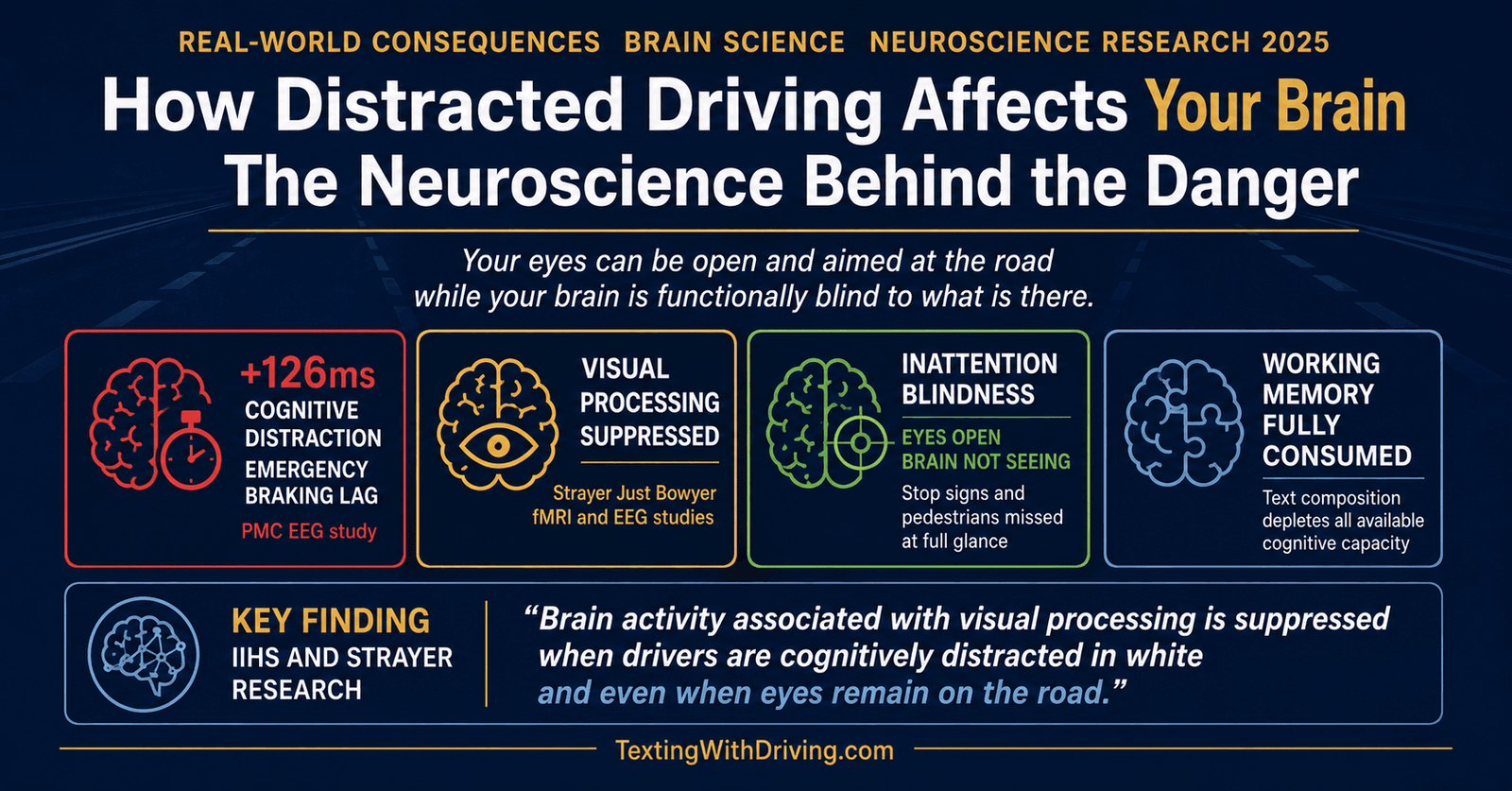
This is not a hypothesis. It has been measured with brain imaging technology, replicated across multiple research groups, and documented in peer-reviewed journals. When a driver’s cognitive resources are consumed by a secondary task, the brain’s visual processing systems are actively suppressed, even when the eyes are physically oriented toward the driving environment. The result is a phenomenon researchers call inattention blindness: you are looking at something and not seeing it.
Understanding this mechanism explains why distracted driving is so dangerous in ways that the statistics alone cannot. It is not that drivers become slower or clumsier when distracted. In the most dangerous cases, they stop processing the road environment altogether, while being completely unaware that this is happening.
The Brain During Normal Attentive Driving
To understand what distraction does to the brain, it helps to start with what the brain is actually doing during normal, attentive driving. It is considerably more demanding than most drivers appreciate.
Driving a vehicle requires continuous integration of visual input from a wide field of view including peripheral vision and central focus, constant monitoring of vehicle dynamics including speed, position, and trajectory, real-time hazard detection and priority assignment, working memory for recent events including the last few seconds of traffic behavior, spatial reasoning and route planning, and motor control for steering, braking, and acceleration. These processes run simultaneously, drawing on different neural systems that the driving brain coordinates with practiced efficiency.
Experienced drivers handle most of this automatically, which is why driving can feel effortless on a familiar route. But automatic does not mean zero cognitive demand. It means the demand has been distributed across well-practiced neural routines that operate below the threshold of conscious awareness. Those routines still require neural resources, and when those resources are diverted elsewhere, the routines degrade.
The prefrontal cortex manages executive functions including decision-making and hazard prioritization. The occipital cortex handles visual processing. The parietal cortex integrates spatial information. The cerebellum coordinates motor responses. When driving is going well, these regions communicate efficiently through established neural pathways built by experience. Distraction disrupts that communication at the source.
What the Brain Imaging Research Shows
The most direct evidence of how distraction affects the driving brain comes from neuroimaging studies using fMRI, which measures blood flow to active brain regions, and EEG, which measures electrical activity in the brain with millisecond-level precision.
Researchers have found that brain activity associated with visual processing and attention is suppressed when drivers are cognitively distracted, based on research by Bowyer, Strayer, and Just using EEG and fMRI measurements of drivers in various distraction conditions. Mahoneymahoney
The key word in that finding is suppressed. Not slowed. Not reduced. Suppressed. When cognitive resources are demanded by a secondary task, the brain actively down-regulates its visual processing systems. The neural resources that would normally be dedicated to interpreting what the eyes are seeing are redirected toward the competing cognitive task.
This suppression is measurable, consistent, and occurs regardless of whether the driver consciously chooses to look away from the road. The eyes remain forward. The photons from the road environment still reach the retinas. But the neural pathways that convert that visual input into situational awareness are operating at reduced capacity because the brain’s limited bandwidth is being consumed elsewhere.
Driving motor vehicles is a complex task that depends heavily on how visual stimuli are received and subsequently processed by the brain. The frontal and parietal regions of the brain are particularly active during driving and are associated with higher-order cognitive functions including planning, decision-making, and spatial processing. When these regions are engaged with a secondary task such as composing a text message, their availability for driving-specific processing is reduced.
The Reaction Time Evidence
The most quantifiable outcome of distraction-induced brain impairment is reaction time delay, which has been measured with exceptional precision in controlled research settings.
A peer-reviewed EEG study published in PMC tested the effect of different distraction types on emergency braking reaction time using instrumented driving simulators. All distractions caused a lag in emergency braking reaction time, with 107.22 milliseconds for visual distraction, 67.15 milliseconds for auditory distraction, and 126.38 milliseconds for cognitive distraction. Auditory distraction had the least effect and cognitive distraction the greatest effect on the lag.
Those are millisecond-level measurements, but their consequences at driving speed are not small. A reaction time delay of 126 milliseconds for cognitive distraction means that in an emergency requiring immediate braking, a distracted driver’s response begins 126 milliseconds later than an attentive driver’s response. At 60 miles per hour, that delay means the vehicle travels an additional 11 feet before braking begins, entirely from the cognitive distraction effect alone, before accounting for the additional delay from any visual distraction.
When visual and cognitive distraction combine, as they do in texting, the delays compound. The driver needs to disengage from the phone visually, return attention to the road, process the hazard that has appeared, and then initiate a braking response. Each step in that chain consumes time that a fully attentive driver does not need.
Nearly all experimental studies using driving simulators or instrumented vehicles reported that some measures of driver performance were affected by the cognitive distractions associated with cellphone tasks. Statistical analyses aggregating the results of multiple studies reported significant delays in drivers’ reaction time as a consistent finding across studies and methodologies.
The Working Memory Bottleneck
The brain mechanism that makes text messaging specifically dangerous, beyond the reaction time data, involves working memory, which is the brain system responsible for temporarily holding and manipulating information.
Working memory has a limited capacity. Human working memory can hold approximately four chunks of information simultaneously, and it can actively process far fewer than that at any given moment. During normal attentive driving, working memory is used for tracking the positions of nearby vehicles, remembering recent traffic signal states, maintaining route information, and preparing for upcoming maneuvers.
Driver distraction involves several cognitive processes: prioritizing tasks such as focusing on the road versus attending to the dashboard, allocating attention and encoding stimuli such as reading a text message, and maintaining encoded information to guide subsequent actions such as immediately responding or delaying the response. This sequence closely parallels classic models of attention and working memory studied extensively in controlled cognitive neuroscience laboratories. Attention deployment typically coincides with alpha power reductions over the occipito-parietal cortex, and encoding or maintaining higher working memory loads similarly correlates with greater alpha suppression. The Zebra
When a driver begins composing or reading a text message, their working memory must hold the content of the message in an active state for comprehension or composition, manage the linguistic processes of reading or writing, maintain task-switching protocols between the message task and the driving task, and simultaneously try to monitor the driving environment. This demand exceeds working memory capacity. Something has to give. And what gives is the driving-related processing, because the message task is actively demanding cognitive engagement in a way that the habitual driving routines are not.
The result, measured in the EEG studies, is the suppression of the neural activity associated with processing the driving environment. The brain is not neglecting the road. It is running out of neural bandwidth and the driving environment loses the competition for that bandwidth to the more actively demanding text message.
Inattention Blindness: When Seeing Is Not Perceiving
The most striking and least intuitive consequence of cognitive overload during driving is inattention blindness, which researchers define as the failure to perceive and respond to clearly visible stimuli when attention is directed elsewhere.
Increased mental workload and cognitive distractions can lead to a type of tunnel vision or inattention blindness where motorists do not see potential hazards right in front of them. As mental workload and distractions increase, reaction time slows, brain function is compromised, drivers scan the road less and miss visual cues, potentially resulting in drivers not seeing items right in front of them including stop signs and pedestrians.
The classic laboratory demonstration of inattention blindness, the gorilla in the basketball game, shows participants who are carefully counting passes between players completely failing to notice a person in a gorilla suit walking through the scene. The gorilla is visible. It is not hidden or obscured. Participants simply do not see it because their attention is fully occupied with the counting task.
The driving equivalent involves hazards in the forward visual field that a cognitively distracted driver fails to register and respond to. The hazard is not invisible. It is directly in front of the vehicle. But the neural processing required to recognize it as a hazard, classify it as requiring action, and initiate a response is not available because it has been consumed by the secondary task.
This explains crash scenarios that otherwise seem implausible. A driver rear-ends a stopped vehicle at relatively low speed in clear daytime conditions. The stopped vehicle is fully visible. There is no mechanical reason the driver could not have braked in time. But the driver was cognitively distracted and the stopped vehicle was not processed as a hazard requiring response until it was too late to brake effectively. Inattention blindness is the neural mechanism that produces this outcome.
How Different Distractions Compare Neurologically
Not all distractions produce the same neural disruption. The research allows a meaningful comparison.
Auditory distractions, such as listening to a radio program or podcast, produce the smallest reaction time delays of the measured distraction types at around 67 milliseconds in the PMC study. Auditory processing draws primarily on the auditory cortex and associated language areas, leaving more visual and spatial processing capacity available. The cognitive load is real but relatively contained.
Visual distractions, such as looking at a phone screen or GPS device, produce larger delays at around 107 milliseconds. The visual cortex is engaged with the off-road stimulus, reducing its availability for processing the driving environment. The eyes are functionally gone from the road for the duration of the glance.
Cognitive distractions produce the largest delays at approximately 126 milliseconds even when the eyes remain on the road. This is the mechanism described above: the visual processing suppression effect means that cognitive demand impairs driving even without any eye movement away from the road.
And text messaging combines all three effects simultaneously. The eyes look at the phone, creating visual distraction. The hands manage the device, creating manual distraction. And the mind composes or reads the message, creating cognitive distraction. The neural impacts of all three stack, producing a combined impairment that exceeds what any single distraction type produces in isolation.
The Fatigue Amplifier
One aspect of distraction’s neurological impact that receives less attention than it deserves is the interaction with fatigue. The prefrontal cortex’s ability to manage competing demands and maintain attention is sensitive to fatigue in ways that lower-level motor and sensory systems are not.
Stretching cognitive effort across multiple tasks can impair cognitive performance, and the effects of distracted driving, including distraction hangover and persistence of distraction, are difficult to assess because they occur both when cognitive demands are too high and when they are too low.
That second condition, when cognitive demands are too low, is relevant for the long monotonous stretches of highway driving where mind wandering is most common. The understimulated brain seeks additional input, which is one reason drivers on empty highways are more likely to reach for their phones. The brain’s demand for stimulation and the phone’s ready supply of it create a neurological incentive for exactly the behavior most likely to produce a catastrophic outcome.
As we covered in our article on distracted driving at night, the evening hours produce the highest rates of phone use while driving precisely because fatigue degrades the prefrontal cortex’s impulse control just as social media engagement peaks. The neurological mechanism behind that pattern is this interaction between depleted prefrontal resources and the brain’s incentive-driven reach for stimulation.
What Hands-Free Does and Does Not Fix
Understanding the neural mechanism of cognitive distraction clarifies exactly what hands-free technology addresses and what it does not.
Hands-free phone calls eliminate the manual distraction of holding a device and the visual distraction of looking at a screen. They do not eliminate the cognitive distraction of conducting a phone conversation, which is the most damaging of the three distraction types in terms of reaction time delay and visual processing suppression.
The AAA Foundation research we covered in our dedicated article on whether voice-to-text is safe while driving measured the cognitive distraction ratings of various in-vehicle technologies. Hands-free phone calls rated 2.7 on the 1-to-5 scale. Voice-to-text rated 3.4 to 4.1 depending on the system. Both are significantly above the baseline attentive driving score of approximately 1.0.
The neural suppression of visual processing occurs in hands-free conversations as in held-phone conversations, because the mechanism is cognitive demand, not physical device interaction. This is why the research finds that banning handheld phones produces real safety improvements, because it eliminates the most dangerous behaviors, but does not produce complete elimination of distraction-related crashes, because the cognitive distraction from permissible hands-free calls persists.
The 27-Second Recovery Window
One of the most practically important neuroscience findings for drivers is the duration of cognitive impairment after a distracting task ends.
As we covered in both the psychology of phone addiction article and the real danger of texting while driving article, AAA Foundation research established that cognitive distraction persists for up to 27 seconds after the distracting task ends. The brain does not return immediately to full driving engagement the moment a driver puts their phone down. The neural resources that were engaged with the secondary task take time to fully redirect to driving.
The neural basis for this recovery delay is the time required for the prefrontal cortex to reassert attentional control, for working memory to clear the residual task content and reload driving-relevant information, and for the suppressed visual processing pathways to return to full sensitivity. These are not instantaneous processes. They take time, and during that time the driver is operating with degraded cognitive resources even though the phone is no longer in hand.
At 55 miles per hour, 27 seconds of residual cognitive impairment means the vehicle travels approximately a quarter of a mile after the phone is put down before the driver’s brain is fully re-engaged with driving. This is why the common behavior of checking a phone at a red light and putting it down when the light changes produces a genuine safety risk for the first several blocks of driving that follows.
What This Means for How Every Driver Should Think About Distraction
The neuroscience of distracted driving produces several specific, actionable implications that go beyond the general advice to put your phone away.
The phone must be out of reach before the drive, not just off the screen. Because the working memory demand of recent phone interaction produces residual cognitive impairment, the safest protocol is completing any phone interaction before getting in the car, not during a pause just before driving. A driver who finishes a message exchange, puts the phone down, and immediately starts the car is still in the residual impairment window for the first part of their drive.
Cognitive distraction from hands-free calls is real and measurable. The neural evidence does not support the assumption that hands-free equals risk-free. If the content of a call is emotionally demanding, cognitively complex, or requires active working memory engagement, the visual processing suppression effect occurs regardless of where the phone is located.
The Do Not Disturb feature addresses the problem at the neural trigger level. As we covered in our setup guide for Do Not Disturb while driving, silencing notifications prevents the incoming stimulus that triggers the dopamine response and the subsequent reach for the phone. No incoming notification means no dopamine trigger means no cognitive load associated with message processing. The neural cascade never starts.
Monotonous highway driving creates specific vulnerability. The understimulated brain’s tendency to seek additional input during long, empty stretches of highway is a neurological reality, not a character flaw. The practical response is pre-trip preparation that removes the phone as the most accessible source of stimulation, whether through back-seat placement, driving mode activation, or both.
For the complete picture of the crash statistics that flow from these neurological mechanisms, see our distracted driving statistics 2026 overview. For the specific behavioral and technology solutions that address the mechanisms described in this article, our guide to the best apps to block texting while driving covers everything from free built-in options to enterprise telematics solutions.
Sources Used in This Article
All links verified working before publication.
IIHS: Distracted Driving Research Overview — Brain activity suppression finding, Strayer, Bowyer, Just research
PMC: Emergency Braking Evoked Brain Activities During Distracted Driving — EEG reaction time delay data, 126ms cognitive distraction finding
Frontiers in Psychology: Cognitive Workload and Driver Attention Using EEG — Cognitive workload effects on driving performance, March 2023
Frontiers in Human Neuroscience: Driving with Distraction Brain Activity and Oculomotor Behavior Using fMRI — fMRI study of visual processing during distracted driving
BioRxiv: The Neuro-Ocular Costs of Texting During Driving — Alpha oscillatory power and working memory during text distraction, 2025
ScienceDirect: Cognitive Load During Driving EEG Microstate Metrics — Reaction time and situational awareness impairment data, September 2024
AAA Foundation: Measuring Cognitive Distraction in the Automobile — Cognitive distraction scale, visual suppression, 27-second residual finding
Springer Nature: Exploring the Effect of Cognitive Load in Daily Driving Scenarios — Distraction hangover and persistence, July 2024
NHTSA: Distracted Driving — 3,208 deaths 2024 and national statistics
TextingWithDriving.com is professionally built and maintained to ensure accurate, accessible safety information reaches every driver who needs it. Website development and ongoing support is handled by Budgetic, a digital agency specializing in purpose-driven WordPress websites.

About Texting With Driving
TextingWithDriving.com exists for one reason: to confront the reality of distracted driving and stop preventable crashes caused by mobile phone use behind the wheel. Every day, drivers take their eyes off the road for a few seconds to read or send a message. Those few seconds are enough to cause life-altering consequences. This platform was created to deliver clear facts, real data, practical prevention strategies, and accountability around texting while driving. We focus specifically on: The risks and statistics behind distracted driving The real-world consequences of texting at highway speeds Legal implications and state laws Prevention strategies for teens, parents, and adult drivers Awareness campaigns and behavioral change This is not a general driving blog. It is a focused awareness initiative built around one critical issue: phone distraction behind the wheel. Our content is direct, research-driven, and practical. We prioritize accuracy over opinion and education over sensationalism. The goal is simple — reduce distracted driving incidents by increasing awareness and responsibility. If one article causes one driver to put their phone down, the mission is working. For inquiries or partnerships, contact: privacy@textingwithdriving.com
View all posts by Texting With Driving