

The Psychology of Phone Addiction: Why Drivers Cannot Ignore Notifications

The Psychology of Phone Addiction: Why Drivers Cannot Ignore Notifications
Here is a scenario most drivers recognize.
You are at a red light. Your phone buzzes on the seat next to you. You tell yourself you will not look. Five seconds pass. You look.
This is not a character flaw. It is not laziness. It is not carelessness. It is a neurological response to a stimulus that was designed by teams of engineers specifically to be as difficult as possible to ignore. Understanding the mechanism is the first step toward defeating it. Because once you understand what is actually happening in your brain when that notification arrives, the decision about what to do with your phone becomes much clearer.
The Scale of the Problem: How Much We Are Actually Checking
Before getting into the neuroscience, it helps to understand the raw behavioral data. Because most people dramatically underestimate how often they interact with their phones.
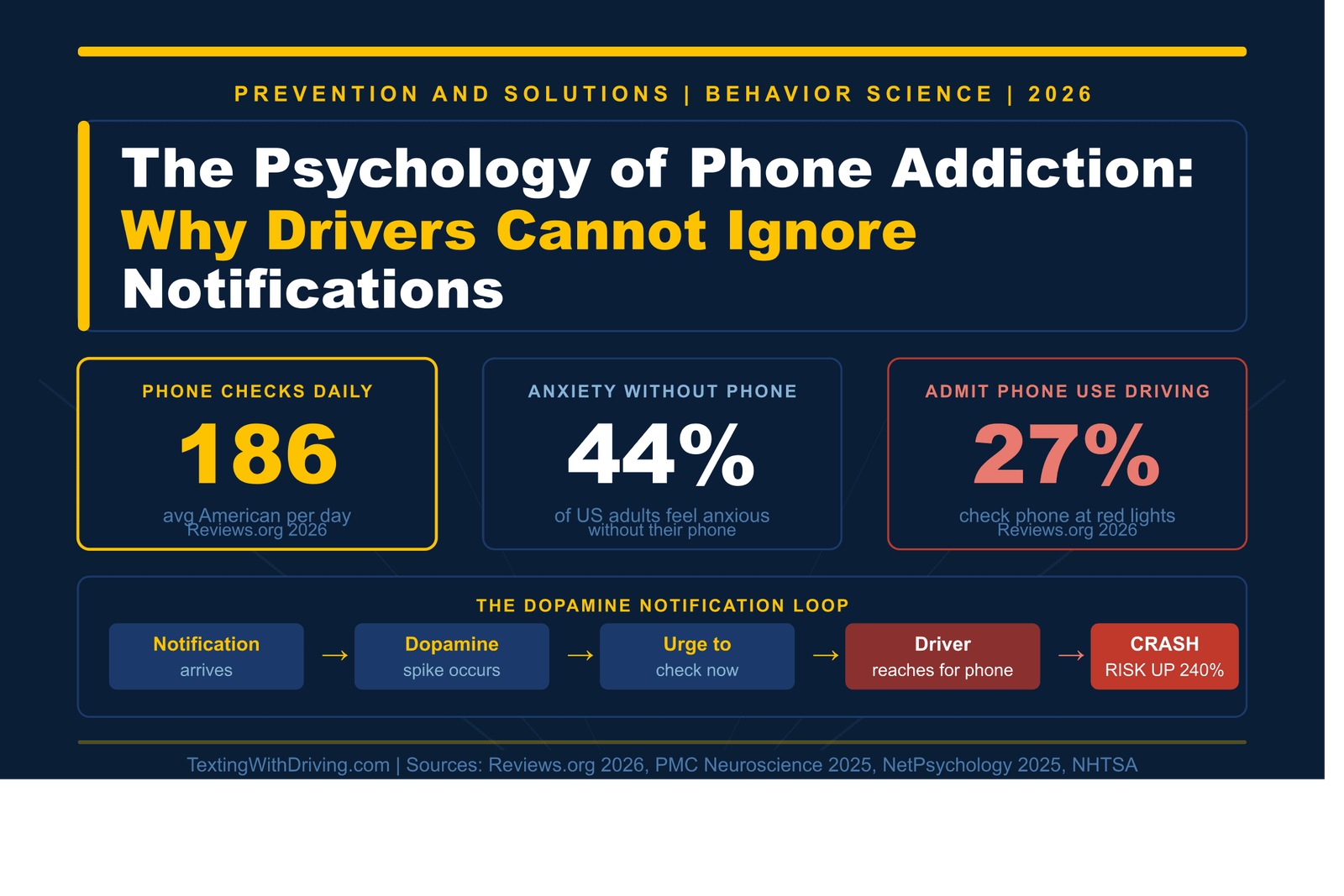
Americans check their phones 186 times a day in 2026, according to Reviews.org’s most recent survey of approximately 1,000 US adults. That figure dropped slightly from 205 times a day in their 2025 report, suggesting people may be picking up their phones slightly less overall but spending more time on screens when they do. Governor’s Traffic Safety Committee
186 times a day. That is roughly once every five to six minutes during waking hours. If the average American is awake for 16 hours, they are checking their phone more than eleven times per hour on average. Not always for long. Often just a glance. But 186 separate interactions with the device between waking up and going to sleep.
Even in self-reporting, where people tend to downplay risky habits, nearly 3 in 10 Americans admit to using their phone while driving. Reviews.org noted that self-report surveys are good for broad behavioral signals but cannot verify the frequency or context, meaning the true number could be even higher than what self-reporting reveals. Federal Motor Carrier Safety Administration
44 percent of US adults say that not having their phone gives them anxiety. Cell phones cause more than one out of five car accidents. 27 percent of drivers check their phones when stopped at red lights, highlighting the difficulty many people have in disconnecting from their devices even momentarily. Cmtelematics
Nearly half of American adults experience anxiety when separated from their phone. A quarter check it at red lights despite knowing the risk. These are not fringe behaviors. They are mainstream, documented, and directly traceable to how the brain has been conditioned by years of phone use.
The Neuroscience: What Happens in Your Brain When a Notification Arrives
This is the part of the story that changes how you think about your own behavior.
When you scroll and encounter something novel, surprising, or emotionally charged, your brain releases dopamine, a neuromodulator involved in motivation, learning, and reinforcement. Multiple systems in the brain, shaped by evolution to maximize survival, are being engaged by digital platforms in ways that make disengagement difficult. You intend to check one notification and 45 minutes later you are still scrolling. This is not simply a lapse in willpower. It is your brain doing exactly what it was shaped to do in a completely new environment. Sentryroad
Dopamine is commonly mischaracterized as the pleasure chemical. It is more accurately the anticipation chemical. Dopamine is released not when you receive a reward but when your brain predicts one might be coming. The buzz of a notification does not deliver a reward. It signals that a reward might be in the notification. That anticipation triggers a dopamine response that creates an urgency to resolve the uncertainty by checking.
When people obtain positive experiences from smartphones, the reward circuit is activated, and dopaminergic neurons in the nucleus accumbens release dopamine, interacting simultaneously with brain regions such as the prefrontal cortex and the amygdala. The prefrontal cortex is responsible for decision-making and impulse control. When confronted with something new, the brain releases dopamine to enhance focus and learning. There are numerous dopamine-producing cells in the brain that respond to novel stimuli but remain quiet in the face of familiar things. Whenever a smartphone notifies us of a new message, we cannot resist the urge to check it immediately. NAHB
The word immediately in that research is doing important work. The brain’s dopamine response to an incoming notification does not create a gentle suggestion to check the phone later. It creates an urgent pull toward resolution right now. The uncertainty of what the notification contains is neurologically aversive. Checking resolves the uncertainty and delivers a small dopamine reward for doing so.
This mechanism was not designed by evolution to interact with smartphones. It evolved to drive our ancestors to follow up on signals of food, danger, and social opportunity. But the same circuit that once made it adaptive to immediately investigate a rustling in the bushes now makes it feel necessary to immediately check why Instagram buzzed.
If you are like the average person, you check your phone around 96 to 186 times daily, once every five to ten waking minutes. This automatic, almost compulsive behavior is not a personal failing or a character flaw. It is your brain’s reward circuit doing exactly what evolution designed it to do, except now instead of hunting for berries, you are hunting for notifications. Baderlaw
The Variable Reward Schedule: Why Social Media Is Especially Hard to Resist
Not all notifications create the same dopamine response. The most powerful driver of compulsive checking is a concept from behavioral psychology called a variable reward schedule.
A variable reward schedule is one where the reward is unpredictable in timing and magnitude. Sometimes you check your phone and there is a message that matters a lot. Sometimes there is nothing at all. Sometimes there is a mildly interesting update. The variability is the key.
Research on behavioral conditioning, building on B.F. Skinner’s foundational work, has consistently shown that variable reward schedules produce the strongest and most persistent behaviors. A slot machine pays out unpredictably, which is why it produces stronger compulsive engagement than a machine that pays out every fifth pull. The uncertainty is not a flaw in the system. It is the mechanism that drives compulsive use.
Social media notifications operate on an identical principle. When a post gets liked, a comment arrives, a message comes through, or a story mention appears, the timing is unpredictable. You cannot know when the next notification will arrive or how significant it will be. That unpredictability drives the compulsive checking behavior that makes putting the phone down feel neurologically uncomfortable rather than merely inconvenient.
This is not accidental. Technology companies use frictionless design deliberately to keep users engaged. The notification systems, the infinite scroll, the auto-play, the seen receipts, are all design choices that exploit the same reward circuits that drove human survival behavior. They were built by people who understood dopamine and reward loops and designed platforms to maximize engagement by maximizing the frequency and unpredictability of rewards. Baderlaw
The Notification Itself Is Enough: Research on Auditory Alerts
Here is a finding that most people are unaware of and that changes the calculus around phone-free driving significantly.
Research published in PLOS ONE and reviewed in the PMC database examined the effect of simply hearing a smartphone notification sound on cognitive performance.
A study published in PLOS ONE examining the effects of smartphone notifications on cognitive control found that participants responded slower on trials paired with smartphone notification sounds versus control sounds. People with higher smartphone addiction proneness showed lower attentional engagement when smartphone sounds were present. These results suggest that the mere sound of a notification, without seeing or interacting with the phone at all, produces measurable cognitive disruption. Mattiacci Law
Read that carefully. The notification sound alone, without looking at the phone, without touching it, without reading anything, produced slower responses and reduced attentional engagement. The phone does not have to be in your hand to distract you. It just has to be within earshot.
This is why the Do Not Disturb while driving feature on iPhone and Android is not merely about blocking the impulse to look at the phone. It eliminates the notification sound itself. When there is no buzz, no ping, no vibration, there is no dopamine trigger. No trigger means no anticipation. No anticipation means no urgency. No urgency means the phone in the back seat stays there.
We covered exactly how to set up these features in our guide to setting up Do Not Disturb while driving on iPhone and Android. The two-minute setup eliminates the neurological trigger at the source rather than asking your prefrontal cortex to override it in real time.
Why Willpower Is the Wrong Tool for This Problem
The prefrontal cortex is the part of the brain responsible for impulse control, long-term planning, and overriding instinctive responses with rational decisions. When your phone buzzes while you are driving and you consciously decide not to look at it, your prefrontal cortex is doing real work. It is overriding a dopamine-driven impulse with a reasoned decision.
The problem is that prefrontal cortex activity is resource-intensive and degrades under several conditions that are frequently present during driving.
Fatigue reduces prefrontal cortex effectiveness. The more tired you are, the harder it becomes to override impulses. Evening driving, which we know from Cambridge Mobile Telematics data is when phone use while driving peaks, is also when fatigue is highest after a full day of work and decision-making.
Cognitive load reduces prefrontal effectiveness. Complex driving conditions, navigation in unfamiliar areas, heavy traffic, highway merging, all increase the cognitive load on the brain and reduce the available resources for impulse control. The moments when a driver most needs to resist the phone are often the same moments when their capacity to do so is reduced.
Habit strength overrides prefrontal override attempts. After years of checking your phone every time it buzzes, the response is no longer a decision. It is closer to a reflex. Habits operate largely outside conscious prefrontal control. A deeply conditioned habit of reaching for the phone when it buzzes will frequently execute before the prefrontal cortex has time to intervene.
Research from the University of Pennsylvania found that limiting social media use to 30 minutes per day significantly reduced loneliness and depression, but the key was active, intentional limitation rather than vague cutting back. The same principle applies to driving behavior: the intervention must be structural and pre-committed, not reliant on in-moment willpower. Baderlaw
This is the core behavioral science insight behind every effective distracted driving prevention strategy. Remove the decision from the moment of temptation. Create environmental conditions that make the behavior impossible or require active effort, rather than trying to suppress a conditioned response with willpower at the moment it fires.
Nomophobia and Driving: When Phone Anxiety Becomes a Safety Issue
Nomophobia, the anxiety experienced when separated from a mobile phone, has been increasingly recognized in psychological literature as a genuine and measurable phenomenon.
44 percent of adults in the United States say that not having their phones gives them anxiety. Cmtelematics
For drivers, nomophobia creates a specific challenge. The anxiety of being separated from the phone, combined with the knowledge that notifications might be accumulating, creates a background level of distraction that exists even when the phone is not visible. The driver is thinking about the phone, wondering what might be arriving, calculating whether something might need a response, even without touching the device.
Battery anxiety is real too, with nearly 40 percent of people feeling panic when their charge dips below 20 percent. Phone use while driving covers a wide range of behaviors from glancing at a notification or changing music to texting, talking, or using maps while in motion. Federal Motor Carrier Safety Administration
The anxiety component of phone dependence is relevant to distracted driving prevention because it explains why simply telling people not to look at their phone is insufficient. The phone’s psychological pull does not require a notification to activate. The anticipation of potential notifications, combined with the anxiety of separation, creates a low-level cognitive preoccupation that persists throughout the drive.
The most effective intervention for this anxiety component is not willpower. It is structured removal. Placing the phone in the back seat physically removes it from the anxiety field. Activating Do Not Disturb eliminates the anticipation of incoming notifications. Both interventions work on the anxiety mechanism directly rather than asking the driver to sit with the anxiety and override it.
The Social Pressure Dimension: When the Urgency Is Real
One aspect of the psychology behind phone use while driving that is often overlooked is that sometimes the urgency is genuine.
A parent waiting for news from a school. An employee expecting a critical work message. Someone waiting for a medical callback. For these drivers, the difficulty of not checking their phone is not purely about dopamine and habit loops. It involves real, legitimate stakes.
This dimension of the problem explains why solutions that remove the phone entirely, like placing it in the back seat, work better than solutions that rely on willpower. A parent who has placed the phone in the back seat has already made a structural commitment that reduces the moment-by-moment pressure of the decision. The phone is inaccessible. There is no constant re-evaluation of whether to check it.
The auto-reply feature of iPhone Driving Focus and Android driving mode also addresses this directly. When the feature is active, anyone who messages you receives an automatic reply explaining that you are driving and will respond when you stop. The social contract of immediate response is managed. You are not ignoring people. You are communicating your unavailability in real time.
For situations of genuine urgency, the single-touch call acceptance that most hands-free laws permit provides a legal and safe pathway. If something truly cannot wait, a Bluetooth call allows communication without any of the visual or manual distraction components that make phone interaction while driving so dangerous.
What the Research Says Actually Changes the Behavior
Given that willpower is unreliable, law awareness is insufficient, and notification urgency is real, what does the research support as effective interventions?
Environmental restructuring before the drive. The most consistent finding across behavioral research on distracted driving is that pre-drive commitments outperform in-moment decision-making. Phone in the back seat, driving mode active, navigation set, all executed before the car starts, removes the decision from the moment when dopamine, fatigue, habit, and urgency are all working against the driver.
Habit substitution rather than habit elimination. Behavioral research on habit change suggests it is easier to replace a habit with a different behavior than to simply eliminate the habit. Instead of trying to not check the phone, replace the trigger-behavior loop with a different response: when the phone buzzes while driving, the response is to take a breath and note that you will check it when you arrive. The trigger remains. The behavior becomes different.
Technology that eliminates the trigger. As the PMC research on notification sounds showed, the trigger itself, not just the phone, produces cognitive disruption. Eliminating the notification sound through Do Not Disturb removes the trigger before the dopamine response can fire. This is intervention at the earliest possible point in the loop.
Social commitment. Publicly committing to phone-free driving within your social network changes the social permission structure around the behavior. When the people you drive with know you do not check your phone while driving and expect that from you, the social reinforcement shifts from the phone to the phone-free habit.
For parents who want to understand how to use these behavioral insights in conversations with teen drivers, our parent’s guide to talking to your teen about phone use while driving applies the same behavioral science to the specific dynamics of the parent-teen conversation. For the technology solutions that make phone-free driving automatic, our guide to the best apps to block texting while driving covers the full range from free built-in features to fleet-grade solutions.
The One-Decision Framework
Here is the practical takeaway from everything in this article.
You cannot reliably make the right decision 186 times a day, one for every time your phone would otherwise buzz, against a neurological system that was designed to produce exactly the opposite response. You were not built with hardware capable of consistently overriding a dopamine-driven urgency signal with a reasoned prefrontal decision under conditions of fatigue, cognitive load, and habit.
What you can do is make one decision before the drive starts and let that decision handle everything that follows.
Phone in the back seat. Driving mode on. Navigation set. Auto-reply active.
One decision. Made in a moment of calm, before the dopamine loop has a chance to start. Everything after that is handled automatically by the environment you created for yourself.
The crash risk data is clear. Distracted driving kills over 3,200 Americans per year according to the most recent NHTSA figures we covered in our distracted driving statistics 2026 overview. It raises crash risk by 240 percent per the GHSA and Cambridge Mobile Telematics September 2025 report. The neuroscience explains why people do it anyway. The behavioral science explains how to stop.
One decision. Before the car starts.
Sources Used in This Article
All links verified working before publication.
Reviews.org: Cell Phone Usage Stats 2026 — Americans Check Their Phones 186 Times a Day — Q4 2025 survey of 1,000 US adults
Reviews.org: Nearly 3 in 10 Americans Admit to Using Their Phone While Driving — April 2026
NetPsychology: Dopamine and Digital Addiction — How the Brain’s Reward Circuit Drives Compulsive Tech Use — November 2025
Samphire Neuroscience: Understanding Phone Addiction — A Neuroscientific Perspective — August 2025
PMC: Smartphone Dependence and Its Influence on Physical and Mental Health — Frontiers in Psychiatry, August 2025
PMC: The Hidden Cost of a Smartphone — Effects of Notifications on Cognitive Control — PLOS ONE, November 2022
CrossRiverTherapy: Cell Phone Addiction Statistics — Updated March 2026
PrioriData: How Much Time Does the Average Person Spend on Their Phone in 2025 — January 2025
ConsumerAffairs: Cell Phone Statistics 2026 — January 2026
NHTSA: Distracted Driving — 2024 fatality data
GHSA: Distracted Driving Raises Crash Risk 240 Percent — September 2025
AAA Foundation: Measuring Cognitive Distraction in the Automobile — 27-second residual distraction research
TextingWithDriving.com is professionally built and maintained to ensure accurate, accessible safety information reaches every driver who needs it. Website development and ongoing support is handled by Budgetic, a digital agency specializing in purpose-driven WordPress websites.

About Texting With Driving
TextingWithDriving.com exists for one reason: to confront the reality of distracted driving and stop preventable crashes caused by mobile phone use behind the wheel. Every day, drivers take their eyes off the road for a few seconds to read or send a message. Those few seconds are enough to cause life-altering consequences. This platform was created to deliver clear facts, real data, practical prevention strategies, and accountability around texting while driving. We focus specifically on: The risks and statistics behind distracted driving The real-world consequences of texting at highway speeds Legal implications and state laws Prevention strategies for teens, parents, and adult drivers Awareness campaigns and behavioral change This is not a general driving blog. It is a focused awareness initiative built around one critical issue: phone distraction behind the wheel. Our content is direct, research-driven, and practical. We prioritize accuracy over opinion and education over sensationalism. The goal is simple — reduce distracted driving incidents by increasing awareness and responsibility. If one article causes one driver to put their phone down, the mission is working. For inquiries or partnerships, contact: privacy@textingwithdriving.com
View all posts by Texting With Driving