

How to Create a Distracted Driving Policy for Your Employees in 2026

How to Create a Distracted Driving Policy for Your Employees in 2026
Most employers who think about workplace safety think about factory floors, construction sites, and chemical exposure. The road rarely gets the same attention.
It should. Because the data is unambiguous.
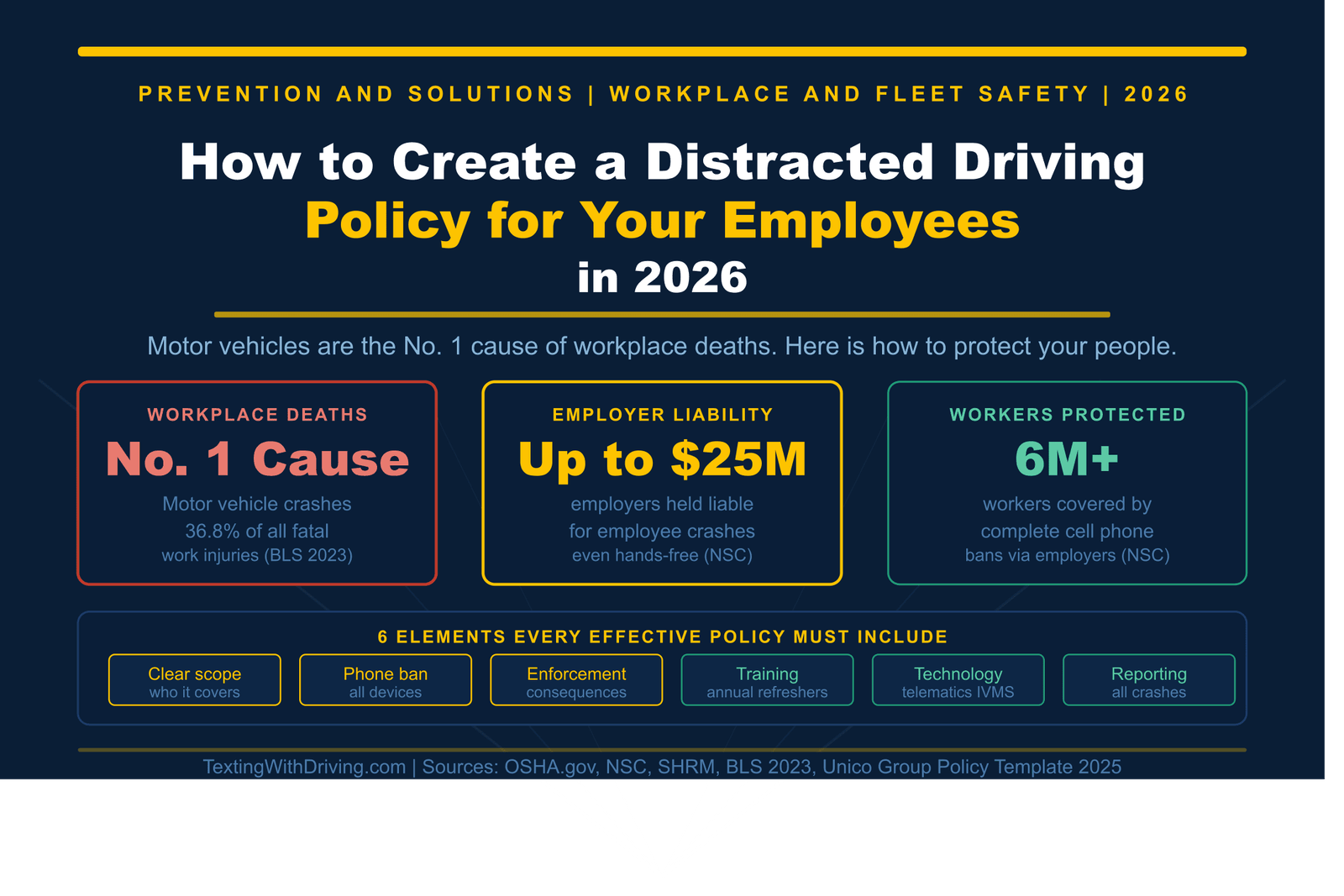
The most dangerous thing a person can do on the job is get in a vehicle, according to Lorraine Martin, NSC president and CEO and chair of the Road to Zero Coalition. In 2023, the Bureau of Labor Statistics found transportation-related incidents caused 36.8 percent of the 5,283 fatal work injuries in the United States. Michigan Auto Law
More than one in three workplace deaths happens on the road. Not on a factory floor. Not on a scaffold. In a vehicle.
And the number one behavioral risk factor driving those deaths is distracted driving, with phone use at the top of the distraction list. If your employees drive as part of their jobs, in company vehicles, personal vehicles for work purposes, or even during commutes where they are fielding work calls, you have a legal, financial, and ethical responsibility to address this.
This guide covers everything you need to create an effective distracted driving policy in 2026: the legal framework, the liability exposure, the specific elements every policy needs, how to implement it, how to enforce it, and the free resources that make the whole process easier than most employers realize.
The Legal Exposure: What Employers Actually Face
Employers are being held liable up to $25 million for employee crashes, even when employees use hands-free devices, according to the National Safety Council. NAHB
That figure, $25 million, stops most HR and risk management discussions immediately. And the key phrase is even when employees use hands-free devices. As we covered in detail in our article on whether voice-to-text is actually safe while driving, hands-free does not mean risk-free. The cognitive distraction from a hands-free call is measurably dangerous. Courts and juries have consistently found employers liable for employee crashes that occurred during work-related calls, even when no phone was physically held.
According to OSHA, an employer’s responsibility extends to workers who drive full or part time, and includes all workers whether they drive a company vehicle or their own, or whether they use a company-provided phone or their own for work purposes. Mattiacci Law
The scope of employer liability is broader than most organizations assume. It is not limited to company vehicles. It is not limited to company-provided phones. If an employee was driving their personal vehicle to a client meeting and fielding a work call when they crashed, the employer’s liability exposure is real. OSHA’s general duty clause requires employers to provide a workplace free from recognized hazards that are causing or likely to cause death or serious physical harm. Roads used by employees for work purposes are workplace environments under this framework.
Distracted driving is the No. 1 cause of workplace deaths in the United States according to OSHA. The NSC estimates that cellphones are involved in 26 percent of all traffic crashes. Mattiacci Law
The combination of OSHA liability and civil lawsuit exposure creates a significant financial risk that scales directly with how much driving your employees do and how clearly your organization has addressed phone use as a workplace safety matter.
The Scope Question: Who Does the Policy Cover?
This is where many employer policies fail. They address the obvious category, company vehicle drivers, and leave employees who drive their own vehicles for work in a legal gray area.
A best-practice cell phone policy covers all employees, both handheld and hands-free devices, company vehicles, company cellphones, and all work-related communications. Mattiacci Law
Best practice means the policy covers:
Every employee who drives a company vehicle for any purpose during work hours. This is the most obvious category and should be in every employer policy regardless of organization size or industry.
Every employee who drives a personal vehicle for work-related purposes, including client visits, site inspections, deliveries, errands run on behalf of the organization, or any other work task that involves driving a personal vehicle. If the employer would reimburse a mileage claim for that trip, the trip is within scope.
Every employee who uses a company-provided phone while driving, regardless of vehicle type. If the employer provides the phone, the employer has both the authority and the obligation to dictate how it may be used.
Every employee who uses a personal phone for work-related calls or communications while driving. This is the category that creates the most organizational resistance but carries the same liability exposure.
The rationale for the broad scope is straightforward. When an employee causes a crash while on a work-related call on their personal phone in their personal vehicle, their employer is a potential defendant in any resulting civil lawsuit. A policy that explicitly addresses this scenario, that tells employees no work-related calls while driving in any vehicle at any time, creates a documented standard of care that a policy covering only company vehicles and company phones does not.
The Six Elements Every Effective Policy Must Include
After reviewing guidance from OSHA, the NSC, SHRM, and multiple industry safety organizations, six elements appear consistently in effective distracted driving policies.
1. Clear Scope Language
The policy must state explicitly who is covered, when it applies, and what vehicles and devices it addresses. Vague language creates enforcement ambiguity and reduces legal protection. Clear language reads like this: “This policy applies to all [Company Name] employees, contractors, and temporary workers who drive any vehicle, including personal vehicles, while conducting company business or using company communication devices.”
2. A Comprehensive Phone Ban
The NSC recommends that employers implement and enforce policies banning cell phone use while driving. Such a policy should include clear language banning all handheld and hands-free cell phone use while driving, covering all work-related calls, and applying to all employees regardless of role or seniority. Mattiacci Law
Hands-free is not risk free. The science is crystal clear on this fact and numerous studies have demonstrated that the use of handheld and hands-free devices while driving pose a significant safety risk to motorists, their passengers, and others on the road. Zutobi
The gold standard policy bans all phone use, including hands-free, while operating a vehicle. The research supporting this position is extensive and consistent. The AAA Foundation research we covered in our article on whether voice-to-text is safe while driving shows that hands-free calls produce a cognitive distraction rating of 2.7 on a 5-point scale. Voice-to-text rates even higher.
Some organizations resist a complete hands-free ban because it feels operationally disruptive. The OSHA and NSC position is that this disruption is the point. The policy should require employees to pull over and park before making or receiving any call, just as the policy requires them to stop before texting.
The exception framework for urgent operational needs should be specific and narrow. Emergency calls to 911 are universally excepted. Any other exception should require a safe, complete stop before the call begins.
3. Specific Prohibited Behaviors
Beyond the phone ban, the policy should list specific prohibited behaviors explicitly. Drivers should refrain from eating, drinking, reading and other activities that may divert attention away from the task of driving. The policy should require that any global positioning system, music device, or dashboard infotainment system be programmed prior to departing, and that if adjustments are needed while driving, the driver should pull over to a safe place out of traffic lanes and put the vehicle in park to make the appropriate adjustment. Zutobi
Listing behaviors explicitly removes the ambiguity that allows employees to rationalize borderline activities. “No distracted driving” is vague. A list that includes no phone handling, no texting, no eating, no manual GPS adjustments while in motion, and no hands-free calls is specific and enforceable.
4. Clear Consequences for Violations
A policy without consequences is a suggestion. The enforcement framework must be explicit and proportionate. Industry guidance consistently recommends a structure that treats violations as serious safety events rather than minor administrative infractions.
Employers should reprimand employees who violate safe driving policies and those reprimands should involve serious penalties, including, where appropriate, termination. There is no way to protect employees from every hazard they may encounter on the road, but implementing a strong safe driving program will go a long way towards decreasing the likelihood of a workplace tragedy on the road. Mattiacci Law
A typical enforcement progression includes a verbal warning and mandatory retraining for a first violation, a written warning and suspension from driving duties pending review for a second violation, and termination of driving privileges or employment for a third violation. In cases where a violation causes a crash or injury, the response should be immediate investigation and the consequences may escalate beyond the standard progression.
Critically, the consequences must apply equally across all levels of the organization. A policy that managers and executives routinely violate without consequence sends a message that the policy is performative rather than operational. Senior leadership compliance and modeling matters as much as the written policy itself.
5. Training Requirements
Employers should strongly discourage distracted driving by incorporating written safe driving policies into employee handbooks, providing training on these policies during worker orientation, and providing annual refresher training. Mattiacci Law
A one-time policy acknowledgment at onboarding is insufficient. Annual refresher training ensures the policy remains current as laws change, as new research becomes available, and as employees who have been with the organization for years are reminded of expectations that may have faded from active awareness.
Training content should cover what the policy requires, why the research supports it, what the legal consequences of violations are for the employee personally, and how to use the technology tools the employer provides or recommends to support compliance. Practical training on setting up iPhone Driving Focus or Android driving mode, which we cover in our Do Not Disturb while driving setup guide, should be part of the orientation for any employee who drives for work.
OSHA recommends that employers involve drivers in creating and refining safety programs, as their firsthand knowledge can help identify and address potential hazards. Employees are more likely to comply with policies they had input in developing than policies handed down without their participation. Sentryroad
6. Technology Support
The most effective distracted driving policies combine behavioral requirements with technology tools that make compliance easier.
Employers may want to consider using an in-vehicle monitoring system to reduce the risk of crashes. These systems are designed to improve drivers’ performance by identifying risky driving behaviors for self-correction and for supervisors to use to coach drivers and identify fleet-wide problems. A NIOSH study found that an IVMS with in-vehicle driver feedback and supplemental supervisory coaching using driver and outward-facing video led to a significant decline in overall risky driving behaviors. Sentryroad
In-vehicle monitoring systems (IVMS) and telematics platforms give fleet managers real data on driving behavior, including phone use events, hard braking, speeding, and other risk indicators. For organizations with significant vehicle fleets, this technology pays for itself through insurance savings, reduced crash costs, and the behavioral improvement that comes from drivers knowing their behavior is being monitored.
For smaller organizations or employees using personal vehicles for work, requiring employees to activate their phone’s built-in driving mode before beginning any work-related drive is a low-cost, high-effectiveness requirement. The apps we reviewed in our guide to the best apps to block texting while driving cover both built-in options and enterprise-grade solutions.
The Operational Dimension: Scheduling and Workload
One element of effective distracted driving policy that goes beyond device restrictions is the operational practices that create or reduce pressure on employees to use phones while driving.
Employers should review their operational procedures to ensure that the procedures are not causing or contributing to distracted driving. For example, systems and procedures for dispatching and rerouting vehicles have the potential to cause cognitive, visual, and manual distractions which may directly cause or contribute to a vehicle collision. Employers should ensure that workloads and work schedules allow employees to drive at a safe speed and obey any applicable hours-of-service regulations. Sentryroad
If your operations require dispatchers to contact drivers constantly while they are on the road, or if schedules create time pressure that leads drivers to try to handle communications while driving, the policy alone will not solve the problem. The policy must be paired with operational changes that make phone-free driving practically achievable.
This means creating communication windows before and after drives rather than during them. It means ensuring that drivers have time to stop safely before returning calls. It means not expecting immediate response to messages from employees who are currently driving. And it means making the organizational culture around responsiveness compatible with phone-free driving rather than in conflict with it.
Crash Reporting and Investigation
Every effective policy includes a mandatory crash reporting requirement.
Employers should establish a crash investigation process. All crashes, regardless of severity, should be reported to the employee’s supervisor as soon as feasible after an incident. Crashes that go unreported prevent the organization from identifying patterns, improving policies, and defending against claims where the employer’s lack of awareness becomes a liability rather than a defense. Sentryroad
The crash report should capture time and location, conditions at the scene, whether any device was in use before the crash, witness information, and any police report number. The investigation that follows should determine whether policy violations contributed to the crash, whether the policy needs updating, and whether the employee requires additional training, modified driving responsibilities, or other organizational response.
For organizations where employees may be reluctant to report crashes for fear of consequences, creating a reporting culture that distinguishes between reporting and punishment for non-violation crashes is important. The goal of reporting is organizational learning, not individual punishment for accidents that happen despite compliance.
Free Resources to Get Started Today
The NSC has produced a comprehensive free Safe Driving Kit specifically designed for employers who want to implement or strengthen a distracted driving policy. It includes policy templates, leadership communication tools, employee training materials, and campaign materials. Access it at the NSC distracted driving for employers page.
OSHA’s Motor Vehicle Safety employer guidance page provides the regulatory framework and practical implementation guidance developed specifically for employer use. It is free and authoritative.
SHRM’s publication on distracted driving policies includes real case studies and specific policy language recommended by employment attorneys. It is a useful complement to the NSC’s operational tools for organizations that need both the HR and safety dimensions covered.
For a ready-to-adapt policy template, the Unico Group’s distracted driving policy example provides clear, specific language that can be adapted to your organization’s specific context.
Why “We Have a Hands-Free Policy” Is No Longer Enough
Most employers do not have a long-standing distracted driving policy but rather have just a hands-free mobile device use policy. A best-practice cell phone policy covers all employees, both handheld and hands-free devices, company vehicles, company cellphones, and all work-related communications. Mattiacci Law
Many organizations created hands-free policies when their state passed a hands-free law, believing that compliance with the law was sufficient. It is not, for two reasons.
First, as the research we covered in our article on whether voice-to-text is safe while driving demonstrates clearly, hands-free calls produce significant cognitive distraction. An employer whose policy permits hands-free calls while driving is still exposing their employees and organization to a demonstrably dangerous behavior.
Second, legal compliance is the floor, not the ceiling, for employer duty of care. Courts evaluate employer liability against what a reasonable employer should have done to protect employees and others, not merely against whether a law was technically complied with.
Currently more than 6 million workers are safeguarded by complete cell phone bans through their employers. But these policies often cover only fleet drivers and often do not include hands-free devices. A huge opportunity exists for more employers to put policies in place or upgrade the ones they have. Mattiacci Law
Six million workers is a significant number. It is also a small fraction of the total workforce whose jobs involve driving. The gap between the scope of the problem and the current reach of employer policies represents both a risk and an opportunity.
An organization that implements a comprehensive, well-trained, consistently enforced distracted driving policy in 2026 is not just reducing its legal exposure. It is reducing the probability that it will get the call that one of its employees was involved in a fatal crash on a Tuesday afternoon while returning from a client meeting.
That call is the one no organizational policy can undo.
For the full picture of what workplace crashes cost economically, see our article on the economic cost of distracted driving in America. For the legal liability picture of what happens to individual drivers after a distracted driving crash, see our article on whether you can be sued for texting while driving. And for the national death toll that provides the full context for why this matters at every level, our distracted driving statistics 2026 overview covers everything in one place.
Sources Used in This Article
All links verified working before publication.
OSHA: Motor Vehicle Safety for Employers — Official OSHA employer guidance, updated 2025
OSHA: Distracted Driving in the Workplace — Three-category distraction framework and employer responsibilities
OSHA: OSHA, NSC and Road to Zero Coalition Initiative — January 16, 2025, partnership announcement and BLS 2023 workplace death data
NSC: Distracted Driving for Employers — Free Safe Driving Kit, policy templates, $25M liability data
SHRM: Distracted Driving Policies Save Lives Protect Organizations — Policy language guidance and legal framework
Unico Group: Distracted Driving Policy Example — Ready-to-adapt policy template, April 2025
Clue Fleet: 7 Things to Consider for Fleet Safety Policy — IVMS and fleet safety program elements, August 2025
HSE Network: OSHA Updates on Distracted Driving in Employment — OSHA regulatory overview
NHTSA: Distracted Driving — National data context
GHSA: Distracted Driving State Laws — Legal compliance context
TextingWithDriving.com is professionally built and maintained to ensure accurate, accessible safety information reaches every driver who needs it. Website development and ongoing support is handled by Budgetic, a digital agency specializing in purpose-driven WordPress websites.

About Texting With Driving
TextingWithDriving.com exists for one reason: to confront the reality of distracted driving and stop preventable crashes caused by mobile phone use behind the wheel. Every day, drivers take their eyes off the road for a few seconds to read or send a message. Those few seconds are enough to cause life-altering consequences. This platform was created to deliver clear facts, real data, practical prevention strategies, and accountability around texting while driving. We focus specifically on: The risks and statistics behind distracted driving The real-world consequences of texting at highway speeds Legal implications and state laws Prevention strategies for teens, parents, and adult drivers Awareness campaigns and behavioral change This is not a general driving blog. It is a focused awareness initiative built around one critical issue: phone distraction behind the wheel. Our content is direct, research-driven, and practical. We prioritize accuracy over opinion and education over sensationalism. The goal is simple — reduce distracted driving incidents by increasing awareness and responsibility. If one article causes one driver to put their phone down, the mission is working. For inquiries or partnerships, contact: privacy@textingwithdriving.com
View all posts by Texting With Driving