

Best Hands-Free Car Phone Mounts 2026: A Distracted Driving Safety Guide

Best Hands-Free Car Phone Mounts 2026: A Distracted Driving Safety Guide
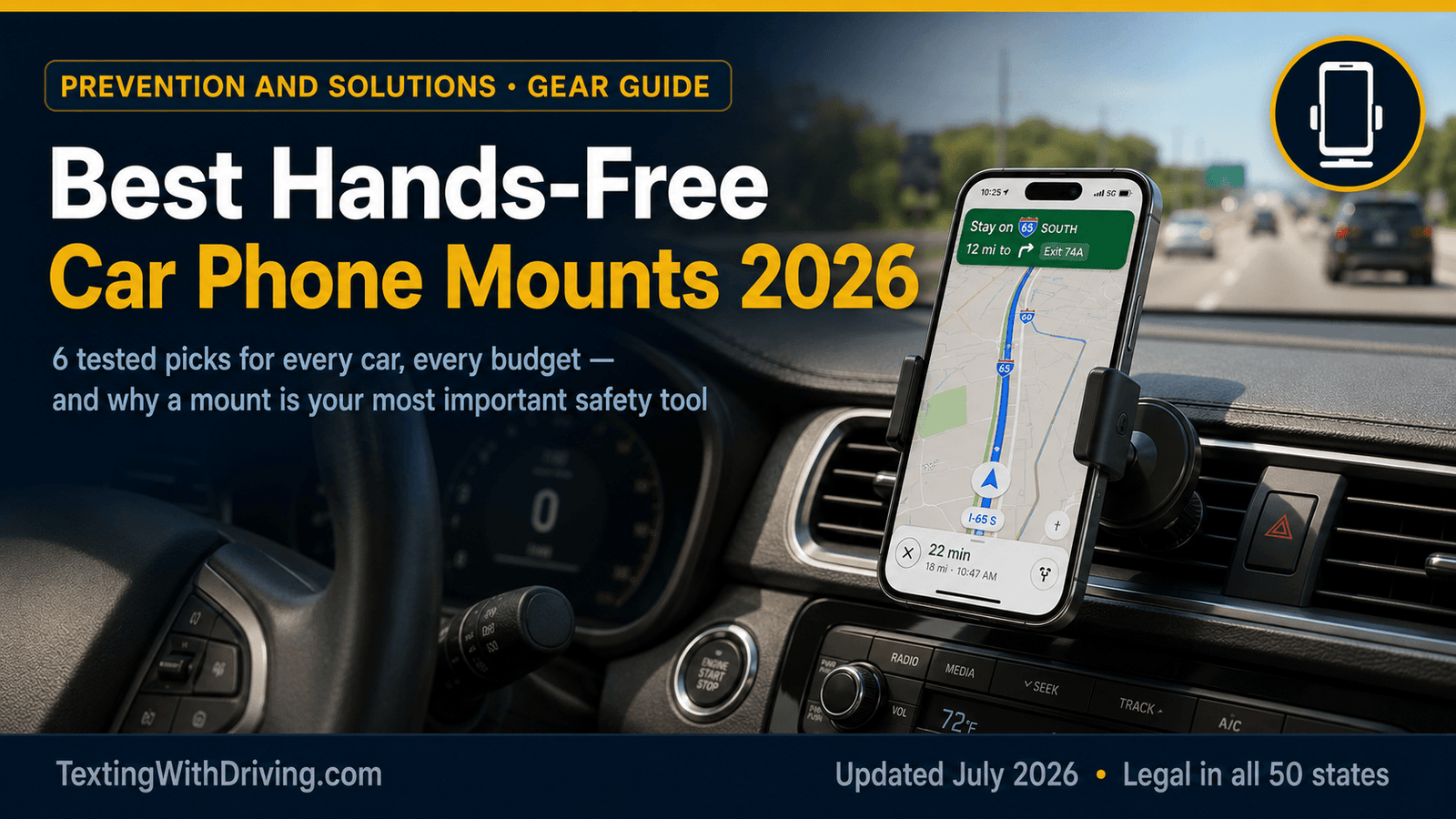
The best hands-free car phone mount is not a luxury accessory. In 2026, it is the single most practical tool available to any driver in the 33 states plus DC with comprehensive handheld phone bans — and a critical safety tool for every driver in every state regardless of law. Without a mount, every GPS check, every voice command activation, every glance at a notification requires either holding the phone or reaching for it. With a mount, the phone stays at eye level, hands stay on the wheel, and every permitted hands-free function operates exactly as the law requires.
This guide covers everything a driver needs to know to choose the best hands-free car phone mount in 2026: the four mount types with their specific trade-offs, the six picks that independent testing has validated across price points, the legal considerations for windshield versus dashboard placement, the specific features that matter for safety versus the ones that are marketing noise, and the critical step that most mount buyers overlook entirely.
Why a Phone Mount Is Your Most Important Driving Safety Tool
Before the picks, the safety case needs to be stated clearly. A hands-free car phone mount does not eliminate distracted driving. It eliminates one of its most dangerous forms: the handheld reach-and-look behavior that takes both hands and eyes off the road simultaneously.
Research from the Virginia Tech Transportation Institute has long linked handheld phone use to a sharp rise in crash risk. The 5-second glance that occurs when a driver picks up a phone to check a notification covers a football field at 55 mph with eyes effectively off the road. A mounted phone at eye level reduces that glance distance to essentially zero — the screen is in the driver’s natural forward field of view rather than requiring a downward head turn.
The legal argument is equally direct. In the 33 states plus DC with comprehensive hands-free laws — and the additional states with school zone and work zone handheld bans — any phone that is not mounted is a phone that cannot be legally used for any purpose including navigation. A mount saves you from having to pick up and hold the device, which are safety and legal no-nos.
The financial argument follows immediately from our how distracted driving affects car insurance article: a single distracted driving citation produces an average 23 percent insurance rate increase that lasts three to five years. The best hands-free car phone mount costs $15 to $80. That is a straightforward return on investment.
The Four Mount Types: Trade-Offs Every Driver Should Understand
The right best hands-free car phone mount choice starts with understanding the four mounting surfaces and what each produces in real-world use.
Windshield Mounts
Windshield mounts attach via suction cup to the interior glass, positioning the phone at the top of the driver’s visual field near the windshield line.
Advantages: Closest to the driver’s natural eye line. Easy to install and reposition. No risk of blocking air flow. Available with long telescoping arms that bring the phone close to the driver regardless of windshield distance.
Disadvantages: Some states restrict windshield mounting because the mount can obstruct the driver’s field of view. California restricts mounts to a small area in the lower-left or lower-right corners of the windshield. Check your state’s specific rules before windshield mounting. Suction cups can fail in extreme temperatures — both very hot (summer dashboard heating) and very cold (winter glass). Require periodic reapplication.
Several states and countries restrict anything mounted on the windshield because it can obstruct your view. If in doubt, mount on the dashboard or vent instead.
Dashboard Mounts
Dashboard mounts use adhesive pads or suction cups to attach to the dashboard surface, positioning the phone slightly below the windshield line.
Advantages: Generally legal in all states. Positions the phone in the natural downward navigation glance zone — where the speedometer and instrument cluster are, producing a minimal eye-movement requirement. Very stable on flat dash surfaces. Does not restrict air flow.
Disadvantages: Adhesive mounts can leave residue and cannot be repositioned after installation without purchasing new adhesive pads. Some dashboards are textured, curved, or covered in leather that creates adhesion challenges. Distance from the driver can be significant in cars with deep dash designs.
The iOttie’s one-touch system gives true one-handed operation, and its redesigned suction cup grips dashboards and windshields like industrial adhesive. Wirecutter’s long-term testing found the cup held firm for months through extreme heat and cold.
Air Vent Mounts
Vent mounts clip onto the horizontal slats of the vehicle’s climate control vents, positioning the phone at center dashboard height.
Advantages: Easy to install without tools. Easy to remove and transfer between vehicles. Legal in all 50 states. Does not require adhesive. Generally the most secure position against road vibration once properly clipped.
Disadvantages: Blocks airflow from that vent — meaningful in summer or winter when climate control matters. Only compatible with horizontal slat vents — round vents, vertical slat vents, or modern climate control designs may not accept standard vent clips. The weight of a large phone can cause some vent clips to droop over time.
Cup holder phone holders were intentionally omitted from the CNN Underscored testing guide because they’re dangerously far from your view as a driver — a specific and important safety warning that applies to any buyer considering this option.
CD Slot Mounts
CD slot mounts insert into the vehicle’s CD player slot and provide a very stable, centered mounting position.
Advantages: Extremely stable — the CD slot provides mechanical grip that suction cups and vent clips cannot match. Central dashboard position. Does not block airflow. Does not use adhesive.
Disadvantages: Requires a CD slot — many modern vehicles no longer have them. The slot may be needed for other uses. Limited adjustability compared to suction cup mounts.
The 6 Best Hands-Free Car Phone Mounts for 2026
1. iOttie Easy One Touch 6 — Best Overall
Type: Dashboard or windshield suction
Grip: Mechanical clamp (one-touch spring release)
Best for: Most drivers, most cars, most use cases
The iOttie Easy One Touch 6 is the most consistently recommended mount across every major 2026 testing publication, and the recommendation is deserved. The one-touch spring clamp system allows single-handed phone insertion — push the phone into the center and the spring-loaded side arms grab it automatically. Release requires squeezing two levers simultaneously, which prevents accidental ejection during sharp turns or hard braking.
The redesigned suction cup uses industrial-grade adhesive material rather than the standard rubber that most competitors use. Testing by multiple publications found the cup held firm across months of use including extreme summer heat in cars parked in direct sun. The telescoping arm extends from 5 to 8 inches, which solves the deep-dashboard reach problem that shorter-arm mounts create in trucks and SUVs.
I’ve never liked windshield mounts until I tried iOttie’s One Touch 6, which holds the phone rock-steady, unlike the wobbly gooseneck mounts of yesteryear.
The 270-degree rotation with a locking mechanism allows portrait or landscape positioning in any direction. For drivers using navigation apps in landscape mode for a wider map view, this flexibility is a genuine daily-use feature.
Price range: $30 to $50 depending on retailer and variant.
2. Andobil Car Phone Holder Mount — Best Dashboard and Windshield Versatility
Type: Dashboard, windshield, or vent (3-in-1)
Grip: Mechanical clamp
Best for: Drivers who want maximum positioning flexibility
The Andobil mount’s 3-in-1 capability — dashboard suction, windshield suction, or vent clip from the same base unit — is its primary differentiator. The suction cup is rated to 60-plus pounds of holding force, which significantly exceeds what any phone will actually require. In bumpy-road testing, the Andobil showed no movement across potholes, speed bumps, and sharp turns.
Our top choice for 2026. It works on dashboard, vent, and windshield. Its clamp phone holder design is versatile, holding large phones and smaller models.
The 360-degree ball joint rotation provides more angular freedom than the iOttie’s 270-degree system, which matters for vehicles where the mounting position is not perfectly aligned with the driver’s natural head position. The one-touch clamp release uses a front-mounted button rather than the rear-mounted release that some competing clamp mounts use — a small but genuine daily-use ergonomic advantage.
Price range: $25 to $40.
3. Belkin Wireless Car Charger Mount (MagSafe Compatible) — Best for iPhone 12 and Newer
Type: Dashboard or vent options
Grip: Magnetic (MagSafe)
Best for: iPhone 12 through current models using MagSafe cases
For iPhone 12 and newer users with MagSafe cases, the Belkin MagSafe car mount delivers the fastest possible combination of secure attachment and wireless charging simultaneously. The MagSafe magnetic alignment means the phone snaps to the mount with perfect Qi charging alignment every time — no repositioning, no cable, no checking whether the phone is centered on the charger.
This Belkin delivers true 15W fast wireless charging for MagSafe iPhones (10W for Qi Androids), so you arrive with more battery than you left with.
The magnetic hold is sufficient for all normal driving conditions including highway speeds and city traffic. For extreme off-road use or particularly aggressive driving, a mechanical clamp mount provides more confident security.
The limitation is obvious: non-MagSafe phones require a metal plate adhesive that reduces the elegance of the solution and adds a step to the setup. For Android users or iPhone users without MagSafe cases, the iOttie or Andobil mechanical clamp mounts are the better choice.
Price range: $40 to $60.
4. ESR HaloLock Qi2 Wireless Car Charger — Best for Long Road Trips
Type: Vent mount with wireless charging
Grip: Magnetic (Qi2 / MagSafe compatible)
Best for: Road trip drivers who need charging and hands-free simultaneously
The ESR HaloLock Qi2 addresses the specific road trip use case: drivers who will be navigating for multiple hours and need to maintain battery level while the screen stays active for GPS. Standard navigation use drains phone battery faster than most passive mounts can charge, but the ESR’s Qi2 charging protocol delivers enough power to maintain or slightly increase battery level even with the screen active.
A versatile wireless charging phone mount. It works with MagSafe cases and offers strong grip. The compact design keeps your phone stable while driving. Both mounts excel for iPhone users with MagSafe cases. The ESR HaloLock is ideal for long road trips.
The vent clip design means no adhesive residue and easy transfer between vehicles — relevant for rental car use or multi-car households where the mount needs to move between vehicles frequently.
Price range: $35 to $55.
5. VANMASS Military-Grade Suction Cup Mount — Best for SUVs and Trucks
Type: Dashboard or windshield
Grip: Mechanical clamp
Best for: Truck and SUV drivers with textured or elevated dashboards
The VANMASS mount addresses the specific problem that truck and SUV owners face with standard suction cup mounts: the higher, more distant, often textured dashboard that standard suction cup mounts struggle to adhere to reliably.
I was seriously impressed by the military-grade durability — this mount feels like it could survive a tank ride. The upgraded suction cup holds firm on both dashboard and windshield, and the smooth one-handed operation makes it easy to snap my phone in and out while driving. It’s been through months of daily commuting without any signs of wear.
Temperature resistance from negative 40°F to 194°F means the VANMASS handles extreme conditions — from northern winter parking to southern summer direct sun — better than most standard suction cup mounts. This temperature range matters for drivers in extreme climate states: Arizona’s 194°F interior temperatures in direct summer sun, Minnesota’s negative 40°F winter starts.
Price range: $25 to $45.
6. Vanwa Budget Vent Mount — Best Under $15
Type: Air vent clip
Grip: Mechanical clamp
Best for: First-time mount buyers, short commuters, secondary vehicle use
Not every driver needs a $50 mount with wireless charging. For a driver who primarily needs to keep their phone visible for GPS navigation during a short daily commute without charging, a budget vent clip mount performs the primary safety function at a fraction of the cost.
The Vanwa and similar budget vent clips — typically priced between $8 and $15 — provide the legal compliance function (phone not in hand), the safety function (phone at eye level), and the basic navigation function reliably. Testing notes that the release button placement on the side rather than the back makes single-handed removal easier than comparable budget competitors.
The trade-off is durability. Budget vent mounts typically use less robust plastic construction and the clamp mechanism may show wear after 12 to 18 months of daily use. For a primary vehicle and a driver who mounts and dismounts the phone multiple times daily, the iOttie or Andobil mechanical clamp mounts provide better long-term value. For a secondary vehicle or occasional use, the budget option is perfectly adequate.
Price range: $8 to $15.
The Critical Step Most Mount Buyers Skip
Buying the best hands-free car phone mount is not the final step. The critical step that the majority of mount buyers skip is the pre-drive phone setup that the mount exists to support.
A phone in a mount that still receives and displays notifications, still vibrates with incoming calls, still shows lock screen previews of messages is a mounted distraction rather than a mounted navigation tool. The mount positions the phone correctly. The phone settings determine whether what appears on that screen while driving is a navigation map or a stream of incoming distractions.
Every driver who installs a best hands-free car phone mount should complete the following setup before their first drive with the new mount:
iPhone Driving Focus setup (2 minutes): Settings → Focus → Driving → turn it on → set to Activate: Automatically. Add auto-reply message. Verify that all apps except navigation are excluded from the Driving Focus home screen. Our Do Not Disturb while driving setup guide covers this step-by-step.
Android driving mode setup (2 minutes): Settings → Digital Wellbeing → Focus mode (or Drive Safely depending on Android version) → enable automatic activation when connected to car Bluetooth or when driving is detected. Set up auto-reply for messages.
Navigation app pre-setup: Open your navigation app, enter your destination, start navigation, and lock the phone before the car moves. A phone in a mount displaying a static navigation map requires no interaction while driving. A phone in a mount that the driver reaches to adjust mid-drive is still a distraction even if the device is technically mounted.
With the mount correctly positioned and the phone settings correctly configured, the combination produces the closest practical approximation to phone-free driving while still using the navigation and Bluetooth call functions that hands-free laws permit.
The Law Compliance Dimension: What Your State’s Law Requires From a Mount
The relationship between the best hands-free car phone mount and legal compliance varies depending on which state you are driving in. A summary of the key compliance points from our state law series:
Single-touch standard (most states with hands-free laws): Ohio, Michigan, Colorado, Arizona, Virginia, Tennessee, and most other hands-free states permit a single touch or swipe to accept a call or activate a function on a mounted device. Any interaction beyond a single touch requires stopping completely off the travel lane.
Pre-set standard (all states): Navigation destination must be entered before the vehicle moves, regardless of whether the phone is mounted. A driver entering a destination in a mount while moving is in violation in every state with a hands-free law.
Windshield restriction (California and select states): California limits windshield mounts to a 5-inch square in the lower-left corner or a 7-inch square in the lower-right corner. Check your specific state’s rules before installing a windshield mount.
Red light standard (most states): Most states with comprehensive hands-free laws do not permit phone interaction at red lights. A mounted phone can be glanced at (the screen is in your field of view) but not touched for interaction while stopped at a traffic signal. Ohio, Illinois, New York, Washington, and most other primary enforcement states confirm this explicitly.
For the complete state-by-state hands-free law guide, our hands-free driving laws by state 2026 covers every state’s specific requirements and how they interact with mounting standards.
The Cup Holder Warning
One mounting option deserves a specific warning rather than inclusion as a budget pick. Cup holder phone mounts — which position the phone in the cup holder on the center console — are the most widely sold phone mounting option by volume and among the least safe by engineering.
Cup holder phone holders were intentionally omitted from independent testing because they’re dangerously far from your view as a driver. A phone in a cup holder requires the driver to look significantly downward and to the side to read the screen — a head movement comparable to checking the instrument cluster at the most extreme angle, for an extended glance distance that significantly increases crash risk compared to a dashboard or vent mount at center console height.
Beyond the visual distance problem, cup holder mounts are not a permissible navigation display position under the practical intent of single-touch standards in most hands-free states. If a driver must look significantly away from the road to see the navigation display, the mounting position undermines the legal and safety purpose of the mount.
Spend the additional $10 to $20 for a vent or dashboard mount. The cup holder option costs less and provides substantially less safety value.
What to Look For When Buying
When evaluating any best hands-free car phone mount beyond these specific picks, the features that genuinely matter for safety and legal compliance are:
Stability. The mount must hold the phone completely still through potholes, speed bumps, sharp turns, and highway speeds. A vibrating or drifting mounted phone is a distraction equivalent to a loose phone on the seat. Test stability by tapping the mounted phone with a fingernail — any movement indicates inadequate grip.
One-handed operation. The mount must allow the driver to remove the phone after parking with one hand, without requiring the dashboard to be used as a stabilizing surface, and without the phone ejecting suddenly in a way that requires a catch.
Viewing angle. The phone screen must be visible at the minimum necessary glance without a significant head-down movement. Dashboard and vent mounts should be adjusted so the screen center is within approximately 15 degrees of straight ahead.
Phone size compatibility. Verify that the mount accommodates your specific phone model including its case. Phone sizes have continued to expand — the iPhone 15 Pro Max and Galaxy S25 Ultra both require mounts rated for 7.0 to 7.5 inches in length. Most 2026 mechanical clamp mounts specify a maximum phone width in millimeters.
For the complete distracted driving prevention technology guide that places phone mounts in the full context of phone-free driving tools, our hands-free driving complete setup guide covers mounts, Bluetooth systems, vehicle integration, and app tools together. For the best apps that complement a phone mount by managing notifications automatically, our best apps to block texting while driving guide covers the top picks across iPhone and Android.
Sources Used in This Article
All links verified working before publication.
Yahoo Tech: The Best Phone Mount for Your Car in 2026 Tested and Reviewed — iOttie One Touch 6 top pick, rock-steady review, windshield temperature guidance, April 2026
CNN Underscored: Best Car Phone Holders of 2026 Tried and Tested — iOttie Easy One Touch Wireless 2, cup holder danger warning, 15 mounts tested
EVparts4x4: Best Car Phone Holder 2026 10 Mounts That Actually Work — Belkin MagSafe 15W, VANMASS military-grade, Virginia Tech research reference, June 2026
DriveGadgetHub: The Best Car Phone Mounts of 2026 Tested Reviewed Rated — Andobil top pick 2026, ANDERY MagSafe, ESR HaloLock road trip use
Automoblog: Best Car Phone Mounts Tested by Experts 2026 — Stability testing methodology, visibility scoring, temperature testing
EyeAndPen: Best Phone Mount for Car 2026 Reviews — GUWEZ 3-in-1, VANMASS durability review, one-handed operation scoring
NHTSA: Distracted Driving — 3,208 deaths 2024, 5-second football field statistic
TextingWithDriving.com is professionally built and maintained to ensure accurate, accessible safety information reaches every driver who needs it. Website development and ongoing support is handled by Budgetic, a digital agency specializing in purpose-driven WordPress websites.

About Texting With Driving
TextingWithDriving.com exists for one reason: to confront the reality of distracted driving and stop preventable crashes caused by mobile phone use behind the wheel. Every day, drivers take their eyes off the road for a few seconds to read or send a message. Those few seconds are enough to cause life-altering consequences. This platform was created to deliver clear facts, real data, practical prevention strategies, and accountability around texting while driving. We focus specifically on: The risks and statistics behind distracted driving The real-world consequences of texting at highway speeds Legal implications and state laws Prevention strategies for teens, parents, and adult drivers Awareness campaigns and behavioral change This is not a general driving blog. It is a focused awareness initiative built around one critical issue: phone distraction behind the wheel. Our content is direct, research-driven, and practical. We prioritize accuracy over opinion and education over sensationalism. The goal is simple — reduce distracted driving incidents by increasing awareness and responsibility. If one article causes one driver to put their phone down, the mission is working. For inquiries or partnerships, contact: privacy@textingwithdriving.com
View all posts by Texting With Driving